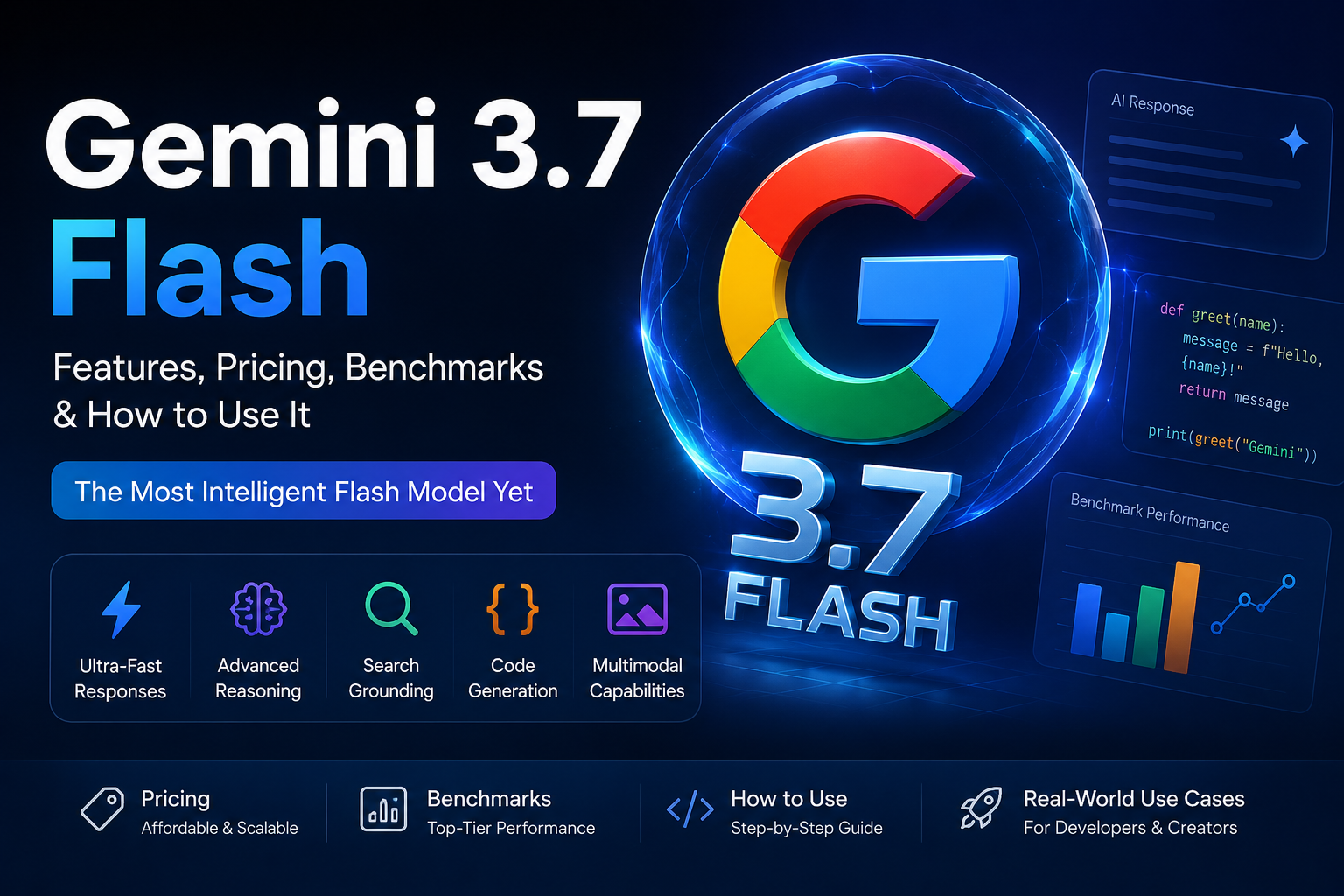
Gemini 3.7 Flash Review: Features, Pricing, Benchmarks & How to Use It
Updated September 2026
Gemini 3.7 Flash was released on August 13, 2026, as Google’s new workhorse model for coding, agentic workflows, web development, and knowledge-intensive tasks.
At launch, Google positioned it as its most capable Flash model yet for coding and AI agents, with improvements over Gemini 3.6 Flash across software engineering, document understanding, web development, and workflow automation.
There is one important update to keep in mind, however: Gemini 3.8 Flash is now available. Google currently describes Gemini 3.8 Flash as its latest and most intelligent Flash model, while Gemini 3.7 Flash remains supported as a previous stable model.
So why should you still care about Gemini 3.7 Flash?
Because it remains a capable model with a large context window, multimodal input, configurable reasoning, function calling, code execution, Search grounding, URL context, structured outputs, and Computer Use support. And depending on your workload, its lower-cost pricing can still make it an interesting option.
This guide explains what Gemini 3.7 Flash is, what it can actually do, how its benchmarks should be interpreted, how much it costs, how to use it, and when you should consider it instead of a newer model.
Gemini 3.7 Flash at a Glance
| Category | Gemini 3.7 Flash |
|---|---|
| Model ID | gemini-3.7-flash |
| Released | August 13, 2026 |
| Current status | Previous stable model; still supported |
| Input types | Text, images, video, audio, PDF |
| Maximum input tokens | 1,048,576 |
| Maximum output tokens | 65,536 |
| Thinking | Low, Medium, High |
| Function calling | Yes |
| Code execution | Yes |
| Google Search grounding | Yes |
| URL context | Yes |
| Structured outputs | Yes |
| Computer Use | Yes, preview |
| Image generation | No |
| Audio generation | No |
| Introductory input price | $0.75 / 1M tokens through Dec. 31, 2026 |
| Introductory output price | $3.75 / 1M tokens through Dec. 31, 2026 |
Google’s current model documentation lists Gemini 3.7 Flash as a multimodal reasoning model that accepts text, images, video, audio, and PDF inputs and supports capabilities including function calling, code execution, Search grounding, Maps grounding, URL context, structured outputs, and Computer Use.
What Is Gemini 3.7 Flash?
Gemini 3.7 Flash is a multimodal reasoning model in Google’s Gemini 3 family.
When Google launched it in August 2026, the company described it as its most intelligent Flash model yet for coding and agents.
The model was designed around workflows that require more than producing a short answer.
A traditional chatbot workflow might look like:
Prompt → Answer
A more advanced application can look like:
Goal → Reason → Call tools → Process information → Take action → Verify → Return result
That second workflow is where Gemini 3.7 Flash becomes particularly interesting.
It can be connected to external tools and applications through capabilities such as function calling, code execution, Search grounding, URL context, and structured outputs.
However, the model itself does not automatically have permission to access your business systems.
Developers still need to build the tools, define permissions, validate outputs, and decide which actions the model is allowed to perform.
That distinction is important.
Gemini 3.7 Flash can be the reasoning engine inside an agent. It is not, by itself, a complete autonomous business system.
Is Gemini 3.7 Flash Still Relevant in 2026?
Yes, but the answer needs some context.
Gemini 3.8 Flash is now Google’s newer Flash model and is positioned for long-horizon software engineering, autonomous agents, and complex enterprise workflows.
Google’s current documentation still lists Gemini 3.7 Flash as a supported previous stable model.
That means you should not automatically choose 3.7 simply because this article is about it.
Instead, consider three situations:
If you are starting a new project
Compare Gemini 3.7 Flash with the current Gemini 3.8 Flash and other models before committing to an architecture.
If you already use Gemini 3.7 Flash
There may be no reason to migrate immediately if your application is stable and the newer model does not produce a meaningful improvement.
If you need lower-cost experimentation
Gemini 3.7 Flash’s current API pricing can still make it attractive for testing and certain production workloads.
The important question is therefore not:
“Is Gemini 3.7 Flash the newest Gemini model?”
It isn’t.
The better question is:
“Does Gemini 3.7 Flash provide the right combination of quality, cost, latency, and reliability for my workload?”
Who Should Use Gemini 3.7 Flash?
Gemini 3.7 Flash is most useful when your workload requires reasoning, code, tools, documents, or multiple steps.
Developers
Developers are one of the clearest target audiences.
Potential applications include:
- Code generation
- Debugging
- Refactoring
- Codebase analysis
- Software testing
- Issue resolution
- Web development
- Documentation generation
- Tool-assisted development
Google’s launch evaluation showed substantial improvements over Gemini 3.6 Flash on several software-engineering benchmarks.
AI-Agent Builders
Agent builders can use Gemini 3.7 Flash as the reasoning layer inside applications that need to:
- Call external functions
- Search for information
- Process documents
- Execute code
- Make decisions
- Generate structured results
- Perform multi-step workflows
This is one of the strongest reasons to evaluate the model.
Businesses
Businesses may find the model useful for:
- Internal research
- Document processing
- Customer-support workflows
- Data analysis
- Software development
- Report generation
- Workflow automation
- Knowledge management
But business automation should not mean unrestricted autonomy.
For important workflows, use:
- Permission controls
- Logging
- Validation
- Human approval
- Error handling
- Rollback mechanisms
Researchers and Analysts
The model’s multimodal capabilities and 1-million-token input context can be useful when analyzing large collections of documents, reports, PDFs, technical material, or other information.
However, a large context window does not guarantee perfect comprehension.
More information can also mean more irrelevant information, conflicting instructions, and more difficult verification.
Content Writers
Gemini 3.7 Flash can write, edit, summarize, and transform content.
But you may not need a reasoning-oriented model for every writing task.
For example:
“Rewrite this paragraph in a professional tone.”
is relatively simple.
A more complex task such as:
“Analyze five research papers, compare their conclusions, identify contradictions, and produce a structured report with clearly separated evidence and interpretation.”
benefits much more from advanced reasoning and context.
Gemini 3.7 Flash Features
Rather than simply listing every capability, here are the features that matter most in practice.
1. Configurable Reasoning
Gemini 3.7 Flash uses dynamic thinking and supports three thinking levels:
- Low
- Medium
- High
Google currently lists Medium as the default for Gemini 3.7 Flash.
The basic trade-off is:
Low
- Lower reasoning effort
- Better for latency-sensitive tasks
- Useful for simpler requests
Medium
- Balanced quality and latency
- Default setting
- Strong starting point for most workloads
High
- More reasoning effort
- Useful for difficult problems
- Can increase token consumption and cost
This is more useful than simply asking which model is “smarter.”
Different tasks need different amounts of reasoning.
For example, a short rewrite probably does not need the highest setting.
A complicated debugging problem involving multiple files may benefit from it.
Our recommendation
Start with Medium.
Move to High only when testing shows that the additional reasoning improves your actual results.
2. Strong Coding Performance
Coding is one of Gemini 3.7 Flash’s strongest use cases.
In Google’s published comparison with Gemini 3.6 Flash, the model achieved:
- FrontierCode 1.1 Main: 43.6% vs. 34.4%
- DeepSWE v1.1: 65.3% vs. 49.0%
Google also reported a higher score on WebDev Arena:
- Gemini 3.7 Flash: 1,588 Elo
- Gemini 3.6 Flash: 1,538 Elo
These results come from Google’s published evaluations. They should not be interpreted as a guarantee that Gemini 3.7 Flash will outperform every competing model on your own codebase.
The practical value is more straightforward.
A stronger coding model can potentially reduce:
- First-pass errors
- Debugging iterations
- Manual corrections
- Repetitive implementation work
- Time spent explaining the same problem repeatedly
But generated code still needs to be tested.
A benchmark score is not a substitute for:
- Unit tests
- Integration tests
- Security review
- Code review
- Production monitoring
3. Web Development and UI Generation
Google also highlighted improvements in web development.
Gemini 3.7 Flash can work with visual references such as screenshots and images, making it useful for workflows such as:
Screenshot → Web interface
or:
Design reference → HTML/CSS/JavaScript
This can accelerate prototyping and frontend development.
But an attractive generated interface is not automatically production-ready.
You should still check:
- Mobile responsiveness
- Accessibility
- Semantic HTML
- JavaScript behavior
- Performance
- Security
- SEO
- Browser compatibility
- Maintainability
AI can reduce development time.
It does not remove the need for engineering judgment.
4. One-Million-Token Context Window
Gemini 3.7 Flash supports an input context limit of 1,048,576 tokens and a maximum output limit of 65,536 tokens.
That is useful for workloads involving large amounts of information.
For example:
Software development
You could provide:
- Project documentation
- Relevant source files
- Error logs
- Product requirements
- API documentation
and ask the model to identify conflicts or develop an implementation plan.
Research
You could analyze:
- Multiple reports
- Research papers
- Long PDFs
- Interview transcripts
- Technical documentation
Business analysis
You could combine:
- Customer feedback
- Internal reports
- Product documentation
- Sales information
and ask for patterns or recommendations.
But do not confuse large context with perfect understanding.
Uploading 1 million tokens simply because the model accepts them can make a workflow worse if most of the information is irrelevant.
The best approach is still to provide the information that actually matters.
5. Multimodal Input
Gemini 3.7 Flash accepts:
- Text
- Images
- Video
- Audio
- PDFs
and produces text output.
This enables workflows such as:
PDF → analysis
Image → description
Video → analysis
Audio → transcription or interpretation
Documents + instructions → structured report
This is particularly useful when the information you need is not contained in plain text.
6. Function Calling
Function calling allows developers to connect the model to external tools.
For example, imagine a business application with a function called:
get_sales_data()
Instead of asking the model to guess yesterday’s sales, the application can allow it to call the function, retrieve the actual data, and then summarize it.
The workflow becomes:
User request → Model → Function call → Database → Result → Model → Answer
This is much more useful than relying on the model’s internal knowledge.
It is also much safer when the application controls what functions exist and what parameters they accept.
7. Code Execution
Gemini 3.7 Flash supports code execution through the Gemini API.
This can be useful for tasks involving:
- Calculations
- Data processing
- Structured analysis
- Programmatic transformations
- Working with generated code
The important distinction is that code execution occurs within the capabilities and environment provided by the platform.
It does not mean the model has unrestricted access to your computer or infrastructure.
8. Search Grounding and URL Context
Gemini 3.7 Flash supports Google Search grounding and URL context.
These capabilities matter because model knowledge is not automatically a live information source.
For example, if you ask:
“What happened in AI today?”
a current-information workflow is more appropriate than relying only on static model knowledge.
URL context can also be useful when you want to provide specific webpages for analysis.
A useful rule
For current facts:
Use fresh sources and verify important claims.
For creative work:
External grounding may not be necessary.
For research:
Grounding should support, not replace, source evaluation.
9. Structured Outputs
Structured outputs are useful when the model’s response needs to be consumed by software rather than read only by a human.
For example, instead of asking for:
“Give me information about these products.”
you could design a workflow that expects fields such as:
{
  "name": "...",
  "category": "...",
  "price": "...",
  "summary": "...",
  "confidence": "..."
}
This makes AI output easier to integrate into applications and automation systems.
The exact schema and implementation should still be validated by the developer.
10. Computer Use
Gemini 3.7 Flash supports Computer Use as a preview capability. Google’s current Computer Use documentation lists Gemini 3.8 Flash as the recommended model, while Gemini 3.7 Flash remains a previous stable option.
Computer Use can support interactions with:
- Browsers
- Desktop environments
- Mobile environments
Potential applications include:
- Browser testing
- Repetitive data entry
- Form interaction
- Website research
- Software workflows
This capability also creates additional security concerns.
A model that only produces text can make a wrong recommendation.
An agent that can operate a computer can potentially make a wrong action.
That is a fundamentally different risk.
Google provides prompt-injection detection for Computer Use, but its documentation states that this protection is opt-in rather than enabled by default.
For sensitive workflows, developers should therefore use explicit permissions, validation, action limits, and human approval where appropriate.
Gemini 3.7 Flash vs. Gemini 3.6 Flash
Gemini 3.7 Flash delivered meaningful improvements over Gemini 3.6 Flash according to Google’s published evaluations.
| Area | Gemini 3.7 Flash vs. 3.6 |
|---|---|
| Software engineering | Strong improvement |
| Web development | Strong improvement |
| Document understanding | Strong improvement |
| Workflow automation | Strong improvement |
| Complex reasoning | Improved |
| Simple writing | Potentially less noticeable |
| Casual chat | Depends on the task |
Google reported improvements across coding, WebDev Arena, GDP.pdf, and AutomationBench.
However, benchmark improvement does not necessarily equal a dramatic improvement for every user.
If your workload is simple writing, the difference may be difficult to notice.
If you are debugging a complex application or building a multi-step agent, the difference may matter much more.
Gemini 3.7 Flash Benchmarks
Here are several results published by Google comparing Gemini 3.7 Flash with Gemini 3.6 Flash:
| Benchmark | Gemini 3.7 Flash | Gemini 3.6 Flash |
|---|---|---|
| FrontierCode 1.1 Main | 43.6% | 34.4% |
| DeepSWE v1.1 | 65.3% | 49.0% |
| WebDev Arena | 1,588 Elo | 1,538 Elo |
| AutomationBench | 30.4% | 17.0% |
| GDP.pdf | 34.0% | 22.0% |
These figures are from Google’s own published evaluation results.
What do these numbers actually tell us?
They show that Gemini 3.7 Flash performed better than Gemini 3.6 Flash on these specific evaluations.
They do not prove that:
- It is the best AI model for every task.
- It will always produce better code.
- It will always be more accurate.
- It will outperform every competitor.
- Your particular application will see the same percentage improvement.
This distinction is important when reading AI benchmarks.
The better test: your own workload
If you are choosing a model for a business or development project, create a test set of approximately 10–20 representative tasks.
Measure:
- Accuracy
- First-pass success
- Number of corrections
- Number of retries
- Completion time
- Token usage
- Cost
- Reliability
- Final output quality
Your own workflow is a more relevant benchmark than a generic leaderboard.
Gemini 3.7 Flash Pricing
Google’s current pricing page lists Gemini 3.7 Flash at the following standard API rates:
| Period | Input | Output |
|---|---|---|
| Through Dec. 31, 2026 | $0.75 / 1M tokens | $3.75 / 1M tokens |
| From Jan. 1, 2027 | $1.50 / 1M tokens | $7.50 / 1M tokens |
The introductory pricing is scheduled to end on December 31, 2026.
The output price includes thinking tokens according to Google’s current pricing documentation.
There is also pricing for context caching and other services, so developers should not calculate their total application cost from input and output token prices alone.
What Does Gemini 3.7 Flash Actually Cost?
The advertised token price is only part of the calculation.
Consider an AI agent that performs:
- Initial reasoning
- Search
- Tool call
- Code execution
- Another model call
- Verification
- Final response
The total cost can be significantly higher than the cost of a single model response.
A more useful business metric is:
Cost per successfully completed workflow
rather than:
Cost per million tokens
For example, a model that costs slightly more per token but completes a task in fewer retries may actually be cheaper overall.
Gemini 3.7 Flash Free Tier
Google’s current pricing documentation lists a Free tier for Gemini 3.7 Flash with free input and output token pricing, subject to applicable limits and availability.
Google AI Studio is also available as an entry point for experimentation.
However, developers should pay attention to data-use terms.
Google’s current documentation distinguishes between Free and Paid usage regarding how submitted content may be used for product improvement. Before sending confidential business information, proprietary source code, customer data, or other sensitive material, review the applicable Google terms and choose the appropriate tier and architecture.
Free access is therefore best viewed as an experimentation option, not automatically as the correct environment for sensitive production workloads.
How to Use Gemini 3.7 Flash
For beginners, Google AI Studio is one of the simplest places to experiment with Gemini models.
A good testing process is:
Step 1: Choose a real task
Don’t test the model with:
“Hello, what can you do?”
That tells you almost nothing about whether it will help you.
Instead, use an actual problem from your work.
Step 2: Give enough context
Provide:
- The objective
- Relevant background
- Constraints
- Desired output
- Important examples
Step 3: Start with Medium thinking
Medium is the default thinking level for Gemini 3.7 Flash and is a sensible starting point.
Step 4: Compare the result
Ask:
- Was it accurate?
- Did it follow instructions?
- Did it miss important information?
- How much correction was necessary?
- Was it faster or cheaper than your current workflow?
Step 5: Increase reasoning only when necessary
If the task is genuinely difficult, test High.
If the task is simple and latency matters, test Low.
This is better than automatically using the highest reasoning setting for every request.
How to Prompt Gemini 3.7 Flash
Good prompting is less about writing extremely long prompts and more about defining the task clearly.
Instead of:
“Build me a website.”
try:
“Build a responsive landing page for an AI SaaS product using HTML, CSS, and JavaScript. Include a navigation bar, hero section, three pricing cards, testimonials, FAQ, and a CTA. Prioritize mobile responsiveness, semantic HTML, accessibility, and fast loading. First identify the implementation steps and major risks, then produce the code.”
The second prompt provides:
- A clear objective
- Technology constraints
- Required components
- Quality requirements
- A requested process
That gives the model a much better definition of success.
How to Use Gemini 3.7 Flash for Coding
A reliable coding workflow is more useful than asking the model to build an entire application in one shot.
1. Explain the project
Tell the model what you are building and what the application is supposed to do.
2. Provide relevant context
Give it the files, requirements, documentation, or error messages that actually matter.
Avoid uploading an entire project when only three files are relevant.
3. Describe the problem
Explain:
- What currently happens
- What you expected
- What error you received
- When the problem occurs
4. Ask for diagnosis first
Instead of:
“Fix everything.”
use:
“Analyze the problem first. Identify the likely causes and explain which files need to change. Do not modify anything yet.”
5. Review the proposed solution
Look for:
- Hidden assumptions
- Unnecessary changes
- Security implications
- Breaking changes
- Missing edge cases
6. Implement
Only after understanding the proposed solution should you apply it.
7. Test
Run the application and verify the actual behavior.
8. Return real errors to the model
If something fails, provide the actual error message instead of asking the model to guess.
9. Test again
This creates a much stronger development loop than asking an AI to “build everything.”
How to Use Gemini 3.7 Flash for Research
AI research becomes much more useful when you separate evidence from interpretation.
Instead of:
“Tell me everything about AI marketing.”
try:
“Analyze the provided sources and identify the five most important developments. Separate confirmed facts from interpretation. For each development, explain why it matters to an AI marketer and identify claims that require additional verification.”
This creates three useful layers:
Fact → Interpretation → Recommendation
That distinction reduces the risk of presenting an AI-generated conclusion as if it were an established fact.
For current topics, use Search grounding or fresh primary sources whenever possible.
What Can Go Wrong With Gemini 3.7 Flash?
More capable AI does not eliminate the fundamental limitations of generative models.
In some cases, greater capability makes verification even more important.
1. Hallucinations
Gemini 3.7 Flash can still produce incorrect information.
Possible problems include:
- Incorrect facts
- Incorrect code
- Misinterpreted documents
- Unsupported conclusions
- Incorrect citations
- Outdated information
The solution is not to stop using the model.
The solution is to match verification effort to the importance of the task.
A casual brainstorming session needs little verification.
A financial, legal, security, or production decision needs substantially more.
2. Convincing Errors
One of the biggest risks with modern AI is not obviously bad output.
It is confident-looking output that is wrong.
A polished explanation can make an incorrect answer seem trustworthy.
For important tasks, verify:
- Numbers
- Sources
- Code
- Business decisions
- Legal claims
- Security recommendations
- Current information
3. Agentic Errors
An agent introduces a different type of risk.
A chatbot might produce:
Wrong answer
An agent can potentially produce:
Wrong reasoning → wrong tool call → wrong action
That is why agent systems should use:
- Restricted permissions
- Human approval for sensitive actions
- Logging
- Validation
- Action limits
- Rollback procedures
The more autonomy you provide, the more important these controls become.
4. Context Overload
A 1-million-token context window is powerful, but it does not mean you should always use it.
Too much information can introduce:
- Irrelevant details
- Conflicting instructions
- Duplicate information
- Harder verification
- Greater token consumption
The goal should be relevant context, not maximum context.
5. Cost Creep
An inexpensive model can become expensive when embedded inside a complicated agent.
A workflow might call the model multiple times before completing one task.
Always monitor:
Total tokens + tool usage + retries + successful task completion
rather than looking only at the advertised token price.
Gemini 3.7 Flash vs. Gemini 3.8 Flash
Because Gemini 3.8 Flash is now available, this comparison is more useful than pretending 3.7 is still Google’s newest Flash model.
| Factor | Gemini 3.7 Flash | Gemini 3.8 Flash |
|---|---|---|
| Status | Previous stable | Current newer Flash model |
| Coding | Strong | Newer generation |
| Agentic workflows | Strong | More advanced |
| Long-horizon tasks | Strong | Specifically emphasized |
| Computer Use | Supported | Recommended model |
| Context | 1M tokens | 1M tokens |
| Thinking | Low / Medium / High | Low / Medium / High |
| Best reason to choose | Established workflow / cost | New projects and latest capability |
Google describes Gemini 3.8 Flash as its most intelligent Flash model and says it is engineered for long-horizon software engineering, autonomous agents, and complex enterprise workflows. Gemini 3.7 Flash remains fully supported.
Should you immediately migrate from 3.7?
Not necessarily.
If your existing 3.7 workflow is stable, measure the newer model before changing production infrastructure.
For a new application, however, 3.8 deserves serious consideration because it is the newer generation.
Is Gemini 3.7 Flash Good for Coding?
Yes.
Coding is one of the model’s primary target workloads.
Google’s published evaluations show meaningful gains over Gemini 3.6 Flash in software-engineering tasks, including FrontierCode 1.1 Main and DeepSWE v1.1.
However, “good for coding” does not mean “replace your engineering process.”
Use it to accelerate:
- Prototyping
- Debugging
- Refactoring
- Documentation
- Test generation
- Code analysis
- Boilerplate implementation
Then validate the result.
Is Gemini 3.7 Flash Good for AI Agents?
This is arguably its most interesting use case.
The model supports capabilities such as:
- Function calling
- Code execution
- Search grounding
- URL context
- Structured outputs
- Computer Use
These features allow developers to build systems that can reason through multiple steps and interact with external tools.
But agent quality depends on much more than the underlying model.
A reliable agent also requires:
- Good tool design
- Clear permissions
- State management
- Error handling
- Validation
- Observability
- Security controls
A powerful model cannot compensate for a poorly designed agent architecture.
Is Gemini 3.7 Flash Good for Research?
It can be.
Its large context window and multimodal input make it useful for working with substantial information.
However, AI-generated research should not be treated as automatically authoritative.
A strong research workflow is:
- Find primary sources.
- Provide relevant sources to the model.
- Ask it to extract facts.
- Separate facts from interpretation.
- Verify important claims.
- Cite the original sources.
This produces much more trustworthy results than simply asking an AI model to “research everything.”
Is Gemini 3.7 Flash Good for Content Writing?
Yes, but it may be unnecessary for simple tasks.
For example:
Simple task
Rewrite a product description.
A lighter model may be enough.
Complex task
Analyze a set of source documents, identify original insights, compare competing claims, create an evidence-based outline, and draft a structured report.
That is a much stronger use case for an advanced reasoning model.
For publishers, the important issue is not whether AI can write an article.
It is whether the final article contains real value, original analysis, accurate sourcing, and useful information for readers.
Using an AI model does not automatically make content high quality.
Gemini 3.7 Flash: Strengths and Weaknesses
Strengths
- Strong coding focus
- Strong agentic workflow support
- Multimodal input
- 1M-token input context
- Configurable reasoning
- Function calling
- Code execution
- Search grounding
- URL context
- Structured outputs
- Computer Use support
- Competitive introductory API pricing
Weaknesses
- It is no longer Google’s newest Flash model
- Benchmark results come primarily from Google’s own evaluations
- Generated code still requires testing
- Large context can increase cost and complexity
- Agentic workflows introduce additional security risks
- Computer Use is still a preview capability
- Higher reasoning can increase token usage
- Model capability does not guarantee reliable autonomous behavior
Who Should Use Gemini 3.7 Flash?
| User | Recommendation | Reason |
|---|---|---|
| Software developers | Strong fit | Coding and debugging are major strengths |
| AI-agent builders | Strong fit | Designed around tool use and multi-step workflows |
| Web developers | Strong fit | Strong web-development and UI-generation capabilities |
| Businesses | Worth testing | Useful for automation and knowledge work |
| Researchers | Worth testing | Large context and multimodal inputs |
| Content teams | Depends | Useful for complex research and transformation |
| Casual users | Depends | Many simple tasks do not require its full capabilities |
How We Evaluate Gemini 3.7 Flash
Rather than assigning arbitrary star ratings, we evaluate the model across six practical dimensions:
1. Coding capability
How useful is it for software development, debugging, and code-related tasks?
2. Agentic capability
How well does it fit workflows involving tools, multiple steps, and external actions?
3. Context and multimodality
How useful are its large context window and support for documents, images, video, audio, and PDFs?
4. Tool integration
How useful are function calling, code execution, grounding, structured outputs, and related capabilities?
5. Cost efficiency
How much value can developers obtain relative to token and workflow costs?
6. Reliability requirements
How much human verification and engineering control is needed before the model can be trusted with important tasks?
This methodology is more useful than giving the model a generic “9/10” score because different users have different requirements.
Our Verdict
Gemini 3.7 Flash was an important release in Google’s move toward AI models designed not only to answer questions, but to complete more complex tasks through reasoning and tool use.
Its strongest areas include:
- Coding
- Software engineering
- AI agents
- Web development
- Document analysis
- Multimodal workflows
- Tool use
- Workflow automation
Google’s published evaluations showed substantial improvements over Gemini 3.6 Flash in several of these areas.
However, the model should be evaluated differently today than it was on launch day.
Gemini 3.8 Flash is now Google’s newer Flash generation.
That makes Gemini 3.7 Flash most attractive when:
- You already have a working 3.7 integration.
- You specifically want its current pricing.
- Your workload performs well with it.
- Migration to a newer model would add complexity without meaningful benefits.
- You are comparing several models before choosing one.
For a brand-new project, compare Gemini 3.7 Flash with Gemini 3.8 Flash before making a long-term decision.
Bottom line
Gemini 3.7 Flash is still a capable coding and agent-oriented model, but it is no longer the newest Flash model from Google.
Its real value depends on the combination of quality, cost, latency, tool use, and reliability in your particular workflow.
The best way to evaluate it is simple:
Take 10–20 difficult tasks from your real work, run them through the model, measure the results, and compare the total cost and correction effort with your current solution.
That test is more meaningful than any single benchmark score.
Frequently Asked Questions
Is Gemini 3.7 Flash free?
Google currently lists a Free tier for Gemini 3.7 Flash API usage, subject to applicable limits and availability. Paid usage is available for higher-capacity workloads.
How much does Gemini 3.7 Flash cost?
Through December 31, 2026, Google lists introductory pricing of $0.75 per million input tokens and $3.75 per million output tokens. Starting January 1, 2027, the listed standard prices are $1.50 and $7.50 respectively.
Is Gemini 3.7 Flash better than Gemini 3.6 Flash?
According to Google’s published evaluations, Gemini 3.7 Flash performs substantially better on several coding, web-development, document, and automation benchmarks.
Whether the improvement matters to you depends on your actual workload.
Is Gemini 3.7 Flash still supported?
Yes. Google’s current model documentation continues to list gemini-3.7-flash as a stable model, while newer Gemini 3.8 Flash is now available.
Is Gemini 3.7 Flash the latest Gemini Flash model?
No.
Gemini 3.8 Flash is now the newer Flash generation. Google describes it as its most intelligent Flash model and recommends it for newer long-horizon and autonomous workflows.
Is Gemini 3.7 Flash good for coding?
Yes. Coding and software engineering are among its primary strengths, and Google reports meaningful improvements over Gemini 3.6 Flash on several software-engineering evaluations.
Can Gemini 3.7 Flash build AI agents?
Yes.
It supports capabilities including function calling, code execution, Search grounding, URL context, and structured outputs that can be used to build agentic applications.
Can Gemini 3.7 Flash control a computer?
Yes, through the Computer Use capability, which is currently a preview feature. Google now recommends Gemini 3.8 Flash for Computer Use, while 3.7 Flash remains supported.
Does Gemini 3.7 Flash generate images?
No.
Google’s current model documentation lists image generation as unsupported for Gemini 3.7 Flash.
Does Gemini 3.7 Flash have a large context window?
Yes.
It supports up to 1,048,576 input tokens and 65,536 output tokens.
Can Gemini 3.7 Flash replace a developer?
No.
It can accelerate coding and software-engineering work, but production code still requires testing, security review, debugging, and human judgment.
Should I choose Gemini 3.7 Flash for a new project?
Compare it with Gemini 3.8 Flash and other models first.
Gemini 3.7 Flash can still be a good choice for some workloads, particularly when its cost and existing integration are advantages. But the newer Gemini 3.8 Flash should be part of any current model-selection process.
Final Takeaway
If you remember only six things about Gemini 3.7 Flash, remember these:
- Gemini 3.7 Flash was launched on August 13, 2026, with a strong focus on coding and AI agents.
- It supports multimodal input, a 1-million-token context window, configurable reasoning, function calling, code execution, grounding, structured outputs, and Computer Use.
- Google reported substantial improvements over Gemini 3.6 Flash on several software-engineering, web-development, document, and automation evaluations.
- Its introductory API pricing is $0.75 per million input tokens and $3.75 per million output tokens through December 31, 2026.
- Gemini 3.8 Flash is now the newer Flash generation, so new projects should compare the two rather than assuming 3.7 is the latest option.
- The best model is not necessarily the one with the highest benchmark score; it is the one that completes your real tasks accurately, reliably, quickly, and at an acceptable cost.
For developers and AI-agent builders, Gemini 3.7 Flash remains worth testing.
For new production projects, however, compare it directly with Gemini 3.8 Flash before making your final decision.
Official Resources
Gemini 3.7 Flash — Google AI for Developers
What’s New in Gemini 3.7 Flash
Google’s Gemini 3.7 Flash Announcement

One Comment