OpenAI AI Updates in 2026: GPT-6 Astra, GPT-5.6, ChatGPT and API Changes
Updated September 11, 2026
OpenAI has made several major changes to its AI products and developer platform in 2026. The most important recent development is the arrival of GPT-6 Astra, OpenAI’s new frontier model for complex work, alongside continued improvements to GPT-5.6, ChatGPT, image generation, voice AI, and agent development.
These changes matter for different reasons. Some affect everyday ChatGPT users, while others are primarily relevant to developers and businesses building AI-powered products.
This guide explains the most important OpenAI AI updates in 2026, what changed, who can access each feature, and what the updates mean in practical terms.
Editorial note: This article focuses on information published by OpenAI and its official documentation. Product availability, pricing, and usage limits can change as OpenAI continues to roll out new features.
Quick Summary
| OpenAI update | Main change | Most relevant to |
|---|---|---|
| GPT-6 Astra | New frontier model for complex work | Professionals, developers, researchers |
| GPT-5.6 family | Sol, Terra, and Luna model tiers | Developers and businesses |
| Agents API | Managed infrastructure for building long-running agents | Developers and startups |
| ChatGPT Images 2.5 | Faster generation and more precise image editing | Creators, marketers, designers |
| GPT-Live-1 | Natural full-duplex voice for the API | Voice-app developers |
| Expanded ChatGPT capabilities | More tools, integrations, and specialized experiences | Everyday and professional users |
1. GPT-6 Astra Is OpenAI’s New Frontier Model
The biggest recent OpenAI update is GPT-6 Astra, introduced in September 2026.
OpenAI describes Astra as its most capable model and says it is designed for demanding work across computer use, software engineering, cybersecurity, science, research, browsing, and professional workflows.
Unlike a model designed primarily to answer individual questions, Astra is built around longer, multi-step tasks. It can work with tools, interact with computer environments, create documents and spreadsheets, and adapt when requirements change.
OpenAI initially began rolling Astra out to a limited group of organizations, with broader availability planned for ChatGPT Plus, Pro, Business, and Enterprise users as well as through the API.
Why GPT-6 Astra Matters
The significance of Astra is not simply that it is a newer model.
The bigger change is the emphasis on completed workflows.
For example, an AI system that can reason about a task is useful. A system that can reason, use software, inspect files, perform several actions, and produce a finished deliverable can potentially take on a much larger part of the workflow.
OpenAI says Astra can work on tasks such as:
- Software development
- Computer-based research
- Document creation
- Spreadsheet work
- Presentation creation
- Data analysis
- Website development
- Scientific workflows
- Professional knowledge work
This makes Astra particularly relevant to businesses and professionals who want AI to perform multi-step tasks rather than simply generate text.
What Makes Astra Different?
According to OpenAI, Astra improves several capabilities simultaneously:
- Computer use
- Coding
- Research
- Browsing
- Scientific reasoning
- Professional workflows
- Document creation
- Spreadsheet and presentation generation
- Following changing instructions
- Understanding task boundaries
OpenAI also reports major benchmark improvements compared with GPT-5.6 Sol, although benchmark results should be interpreted carefully because they measure specific tasks rather than overall real-world performance.
Limitations to Keep in Mind
A more capable model does not mean every task can be safely delegated without supervision.
Important considerations include:
- Availability depends on the user’s plan and product.
- Agentic workflows can require additional permissions and tools.
- Complex tasks can still produce incorrect results.
- Professional and high-stakes work may require human review.
- API usage has associated costs.
- Some features are still rolling out.
For important business, legal, financial, medical, or technical decisions, AI output should be checked against appropriate authoritative sources.
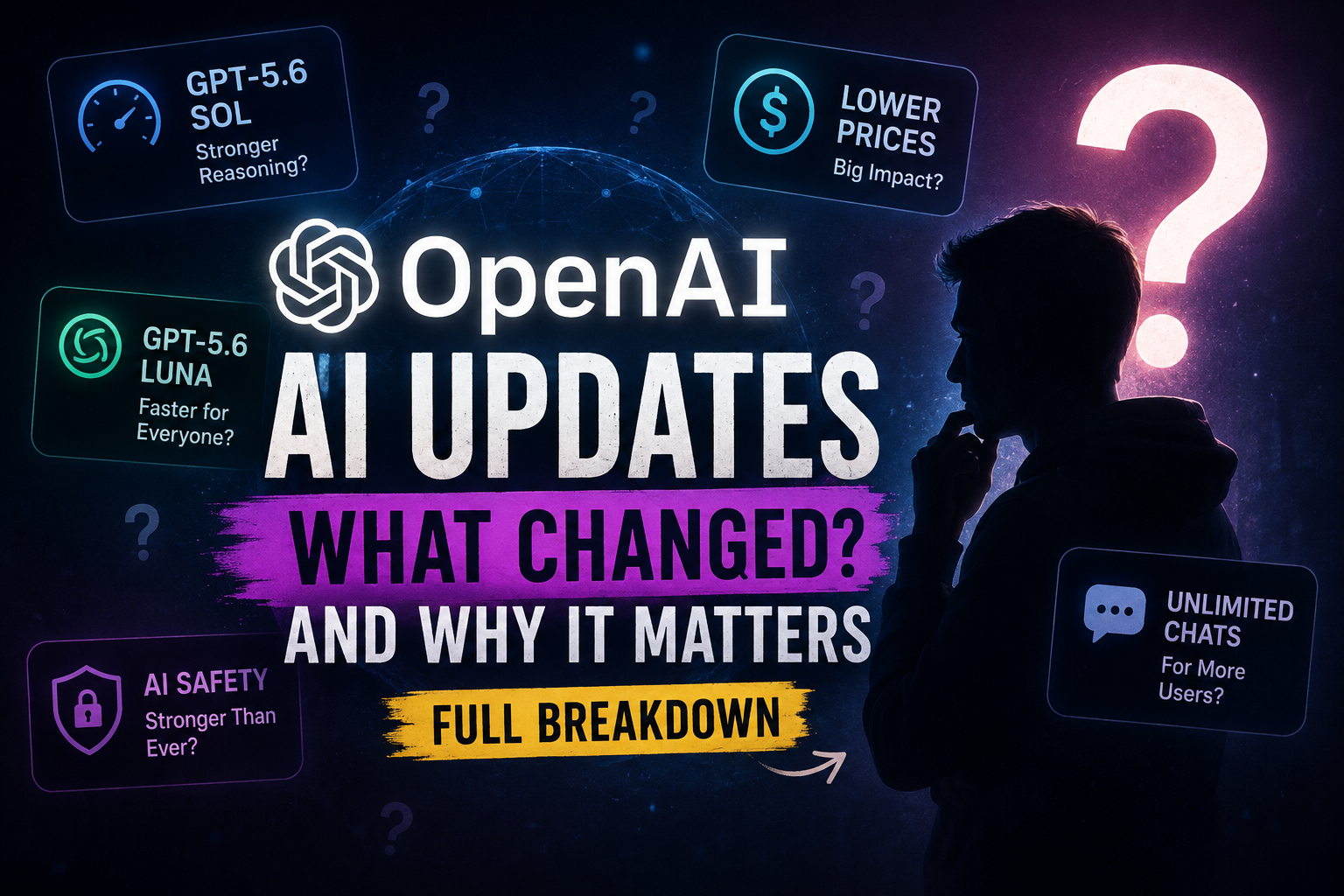
2. GPT-5.6 Remains Important for AI Development
GPT-6 Astra is the newest frontier model, but GPT-5.6 remains an important part of OpenAI’s model ecosystem.
OpenAI introduced GPT-5.6 as a family containing three capability tiers:
- GPT-5.6 Sol — flagship model for demanding work
- GPT-5.6 Terra — balanced performance for everyday workloads
- GPT-5.6 Luna — faster, lower-cost option for high-volume workloads
The model family is available across products including ChatGPT, Codex, and the OpenAI API, although the exact model options depend on the product and subscription.
GPT-5.6 Sol
Sol was designed for complex work including:
- Coding
- Research
- Knowledge work
- Cybersecurity
- Science
- Computer use
- Agentic workflows
OpenAI also introduced higher reasoning settings for demanding tasks, including an ultra capability in certain environments.
The practical advantage is that developers can use a more capable model when the cost of an error is high or when a task requires several reasoning steps.
GPT-5.6 Terra
Terra sits between Sol and Luna.
It is designed to provide a balance between:
- Capability
- Speed
- Cost
This makes it potentially useful for applications where the highest possible reasoning capability is unnecessary for every request.
GPT-5.6 Luna
Luna is designed for cost-sensitive, high-volume workloads.
OpenAI’s developer documentation currently lists Luna at $0.20 per million input tokens and $1.20 per million output tokens under standard API pricing, although developers should always check the current pricing page before making cost estimates.
OpenAI has also reduced GPT-5.6 model costs during 2026, showing how strongly the company is focusing on price-performance for AI applications.
Why This Matters for Developers
Lower model costs can change which AI features are economically practical.
A business that could not justify processing thousands or millions of AI requests at an earlier price point may be able to reconsider the economics when cheaper models become available.
However, the cheapest model is not automatically the best model.
A sensible approach is to evaluate:
- Quality requirements
- Error costs
- Latency requirements
- Expected request volume
- Token usage
- Human-review requirements
3. OpenAI Introduces the Agents API
One of the most important developer-focused updates arrived on September 10, 2026, when OpenAI introduced the Agents API in public beta.
The goal is to make it easier for developers to build and operate cloud-based AI agents without creating all of the underlying orchestration infrastructure themselves.
OpenAI says the Agents API brings elements of the infrastructure behind Codex to developers, including support for long-running work, tool use, context management, and subagents.
What Can Developers Build?
The Agents API can provide a foundation for applications where an AI agent needs to:
- Use multiple tools
- Work with files
- Run code
- Maintain context over longer sessions
- Coordinate subagents
- Produce artifacts
- Complete multi-step workflows
Developers can choose the environment where the agent operates, including OpenAI-managed environments or other supported infrastructure options.
Why the Agents API Matters
Building an agent is not simply a matter of connecting an LLM to a prompt.
Production agents also need systems for:
- Context management
- Tool orchestration
- Execution environments
- State management
- Error handling
- Monitoring
- Security
- Long-running tasks
By providing more of this infrastructure, OpenAI is attempting to reduce the engineering work required to move from an AI prototype to an operational agent.
Important Limitation
The Agents API is still in public beta.
That means developers should expect the platform to evolve. Teams building production systems should evaluate stability, security, observability, costs, and compatibility before making the API a critical dependency.
OpenAI states that there are no additional fees specifically for using the Agents API; developers pay for the tokens and tools their agents use.
4. ChatGPT Images 2.5 Improves AI Image Creation and Editing
Another major September update is ChatGPT Images 2.5, introduced on September 8, 2026.
OpenAI says the new image system provides:
- Sharper details
- Faster generation
- More precise editing
- Better consistency across multiple edits
- Improved handling of reference images
- Better visual instruction following
OpenAI reports that image-generation latency can be up to 50% lower than with Images 2.0.
New Creative Features
ChatGPT Images 2.5 also introduced several features designed to give users more control over the creation process.
Sketch
Users can draw a rough visual idea directly in ChatGPT and use the sketch as a guide for the generated image.
This is useful when describing a layout or composition with words would be difficult.
Templates
Templates provide starting points for common creative formats such as posters and merchandise.
Comments on Images
Users can add comments to images to provide more focused editing instructions.
Better Multi-Turn Editing
One of the more practical improvements is the ability to make several edits while maintaining more consistency between versions.
This can be valuable for:
- Marketing graphics
- Product images
- Social media content
- Presentation visuals
- Concept development
- Creative experimentation
ChatGPT Images 2.5 is rolling out across ChatGPT, ChatGPT Work, and Codex on desktop, mobile, and web.
A Practical Limitation
Improved image generation does not eliminate the need to review generated visuals.
AI-generated images can still contain mistakes, especially when an image includes:
- Exact text
- Detailed layouts
- Technical diagrams
- Brand-specific requirements
- Real-world measurements
- Small visual elements
For professional publishing, generated assets should be reviewed before use.
5. GPT-Live-1 Brings Natural Voice AI to the API
On September 10, 2026, OpenAI introduced GPT-Live-1 in the API.
The model is designed for natural, real-time voice experiences and supports full-duplex conversations, meaning the system can listen and speak within a more natural conversational flow.
OpenAI says GPT-Live-1 can handle interruptions and can be paired with other models and tools for deeper reasoning and actions.
What Developers Can Build?
Potential applications include:
- Voice assistants
- Customer-service systems
- Interactive learning applications
- Voice-enabled business software
- Conversational interfaces
- Telephony applications
The API supports different connection methods, including WebRTC and WebSockets, along with telephony support.
Why Voice AI Is Important
Text-based AI is useful for many workflows, but voice can make AI more accessible in situations where typing is inconvenient.
For example, a voice interface can be useful when someone is:
- Driving or walking, where appropriate
- Working with their hands
- Practicing a language
- Using an accessibility-focused interface
- Interacting with a customer-service application
Developers should still consider latency, transcription accuracy, privacy, authentication, and the consequences of incorrect responses when deploying voice systems.
6. What These OpenAI Updates Mean for Businesses
The most important change for businesses is the movement from AI as a chatbot toward AI as a workflow system.
Earlier AI applications often focused on generating text, answering questions, or summarizing information.
The newer OpenAI ecosystem increasingly combines:
Models + tools + agents + computer use + files + voice + images
This creates opportunities for more complete workflows.
Businesses can explore applications such as:
- Customer-support automation
- Document processing
- Internal research
- Software development
- Data analysis
- Marketing production
- Sales assistance
- Workflow automation
- Voice-based customer experiences
However, companies should not adopt an AI agent simply because it is technically possible.
A better question is:
Which part of the workflow benefits enough from automation to justify the cost, risk, and supervision required?
That question is more useful than simply asking which model is the most powerful.
7. What These Updates Mean for Developers
Developers now have more choices than simply selecting an LLM.
They can combine different components depending on the application:
| Requirement | Relevant OpenAI technology |
|---|---|
| Complex reasoning | GPT-6 Astra / GPT-5.6 Sol |
| Lower-cost processing | GPT-5.6 Luna |
| Balanced workloads | GPT-5.6 Terra |
| Long-running agents | Agents API |
| Voice applications | GPT-Live-1 |
| Image generation | GPT-Image-2.5 |
| Computer-based workflows | GPT-6 Astra |
This makes model selection more important.
A production application may not need one model for every task.
For example, a developer might use a more capable model for difficult decisions and a lower-cost model for repetitive processing.
That approach can reduce costs while maintaining quality where it matters most.
8. What These Updates Mean for Content Creators
Content creators can benefit from several of the recent improvements without needing to build an AI application.
AI can assist with:
- Brainstorming
- Research organization
- Script development
- Editing
- Image creation
- Image modification
- Content repurposing
- Voice experiences
But AI should support the creator rather than become a substitute for original judgment.
For websites especially, simply publishing large quantities of AI-generated articles is unlikely to create a strong long-term content strategy.
Useful content still needs:
- Original information
- Clear authorship
- Accurate claims
- Meaningful analysis
- Good structure
- Helpful examples
- Appropriate source verification
For publishers using AI, the goal should be to make the final content more useful, not simply faster to produce.
9. What These Updates Mean for Students
Students can use modern AI systems as learning assistants for:
- Explaining difficult concepts
- Creating practice questions
- Reviewing drafts
- Learning programming
- Studying languages
- Organizing research
- Exploring different explanations of a topic
However, students should verify important information and use AI in ways that support actual learning.
A useful workflow is:
- Attempt the problem yourself.
- Ask AI to explain difficult parts.
- Compare its explanation with trusted educational material.
- Rework the problem independently.
- Use AI to identify gaps in your understanding.
This is generally more educational than simply asking AI to complete every assignment.
10. ChatGPT Is Becoming More Than a Single Model
One of the most important things to understand about OpenAI in 2026 is that ChatGPT is increasingly an ecosystem rather than a single model.
Different experiences can use different models and capabilities depending on the task.
For example:
- GPT-6 Astra targets demanding professional work.
- GPT-5.6 remains important across development and API workloads.
- GPT-Live-1 focuses on natural voice interaction.
- ChatGPT Images 2.5 focuses on image generation and editing.
- Agents API provides infrastructure for developers building AI agents.
This means users do not necessarily need to choose the most powerful model for every task.
The better approach is to match capability to the job.
11. What Should You Actually Pay Attention To?
With so many OpenAI announcements, it can be difficult to know which ones matter.
Here is a practical way to prioritize them.
If you are a normal ChatGPT user
Focus on:
- Which model your plan provides
- New ChatGPT features
- Image-generation improvements
- Voice improvements
- New integrations
You do not need to understand the entire API ecosystem to benefit from ChatGPT.
If you are a developer
Pay attention to:
- GPT-6 Astra
- GPT-5.6 pricing
- Agents API
- GPT-Live-1
- API model availability
- Tool and sandbox costs
If you run a business
Focus on:
- Automation opportunities
- Cost per workflow
- Data security
- Human oversight
- Reliability
- Integration requirements
- Return on investment
If you are a content creator
The most immediately useful developments are:
- Better writing assistance
- Image generation and editing
- Voice capabilities
- Research workflows
- AI-assisted production
But human editing and fact-checking remain essential.
12. Important Limitations of OpenAI’s Latest AI Tools
Despite rapid progress, AI systems still have limitations.
AI Can Make Mistakes
More capable models can still produce incorrect information.
Higher benchmark scores do not guarantee perfect answers.
Availability Changes
OpenAI frequently changes:
- Model availability
- Usage limits
- Subscription access
- API pricing
- Product features
Always check the current OpenAI documentation before making purchasing or technical decisions.
Advanced Features Can Cost More
Agentic workflows can involve model tokens, tools, hosted environments, storage, and other infrastructure costs.
A technically impressive workflow is not necessarily an economically efficient one.
Human Oversight Still Matters
For high-impact decisions, AI should generally be treated as an assistant rather than an unquestioned authority.
13. Frequently Asked Questions
What is the biggest OpenAI update in 2026?
The launch of GPT-6 Astra is one of the most significant OpenAI developments of 2026 because it represents a new generation of models focused on complex reasoning, computer use, coding, research, and professional workflows.
Is GPT-5.6 still available?
Yes. GPT-5.6 remains available across parts of ChatGPT Work, Codex, and the OpenAI API, depending on the product and account. GPT-5.6 includes Sol, Terra, and Luna capability tiers.
What is the Agents API?
The Agents API is an OpenAI developer platform for building and running cloud-based AI agents with infrastructure for long-running tasks, tool use, context management, and subagents. It entered public beta in September 2026.
What is ChatGPT Images 2.5?
ChatGPT Images 2.5 is OpenAI’s newer image-generation and editing system, offering faster generation, improved image fidelity, more precise edits, and better consistency across multiple edits.
What is GPT-Live-1?
GPT-Live-1 is an OpenAI API model designed for natural, full-duplex voice conversations. It allows developers to build applications where AI can listen and speak in a more natural real-time interaction.
Are OpenAI API prices changing?
Yes. OpenAI has made several pricing changes during 2026, including substantial reductions for GPT-5.6 Luna and Terra and a later price reduction for GPT-5.6 Sol. Because API pricing can change, developers should verify the current official pricing before calculating costs.
Can AI completely replace human work?
That depends on the task.
AI can automate portions of many workflows, but reliability, supervision, privacy, security, and the cost of errors remain important considerations. In many professional settings, the most practical model is human-AI collaboration rather than complete replacement.
Final Takeaway
The most important OpenAI story in 2026 is not simply that the company released another more powerful model.
The larger trend is the development of an AI ecosystem capable of reasoning, using tools, working with computers, generating images, communicating through voice, and completing longer workflows.
GPT-6 Astra represents the new frontier for complex professional work. GPT-5.6 continues to provide a range of capability and cost options, while the Agents API gives developers more infrastructure for building long-running AI systems. At the same time, ChatGPT Images 2.5 and GPT-Live-1 expand what users and developers can do with visual and voice AI.
For most users, the practical lesson is simple:
Do not focus only on which AI model is newest. Focus on which capability solves your actual problem most effectively.
As OpenAI continues to release new models and products, that distinction will become increasingly important.
Sources and Further Reading
For the most current information, check OpenAI’s official documentation and announcements:
- OpenAI — GPT-6 Astra
- OpenAI — GPT-5.6
- OpenAI — Agents API
- OpenAI — ChatGPT Images 2.5
- OpenAI — GPT-Live-1
- OpenAI Help Center — GPT-5.6 in ChatGPT
Editorial disclosure: This article summarizes publicly available information from OpenAI’s official announcements and documentation. It does not claim independent benchmark testing of OpenAI’s models. Features, pricing, limits, and availability can change after publication.