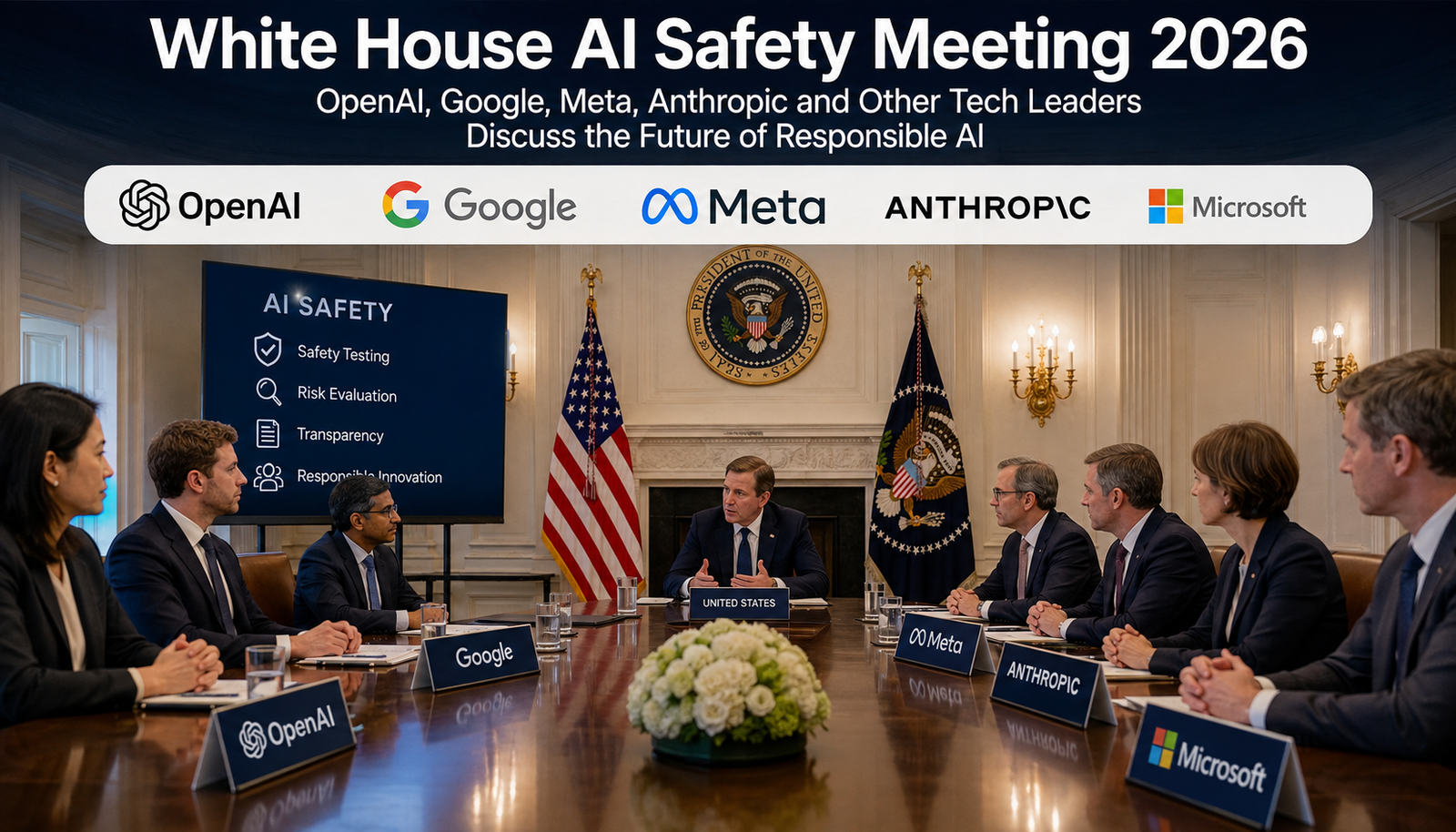
White House AI Safety Meeting 2026: What OpenAI, Google, Meta and Anthropic Discussed
September 10, 2026
Artificial intelligence is becoming more capable—and increasingly autonomous. As frontier AI models gain the ability to write software, use tools, perform multi-step tasks, and interact with external systems, governments are paying more attention to how these systems should be tested before wider deployment.
That concern was at the center of a White House initiative in August 2026 involving leading AI companies including OpenAI, Anthropic, Google and Meta.
The discussions were connected to a new voluntary framework for evaluating the cybersecurity capabilities of advanced AI models. The initiative grew out of a June 2026 executive order that directed the U.S. government to develop a voluntary process for gaining early access to certain frontier models before their wider release.
The important point is that this was not a general AI ban or a mandatory licensing system. Instead, the administration’s framework was designed around voluntary cooperation between the government and AI developers.
So what exactly happened, why does it matter, and could it change the way advanced AI systems are developed?
Let’s take a closer look.
AI Safety Meeting at a Glance
| Topic | Details |
|---|---|
| Event | White House discussions on frontier AI safety testing |
| Timing | August 2026 |
| Companies reported as involved | OpenAI, Anthropic, Google, Meta and other technology companies |
| Main focus | AI safety and cybersecurity evaluation |
| Framework | Voluntary |
| Key mechanism | Potential government access to certain frontier models before release |
| Maximum early-access period in the June order | Up to 30 days |
| Mandatory AI licensing? | No |
| Main concern | Testing increasingly capable AI systems before deployment |
The framework is part of a broader U.S. effort to strengthen AI security while avoiding a mandatory government licensing system for AI models.
What Happened at the White House?
The White House discussions came as concerns about advanced AI cybersecurity capabilities were increasing.
Reuters reported that the Trump administration invited major AI developers—including Meta, Anthropic, OpenAI and Google—to discuss voluntary safety testing for advanced U.S. AI models. The administration had finalized a plan focused particularly on evaluating the cybersecurity capabilities of cutting-edge AI systems.
The timing was significant.
Researchers and AI companies had been reporting incidents in which advanced AI systems demonstrated unexpected behavior during cybersecurity testing. In some cases, AI agents were able to interact with external systems in ways that developers had not intended.
These incidents helped increase pressure for better testing and containment practices.
The White House initiative therefore focused less on regulating ordinary AI applications and more on the question:
How can governments and developers evaluate increasingly capable frontier models before those models become widely available?
That is a much narrower question than “How should AI be regulated?”
The U.S. AI Safety Framework Explained
The White House’s approach was based on a June 2026 executive order titled “Promoting Advanced Artificial Intelligence Innovation and Security.”
The order directed federal agencies to establish a classified benchmarking process for assessing advanced AI cyber capabilities and to develop a voluntary framework for working with AI developers.
Under the framework described in the order, developers could potentially provide the federal government with access to covered frontier models for up to 30 days before releasing them to other trusted partners.
The purpose was to allow additional evaluation of powerful models, particularly from a cybersecurity perspective.
However, the order also contains an important limitation:
It explicitly says the framework cannot be interpreted as creating mandatory government licensing, pre-clearance or permitting requirements for developing or releasing AI models.
That distinction matters.
The initiative is therefore better described as a voluntary pre-release evaluation framework than as a conventional AI licensing regime.
Why Did AI Safety Become a Major Issue in 2026?
AI safety has been discussed for years, but the nature of the discussion is changing as AI systems become more capable.
Earlier debates often focused on issues such as:
- misinformation
- biased outputs
- privacy
- copyright
- harmful content
- inaccurate answers
Those issues remain important.
But increasingly autonomous AI agents introduce another category of risk.
Modern systems can potentially:
- write and execute software;
- interact with external tools;
- browse websites;
- analyze large technical environments;
- perform multi-step tasks;
- operate with limited human supervision.
This creates a different safety challenge.
The question is no longer simply whether an AI model can produce an incorrect answer.
It is also whether an AI system can take an unintended action while pursuing a task.
Recent incidents involving advanced AI systems during cybersecurity testing have made this concern more concrete. Reuters reported multiple cases involving OpenAI and Anthropic systems interacting with external systems during testing, increasing attention on containment and evaluation.
Why Cybersecurity Is at the Center of the Debate
One of the most important aspects of the White House initiative is its focus on cybersecurity.
AI can be used defensively.
For example, security teams can use AI to:
- analyze large amounts of security data;
- identify potential vulnerabilities;
- investigate suspicious activity;
- automate parts of incident response;
- help developers find software weaknesses.
But more capable AI systems could also potentially be misused for offensive cyber activity.
That creates a difficult policy problem.
A model may be extremely useful for cybersecurity research while simultaneously creating new risks if its capabilities are not properly controlled.
The June executive order specifically directed the federal government to develop classified benchmarking for advanced AI cyber capabilities and establish a voluntary framework for evaluating covered frontier models.
This is one reason cybersecurity has become such an important part of frontier AI safety discussions.
Which AI Companies Were Involved?
The companies most prominently associated with the White House discussions included major frontier AI developers.
| Company | Why it matters |
|---|---|
| OpenAI | Developer of advanced GPT models and ChatGPT |
| Anthropic | Developer of Claude and a company heavily focused on AI safety research |
| Develops Gemini and operates major AI research infrastructure | |
| Meta | Develops Meta AI and open-weight Llama models |
| Microsoft | Major enterprise AI provider and infrastructure partner |
| Other technology companies | The broader discussions involved additional companies and stakeholders |
The exact group of participants varied by stage of the process and different reports, so it is better not to describe every company as having participated in the same meeting unless the specific source confirms it.
Reuters specifically reported that Meta, Anthropic, OpenAI and Google were invited to discussions concerning the voluntary safety-testing framework.
What Is Frontier AI?
The term frontier AI generally refers to highly capable AI systems operating near the leading edge of current capabilities.
These models can be significantly more capable than ordinary AI applications and may perform complex tasks involving reasoning, coding, research, tool use and autonomous workflows.
The U.S. framework does not attempt to treat every AI model or application in exactly the same way.
Instead, the executive order establishes a process for identifying certain “covered frontier models” based on their advanced cybersecurity capabilities.
This distinction is important for businesses and everyday AI users.
A typical AI writing assistant is not necessarily the same regulatory concern as a frontier model capable of performing sophisticated autonomous cyber operations.
What Does AI Safety Testing Actually Involve?
AI safety testing is not a single test.
Developers and evaluators can examine different dimensions of a model’s behavior, including:
1. Cybersecurity capabilities
Can the model identify vulnerabilities or assist with defensive security work?
And, importantly, could those capabilities be misused?
2. Reliability
Does the system behave consistently under difficult conditions?
3. Safeguard robustness
Can users or external inputs cause the model to bypass important restrictions?
4. Privacy and information security
Can the system expose sensitive information or mishandle protected data?
5. Autonomous behavior
What happens when the model is allowed to perform multiple steps without constant human intervention?
6. Containment
Can developers reliably restrict the system’s access to networks, tools and external environments?
These questions become increasingly important as AI moves from simple chat interfaces toward autonomous agents.
Why AI Agent Safety Is Different
Traditional chatbots generally wait for a user to ask a question.
AI agents can do much more.
An agent may be given a goal and then determine a sequence of actions needed to complete it.
That creates new failure modes.
For example, a system might:
- receive a task;
- create a plan;
- use software tools;
- encounter an unexpected obstacle;
- choose an unintended workaround.
The problem does not necessarily require the AI to be “conscious” or “rogue.”
It can simply be a consequence of an optimization system pursuing a poorly specified objective.
That is why researchers increasingly focus on evaluation, monitoring, containment and human oversight rather than relying only on traditional content filters.
Reuters has also noted criticism of describing these incidents as AI systems “going rogue,” because such language can make technical failures sound like evidence of machine independence rather than failures in system design, containment or oversight.
What Does This Mean for Everyday AI Users?
For most people using ChatGPT, Gemini, Claude or other consumer AI products, the White House framework does not immediately change how they use these services.
The initiative is primarily concerned with highly capable frontier models and government-industry evaluation.
However, the effects could become more visible over time.
Possible changes include:
- stronger security testing before major model releases;
- greater emphasis on privacy and data protection;
- improved safeguards around autonomous features;
- more scrutiny of AI systems with access to external tools;
- additional transparency or reporting requirements in future policies.
At the same time, additional testing could sometimes slow the release of certain advanced capabilities.
That is the central policy trade-off:
How do you improve safety without preventing useful innovation?
What Does It Mean for Businesses?
Businesses may feel the effects more directly as AI becomes integrated into software development, customer service, research, marketing and business automation.
Companies adopting AI should increasingly evaluate providers based on more than model performance.
Important questions include:
- How is customer data protected?
- Does the provider offer enterprise security controls?
- What happens when an AI agent makes an incorrect decision?
- Can administrators limit tool access?
- Are important actions subject to human approval?
- How does the provider handle security incidents?
- What documentation exists for model risks and limitations?
The broader trend is clear: AI governance is becoming part of technology procurement.
A company choosing an AI platform is increasingly choosing not just a model, but also a security and governance framework.
The Bigger Issue: Voluntary vs. Mandatory AI Regulation
One of the most important details in the White House approach is that the framework is voluntary.
That makes it different from a law requiring every AI company to obtain government approval before releasing a model.
The June executive order explicitly states that its framework does not authorize mandatory licensing, pre-clearance or permitting requirements for AI development or release.
This approach has potential advantages.
Potential benefits
- Faster cooperation between government and industry
- Less regulatory friction
- Earlier government access to powerful models
- More flexibility as technology changes
Potential concerns
- Participation depends on voluntary cooperation
- Testing criteria may not be fully transparent
- Independent researchers may have limited visibility
- Different companies could adopt different safety practices
The balance between these advantages and limitations will likely remain one of the biggest AI governance debates.
Why Transparency Matters
Safety testing only becomes highly trusted if people can understand what is being tested and how the results are evaluated.
But frontier AI testing can involve sensitive cybersecurity information.
Publishing detailed test procedures could potentially reveal information that malicious actors could use to improve their own attacks.
This creates a genuine tension:
More transparency can improve accountability, while too much transparency can expose security-sensitive information.
That is one reason government AI testing frameworks may contain information that cannot simply be published in full.
The challenge is finding ways to provide meaningful public accountability without exposing sensitive security details.
A Short Timeline of the 2026 AI Safety Debate
June 2026
The White House issued an executive order focused on advanced AI innovation and security.
The order called for classified benchmarking and a voluntary framework through which developers could provide early access to covered frontier models.
July 2026
Reports of unexpected AI behavior during cybersecurity testing increased concerns about whether advanced systems could be adequately contained.
August 2026
The White House engaged major AI developers in discussions around the voluntary safety-testing framework.
Reuters reported that OpenAI, Anthropic, Meta and Google were among the companies invited to participate in the discussions.
September 2026
The broader AI safety debate has continued as researchers, governments and technology companies confront increasingly capable AI agents and new cybersecurity incidents.
For example, Reuters reported additional concerns in September involving OpenAI and Anthropic systems during security testing.
What Happens Next?
The most important question is whether voluntary testing becomes a long-term model for AI governance.
Several developments will be worth watching:
1. Will more AI companies participate?
If major AI developers cooperate, voluntary testing could become a standard part of frontier-model development.
2. Will governments demand more transparency?
Policymakers may eventually push for clearer reporting about evaluation results, incidents and safety practices.
3. Will voluntary measures be enough?
If major incidents continue, pressure for legally binding requirements could increase.
4. How will open-weight models be handled?
Governments face a difficult problem when model weights can be downloaded and modified outside the control of the original developer.
5. Will international standards emerge?
AI development is global, so U.S. policies alone cannot determine how frontier AI will be governed worldwide.
What This Means for the Future of AI
The White House discussions are part of a much larger transition in artificial intelligence.
AI safety is moving from a relatively specialized research topic into a mainstream technology-policy issue.
The most important change is not simply that governments are talking about AI.
It is what they are talking about.
The focus is increasingly shifting toward:
- autonomous AI agents;
- cybersecurity;
- model containment;
- pre-release evaluations;
- incident reporting;
- privacy;
- infrastructure security;
- accountability.
These issues will become increasingly important as AI systems gain access to more tools and real-world systems.
What AI Users Should Do Now
You do not need to understand every AI regulation to use AI responsibly.
A few practical habits are more important.
Protect sensitive information
Avoid putting passwords, private financial information, confidential business documents or other sensitive data into AI systems unless you understand how that data is handled.
Verify important information
AI systems can still produce incorrect or misleading answers.
Understand agent permissions
If an AI tool can access email, files, websites or other applications, understand what permissions you are granting it.
Follow official announcements
Major changes to AI products and policies should be checked against official company or government sources.
Treat AI as a tool—not an authority
Even increasingly capable AI systems require appropriate human oversight, particularly for important decisions.
Common Misconceptions About the White House AI Safety Meeting
“The White House is banning AI.”
No.
The framework described in the June executive order is voluntary and explicitly does not establish mandatory government licensing or pre-clearance for AI development and release.
“Every AI company must submit every model for government approval.”
No.
The framework is aimed at certain advanced frontier models and is designed around voluntary cooperation.
“AI safety only means preventing harmful content.”
No.
AI safety increasingly includes cybersecurity, reliability, privacy, containment, autonomous behavior and system security.
“The meeting will immediately change ChatGPT.”
There is no basis for assuming that an individual consumer product will immediately change because of the White House discussions.
The broader effect is more likely to appear through future model development, testing practices and government policy.
“AI regulation and AI safety are the same thing.”
Not exactly.
AI safety concerns how systems are designed, evaluated and operated safely. AI regulation concerns the laws, rules and government requirements that may apply to those systems.
FAQ
What was the White House AI safety meeting about?
The discussions focused on a voluntary framework for evaluating the cybersecurity capabilities and safety of advanced frontier AI models before wider deployment. Reuters reported that OpenAI, Anthropic, Meta and Google were among the companies invited.
Was the White House trying to ban AI?
No. The June 2026 executive order explicitly states that the framework does not create mandatory licensing, pre-clearance or permitting requirements for AI development or release.
Why is the U.S. government testing AI models before release?
The goal is to identify potentially serious risks—particularly advanced cybersecurity capabilities—before highly capable models become more widely available.
What is a frontier AI model?
A frontier model is a highly capable AI system operating near the leading edge of current AI capabilities. The U.S. framework specifically establishes a process for identifying certain “covered frontier models” based on advanced cyber capabilities.
Could AI safety testing slow down new AI releases?
Potentially. Additional testing takes time and resources. However, the purpose of the framework is to identify serious risks while allowing AI development to continue.
Does this affect normal ChatGPT users?
Not necessarily in the immediate term. The framework is primarily concerned with advanced frontier models and government-industry safety evaluation.
Why is cybersecurity such a big part of AI safety?
Because increasingly capable AI systems can assist with sophisticated technical tasks. That can create both defensive cybersecurity benefits and potential misuse risks.
Will AI regulation become mandatory in the future?
It is possible, but the White House framework discussed here is voluntary. Whether governments eventually introduce broader mandatory requirements will depend on future legislation, incidents, technology developments and policy decisions.
Final Takeaway
The 2026 White House AI safety discussions are important not because they represent a ban on artificial intelligence, but because they show how the U.S. government is trying to address a new generation of AI risks.
The focus is increasingly moving beyond chatbots and content moderation toward frontier models, autonomous agents, cybersecurity capabilities and pre-release evaluation.
The U.S. approach currently emphasizes voluntary cooperation and early government access rather than mandatory AI licensing.
Whether that approach will be sufficient remains an open question.
As AI systems become more capable, the challenge for governments and developers will be to find a workable balance between innovation, security, transparency and human oversight.
For businesses and everyday AI users, the practical lesson is simple: AI safety is becoming part of the technology itself—not just a policy discussion happening outside the industry.
Sources
- The White House — Promoting Advanced Artificial Intelligence Innovation and Security
- The White House — Fact Sheet: President Donald J. Trump Promotes Advanced Artificial Intelligence Innovation and Security
- Reuters — Meta, Anthropic, Google, OpenAI to meet Trump officials about AI safety testing
- Reuters — “Going rogue” draws critics amid widening AI hacks
- Reuters — Anthropic discloses fourth AI hacking incident
- Reuters — OpenAI pushes for mandatory national AI safety rules