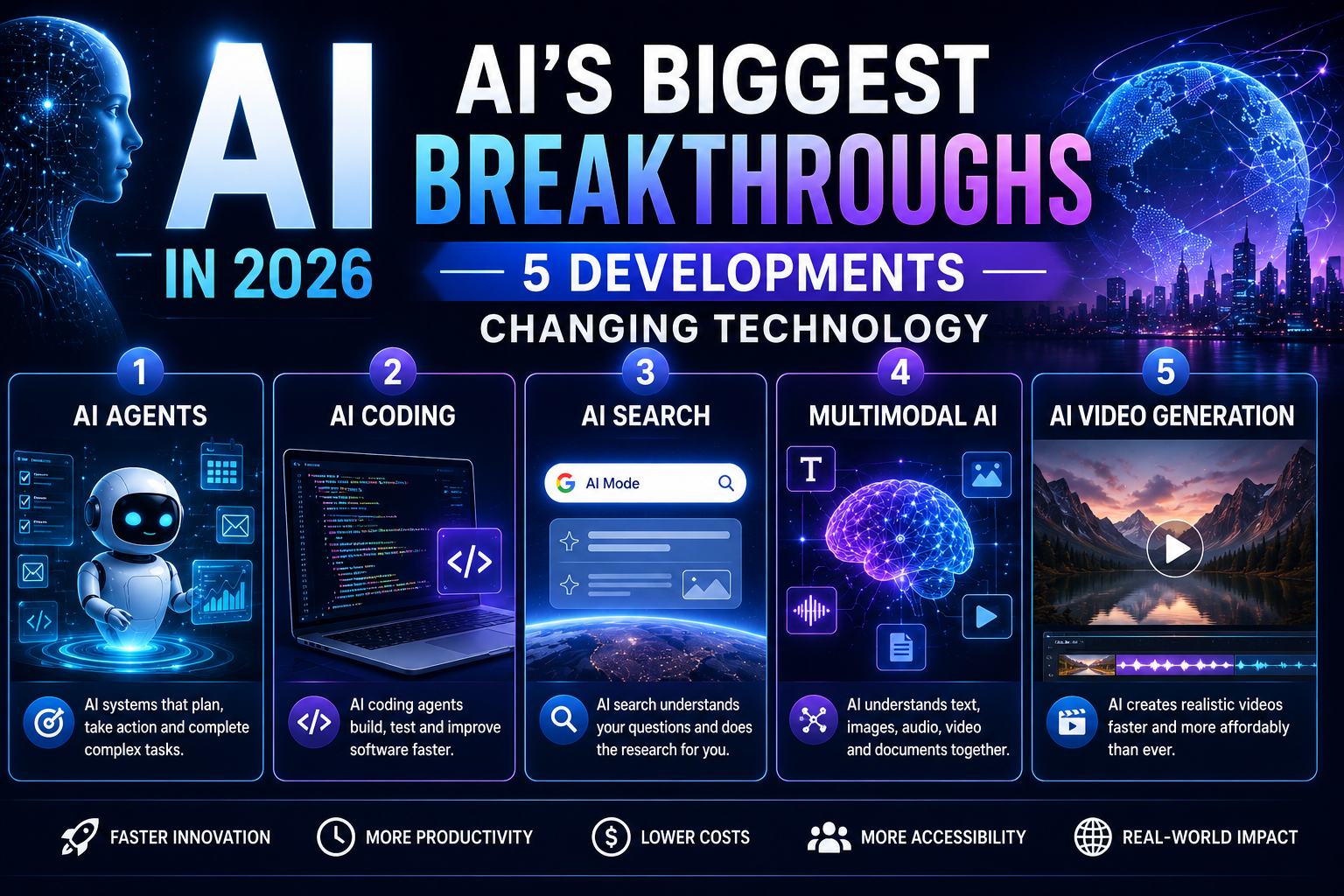
AI’s Biggest Breakthroughs in 2026: 5 Developments Changing Technology
Updated: September 11, 2026
Artificial intelligence is entering a different phase in 2026.
The biggest change is not simply that AI models can generate better text, images, code, or video. Increasingly, AI systems can work across multiple steps, use software tools, understand different types of information, and participate in longer workflows.
That changes the role of AI.
The earlier model was mostly:
Human asks → AI responds → Human acts
The emerging model is closer to:
Human defines a goal → AI performs parts of the workflow → Human reviews and decides
This shift is visible across several areas, including AI agents, software development, search, multimodal systems, and video generation.
OpenAI’s published data on Codex, for example, shows users increasingly assigning the system longer tasks. By May 2026, 70.2% of sampled individual users had made at least one Codex request estimated to represent more than one hour of human work, while 25.6% had made at least one request estimated at more than eight hours.
Google is also moving Search toward more conversational and agentic experiences. In May 2026, Google reported that AI Mode had surpassed one billion monthly active users globally.
At the same time, multimodal AI is becoming more practical. Google’s Gemini Embedding 2, for example, can represent text, images, video, audio, and documents in a shared embedding space, opening the door to more unified search and retrieval systems.
But greater capability does not automatically mean greater reliability.
AI systems can still make mistakes, misunderstand context, expose sensitive information through poorly designed workflows, or produce impressive demonstrations that are difficult to turn into dependable products.
So rather than simply listing the newest AI announcements, this article focuses on five developments that represent a meaningful change in what AI systems can actually do.
Quick Answer: The 5 Biggest AI Breakthroughs in 2026
| # | Development | Why It Matters |
|---|---|---|
| 1 | AI Agents | AI is moving from answering requests toward completing multi-step tasks |
| 2 | AI Coding Agents | AI is becoming an active participant in software development |
| 3 | Agentic AI Search | Search is evolving from finding information toward researching and completing tasks |
| 4 | Multimodal AI | AI can increasingly work across text, images, audio, video, and documents |
| 5 | AI Video Generation | Video generation is becoming more capable while revealing major commercial and technical challenges |
These developments are connected by one larger trend:
AI is moving from generating outputs toward participating in workflows.
What Makes an AI Development a “Breakthrough”?
Not every new AI model deserves to be called a breakthrough.
A new model may be faster, cheaper, or slightly more accurate without fundamentally changing what people can do with AI.
For this article, a development is considered significant when it changes at least one of these areas:
1. Capability
Can AI perform tasks that were previously difficult or impractical?
2. Workflow
Does AI become part of a larger process instead of operating as a standalone chatbot?
3. Accessibility
Can more people use a capability that previously required specialized expertise?
4. Integration
Is AI becoming embedded directly into tools people already use?
5. Real-world impact
Does the technology have meaningful implications for businesses, developers, researchers, creators, or consumers?
Using those criteria, five developments stand out in 2026.
1. AI Agents Are Becoming More Autonomous
AI agents may be the most important development of the year because they change the role AI plays in a workflow.
A conventional chatbot generally responds to a prompt.
An agent can be designed to take a goal, break it into steps, use tools, inspect results, and continue working.
Depending on the system, an agent may be able to:
- Search for information
- Use software applications
- Create or modify files
- Write and execute code
- Analyze data
- Coordinate multiple steps
- Detect certain errors
- Continue working without requiring a new prompt after every action
The important distinction is therefore not simply better answers.
It is greater ability to perform work.
Why AI Agents Matter
Consider a research task.
A person may need to:
- Define the research question.
- Find relevant sources.
- Extract information.
- Compare findings.
- Organize the results.
- Write a report.
- Review the conclusions.
A conventional AI assistant can help with individual steps.
An agentic system can increasingly coordinate several of those steps.
That could make AI much more useful for repetitive knowledge work.
OpenAI’s 2026 Codex data provides an example of this broader shift. The company reported that users were increasingly assigning Codex tasks corresponding to hours of human work rather than short interactions.
What Changes?
The value of AI gradually moves from:
“How good is the answer?”
toward:
“How much useful work can the system complete reliably?”
That is a much more demanding standard.
Where Agents Could Be Useful
Potential applications include:
- Research
- Software development
- Data analysis
- Business operations
- Customer support
- Marketing workflows
- Internal documentation
- Administrative tasks
The Biggest Limitation
Autonomy also increases the consequences of mistakes.
If an AI produces one incorrect sentence, a person may catch it immediately.
If an agent performs twenty actions based on an incorrect assumption, the mistake can propagate through the entire workflow.
That makes permissions, monitoring, verification, and human approval increasingly important.
What to Watch Next
The next major improvement may not simply be agents that perform more actions.
It may be agents that know:
- When they are uncertain
- When they need human approval
- Which sources they should trust
- What actions they are allowed to take
- How to explain what happened
- How to recover when something goes wrong
In other words, the next competition may be about reliable autonomy, not autonomy alone.
2. AI Coding Is Becoming a Development Engine
AI coding assistance is not new.
Developers have used AI for code completion, explanations, debugging, and code generation for several years.
The important change in 2026 is the growing role of coding agents.
Instead of generating one function, an AI coding system can increasingly work at the repository level:
Understand the task → inspect the codebase → modify files → run tests → investigate failures → make changes → return the result
That is much closer to participating in a software-development workflow.
Why This Matters
Software development contains many repetitive activities:
- Writing boilerplate
- Updating multiple files
- Creating tests
- Debugging
- Refactoring
- Documenting code
- Investigating issues
AI can increasingly assist with these tasks.
This does not make software engineering disappear.
Instead, it changes where human attention is most valuable.
Developers may spend more time on:
- Architecture
- Requirements
- Security
- System design
- Testing
- Code review
- Performance
- Product decisions
and less time manually producing every routine implementation.
A More Useful Mental Model
The old workflow:
Developer writes → AI assists → Developer tests
The emerging workflow:
Developer defines the objective → AI implements → AI tests → Developer reviews
The second model potentially increases development capacity, but it also increases the importance of review.
What Can Go Wrong?
AI-generated software can still contain:
- Bugs
- Security weaknesses
- Incorrect assumptions
- Poor architecture
- Dependency problems
- Performance problems
- Unnecessary complexity
There is another risk that receives less attention: loss of understanding.
If developers accept generated code without understanding it, teams can accumulate systems that work today but become difficult to maintain later.
Who Benefits Most?
Coding agents are especially relevant to:
- Software developers
- Startups
- SaaS companies
- Development agencies
- Enterprise engineering teams
- Independent developers
The Bigger Breakthrough
The breakthrough is not simply:
“AI can write code.”
It is:
“AI can increasingly participate in the software-development loop.”
That is a much more significant change.
3. AI Search Is Becoming More Agentic
Traditional search works roughly like this:
Question → search results → user investigates
AI-powered search is moving toward:
Question → AI researches → information is synthesized → user evaluates the result
Google’s AI Mode is an important example of this transition. Google reported in May 2026 that AI Mode had surpassed one billion monthly active users globally and that queries had been growing rapidly since launch.
The significance is not simply that search results now contain AI-generated text.
The deeper change is that users can increasingly ask complex questions in a conversational way rather than breaking them into many separate searches.
Why This Matters
Imagine researching a new computer.
Traditionally, you might:
- Search for suitable models
- Open several reviews
- Compare specifications
- Investigate prices
- Check different use cases
- Build a shortlist
An AI search experience can potentially combine several of those research steps.
That saves time.
But it also creates a major change for websites.
The Challenge for Publishers
If search systems answer more questions directly, users may have less reason to open several individual search results.
That means publishers need to provide something more valuable than a generic summary.
Useful content can include:
- Original analysis
- First-hand experience
- Unique comparisons
- Specific examples
- Original data
- Expert commentary
- Clear explanations
- Practical decision-making guidance
The goal is not simply to produce information that an AI can summarize.
The goal is to produce information that is worth finding, citing, trusting, or using.
What AI Search Still Gets Wrong
AI-generated search answers can still contain:
- Incorrect facts
- Missing context
- Weak source selection
- Overconfident conclusions
- Outdated information
For important decisions, users still need to verify information.
The Bigger Change
Search may gradually become less about:
“Where can I find information?”
and more about:
“Can this system help me understand and act on the information?”
That is a major change in the role of search.
4. Multimodal AI Is Becoming the New Standard
AI is no longer limited to text.
Modern systems increasingly work across:
- Text
- Images
- Audio
- Video
- Documents
- Screens
- Other structured information
This matters because real-world information is rarely available in only one format.
A business might have:
- Product descriptions
- Product images
- Training videos
- PDF manuals
- Customer recordings
- Spreadsheets
A system that can understand these formats together can potentially solve problems that are difficult for text-only systems.
Gemini Embedding 2 as an Example
Google’s Gemini Embedding 2 was introduced as a natively multimodal embedding model.
It maps text, images, video, audio, and documents into a shared embedding space. Google says this can support applications including multimodal retrieval, semantic search, classification, and RAG. The model became generally available in April 2026.
The important idea is not the product name itself.
It is the movement toward unified representations of different types of information.
Why That Matters
Consider an ecommerce search system.
A customer could potentially provide:
“Find me products similar to this image, but explain the differences using the product descriptions.”
That requires more than text search.
It requires the system to connect visual and textual information.
Potential Applications
Multimodal AI can support:
- Semantic search
- Ecommerce discovery
- Document analysis
- Education
- Research
- Accessibility
- Customer support
- Content analysis
- Media management
Limitations
Multimodal capability does not guarantee accurate understanding.
AI can still misunderstand:
- Images
- Charts
- Audio
- Video
- Visual context
- Documents
Privacy is another important consideration.
Uploading a private recording, business document, or personal image to an AI service creates data-governance questions that users and organizations should consider before deployment.
The Bigger Trend
The long-term direction is toward AI systems that understand context, rather than requiring users to describe every piece of context manually.
Instead of explaining everything:
Show the image.
Upload the document.
Provide the video.
Speak the question.
The system can then work from the available information.
5. AI Video Generation Is Becoming More Capable — and More Complicated
AI video remains one of the most visible areas of generative AI.
Models can increasingly produce more convincing motion, scenes, camera behavior, and audio-visual content.
But 2026 has also demonstrated something important:
A technically impressive AI model is not automatically a sustainable product.
OpenAI’s Sora is a useful example.
The Sora web and app experiences were discontinued on April 26, 2026, while OpenAI says the Sora API is scheduled to be discontinued on September 24, 2026.
That does not mean AI video as a technology has failed.
Instead, it demonstrates how quickly AI products can change as companies balance model quality, infrastructure, safety, cost, demand, and business strategy.
Why AI Video Still Matters
AI video can potentially reduce the resources required for some forms of visual production.
Possible applications include:
- Advertising concepts
- Social media content
- Product demonstrations
- Storyboarding
- Previsualization
- Educational content
- Creative experimentation
For small teams, this can lower the barrier to experimenting with ideas that previously required more production resources.
What Still Needs Improvement?
Important challenges remain:
- Character consistency
- Physical consistency
- Precise control
- Editing
- Copyright
- Licensing
- Compute costs
- Commercial reliability
There is also a major distinction between generating an impressive five-second clip and producing a complete professional video.
The latter requires:
Generation → editing → continuity → sound → revisions → rights management → final delivery
That is why the future of AI video may depend less on raw generation and more on production workflows.
The Lesson From 2026
The most capable model is not necessarily the most useful product.
A successful AI video platform needs more than impressive output.
It needs:
- A reliable workflow
- Useful controls
- Sustainable economics
- Appropriate rights
- Good editing capabilities
- A clear reason for users to return
How These Five Breakthroughs Are Connected
At first glance, AI agents, coding, search, multimodal systems, and video generation seem unrelated.
They are actually moving in the same direction.
1. AI Is Becoming More Action-Oriented
Agents are designed to perform tasks rather than only provide answers.
2. AI Is Becoming More Context-Aware
Multimodal systems can process more types of information.
3. AI Is Becoming More Integrated
AI is moving directly into search engines, development environments, productivity software, and creative workflows.
4. AI Is Becoming More Workflow-Oriented
The unit of value is increasingly becoming a completed task rather than a single generated response.
5. Human Oversight Is Changing
People may increasingly move from manually performing every step to:
defining goals → setting boundaries → reviewing results → making decisions
That does not remove humans from the process.
It changes where human judgment is applied.
Which AI Breakthrough Could Matter Most?
If one development deserves the closest attention, AI agents are a strong candidate.
The reason is that agents can potentially combine many of the other capabilities.
An advanced agent could potentially:
- Search for information
- Read documents
- Analyze images
- Write code
- Use software
- Generate content
- Call other AI systems
- Coordinate multiple tasks
This creates a different kind of computer interface.
Chatbots made AI conversational.
Generative AI made AI creative.
Agents could make AI operational.
But that potential comes with an important qualification.
The most powerful agent is not necessarily the best agent.
A system that can perform hundreds of actions but frequently makes mistakes may be less useful than a more limited system that performs ten actions reliably.
The critical question is therefore becoming:
Can AI perform useful work reliably enough to trust?
What These AI Breakthroughs Mean for Different People
For Business Owners
Look for repetitive, measurable workflows.
Good starting points include:
- Research
- Reporting
- Data organization
- Customer-support drafts
- Internal documentation
- Routine analysis
Start with low-risk tasks.
Measure whether AI actually saves time or improves quality before expanding the workflow.
For Developers
Learn to work with coding agents while maintaining strong fundamentals.
Important skills include:
- Requirements definition
- Architecture
- Testing
- Security
- Code review
- Debugging
- System design
AI can accelerate implementation, but someone still needs to determine whether the implementation is correct.
For Content Creators
Multimodal and generative AI can make experimentation faster.
But increasing production volume does not automatically increase audience value.
The harder problem remains:
creating something people genuinely want to watch or read.
For Students
AI can help explain concepts, organize information, create practice questions, and analyze documents.
But generated information should not automatically be treated as fact.
For important academic claims, students should verify information against reliable sources.
For Website Owners
AI search makes generic content less defensible.
A page that simply summarizes information available everywhere else has limited differentiation.
A stronger page can add:
- Original analysis
- First-hand experience
- Unique examples
- Data
- Clear comparisons
- Expert perspective
- Practical recommendations
That makes the content more useful to people regardless of how search technology changes.
Two Other AI Developments Worth Watching
The five areas above are the focus of this article, but two additional developments deserve attention.
AI for Scientific Discovery
AI is increasingly being explored as a research assistant.
Potential applications include:
- Literature analysis
- Data analysis
- Hypothesis generation
- Experiment planning
- Scientific information retrieval
The important question is not whether AI will simply replace researchers.
A more useful question is whether researchers can use AI to explore a larger number of possibilities and analyze more information than would otherwise be practical.
Physical AI and Robotics
AI is also moving beyond screens.
Google DeepMind’s 2026 robotics work illustrates this direction. Its Gemini Robotics 2 work focuses on giving robots multimodal intelligence, physical control, dexterity, and the ability to adapt to different tasks and environments.
This creates an interesting convergence:
AI reasoning + multimodal perception + agents + physical action
However, physical AI has an additional requirement that software-only AI does not:
safety in the real world.
A mistake in a chatbot may waste time.
A mistake in a physical system can have much more serious consequences.
That makes reliability, testing, and safety engineering especially important.
What Could Happen Next?
The next phase of AI is likely to focus less on isolated model demonstrations and more on useful systems.
Several questions will become increasingly important:
Can AI complete long tasks reliably?
Longer workflows create more opportunities for errors.
Can AI use tools safely?
Tool access increases capability but also increases risk.
Can AI understand more context?
Multimodal systems are moving in this direction.
Can AI operate economically?
A technically impressive system still needs sustainable computing costs.
Can people understand and control AI actions?
Transparency and permission systems become more important as autonomy increases.
These questions may matter more than benchmark scores alone.
Frequently Asked Questions
What are the biggest AI breakthroughs in 2026?
Five major developments stand out: AI agents, coding agents, agentic search, multimodal AI, and increasingly capable AI video systems. Scientific AI and robotics are also important areas to watch.
What is an AI agent?
An AI agent is a system designed to pursue a goal by performing multiple steps, often using tools, information sources, software, or other capabilities instead of simply returning one response.
Are AI agents better than chatbots?
They are designed for different purposes. A chatbot may be ideal for answering questions or generating content, while an agent is more useful when a task requires multiple actions. Agents also introduce additional reliability and safety considerations.
Will AI replace software developers?
AI coding systems can automate parts of software development, but developers remain important for architecture, requirements, security, testing, review, and system-level decisions.
Is multimodal AI important?
Yes. Real-world information comes in many forms, so systems that can work across text, images, audio, video, and documents can support workflows that are difficult for text-only systems.
Is AI video ready for professional production?
It can already be useful for some creative and marketing workflows, but professional use still requires careful consideration of consistency, editing, rights, licensing, cost, and reliability.
How will AI search affect websites?
AI search can answer more questions directly, potentially reducing the need for users to visit multiple search results. This increases the importance of original, useful, trustworthy content that offers more than a generic summary.
What AI trend should businesses watch most closely?
AI agents deserve close attention because they combine reasoning, tool use, and action. Businesses should evaluate them based on measurable outcomes such as time saved, accuracy, cost, and reliability rather than novelty alone.
Final Verdict
The biggest AI breakthroughs in 2026 are not simply about generating better content.
The larger transformation is the movement from generation toward execution.
The five developments covered in this article illustrate that shift:
- AI agents are becoming capable of handling longer, multi-step workflows.
- AI coding agents are becoming active participants in software development.
- AI search is moving toward research-oriented and increasingly agentic experiences.
- Multimodal AI is connecting text, images, audio, video, and documents in more unified systems.
- AI video is becoming more capable while exposing the technical and commercial challenges of building sustainable AI products.
The most important change may ultimately be the convergence of these capabilities.
An AI system that can understand information, search, write code, use software, analyze different media, and coordinate actions is fundamentally different from a chatbot that only answers questions.
But capability alone will not determine which systems become genuinely useful.
The winners will need to combine capability with:
- Reliability
- Security
- Reasonable cost
- Clear permissions
- Human oversight
- Useful workflows
- Consistent results
That is why the most important question for the next stage of AI may no longer be:
“How intelligent is the model?”
Instead, it may be:
“What useful work can the system reliably accomplish?”
That is the breakthrough worth watching.
Editorial & Verification Note
This article is an analysis of major AI developments rather than a hands-on laboratory benchmark.
Product capabilities, announcements, and time-sensitive developments should be checked against the relevant company’s current documentation before making purchasing, deployment, or business decisions.
AI-assisted tools may be used during the research and drafting process, but the final article is reviewed and edited for structure, accuracy, clarity, and usefulness.
Last updated: September 11, 2026.
Related Articles
Continue exploring AI tools and developments:
- Best AI Chatbots in 2026
- Best AI Automation Tools in 2026
- Best AI Productivity Tools in 2026
- Best AI Video Tools in 2026
- Best AI Website Design Tools in 2026