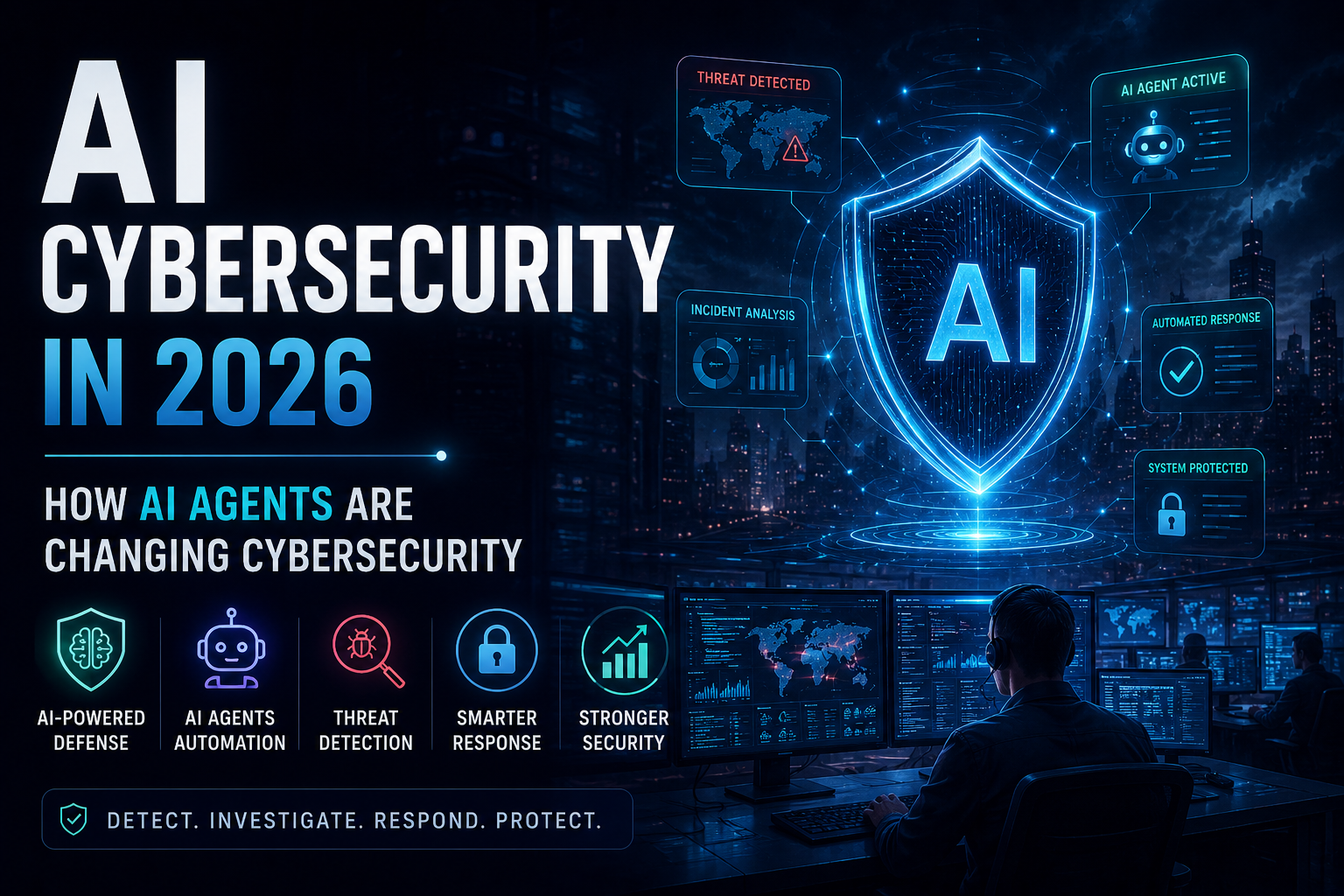
AI Cybersecurity in 2026: 9 Ways AI Agents Are Changing Security
Updated September 2026
Cybersecurity is entering a new phase in 2026.
For years, artificial intelligence was primarily used as a security assistant. It helped analysts summarize alerts, analyze logs, identify anomalies, investigate incidents, and find patterns across large amounts of security data.
Now, AI is moving closer to the operational side of cybersecurity.
AI agents can potentially investigate alerts, collect evidence, interact with security tools, correlate information across systems, recommend responses, and—when explicitly authorized—execute certain actions.
At the same time, threat actors are also using AI as part of broader cyber and fraud operations.
That creates an important shift:
AI can increase the speed and scale of both cyber defense and cyberattacks.
Recent security research supports that trend. Check Point Research’s 2026 AI Security Report describes AI moving in some observed attacks from an assisting role toward more operational use, while also identifying AI systems themselves as an expanding attack surface.
The defensive opportunity is significant, but so are the risks.
The important question is therefore not simply whether businesses should use AI for cybersecurity.
It is:
How can organizations use AI to improve security without giving an AI system more authority than it can safely handle?
This guide explains what AI cybersecurity means in 2026, nine ways AI agents are changing security operations, the biggest risks of agentic security systems, and a practical framework for deploying AI safely.
What Is AI Cybersecurity?
AI cybersecurity refers to the use of artificial intelligence to support activities such as:
- Threat detection
- Alert analysis
- Incident investigation
- Vulnerability prioritization
- Security monitoring
- Threat intelligence
- Security documentation
- Response automation
- AI-system security
Traditional security operations often look like:
Event → Alert → Human investigation → Human response
An AI-assisted workflow can look more like:
Event → AI detection → AI investigation → Recommendation → Human approval → Response
In carefully controlled environments, some low-risk actions can potentially be automated.
For example, an AI security agent could receive a suspicious-login alert and:
- Examine the authentication event.
- Check the user’s recent activity.
- Review device and identity information.
- Search for related alerts.
- Correlate relevant evidence.
- Estimate the likelihood of malicious activity.
- Produce an incident summary.
- Recommend a response.
- Execute an approved action if its permissions allow it.
- Continue monitoring the incident.
The important change is that AI is moving beyond simply answering security questions and becoming part of the workflow used to investigate and respond to them.
But an AI agent does not automatically become trustworthy simply because it can perform more actions.
Its safety depends heavily on its:
Data + tools + permissions + instructions + monitoring + human controls
Why AI Cybersecurity Matters in 2026
AI adoption is creating a two-sided cybersecurity problem.
Defenders can use AI to analyze more information and automate repetitive security work.
Attackers can use AI alongside traditional infrastructure to increase the speed, scale, and efficiency of malicious operations.
Check Point Research’s 2026 report describes this evolution as a shift from AI being primarily a force multiplier to AI becoming more directly involved in some live attack operations. The report also highlights indirect prompt injection, AI-related data leakage, and the security risks surrounding agentic architectures.
Cisco’s 2026 State of AI Security report similarly highlights the growing attack surface created by generative and agentic AI, including prompt injection, AI supply-chain risks, and the security implications of systems that can act autonomously.
The result is a new security equation:
AI capability creates defensive opportunities and new attack surfaces at the same time.
Organizations therefore need to think about two separate questions:
- How can AI improve our cybersecurity?
- How do we secure the AI systems themselves?
Both matter.
AI Is Changing Both Attackers and Defenders
It is easy to discuss AI cybersecurity as if AI were exclusively a defensive technology.
That would be incomplete.
AI can support defenders and attackers because both sides can use similar general-purpose capabilities.
| AI for Defense | AI for Attack |
|---|---|
| Analyze security events | Automate reconnaissance and research |
| Prioritize alerts | Scale social-engineering operations |
| Investigate incidents | Analyze stolen information |
| Correlate security data | Assist with malicious workflows |
| Generate incident reports | Automate repetitive tasks |
| Identify suspicious patterns | Improve fraudulent content |
| Support vulnerability analysis | Assist with coding and operational tasks |
| Automate selected responses | Increase operational scale |
This does not mean AI automatically gives attackers an advantage.
The outcome depends on how effectively organizations combine AI with:
- Security data
- Human expertise
- Infrastructure
- Identity controls
- Monitoring
- Existing security tools
- Governance
OpenAI’s 2026 threat reporting similarly notes that malicious actors generally use AI in combination with traditional tools and platforms rather than relying on an AI model alone.
That distinction is important.
AI is usually part of a larger operational system, not the entire attack.
What Is an AI Security Agent?
An AI assistant typically waits for a person to ask a question.
An AI agent is designed to pursue a goal through multiple steps and interact with tools or external systems.
For example:
Goal: Investigate a suspicious login.
An agent might:
Plan → collect evidence → analyze evidence → make a recommendation → request approval → perform an authorized action → verify the result
The exact behavior depends on the architecture.
An agent may have access to:
- Security information and event management systems
- Endpoint security tools
- Identity systems
- Ticketing systems
- Cloud APIs
- Threat-intelligence platforms
- Databases
- Internal documentation
This is where agentic AI becomes particularly powerful—and particularly risky.
An agent with no meaningful permissions can do little harm, but also has limited operational value.
An agent with broad permissions can accomplish much more, but mistakes or manipulation can have a much larger impact.
The goal is therefore not:
Give the agent maximum access.
It is:
Give the agent the minimum access necessary to perform its job.
9 Ways AI Agents Are Changing Cybersecurity
1. Faster Threat Detection
Modern organizations generate enormous amounts of security telemetry.
Examples include:
- Authentication events
- Endpoint activity
- Network traffic
- Cloud logs
- Email events
- Application logs
- Identity signals
- Security alerts
Human analysts cannot manually examine every event in real time.
AI can help identify relationships and patterns across these signals and highlight activity that deserves investigation.
The goal should not simply be to detect more events.
It should be to identify important threats earlier.
Why this matters
Instead of asking:
“Which of these thousands of alerts should I investigate?”
a security workflow can potentially produce:
“These events appear connected and represent the highest-priority activity.”
That changes the analyst’s job from searching blindly to investigating prioritized evidence.
2. Better Alert Prioritization
Security teams often face alert fatigue.
An organization may generate more alerts than analysts can investigate manually.
AI can help rank alerts using contextual information such as:
- Severity
- User behavior
- Asset importance
- Previous activity
- Event relationships
- Identity signals
- Known indicators
- Environmental context
The objective is not to eliminate human analysts.
It is to help them spend their limited attention where it matters most.
The better metric
Instead of measuring:
How many alerts did the AI process?
measure:
Did the system reduce investigation time without reducing detection quality?
Useful metrics include:
- Mean time to investigate
- False-positive rate
- Analyst workload
- Escalation accuracy
- Detection quality
Those metrics provide a much better picture of whether AI is actually improving security operations.
3. Faster Incident Investigation
Incident investigation often requires information from multiple systems.
An analyst might need to examine:
- Authentication logs
- Endpoint activity
- Network connections
- Cloud events
- User behavior
- Previous alerts
- Security policies
- Threat-intelligence data
An AI agent can potentially coordinate some of these searches much faster than a manual workflow.
Example: suspicious login
Imagine that an employee account logs in from an unusual location.
An AI-assisted workflow could:
- Examine the login event.
- Compare it with the user’s normal activity.
- Review the device and authentication method.
- Search for related events.
- Look for additional suspicious activity.
- Build an incident timeline.
- Estimate the risk.
- Produce a concise investigation summary.
- Recommend next steps.
The analyst can then start with organized evidence rather than several disconnected dashboards.
This is one of the clearest practical use cases for AI in security operations.
4. Automated Security Response
Detection is only half of cybersecurity.
Once a threat is identified, an organization needs to decide what to do.
AI can potentially recommend or execute selected actions such as:
- Isolating an endpoint
- Restricting an account
- Blocking suspicious activity
- Opening an incident
- Escalating an alert
- Collecting additional evidence
But not every response should be autonomous.
Consider the difference between:
AI recommends an action
and:
AI immediately executes an action.
The first preserves a human decision point.
The second can reduce response time but increases the potential impact of an incorrect decision.
A sensible approach is risk-based autonomy.
Low-impact, reversible actions may be easier to automate.
High-impact or irreversible actions should generally require stronger controls and human approval.
5. Security Operations Automation
Security teams spend substantial time on repetitive operational work.
AI agents can potentially assist with:
- Incident summaries
- Ticket creation
- Evidence collection
- Log searches
- Investigation checklists
- Routine classification
- Documentation
- Follow-up monitoring
- Report generation
This can reduce the amount of time analysts spend preparing information.
The objective is not necessarily to reduce the number of security professionals.
It is to allow them to spend more time on:
- Complex investigations
- Risk decisions
- Threat hunting
- Architecture
- Security strategy
- Incident coordination
AI becomes a productivity layer rather than a replacement for the security team.
6. Vulnerability and Risk Prioritization
Large organizations can have thousands of vulnerabilities.
Treating every vulnerability as equally urgent is unrealistic.
AI can help combine vulnerability information with context such as:
- Asset importance
- Internet exposure
- Known exploitation
- Existing security controls
- Business impact
- System dependencies
- Organizational priorities
That can produce a more useful question:
Which vulnerabilities create the greatest practical risk right now?
rather than simply:
“Which systems have the most vulnerabilities?”
However, vulnerability prioritization should remain auditable.
Security teams need to understand why an AI system assigned a particular priority, especially when remediation decisions affect critical systems.
7. Security Knowledge and Analyst Assistance
Cybersecurity is a complex field with constantly changing technologies and attack techniques.
Analysts may need to interpret:
- Security alerts
- Log entries
- Vulnerability reports
- Attack techniques
- Technical documentation
- Incident timelines
- Security policies
AI can act as a contextual assistant that explains unfamiliar information and helps analysts navigate large amounts of technical material.
This can be especially useful for junior analysts.
But AI-generated explanations should not automatically be treated as authoritative.
Important security conclusions should be checked against:
- Trusted telemetry
- Vendor documentation
- Security advisories
- Internal policies
- Human expertise
AI can accelerate analysis.
It should not remove accountability.
8. Continuous Monitoring and Investigation
AI systems can potentially monitor selected security signals continuously.
This can be valuable when:
- Security teams are small.
- Events occur outside business hours.
- Organizations operate across time zones.
- Telemetry volume is extremely high.
- Investigations contain repetitive steps.
An agent could identify an event, gather evidence, classify the situation, and escalate it without waiting for an analyst to begin the process manually.
But continuous monitoring does not mean unlimited autonomy.
The system should still operate within:
- Defined permissions
- Explicit objectives
- Escalation rules
- Monitoring controls
- Action limits
9. AI Security Becomes a Security Function of Its Own
One of the biggest changes is that organizations increasingly have to secure the AI systems they deploy.
That includes:
- AI models
- AI agents
- Prompts
- Agent memory
- Tool connections
- APIs
- AI-generated code
- External AI services
- Data sent to AI systems
- Agent identities
This creates a new security question:
What can our AI systems access, and what can they do?
Cisco’s 2026 research emphasizes that agentic AI, AI supply chains, prompt injection, and other AI-specific risks are becoming part of the broader security landscape.
NSA and partner agencies have likewise issued guidance specifically addressing the risks of agentic AI, including increased attack surface and complexity, and recommend treating these risks as part of established cybersecurity practices.
AI security is therefore no longer just an application-development concern.
It is increasingly part of enterprise cybersecurity.
Should AI Make Security Decisions Autonomously?
Not every security decision should be automated.
A practical approach is to classify actions according to their potential impact.
Low-risk actions
Higher levels of automation may be appropriate for:
- Summarizing alerts
- Organizing incidents
- Classifying events
- Creating reports
- Gathering non-destructive evidence
Medium-risk actions
Human approval may be appropriate for:
- Restricting an account
- Changing permissions
- Isolating a device
- Blocking a user
- Modifying security configurations
High-risk actions
Strong human control is appropriate for actions such as:
- Modifying critical infrastructure
- Deleting systems
- Making major production changes
- Performing irreversible actions
- Changing controls across large environments
A useful principle is:
The greater the potential impact of an action, the stronger the authorization and verification requirements should be.
This is more practical than asking whether an organization should choose “human” or “AI.”
The better question is:
Which parts of the workflow can safely be automated?
The Biggest Security Risks of AI Agents
The major concern with AI agents is not simply that models can make mistakes.
It is that an agent can potentially make a mistake while having access to real systems and real data.
Excessive Permissions
An AI agent may need access to certain tools.
But unnecessary permissions increase the potential blast radius of an error or compromise.
An agent that only needs to read alerts should not automatically have permission to:
- Delete data
- Modify production infrastructure
- Change administrator accounts
- Access unrelated databases
This is the principle of least privilege applied to AI agents.
Give each agent only the access required for its current function.
Prompt Injection
Prompt injection occurs when malicious instructions are embedded in content processed by an AI system.
The content could come from:
- Webpages
- Emails
- Documents
- Tickets
- Search results
- External databases
The problem becomes more serious when the AI system can also call tools or take actions.
For example:
Untrusted webpage
↓
AI agent reads webpage
↓
Malicious instruction influences agent
↓
Agent calls a tool
↓
Unexpected action
This is why organizations must distinguish between:
Data the agent is allowed to read
and:
Instructions the agent is authorized to follow
The two are not automatically the same.
Check Point Research reported a significant rise in observed indirect prompt-injection activity during 2026, illustrating why this is becoming a practical concern for agentic systems.
Larger Attack Surfaces
Traditional applications may have a relatively straightforward architecture:
User → Application → Database
An agentic system can be much more complicated:
User → Model → Memory → Tools → APIs → Files → Websites → Databases → External services
Every additional integration creates another potential failure point.
This is why securing the model alone is insufficient.
Organizations also need to secure:
- Tool permissions
- API credentials
- Agent memory
- External content
- Supply-chain components
- Runtime behavior
- Identity
- Logging
Cisco’s 2026 report specifically highlights the expanding risk surface around agentic systems and AI supply chains.
AI Data Leakage
AI can create security problems even without a conventional cyberattack.
For example, an employee might paste confidential information into an unauthorized AI service.
That information could include:
- Customer information
- Internal documents
- Source code
- Financial data
- Business plans
- Credentials
- Proprietary information
This creates a governance problem:
The organization may lose control of sensitive information simply because employees are using AI tools without appropriate controls.
Check Point’s 2026 report identifies enterprise GenAI data leakage as a persistent and growing risk.
The answer is not necessarily to ban AI.
Instead, organizations should establish policies covering:
- Approved AI services
- Sensitive data
- Access controls
- Data-loss prevention
- Logging
- Employee training
- Vendor risk
AI Supply-Chain Risk
AI systems increasingly depend on more than one model.
A production AI application may use:
- Foundation models
- Open-source libraries
- Plugins
- Agent frameworks
- MCP servers
- External APIs
- Data sources
- Vector databases
- Tool integrations
Every dependency introduces additional risk.
A vulnerability in a component that sits inside an AI workflow can potentially affect the entire application.
That means AI security should include supply-chain security—not just model evaluation.
How AI Helps Defenders Fight Back
The risks are significant, but the defensive opportunity is equally important.
AI can help security teams:
Detect threats faster
Large amounts of telemetry can be analyzed continuously.
Investigate incidents faster
Related events can be correlated automatically.
Reduce repetitive work
Routine searches, summaries, and documentation can be automated.
Prioritize incidents
Analysts can focus on higher-risk events first.
Improve reporting
Complex technical events can be transformed into structured summaries.
Support smaller teams
AI can provide investigative assistance when organizations lack large security operations teams.
OpenAI’s 2026 cybersecurity work also describes AI being used as a force multiplier for defensive investigations and cyber defense.
The biggest defensive advantage may therefore be time.
The Cybersecurity Advantage May Come From Speed
Cybersecurity is often a race against time.
Consider this simplified sequence:
Vulnerability discovered
↓
Attacker investigates
↓
Attack begins
↓
Defender detects activity
↓
Defender investigates
↓
Defender responds
If attackers can move faster than defenders, defenders may lose valuable time.
AI can potentially compress the period between:
Detection → Investigation → Decision → Response
That does not make cybersecurity automatic.
It gives defenders an opportunity to reduce the time required to understand and respond to threats.
And in cybersecurity, time can be critical.
AI Cybersecurity vs. Traditional Cybersecurity
| Traditional approach | AI-enhanced approach |
|---|---|
| Rule-based detection | AI-assisted pattern and behavior analysis |
| Manual investigation | AI-assisted investigation |
| Manual alert review | Automated prioritization |
| Manual event correlation | AI-assisted correlation |
| Fixed workflows | More adaptive workflows |
| Human-only analysis | Human + AI analysis |
| Limited automation | Controlled agentic automation |
| Manual reporting | Automated summaries and documentation |
But there is a critical trade-off:
More automation can increase the impact of an incorrect decision.
The objective should therefore not be maximum automation.
It should be appropriate automation.
How to Secure AI Agents
If your organization deploys AI agents, security should be part of the architecture from the beginning.
1. Create an AI Agent Inventory
Know:
- Which agents exist
- Who owns them
- Which models they use
- What data they access
- Which tools they can call
- Which actions they can perform
An organization cannot effectively secure AI systems it does not know exist.
2. Use Least Privilege
Give each agent only the permissions it needs.
Prefer:
- Read-only access where possible
- Scoped credentials
- Separate service identities
- Temporary permissions
- Explicit approval for sensitive actions
Avoid giving an agent administrator-level access simply because it is convenient.
3. Separate Data From Instructions
Treat external content as potentially untrusted.
A webpage, email, document, or ticket may contain information that attempts to influence the agent.
Your architecture should clearly define:
- Trusted instructions
- Untrusted data
- Allowed tools
- Allowed actions
This reduces the chance that external content can silently redefine the agent’s objectives.
4. Monitor Agent Activity
Maintain visibility into important behavior.
Monitor:
- Inputs
- Tool calls
- Data access
- Decisions
- Actions
- Errors
- Escalations
Good observability is essential when an AI system can take actions.
5. Keep Humans in the Loop for Sensitive Actions
A strong security workflow can look like:
AI investigates
↓
AI recommends
↓
Human approves
↓
System executes
↓
AI verifies
This retains much of the speed advantage without giving the model unrestricted authority.
6. Test Agents Like Security Systems
Do not assume an AI agent is safe because it passed ordinary functional tests.
Test whether it can:
- Access unauthorized information
- Follow malicious instructions
- Bypass intended restrictions
- Leak sensitive data
- Perform actions outside its role
- Make unsafe decisions
Security testing should happen before deployment and continue after deployment.
7. Limit the Blast Radius
Avoid concentrating excessive authority in one agent.
An agent with access to:
Email + databases + cloud infrastructure + production systems
could create a significant risk if compromised or manipulated.
A safer architecture can separate:
Tasks → identities → permissions → tools
This limits what one failure can affect.
8. Build an Approval Model
Not every action needs the same level of approval.
For example:
| Action | Suggested control |
|---|---|
| Summarize alert | Automatic |
| Create ticket | Automatic |
| Gather evidence | Automatic with logging |
| Restrict account | Human approval |
| Isolate critical server | Strong approval |
| Delete production resources | Explicit human authorization |
The exact classification should depend on the organization’s risk tolerance and environment.
Who Should Use AI Cybersecurity?
AI cybersecurity is not one-size-fits-all.
Individuals
Focus first on:
- MFA
- Strong passwords
- Software updates
- Privacy
- Secure AI usage
- Recognizing phishing and scams
Most individuals do not need autonomous security agents.
Small Businesses
The priority should remain foundational security:
- MFA
- Backups
- Endpoint protection
- Access controls
- Employee training
- Secure AI-use policies
- Monitoring
- Incident-response planning
AI should strengthen these foundations rather than distract from them.
Mid-Size Businesses
Organizations with more complex infrastructure can consider:
- AI-assisted security operations
- Alert triage
- Investigation assistance
- Security workflow automation
- AI governance
- Data-loss controls
Autonomy should be introduced gradually.
Enterprises
Large organizations may additionally need:
- AI asset inventories
- Agent identity management
- Least-privilege architecture
- AI observability
- Prompt-injection defenses
- Data-loss prevention
- Agent testing
- AI supply-chain security
- Human approval workflows
- Continuous monitoring
Cisco’s 2026 report highlights a significant readiness gap around agentic AI adoption, reinforcing why enterprise deployment should be accompanied by security preparation rather than treated as a simple software rollout.
Can AI Replace Cybersecurity Professionals?
Not completely.
AI can automate many repetitive activities, but cybersecurity also involves judgment about:
- Business risk
- Operational impact
- Legal requirements
- Organizational priorities
- Incident coordination
- Risk tolerance
- Security architecture
AI may identify:
“This activity has a high probability of being malicious.”
But the organization still needs to determine:
“What should we do about it?”
That decision can involve business and operational consequences that go beyond technical analysis.
The more realistic future is therefore:
AI-assisted cybersecurity professionals
rather than:
AI replacing cybersecurity professionals.
The Future of Cybersecurity: Humans + AI
Cybersecurity may increasingly become a competition between two combined systems:
Attacker + AI + traditional infrastructure
versus
Defender + AI + security infrastructure
That changes where competitive advantage comes from.
The strongest organizations may not simply have the largest security teams.
They may be the ones that combine:
- Strong security fundamentals
- High-quality data
- Effective AI workflows
- Appropriate automation
- Strong identity controls
- Human oversight
- Continuous testing
AI adoption alone is not a security strategy.
What Should Businesses Do Now?
The biggest mistake is to start with:
“Where can we give AI full autonomy?”
A better starting question is:
“Which security workflow can AI improve safely and measurably?”
Start with low-risk tasks such as:
- Alert summarization
- Incident documentation
- Log analysis
- Investigation assistance
- Ticket classification
- Security reporting
Then measure:
- Investigation time
- False positives
- Detection quality
- Analyst workload
- Response time
- Manual steps eliminated
Only increase autonomy when the system demonstrates reliable performance and the organization has appropriate controls around it.
A Practical AI Cybersecurity Adoption Framework
A useful implementation sequence is:
Phase 1: Inventory
Identify AI systems, agents, models, data sources, and integrations.
Phase 2: Select a low-risk workflow
Choose a repetitive task where mistakes have limited consequences.
Phase 3: Establish permissions
Define exactly what data and tools the AI can access.
Phase 4: Add monitoring
Log inputs, tool calls, outputs, actions, and failures.
Phase 5: Test adversarially
Evaluate prompt injection, unauthorized access, data leakage, and unsafe behavior.
Phase 6: Measure performance
Compare the AI-assisted workflow against the existing process.
Phase 7: Introduce controlled autonomy
Automate selected actions only after reliability has been demonstrated.
Phase 8: Continuously review
Models, tools, threats, and integrations change.
Security controls therefore need to evolve as well.
This approach aligns with broader guidance around agentic AI security, which emphasizes managing increased attack surface, complexity, and the need to integrate agentic-AI risks into established cybersecurity practices.
What Is the Biggest Opportunity?
The biggest opportunity is not replacing security professionals.
It is removing repetitive work that consumes their time.
Imagine an analyst who previously spent hours:
- Reading alerts
- Searching logs
- Correlating events
- Collecting evidence
- Writing reports
AI can potentially automate significant portions of that preparation.
The analyst can then spend more time on:
Investigation → strategy → decisions → improving defenses
That is where AI’s long-term value may be greatest.
What Is the Biggest Risk?
The biggest risk is:
Excessive autonomy combined with excessive permissions.
An AI agent that produces a wrong recommendation is one problem.
An AI agent that produces the same wrong recommendation while having permission to change critical infrastructure is a much bigger problem.
Organizations should therefore control:
Identity
Permissions
Data
Tools
Actions
Monitoring
Human approval
As autonomy increases, these controls should become stronger—not weaker.
Is AI Good or Bad for Cybersecurity?
Neither.
AI is a force multiplier.
It can improve defensive capabilities while also increasing the speed and scale of malicious activity.
OpenAI’s recent threat reporting provides real-world examples of malicious actors integrating AI into broader operations, while its defensive work also describes AI as a tool that can strengthen cyber defense.
So the important question is not:
“Is AI good for cybersecurity?”
It is:
“Can we deploy AI more effectively and safely than the threats we are defending against?”
That is the strategic challenge.
Our Verdict
AI is not going to eliminate cybersecurity.
It is going to change how cybersecurity work gets done.
The traditional workflow was often:
Human detects → Human investigates → Human responds
The emerging workflow is increasingly:
AI detects → AI investigates → AI recommends → Human approves → AI executes an authorized action
Some low-risk security workflows may eventually become highly automated.
But greater autonomy creates greater responsibility.
Organizations should give AI agents:
- The minimum necessary permissions
- Clearly defined objectives
- Limited authority
- Strong monitoring
- Thorough security testing
- Human oversight for high-impact decisions
The objective should not be to make AI as autonomous as possible.
It should be to make AI:
As useful as possible without creating unnecessary security risk.
Bottom line
AI has enormous potential to improve cybersecurity operations, particularly in detection, investigation, prioritization, documentation, and controlled response.
But the organizations most likely to benefit will not simply be the ones that adopt AI fastest.
They will be the ones that combine AI with strong identity, least privilege, monitoring, testing, governance, and human judgment.
Frequently Asked Questions
What is AI cybersecurity?
AI cybersecurity is the use of artificial intelligence to support cybersecurity activities such as threat detection, alert prioritization, incident investigation, vulnerability analysis, security monitoring, and response.
How are AI agents changing cybersecurity?
AI agents can coordinate multi-step security workflows, gather evidence from multiple systems, analyze events, create incident summaries, and potentially perform approved actions.
Can hackers use AI?
Yes. Threat actors can use AI alongside traditional tools for activities such as research, social engineering, automation, content generation, and other operational tasks. Recent threat reporting shows that AI is increasingly being incorporated into broader malicious workflows.
What is the biggest risk of AI agents in cybersecurity?
One of the most important risks is excessive authority. If an AI agent has access to more systems and data than necessary, an error, compromise, or manipulation can have a larger impact.
What is prompt injection?
Prompt injection is a technique in which malicious instructions are placed inside content processed by an AI system. The objective is to influence the model or agent into behaving in a way that was not intended by its developer or user.
Can AI replace cybersecurity analysts?
AI can automate repetitive tasks and assist security analysts, but human judgment remains important for complex investigations, business-risk decisions, incident coordination, and high-impact actions.
Should businesses use AI agents for cybersecurity?
Businesses can benefit from AI agents, but deployment should begin with controlled and measurable workflows. Permissions, monitoring, testing, and human approval should be introduced before granting broader autonomy.
How should companies secure AI agents?
Start with an inventory of agents and integrations, apply least privilege, separate trusted instructions from untrusted content, monitor tool calls and actions, test for prompt injection and data leakage, and require human approval for high-impact actions.
Is AI cybersecurity safe?
It can be deployed safely when appropriate controls are in place, but no AI security system should be assumed to be risk-free. The security architecture surrounding the model is as important as the model itself.
What should a small business do first?
Start with foundational cybersecurity: MFA, backups, endpoint protection, access controls, software updates, employee training, and an incident-response plan. AI should complement these controls rather than replace them.
Final Takeaway
If you remember only seven things about AI cybersecurity in 2026, remember these:
- AI is becoming an active part of cybersecurity workflows, not just an analysis assistant.
- AI can help defenders detect, investigate, prioritize, and respond to threats faster.
- Threat actors are also incorporating AI into broader malicious operations.
- AI agents create a new security challenge because they can interact with real tools, data, and systems.
- Least privilege is essential: an AI agent should receive only the permissions it actually needs.
- Prompt injection, data leakage, supply-chain weaknesses, and excessive autonomy are important risks to address.
- The strongest approach is not AI versus humans—it is well-controlled AI working with cybersecurity professionals.
The future of cybersecurity will not simply be about having more AI.
It will be about using AI safely, measurably, and with enough control to trust the actions it is allowed to take.
Related Articles
Sources & Further Reading
- Check Point Research — AI Security Report 2026
- OpenAI — Disrupting Malicious Uses of AI
- Cloud Security Alliance — AI Agent Security Research
- Cisco — State of AI Security 2026
- NSA — Guidance on Agentic Artificial Intelligence