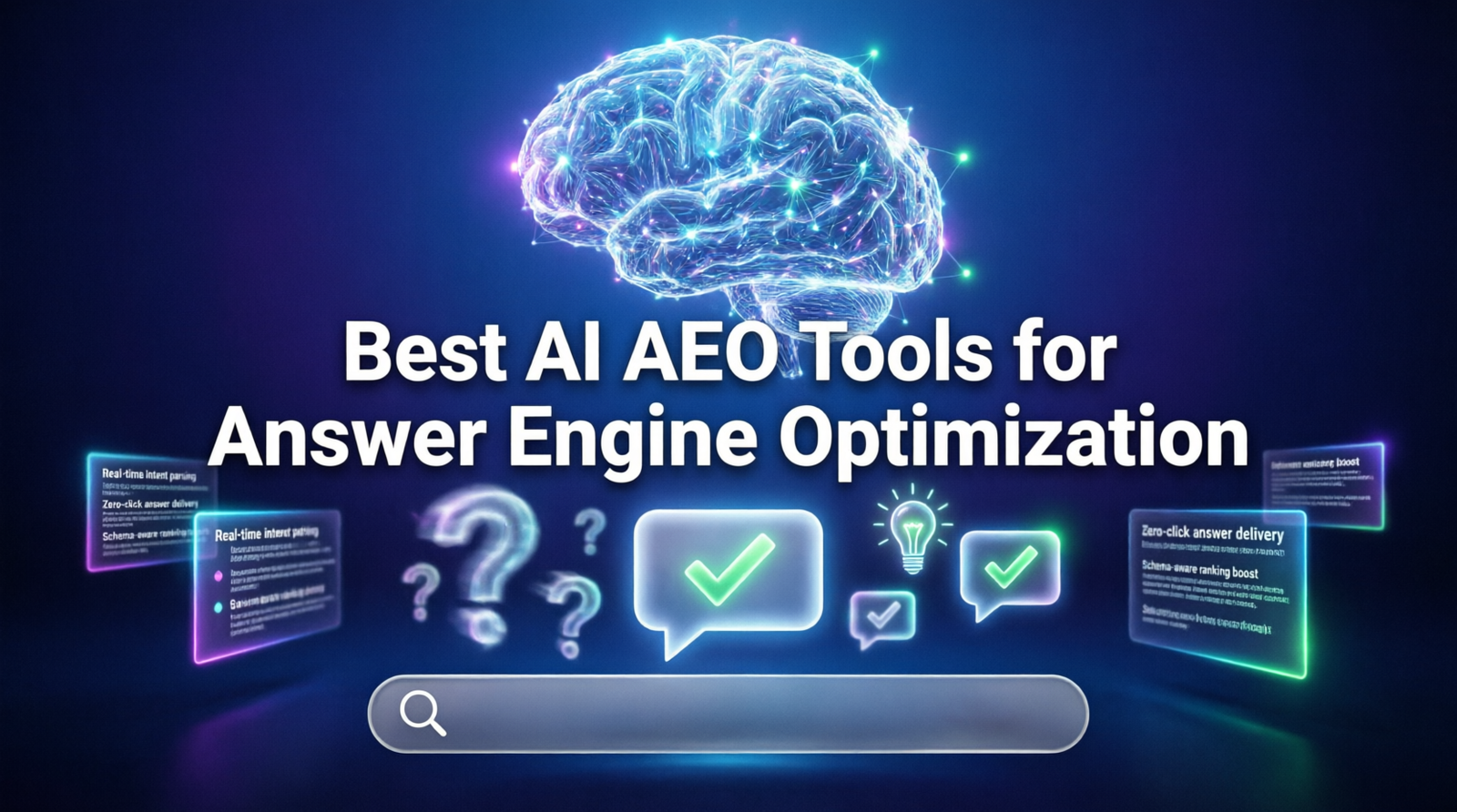
Best AI AEO Tools in 2026: 5 Answer Engine Optimization Platforms
Last updated: September 11, 2026
Search is changing from a world dominated by blue links to one where people increasingly ask AI systems to summarize information, compare options, and recommend products or brands.
Google AI Overviews, Google AI Mode, ChatGPT, Gemini, Perplexity, and other AI-powered search experiences can answer questions directly instead of simply presenting a list of webpages.
For marketers, this creates a new visibility problem:
What happens when people search for your products or services through an answer engine instead of a traditional search results page?
This is where Answer Engine Optimization (AEO) comes in.
AEO is a broad term for improving a website’s ability to be understood, surfaced, mentioned, or cited in answer-oriented search experiences. Different companies use related terms such as AEO, GEO, AI Search Optimization, and AI Visibility somewhat differently, so there is no single universal definition.
Google’s own guidance is important here: there is no special technical requirement that replaces traditional SEO for AI features. Google continues to emphasize useful, unique, reliable content and fundamental SEO practices.
In this guide, we compare five platforms that approach AEO from different angles:
- HubSpot AEO — best for accessible AI visibility monitoring
- Semrush AI Visibility Toolkit — best for SEO professionals
- Surfer — best for content teams combining SEO and AI visibility
- Ahrefs Brand Radar — best for large-scale AI visibility research
- AirOps — best for organizations connecting AI-search insights with content workflows
This is an editorial comparison, not a list of official ratings. We evaluated the products using publicly documented capabilities, current pricing information, intended audience, breadth of AI-search coverage, research depth, and practical usefulness.
Quick Comparison
| Tool | Best for | Main strength | Starting public price* |
|---|---|---|---|
| HubSpot AEO | Small businesses and marketing teams | Simple visibility tracking and recommendations | $50/month |
| Semrush AI Visibility Toolkit | SEO professionals and agencies | SEO + AI visibility in one ecosystem | $99/month/domain |
| Surfer | Content and SEO teams | Content optimization + AI visibility | $82/month for AI Search Analytics |
| Ahrefs Brand Radar | Advanced research | Large AI visibility database | $199/month per AI index |
| AirOps | Large content operations | AI-search insights + content workflows | Free starting tier |
*Prices and features can change. Prices shown here were checked against the vendors’ current public information when this article was updated.
1. HubSpot AEO — Best for Accessible AI Visibility Monitoring
If you want to start measuring how your brand appears in AI-generated answers without building a complicated enterprise workflow, HubSpot AEO is one of the easiest options to understand.
HubSpot’s standalone AEO product tracks brand visibility across ChatGPT, Perplexity, and Gemini. It also provides competitor comparison, citation analysis, prompt tracking, sentiment information, and recommendations for improving visibility.
Why HubSpot AEO stands out
The platform focuses on a straightforward question:
How visible is my brand in AI answers, and what should I do next?
Instead of giving marketers only a collection of AI responses, HubSpot organizes visibility data into a workflow that can be easier for marketing teams to interpret.
For example, you can investigate whether competitors appear more frequently for the prompts you care about, which sources AI systems cite, and where your brand has visibility gaps.
Key features
- AI visibility score
- Brand visibility monitoring
- Competitor comparison
- Citation analysis
- Prompt tracking
- Brand sentiment analysis
- AEO recommendations
- Coverage across ChatGPT, Perplexity, and Gemini
- Integration with HubSpot Marketing Hub Pro and Enterprise
Pricing
HubSpot currently offers a free trial for its standalone AEO product.
After the trial, the standalone product costs $50 per month, or $45 per month when paid annually, and includes 25 prompts across ChatGPT, Perplexity, and Gemini. Additional prompt options are available.
Advantages
- Relatively simple to understand
- Clear visibility reporting
- Competitor comparison
- Citation analysis
- Accessible starting price
- Does not require a HubSpot subscription
Limitations
- The standalone product currently covers fewer AI platforms than some specialized competitors.
- Teams needing extensive prompt coverage may need additional capacity.
- Some deeper capabilities are tied to HubSpot’s higher-level Marketing Hub products.
Best for
HubSpot AEO is a strong choice for:
- Small and medium-sized businesses
- SaaS companies
- Marketing teams
- Agencies
- Brands beginning their AEO strategy
Our take: HubSpot is particularly attractive when simplicity matters more than having the largest possible AI-search dataset.
2. Semrush AI Visibility Toolkit — Best for SEO Professionals
For marketers who already use Semrush for traditional SEO, the AI Visibility Toolkit provides a natural way to extend an existing search workflow into AI visibility.
The toolkit combines AI visibility reports with prompt tracking, competitor research, prompt research, and AI-readiness auditing. Its base offering tracks mentions across ChatGPT, Google AI, Gemini, and Perplexity.
Why Semrush stands out
AEO should not be treated as a replacement for SEO.
Google explicitly says that the fundamental SEO practices used for traditional Search remain relevant to AI features such as AI Overviews and AI Mode.
That makes an integrated platform useful for SEO professionals who don’t want separate systems for every part of their search strategy.
Semrush allows you to investigate both conventional search performance and AI visibility within the same broader marketing ecosystem.
Key features
- AI visibility reports
- Custom prompt tracking
- AI competitor analysis
- Prompt research
- AI-readiness site auditing
- Brand Performance analysis
- Daily, weekly, and monthly data updates
- Coverage across multiple AI search experiences
Pricing
The Semrush AI Visibility Toolkit currently starts at $99 per month per domain when billed annually.
The Base plan includes 25 custom prompts, AI visibility reports, competitor research, prompt research, Brand Performance analysis, and an AI-readiness site audit.
Advantages
- Strong fit for existing SEO workflows
- Combines traditional SEO and AI visibility
- Useful competitor research
- Prompt research capabilities
- Multiple AI-search surfaces
- Familiar ecosystem for experienced SEO teams
Limitations
- The platform can become expensive as requirements grow.
- The depth of its functionality may be unnecessary for a small website.
- Beginners may need more time to understand the broader Semrush ecosystem.
Best for
- SEO professionals
- SEO agencies
- Content strategists
- Large websites
- Businesses already using Semrush
Our take: Semrush makes the most sense when AEO is becoming another part of an established SEO operation rather than a standalone experiment.
3. Surfer — Best for Content Teams
Surfer takes a different approach from a pure AI visibility tracker.
Its strength is the connection between content optimization and AI-search visibility.
Surfer’s AI Tracker monitors how brands and topics appear across AI-generated answers and provides information about mentions, competitors, prompts, and cited sources. Its supported AI environments include ChatGPT, Perplexity, Google AI Overviews, Google AI Mode, and Gemini.
Why Surfer stands out
For a content team, discovering that a competitor is appearing in AI answers is only the beginning.
The more useful question is:
What can we improve on our own website?
Surfer connects AI visibility with content-related workflows such as content optimization, topical planning, content auditing, and internal linking.
That makes it particularly relevant for publishers and marketers who are responsible for both creating content and improving its performance.
Key features
- AI visibility tracking
- Prompt-level analysis
- Mention-gap analysis
- Brand sentiment
- Competitor visibility
- Source and citation analysis
- Content optimization
- Topical Maps
- Content Audit
- AI-search monitoring
Surfer says its AI Tracker checks prompts repeatedly and uses multiple queries to reduce the effect of individual response variations.
Pricing
Surfer’s standalone AI Search Analytics currently starts at $82 per month when billed annually for 50 AI prompts refreshed daily. It tracks ChatGPT, Perplexity, Google AI Mode, Google AI Overviews, and Gemini.
Surfer also offers AI visibility capabilities within its broader SEO plans. The current Standard plan starts at $99/month billed annually, while Pro is $182/month and Peace of Mind is $299/month. The included prompt limits and refresh frequency vary by plan.
Advantages
- Strong connection between SEO and AEO
- Useful for content teams
- Prompt-level visibility
- Competitor and source analysis
- Content optimization tools
- Supports several major AI search environments
Limitations
- The broader platform is more than a simple AEO monitor.
- Users interested only in basic monitoring may not need its full content toolkit.
- Higher prompt volumes require higher-priced plans.
Best for
- Content marketers
- SEO teams
- Publishers
- Agencies
- Websites publishing and updating content regularly
Our take: Surfer is particularly useful when the same team is responsible for both measuring AI visibility and improving the content that could earn future mentions or citations.
4. Ahrefs Brand Radar — Best for Large-Scale AI Visibility Research
Ahrefs Brand Radar is aimed at marketers who want a broader view of how brands appear across AI search rather than monitoring only a small set of manually selected questions.
One of its major differentiators is its AI Visibility Index, which Ahrefs says analyzes more than 459 million search-backed prompts across supported AI platforms. The platform also provides custom prompt tracking.
Why Brand Radar stands out
Large-scale research can answer questions that a small prompt-tracking project cannot.
For example, marketers can investigate:
- Which brands appear for a category?
- Which domains receive citations?
- Which competitors have greater AI visibility?
- Which pages are frequently referenced?
- How does visibility differ between AI platforms?
This makes Brand Radar especially interesting for established brands and SEO teams performing competitive research.
AI platforms and data
Ahrefs currently lists coverage including:
- Google AI Overviews
- Google AI Mode
- ChatGPT
- Perplexity
- Gemini
- Microsoft Copilot
Its AI Visibility Index is based on a large database of search-backed prompts, while custom prompts allow users to monitor their own specific questions.
Pricing
Ahrefs currently lists Brand Radar AI Visibility Index access starting at $199 per month for a single AI platform/index.
Access across all supported platforms is listed at $699 per month, while custom prompt tracking has separate tiers starting at $50/month.
Advantages
- Very large research dataset
- Strong competitive intelligence
- Citation research
- Multiple AI platforms
- Custom prompt tracking
- Useful for established SEO teams
Limitations
- More expensive than entry-level AEO tools
- The scale can be unnecessary for small websites
- Requires some SEO and data-analysis experience
Best for
- Enterprise SEO teams
- Agencies
- Established brands
- Competitive research
- Advanced AI-search analysis
Our take: Brand Radar is most compelling when you need market-level research rather than simply checking whether your own brand appeared in a handful of prompts.
5. AirOps — Best for Large-Scale Content Workflows
AirOps approaches AEO from an execution perspective.
Instead of treating AI visibility as an isolated dashboard, the platform connects AI-search insights with content production and workflow operations.
That can matter for organizations managing hundreds or thousands of pages.
Why AirOps stands out
A large content operation may discover hundreds of potential opportunities from AI-search data.
The difficult part is turning those opportunities into actual work:
- Which pages should be updated?
- Which topics deserve new content?
- Which workflows should be automated?
- How can content stay aligned with brand guidelines?
- How can a team produce and maintain content at scale?
AirOps is designed around this broader content-operation problem.
Its current plans include AI-search insights, content production tasks, brand kits, knowledge bases, integrations, and increasingly advanced AEO and workflow capabilities.
Key features
Depending on the plan, AirOps offers:
- AI-search insights
- Answer-engine visibility
- Content production workflows
- Content refresh workflows
- Brand kits
- Knowledge bases
- CMS integrations
- SEO integrations
- AEO integrations
- Multiple AI models
- Custom prompts and limits on enterprise plans
Pricing
AirOps currently offers a free starting tier for individuals.
Its Pro offering expands insights across seven or more answer engines and adds broader content-production and integration capabilities. Enterprise plans provide custom prompts, regions, languages, agent builds, and custom limits.
Advantages
- Designed for content operations
- Connects insights with execution
- Useful automation capabilities
- Brand and knowledge management
- Suitable for larger teams
Limitations
- More complex than a basic AEO tracker
- May be unnecessary for an individual blogger
- Advanced enterprise functionality requires a larger operation
Best for
- Enterprise content teams
- Large publishers
- SEO agencies
- Organizations producing content at scale
Our take: AirOps is less about giving you another visibility number and more about helping a content organization act on search and AI-search opportunities.
Which AI AEO Tool Should You Choose?
There is no universal winner because the five platforms solve somewhat different problems.
Choose HubSpot AEO if you want:
A relatively simple starting point for measuring brand visibility across major AI answer engines.
Choose Semrush if you want:
A strong connection between traditional SEO, competitor research, and AI visibility.
Choose Surfer if you want:
To connect AI-search monitoring with content optimization and publishing workflows.
Choose Ahrefs Brand Radar if you want:
Large-scale AI visibility and competitor research.
Choose AirOps if you want:
To connect AI-search intelligence with large-scale content production and automation.
What AEO Tools Actually Help You Measure
An AEO platform is useful only if the metrics lead to better decisions.
Depending on the product, you may encounter metrics such as:
Brand mentions
How frequently your company, product, or website appears in tracked AI answers.
Citations
Which websites or pages are referenced by AI-generated answers.
Visibility
A measurement of how often a brand appears within a defined collection of prompts.
Competitor share of voice
How your visibility compares with competing brands for similar questions.
Prompt performance
Which questions produce mentions, citations, or visibility gaps.
Sentiment or brand perception
How an AI system describes a brand when it appears in an answer.
These metrics should be treated as directional measurements, not as permanent rankings.
AI answers can change depending on the query, model, retrieval process, location, timing, and other factors. A visibility score is therefore most useful when you compare it over time using a consistent methodology.
How to Use an AI AEO Tool Effectively
Buying a platform does not automatically improve your visibility.
The useful part is what you do with the information it provides.
1. Start With Real Customer Questions
Don’t build your entire AEO strategy around short keywords.
Think about the questions your actual customers might ask.
Instead of tracking:
AI marketing tools
you could track:
What are the best AI marketing tools for a small business?
Or:
Which AI marketing platform is easiest for beginners?
These questions provide more context and can reveal how different brands are presented in conversational answers.
2. Build a Representative Prompt Set
Avoid tracking only five or ten random questions.
Create groups of prompts based on search intent, such as:
- Informational
- Commercial
- Comparison
- Product research
- Problem solving
- Alternatives
- Best-of queries
- Local or industry-specific questions
This gives you a more useful picture of your brand’s visibility.
3. Study the Sources AI Systems Reference
If competitors consistently appear and your website does not, don’t immediately assume you need more keywords.
Study the sources being referenced.
Look for patterns:
- Do the cited pages contain original research?
- Are they updated regularly?
- Do they answer the question directly?
- Do they provide specific examples?
- Are claims supported by evidence?
- Do they demonstrate genuine expertise?
- Are important facts easy to understand?
This is often more useful than simply watching a visibility score.
4. Improve the Underlying Content
AEO should lead to better content, not merely more AEO pages.
Improve pages by adding information that genuinely helps readers:
- Original research
- First-hand observations
- Clear explanations
- Comparisons
- Examples
- Expert commentary
- Relevant statistics
- Transparent methodology
- Updated information
- Useful tables where appropriate
Google’s guidance for generative AI search emphasizes valuable, unique, non-commodity content and specifically warns against simply recycling information that already exists online.
5. Keep Important Pages Current
AI-search systems can change their answers and sources over time.
For topics where accuracy matters, review important pages periodically.
When you update an article, make a meaningful improvement rather than changing the date simply to make the page appear fresh.
Useful updates might include:
- Correcting outdated information
- Updating prices
- Adding newly released features
- Replacing discontinued products
- Adding original examples
- Improving explanations
- Removing obsolete claims
6. Continue Doing Traditional SEO
AEO is not a replacement for SEO.
Google states that the same fundamental SEO practices remain relevant for AI features such as AI Overviews and AI Mode.
Your website still needs:
- Crawlable pages
- Useful content
- Clear site structure
- Good internal linking
- Strong technical foundations
- Mobile-friendly pages
- Good page experience
- Accurate information
- Clear authorship and transparency
AEO works best as an extension of a strong website rather than a shortcut around one.
What AI AEO Tools Cannot Do
This is one of the most important points to understand before paying for an AEO platform.
They cannot guarantee citations
No legitimate AEO platform can guarantee that ChatGPT, Gemini, Google, Perplexity, or another AI system will cite your website.
They cannot replace editorial judgment
A tool may identify a content gap, but it cannot automatically determine whether filling that gap will genuinely help your audience.
They cannot guarantee traffic
Being mentioned by an AI system does not necessarily result in a click.
They cannot make weak content authoritative
Improving visibility measurements does not compensate for inaccurate, generic, or unhelpful content.
They cannot predict every AI response
AI-generated answers are dynamic, and different prompts or systems can produce different results.
This is why AEO software should be treated as a measurement and research layer, not as a guaranteed ranking system.
AEO vs. GEO: What’s the Difference?
The terms AEO and GEO overlap considerably.
AEO (Answer Engine Optimization) generally emphasizes visibility in answer-oriented experiences.
GEO (Generative Engine Optimization) is often used more broadly for optimizing visibility within generative AI systems.
In practice, companies frequently use these terms differently.
There is no need to build completely separate strategies around the terminology.
The more useful goal is:
Create valuable content that search engines and AI systems can understand, while giving users a genuinely useful experience.
Google’s own guidance for generative AI search focuses on valuable content, technical accessibility, strong user experience, and fundamental SEO rather than requiring a separate secret optimization system.
Common AEO Mistakes
Mistake 1: Tracking Only Your Brand Name
People may ask AI systems questions about a problem or product category without mentioning your company.
Track relevant non-brand questions too.
Mistake 2: Chasing Mentions Instead of Improving Content
More mentions are not automatically better.
The goal is to become a useful and credible source.
Mistake 3: Publishing Large Numbers of Generic AI Articles
Creating hundreds of near-identical pages simply to target different prompts is not a sustainable AEO strategy.
Google specifically warns against producing large amounts of content primarily to manipulate search or generative AI visibility.
Mistake 4: Ignoring Competitors
Your visibility has more meaning when you understand the alternatives appearing for the same questions.
Mistake 5: Treating One AI Response as a Ranking
A single response is not a permanent ranking position.
Look for patterns over time.
Mistake 6: Forgetting the Human Reader
A page should be useful even if no AI system ever cites it.
That is one of the simplest tests for whether your AEO strategy is moving in the right direction.
Are AI AEO Tools Worth Paying For?
It depends on the size and goals of your website.
For a small website with limited traffic, paying hundreds of dollars every month for AI visibility monitoring may not be necessary.
You can start with a small, manually maintained set of important questions and periodically compare how different AI systems describe your brand.
Paid software becomes more useful when you need:
- Hundreds of tracked prompts
- Regular historical measurements
- Competitor monitoring
- Citation analysis
- Multiple AI platforms
- Reporting for clients
- Large-scale research
- Integration with content workflows
In other words, the value of an AEO platform generally increases with the size and complexity of the operation using it.
Frequently Asked Questions
What are AI AEO tools?
AI AEO tools are platforms designed to help businesses monitor and analyze how their brands, products, websites, or competitors appear in AI-generated answers and other answer-based search experiences.
Depending on the platform, they may track prompts, mentions, citations, competitors, visibility, sentiment, and sources.
What does AEO stand for?
AEO stands for Answer Engine Optimization.
It generally refers to improving the visibility and usefulness of content in systems that provide direct answers to users.
Is AEO the same as SEO?
No.
They overlap, but they are not identical.
SEO focuses on visibility in search engines and traditional search results, while AEO generally focuses more on answer-based experiences.
However, the underlying foundations overlap heavily. Google says its existing SEO best practices remain relevant to AI features in Search.
Is AEO the same as GEO?
Not necessarily.
The terminology is still evolving, and different companies use AEO, GEO, AI Search Optimization, and AI Visibility in slightly different ways.
The practical objective is similar: improve the likelihood that useful, trustworthy information about your business can be discovered and represented accurately in AI-powered search experiences.
Which AEO tool is best overall?
There is no objectively best platform for every business.
For marketers who want an accessible standalone solution, HubSpot AEO is a strong starting point.
For established SEO teams, Semrush or Ahrefs Brand Radar may provide more suitable research capabilities.
For content teams, Surfer is particularly interesting because it connects AI visibility with content optimization.
For large content operations, AirOps is designed around connecting insights with execution.
Which AEO tool is best for SEO professionals?
Semrush AI Visibility Toolkit and Ahrefs Brand Radar are strong options for experienced SEO professionals.
Semrush is particularly useful when AI visibility needs to fit into a broader SEO workflow, while Ahrefs is especially interesting for large-scale AI visibility and competitive research.
Which AEO tool is best for content teams?
Surfer is a strong choice because its AI visibility capabilities are connected to content optimization, topical planning, and content auditing.
Which AEO tool is best for large organizations?
There is no single answer.
AirOps is particularly relevant to organizations that need content production and AI-search insights to work together at scale.
Ahrefs and Semrush may be more appropriate when the primary requirement is research and competitive intelligence.
Can AEO tools guarantee AI citations?
No.
AI systems are dynamic, and no legitimate AEO platform can guarantee that a particular website will be mentioned or cited.
The best strategy is to create useful, accurate, distinctive content and use AEO tools to understand how your visibility changes over time.
Do I need an AEO tool to optimize for AI search?
No.
AEO software is optional.
Google’s guidance emphasizes valuable content, crawlability, good page experience, and fundamental SEO practices. A tool can make monitoring easier, but it is not a prerequisite for creating content that can perform well in AI-powered search experiences.
Our Final Verdict
The growth of AI-generated answers is changing how people discover information, products, and brands.
But AEO should not be viewed as a shortcut that allows websites to bypass good SEO or good content.
The strongest strategy is still built around the fundamentals:
Understand your audience → answer real questions → publish useful original information → maintain strong technical SEO → monitor how your brand appears → improve based on evidence.
Among the platforms reviewed here, our picks are:
- HubSpot AEO: best starting point for straightforward AI visibility monitoring
- Semrush AI Visibility Toolkit: best fit for SEO professionals
- Surfer: best for content teams combining optimization with AI visibility
- Ahrefs Brand Radar: best for large-scale AI visibility research
- AirOps: best for large content operations and workflow execution
The right choice depends less on which platform has the longest feature list and more on what you need to measure and what your team will actually do with the data.
For a small website, starting with a focused set of important customer questions may be enough.
For an agency or enterprise team, automated tracking, competitor research, historical data, and workflow integrations can justify a dedicated platform.
Most importantly, don’t optimize only for the machine.
Create something a human reader would consider genuinely useful even if no AI system ever cited it.
That principle aligns closely with Google’s current guidance for both traditional search and generative AI experiences: useful, original, people-first content remains the foundation.
Sources and Further Reading
For Google’s current guidance on creating useful content and appearing in AI-powered search experiences:
Google Search Central: Guide to Optimizing for Generative AI Features
Google Search Central: AI Features and Your Website
For AdSense quality requirements:
Google AdSense: Make Sure Your Site’s Pages Are Ready for AdSense
Official product information:
Related Articles
- Best AI GEO Tools in 2026
- Best AI SEO Tools in 2026
- Best AI Keyword Research Tools in 2026
- Best AI Content Optimization Tools in 2026
- Best AI Marketing Tools in 2026
2 Comments