Best AI SERP Analysis Tools in 2026: 5 Powerful Tools to Understand Google Results
Ranking in Google starts before you write the first paragraph.
A strong SEO strategy begins with understanding the search results for the keyword you want to target. What type of pages are ranking? What search intent do they satisfy? Which SERP features appear? How competitive are the current results? And are there gaps that your content could address better?
This is where SERP analysis tools can help.
Modern SEO platforms can analyze ranking pages, backlinks, organic traffic estimates, SERP features, competitors, content characteristics, and other signals. Some platforms have also expanded into AI-search visibility, helping marketers monitor how brands and pages appear in Google AI Overviews and other AI-generated search experiences.
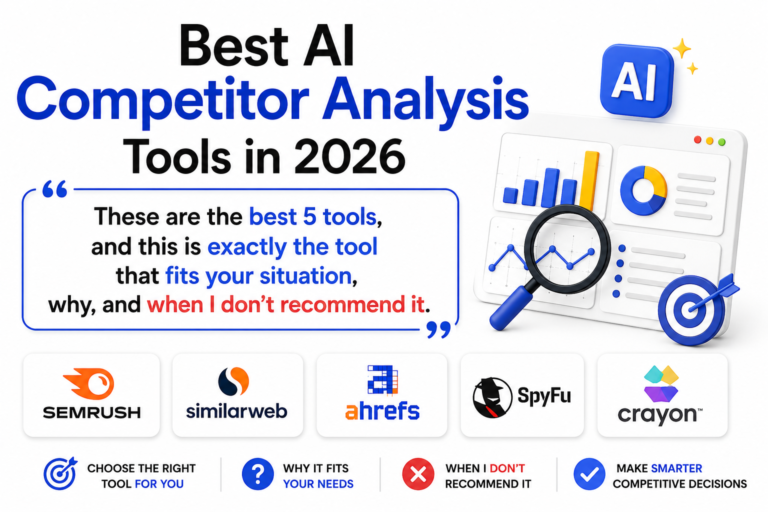
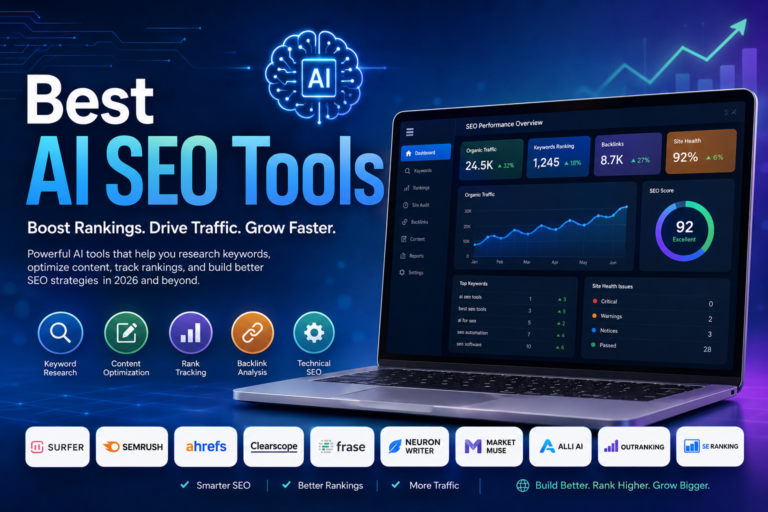
For this guide, we compared five established SEO platforms that offer meaningful SERP or competitor analysis capabilities:
- Semrush
- Ahrefs
- Surfer
- SE Ranking
- SpyFu
The goal is not to identify a tool that guarantees higher rankings. No SERP analysis platform can guarantee a Google ranking.
Instead, this comparison focuses on how useful each platform is for understanding search results, competitors, content opportunities, SERP features, and emerging AI-search visibility.
Quick Comparison
| Tool | Best For | SERP Analysis | Competitor Research | Content Analysis | AI/Search Visibility |
|---|---|---|---|---|---|
| Semrush | Overall SEO and SERP research | Excellent | Excellent | Strong | Excellent |
| Ahrefs | SEO and competitor data | Excellent | Excellent | Strong | Excellent |
| Surfer | Content-focused SERP analysis | Excellent | Strong | Excellent | Strong |
| SE Ranking | Value and broad SEO workflows | Strong | Strong | Strong | Excellent |
| SpyFu | SEO and PPC competitor intelligence | Strong | Excellent | Moderate | Moderate |
Our overall pick: Semrush
Best for deep SEO data: Ahrefs
Best for content-focused analysis: Surfer
Best value: SE Ranking
Best for SEO and PPC competitor intelligence: SpyFu
What Is SERP Analysis?
SERP stands for Search Engine Results Page.
SERP analysis is the process of examining the pages and search features that appear for a particular query.
For example, if you want to create an article targeting the keyword “best AI email marketing tools,” you should first examine the current Google results.
You may discover that the SERP contains:
- Product or software pages
- Comparison articles
- Review articles
- List posts
- Featured snippets
- People Also Ask questions
- Videos
- Images
- AI Overviews
- Other search features
The purpose is not to copy the pages that already rank.
Instead, SERP analysis helps you understand what users are looking for and what types of results Google is currently presenting for that query.
Ahrefs, for example, includes features such as Featured Snippets, AI Overviews, and Local Packs among the SERP features it can track.
Why SERP Analysis Matters Before You Write
One of the biggest SEO mistakes is writing an article first and researching the search results afterward.
The SERP can tell you whether your planned content matches the query.
Suppose you search for:
“best project management software”
and most of the first-page results are software comparison pages.
If you publish a general definition of project management software, your article may not satisfy the dominant intent.
SERP analysis can help answer questions such as:
- What does the searcher appear to want?
- What type of content is ranking?
- Which competitors dominate the results?
- Are there SERP features taking attention away from traditional listings?
- What topics do competing pages cover?
- Are there important questions they fail to answer?
- Is the keyword realistic for your website?
This makes SERP analysis a research process rather than a simple ranking check.
The 5 Best AI SERP Analysis Tools in 2026
1. Semrush — Best Overall
Best for: SEO professionals, marketers, agencies, businesses, and publishers
Our assessment: Excellent overall SERP and competitive research platform
Semrush is our top overall choice because it combines SERP research with a much broader SEO ecosystem.
Its SERP Checker can show Google’s top results for a keyword and location while also identifying SERP features such as AI Overviews, Featured Snippets, and People Also Ask. Semrush also provides SEO metrics that help users investigate the competitive environment around a keyword.
Why We Recommend Semrush
The biggest advantage of Semrush is the connection between SERP analysis and other SEO workflows.
Instead of only asking who ranks, you can investigate areas such as:
- Keyword search volume
- Keyword difficulty
- Search intent
- Ranking pages
- SERP features
- Competitor domains
- Backlinks
- Organic keywords
- Estimated traffic
- AI visibility
Semrush has also expanded its AI visibility capabilities to monitor brand and content visibility across platforms including ChatGPT, Perplexity, Gemini, and Google AI Overviews.
Key Features
- SERP Checker
- Keyword research
- SERP feature analysis
- Competitor research
- Backlink analysis
- Organic keyword analysis
- Rank tracking
- AI visibility tracking
- Google AI Overview visibility
- Search-intent analysis
Pros
- Broad SEO ecosystem
- Strong SERP research
- Extensive competitor data
- Useful keyword research
- Strong AI visibility capabilities
- Suitable for professional SEO workflows
Cons
- Can be expensive for beginners
- Large number of features may feel overwhelming
- Advanced functionality depends on the subscription plan
Best For
Semrush is a strong choice if you want one platform that connects SERP analysis with keyword research, competitor research, rank tracking, backlinks, and AI visibility.
2. Ahrefs — Best for Deep SEO and Competitor Data
Best for: SEO professionals, content marketers, agencies, and competitive research
Our assessment: Excellent for detailed SERP and competitor analysis
Ahrefs is particularly strong when you want to investigate the pages competing for a keyword and the SEO signals surrounding those pages.
Its SERP Overview can display information about ranking pages and lets users explore historical SERPs and additional results. Ahrefs also provides access to the top 100 results for a SERP in its SERP Overview.
Why We Recommend Ahrefs
Ahrefs is useful when your research requires more than simply looking at page titles.
Depending on the report and plan, you can investigate information such as:
- Ranking URLs
- Domain Rating
- URL Rating
- Backlinks
- Referring domains
- Organic traffic estimates
- Ranking keywords
- Historical SERPs
- SERP features
This makes Ahrefs particularly useful for competitive SEO research.
AI Search Visibility
AI search has become another important part of SEO research.
Ahrefs now provides tools for monitoring visibility in Google AI Overviews and other AI-generated search environments. Its AI Overviews Tracker can show where a brand appears, which pages are cited, and which competing sources appear in AI-generated results.
However, AI visibility should be treated as a separate research layer rather than a replacement for traditional SERP analysis.
Key Features
- SERP Overview
- Historical SERPs
- Top 100 results
- Backlink analysis
- Organic keyword analysis
- Competitor research
- SERP feature tracking
- AI Overview tracking
- AI visibility research
Pros
- Excellent SEO database
- Strong backlink data
- Detailed competitor research
- Historical SERP analysis
- Strong international SEO capabilities
- Increasingly useful AI visibility features
Cons
- Can be expensive for beginners
- Large amounts of data can be difficult to interpret
- Some advanced capabilities require higher-tier plans
Best For
Choose Ahrefs if your priority is understanding the SEO strength, backlinks, ranking keywords, and competitive environment surrounding the pages that appear in Google.
3. Surfer — Best for Content-Focused SERP Analysis
Best for: Bloggers, content teams, publishers, and SEO writers
Our assessment: Excellent for analyzing ranking-page characteristics and improving content
Surfer takes a more content-focused approach to SERP analysis.
Its SERP Analyzer allows users to compare ranking pages and examine trends across hundreds of factors. Surfer’s documentation states that its system provides more than 500 ranking factors across categories including NLP, structure, quality, and media.
Why We Recommend Surfer
Surfer is particularly useful when your main question is:
“How does my content compare with the pages currently ranking?”
The platform can help you investigate:
- Content structure
- Keywords and phrases
- Headings
- Page elements
- Images
- Links
- Content length
- On-page characteristics
- Other measurable page attributes
You can also add a custom URL for comparison, even when that URL is not currently ranking for the analyzed SERP.
An Important Limitation
One important distinction is that correlation is not causation.
If a SERP analysis tool finds that highly ranking pages commonly contain a particular number of words, headings, or terms, that does not mean Google requires that exact number.
These metrics are best used to identify patterns and questions for further investigation—not as a checklist for mechanically creating content.
Key Features
- SERP Analyzer
- Competitor comparison
- Content analysis
- Keyword and phrase analysis
- Structure analysis
- NLP-related analysis
- Page comparison
- Content optimization workflows
Pros
- Excellent for content teams
- Strong SERP comparison
- Easy-to-understand visual analysis
- Useful for content optimization
- Helps identify patterns among ranking pages
Cons
- Less broad than all-in-one SEO platforms for some workflows
- Some metrics can be misunderstood as direct Google ranking factors
- Advanced functionality may require paid plans
Best For
Surfer is a strong choice if your main objective is improving content based on what is currently visible in the SERP.
4. SE Ranking — Best Value for Broad SEO and AI Search Tracking
Best for: Small businesses, bloggers, freelancers, and growing agencies
Our assessment: Strong combination of SEO, SERP, competitor, and AI-search features
SE Ranking offers a broad collection of SEO tools while also developing dedicated AI-search visibility capabilities.
Its SERP Analyzer can be used to compare ranking pages and investigate different characteristics of competing results.
Why We Recommend SE Ranking
SE Ranking becomes particularly interesting for users who want to monitor both traditional search and emerging AI-generated results.
Its AI Results Tracker currently covers:
- Google AI Overviews
- Google AI Mode
- Gemini
- ChatGPT
- Perplexity
It can also show competitors and sources appearing in AI-generated answers.
This makes SE Ranking useful for marketers who want to monitor how their website is represented beyond conventional blue-link rankings.
Key Features
- SERP Analyzer
- SERP competitor research
- On-page analysis
- SEO recommendations
- Rank tracking
- Competitor analysis
- AI Results Tracker
- Google AI Overview tracking
- Google AI Mode tracking
- Gemini visibility
- ChatGPT visibility
- Perplexity visibility
Pros
- Broad SEO toolkit
- Strong value proposition
- Traditional and AI search tracking
- Useful competitor research
- Suitable for growing websites
Cons
- Some advanced features depend on the subscription plan
- Its data ecosystem is not as extensive as the largest SEO platforms
- Traditional SERP analysis and AI visibility are separate workflows
Best For
SE Ranking is a good option for users who want a broad SEO platform without limiting their research to traditional Google rankings.
5. SpyFu — Best for SEO and PPC Competitor Intelligence
Best for: Competitive SEO, PPC research, affiliate marketers, and agencies
Our assessment: Strong competitor-focused SERP research
SpyFu is particularly useful when SEO research overlaps with paid search.
Its SERP Analysis provides information about ranking URLs, ranking changes, domain strength, estimated clicks, SERP diversity, and advertisements associated with the keyword.
Why We Recommend SpyFu
SpyFu is useful when you want to answer a question such as:
“Who is competing for this keyword, and what are they doing in both organic and paid search?”
Its research can help you examine:
- Ranking pages
- Ranking changes
- Competitor domains
- Domain strength
- Estimated clicks
- Keyword difficulty
- SERP diversity
- Paid advertisements
- Competitor keywords
- PPC competition
SpyFu also explains that its keyword-ranking data is updated on a rolling schedule, with most keywords cycled through approximately monthly.
Key Features
- SERP Analysis
- Competitor research
- Ranking history
- Keyword research
- SEO competitor analysis
- PPC competitor research
- Estimated clicks
- SERP diversity
- Paid-search analysis
Pros
- Strong competitive intelligence
- Combines SEO and PPC research
- Useful ranking history
- Good competitor discovery
- Helpful for commercial keywords
Cons
- More specialized than some all-in-one SEO platforms
- May not be the best choice for content-focused optimization
- Some advanced functionality requires paid plans
Best For
SpyFu is particularly useful for marketers who want to understand competitors across both organic and paid search.
How to Choose the Best SERP Analysis Tool
There is no single platform that is best for every SEO workflow.
Your choice should depend on what you actually need to analyze.
Choose Semrush if you want:
- Broad SEO research
- SERP analysis
- Keyword research
- Competitor analysis
- Backlink research
- Rank tracking
- AI visibility
Best overall choice: Semrush
Choose Ahrefs if you want:
- Deep backlink research
- Ranking-page analysis
- Competitor SEO research
- Historical SERPs
- Organic keyword analysis
- AI Overview visibility
Best for deep SEO data: Ahrefs
Choose Surfer if you want:
- Content-focused SERP analysis
- Competitor content comparison
- On-page analysis
- Content optimization
Best for content: Surfer
Choose SE Ranking if you want:
- A broad SEO platform
- SERP analysis
- Competitor research
- Rank tracking
- AI search visibility
Best value-oriented option: SE Ranking
Choose SpyFu if you want:
- Competitor intelligence
- SEO and PPC research
- Ranking history
- Paid-search analysis
Best for SEO + PPC competitor research: SpyFu
What Should You Look for During SERP Analysis?
Buying a SERP analysis tool is only useful if you know what to do with the data.
Here are the most important questions to ask.
1. What Is the Search Intent?
Start with intent.
Is the searcher looking for:
- Information?
- A tutorial?
- A product?
- A comparison?
- A review?
- A specific website?
- A local business?
The dominant results can provide useful clues.
For example, if most results are product pages, an informational article may not be the best format for that query.
2. What Content Format Is Ranking?
Look at the structure of the current results.
Are they mainly:
- Listicles?
- Tutorials?
- Reviews?
- Comparison pages?
- Product pages?
- Videos?
- Tools?
- Statistics?
- Detailed guides?
This does not mean you should copy the format blindly.
Instead, use it to understand what kind of result appears to satisfy the query.
3. How Competitive Are the Current Results?
Look at the websites and pages competing for the keyword.
Depending on the tool, useful metrics may include:
- Backlinks
- Referring domains
- Organic traffic estimates
- Ranking keywords
- Domain-level metrics
- Page-level metrics
- Historical rankings
Remember that third-party SEO metrics are estimates. They are useful for comparison, but they are not official Google ranking scores.
4. Which SERP Features Appear?
Traditional blue links are only part of modern search.
Depending on the query, you may encounter:
- AI Overviews
- Featured Snippets
- People Also Ask
- Images
- Videos
- Local results
- Shopping results
- News
- Sitelinks
Ahrefs, for example, tracks AI Overviews and other SERP features as part of its SERP data.
Understanding these features can help you estimate how much visibility traditional organic listings may receive.
5. Is the Keyword Actually Worth Targeting?
Search volume alone should not determine your decision.
A keyword with a large search volume may have:
- Extremely strong competitors
- High commercial competition
- Several SERP features
- AI-generated results
- Low organic click potential
- Search intent that does not match your website
A smaller keyword may sometimes offer a more realistic opportunity.
The goal is not simply to find keywords with the largest numbers.
The goal is to find keywords where your website can create genuinely useful content for the searcher.
How to Perform SERP Analysis Step by Step
You do not need to spend hours analyzing every possible metric.
A practical workflow can look like this.
Step 1: Search the keyword
Open the SERP for your target keyword using the country and location that matter to your audience.
Step 2: Identify the search intent
Look at the dominant types of results.
Step 3: Analyze several competitors
Do not study only the first result.
Look at multiple pages to identify recurring patterns and meaningful differences.
Step 4: Check SERP features
Record whether the query contains AI Overviews, Featured Snippets, People Also Ask, videos, images, local results, or other features.
Step 5: Study the content
Look at:
- Topics covered
- Questions answered
- Headings
- Examples
- Original data
- Images
- Tables
- Explanations
- Missing information
Step 6: Look for gaps
Ask:
What would make my page more useful than the existing results?
That is a much better question than:
How can I make my article look like the top result?
Step 7: Create something genuinely useful
Use the research to inform your content—but add your own explanations, examples, experience, data, comparisons, or other useful information.
Common SERP Analysis Mistakes
Only Studying the #1 Result
The first result is not necessarily the best model for your page.
Analyze several results to identify patterns.
Treating SEO Metrics as Google Ranking Factors
Third-party tools provide estimates and correlations.
They do not give you Google’s actual ranking formula.
Use metrics as evidence for research, not as guaranteed instructions.
Copying Competitors
SERP analysis should help you understand the competitive landscape.
It should not become a process of rewriting another website’s article.
Your goal should be to create something independently useful.
Focusing Only on Word Count
There is no universal word count that guarantees a Google ranking.
A shorter page can be better than a longer page when it answers the user’s question more effectively.
Ignoring Search Intent
Even excellent writing can perform poorly if it does not satisfy the reason behind the search.
Always identify intent before deciding what to publish.
Treating AI Search as Traditional SEO
AI Overviews and other AI-generated experiences introduce additional visibility considerations.
For example, Ahrefs notes that AI Overviews can change frequently, meaning a single observation may not represent what users will see later.
AI visibility should therefore be monitored over time rather than treated as a permanent ranking position.
Benefits of AI SERP Analysis Tools
Used correctly, these tools can help you:
- Save time researching search results
- Understand search intent
- Compare competing pages
- Identify SERP features
- Research competitors
- Discover content gaps
- Investigate backlinks
- Analyze ranking changes
- Compare pages at scale
- Monitor emerging AI-search visibility
The biggest benefit is not automation by itself.
It is the ability to turn large amounts of search data into better research decisions.
Limitations of AI SERP Analysis Tools
These platforms are powerful, but they are not perfect.
They use estimates
Traffic, keyword difficulty, and other third-party metrics may differ between platforms.
They cannot guarantee rankings
No tool can guarantee that a page will rank in a particular position.
Correlation is not causation
A common characteristic among ranking pages does not necessarily mean Google uses that characteristic as a direct ranking factor.
AI-generated recommendations require judgment
AI can help interpret data, but human review remains important.
SERPs change
Search results can change because of algorithm updates, competition, location, personalization, seasonality, and changes in search features.
This is why SERP research should be treated as an ongoing process rather than a one-time checklist.
Frequently Asked Questions
What are AI SERP analysis tools?
AI SERP analysis tools are SEO platforms that help analyze search engine results pages and, increasingly, AI-generated search experiences.
Depending on the platform, they can provide information about ranking pages, competitors, SERP features, backlinks, content characteristics, search intent, and AI visibility.
Which AI SERP analysis tool is best?
For an overall SEO workflow, Semrush is our top choice because it combines SERP research with keyword research, competitor analysis, rank tracking, backlinks, and AI visibility features.
However, the best option depends on your workflow.
Ahrefs is particularly strong for deep SEO and competitor data, Surfer focuses heavily on content analysis, SE Ranking offers broad SEO and AI-search tracking, and SpyFu is especially useful for SEO and PPC competitor intelligence.
Which tool is best for content optimization?
Surfer is our preferred option for content-focused SERP analysis.
Its SERP Analyzer lets users compare pages and investigate hundreds of measurable characteristics across ranking results.
However, these measurements should be treated as analytical signals rather than guaranteed Google ranking requirements.
Which tool is best for competitor research?
Ahrefs, Semrush, and SpyFu are all strong choices, but their strengths differ.
Ahrefs is particularly strong for backlinks and organic SEO research.
Semrush provides a broad competitive SEO ecosystem.
SpyFu is especially useful when you want to combine organic and paid-search competitor research.
Can SERP analysis help me rank higher?
Yes, indirectly.
SERP analysis can help you understand search intent, competing pages, SERP features, and content opportunities.
But the tool itself does not improve rankings.
The value comes from using the research to create a page that is genuinely useful, relevant, accessible, and appropriate for the searcher’s needs.
Should I analyze the SERP before writing an article?
Yes.
Analyzing the SERP before writing can help you determine:
- Search intent
- Content format
- Competition
- SERP features
- Important subtopics
- Questions users may have
- Potential content gaps
It can also prevent you from spending time creating content that does not match the query.
Final Verdict
The best AI SERP analysis tool depends on what you need to understand.
Semrush is our best overall choice because it combines SERP research with a broad SEO and competitive-analysis ecosystem.
Ahrefs is an excellent option when your research depends heavily on backlinks, ranking pages, organic keywords, and competitor SEO data.
Surfer is particularly useful for publishers and content teams that want to compare their content with ranking pages.
SE Ranking stands out for combining broad SEO functionality with dedicated AI-search visibility tracking across platforms such as Google AI Overviews, Google AI Mode, Gemini, ChatGPT, and Perplexity.
SpyFu is a strong choice when competitor research includes both organic search and PPC.
But the most important point is the same regardless of which platform you choose:
Do not use SERP analysis to copy the pages already ranking.
Use it to understand the searcher’s intent, study the competitive environment, identify unanswered questions, and discover ways to create something more useful.
That is the real purpose of SERP analysis.
Related Articles
- Best AI SEO Audit Tools in 2026
- Best AI Rank Tracking Tools in 2026
- Best AI Backlink Tools in 2026
- Best AI GEO Tools in 2026
- Best AI AEO Tools in 2026
- Best AI Keyword Research Tools in 2026