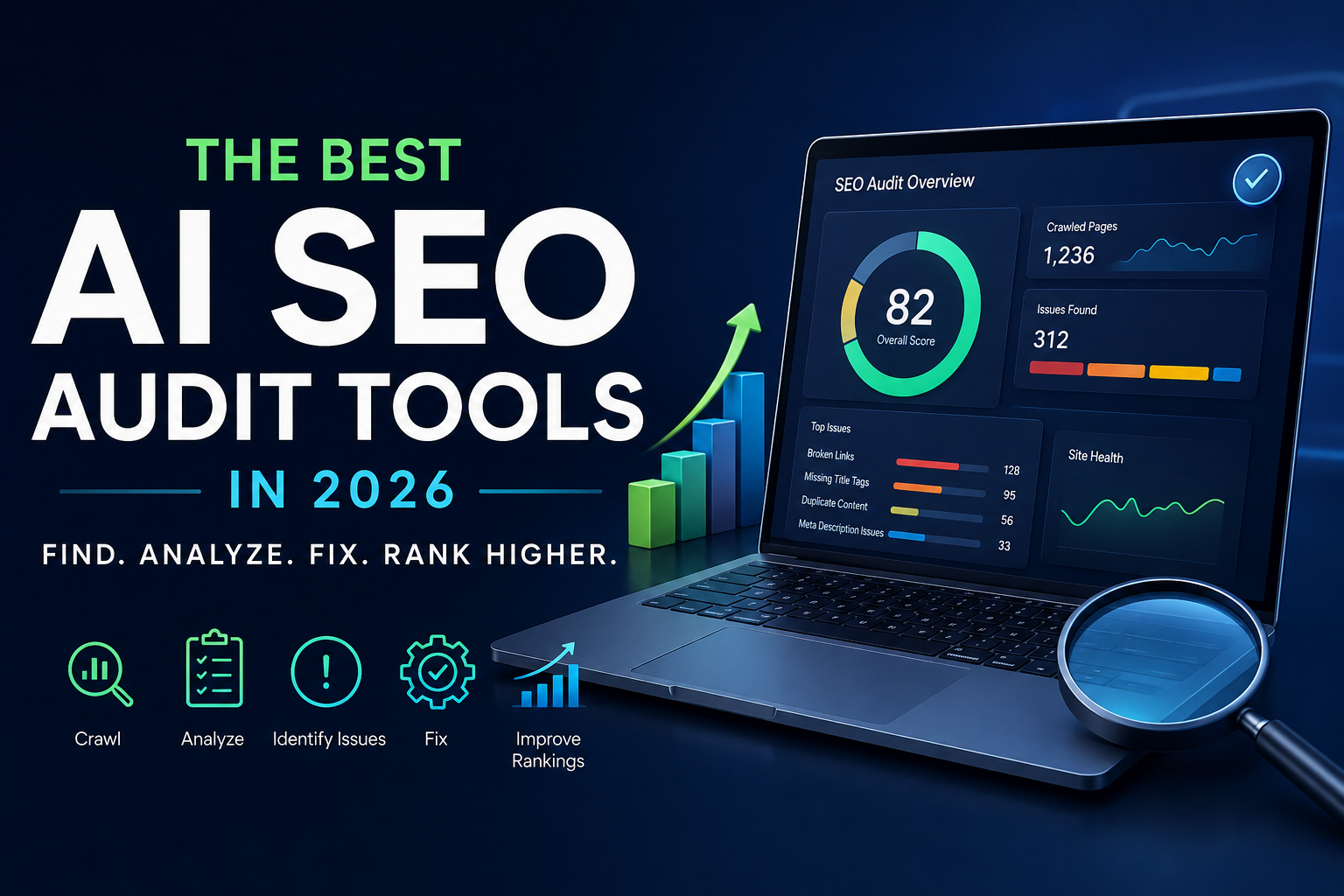
Best AI SEO Audit Tools in 2026: 5 Powerful Tools to Find and Fix SEO Problems
September 11, 2026
A website can have excellent content and still struggle in search because of technical SEO problems.
Broken internal links, incorrect canonical tags, indexability issues, redirect chains, duplicate pages, JavaScript rendering problems, weak internal linking, and other technical issues can make a website harder to crawl, understand, and maintain.
That is where SEO audit tools become useful.
In 2026, many SEO platforms are also adding AI-assisted features. These can help explain technical findings, prioritize issues, analyze AI-search accessibility, and connect technical auditing with broader SEO workflows.
However, there is an important distinction:
Not every SEO audit tool is an AI-first product.
Some platforms are comprehensive SEO suites with AI-assisted features. Others are highly specialized crawlers whose main purpose is technical analysis.
This guide compares five strong options based on:
- Technical SEO auditing
- Website crawling
- Indexability analysis
- On-page SEO
- Internal-link analysis
- JavaScript and rendering capabilities
- AI-assisted functionality
- Reporting and prioritization
- Ease of use
- Suitability for different types of websites
The goal is not to find the tool with the highest audit score.
The goal is to help you choose the tool that can find the problems that matter and help you decide what to fix first.
Quick Comparison
| Tool | Best for | Technical auditing | AI-related features | Crawling | Ease of use |
|---|---|---|---|---|---|
| Semrush | All-around SEO auditing | Excellent | Strong | Excellent | Excellent |
| Ahrefs | SEO auditing + research | Excellent | Strong across the platform | Excellent | Very good |
| Screaming Frog | Deep technical crawling | Excellent | Supporting feature | Excellent | Moderate |
| SE Ranking | Broad SEO functionality | Very good | Strong | Very good | Very good |
| Sitebulb | Visual technical audits | Excellent | Not AI-first | Excellent | Very good |
These are not official scores from the companies. They are editorial judgments based on each platform’s documented capabilities and intended use.
What Is an AI SEO Audit Tool?
An AI SEO audit tool is generally an SEO platform that uses artificial intelligence, automation, or both to help identify, interpret, prioritize, or act on website optimization problems.
The term can be confusing because the products in this category are not identical.
A traditional technical crawler may focus on:
- HTTP status codes
- Redirects
- Canonicals
- Robots.txt
- XML sitemaps
- Metadata
- Internal links
- JavaScript
- Structured data
An AI-enhanced SEO platform may combine those capabilities with:
- AI-assisted recommendations
- AI-search visibility checks
- AI crawler accessibility checks
- Content analysis
- Automated explanations
- Search-intent analysis
- Broader SEO research
Therefore, “AI SEO audit tool” should not automatically mean “an AI that fixes your SEO.”
In most cases, AI is an additional layer on top of established crawling and SEO analysis.
How We Evaluated These SEO Audit Tools
A good audit tool should do more than produce a number such as “85/100.”
We evaluated these platforms according to several practical areas.
Technical SEO
Can the tool identify problems involving crawling, indexability, redirects, canonical tags, metadata, structured data, HTTPS, and other technical elements?
Crawling
How deeply and flexibly can it crawl a website?
This becomes particularly important for large websites, JavaScript-heavy websites, and sites with complicated architectures.
On-Page Analysis
Can it identify issues with titles, headings, content, images, internal links, and other page-level elements?
AI-Assisted Features
Does AI provide useful functionality beyond simply adding an “AI” label?
For example, does it help with recommendations, interpretation, AI-search accessibility, or workflow automation?
Reporting
Can you turn the crawl into an actionable list of problems rather than a huge spreadsheet of warnings?
Practical Value
Finally, we considered who each tool is actually suited to.
A freelance SEO consultant, a 20-page business website, and a million-page enterprise website do not necessarily need the same crawler.
1. Semrush — Best Overall SEO Audit Platform
Semrush is our overall pick for users who want technical SEO auditing connected to a much broader SEO ecosystem.
Its Site Audit currently performs more than 140 technical and on-page checks, covering areas such as crawlability, HTTPS, mobile SEO, Core Web Vitals, structured data, internal links, international SEO, and more. Issues are prioritized so users can focus on higher-impact problems first.
Semrush has also introduced a dedicated AI Search category in Site Audit. It checks technical factors related to access by AI crawlers and AI-powered search systems. Semrush currently documents checks involving crawlers such as ChatGPT, Google, Perplexity, and Claude.
Why Semrush stands out
The main advantage is context.
A technical audit is rarely the entire SEO problem.
After finding an issue, you may also want to understand:
- Which pages are affected?
- Which keywords do those pages target?
- How much organic visibility do they have?
- Do competitors have the same issue?
- Are backlinks pointing to affected pages?
- Is the problem site-wide or limited to a template?
Semrush’s broader SEO ecosystem makes that type of investigation easier.
Key features
- Technical SEO auditing
- 140+ technical and on-page checks
- Crawlability analysis
- Indexability analysis
- Broken-link detection
- HTTPS checks
- Internal-link analysis
- Mobile SEO checks
- Core Web Vitals checks
- Structured-data checks
- International SEO checks
- Site Health Score
- Issue prioritization
- AI Search health checks
- Competitor research
- Position tracking
- Backlink analysis
- Automated reporting
AI Search auditing
One of the more useful developments in Semrush is its AI Search health functionality.
Instead of treating AI visibility as completely separate from technical SEO, Semrush checks whether certain AI crawlers can access website content and flags technical barriers that may interfere with AI-search visibility.
This does not mean passing an AI audit guarantees citations in ChatGPT or another AI search system.
It simply gives you another technical layer to investigate.
Pros
- Strong all-in-one SEO ecosystem
- Excellent technical auditing
- Clear issue prioritization
- Strong competitor research
- AI-search auditing capabilities
- Useful reporting
- Suitable for beginners and professionals
Cons
- Can become expensive
- Large feature set can be overwhelming
- Some advanced functionality depends on the subscription plan
Best for
- SEO agencies
- Businesses
- Content websites
- E-commerce stores
- Affiliate websites
- Professional SEO teams
Bottom line
Semrush is the best choice here if you want one platform to connect technical SEO auditing with the rest of your SEO strategy.
2. Ahrefs — Best for SEO Auditing Plus Deep SEO Research
Ahrefs is another excellent option for website auditing, particularly if you want technical SEO analysis connected to backlink, keyword, competitor, and content research.
Its Site Audit currently checks more than 170 predefined technical and on-page SEO issues. Ahrefs categorizes findings by importance and provides explanations for individual issues and affected URLs.
Why Ahrefs stands out
The major advantage is the connection between auditing and SEO research.
Imagine an important article suddenly loses organic traffic.
A technical audit might reveal:
- A noindex directive
- A canonical problem
- Broken internal links
- A redirect
- A server response issue
- Missing structured data
But you may also want to know:
- Which keywords the page previously ranked for
- Which competitors now outrank it
- Which websites link to it
- Whether the page has lost internal links
- Whether another page is competing for the same topic
Ahrefs makes it possible to investigate many of these questions within the same broader SEO ecosystem.
Key features
- Technical SEO auditing
- 170+ predefined SEO issues
- Crawlability analysis
- Indexability checks
- Broken-link detection
- Redirect analysis
- Canonical checks
- Metadata analysis
- Internal-link analysis
- Image SEO checks
- JavaScript-related checks
- Structured-data checks
- XML sitemap analysis
- Robots.txt analysis
- Health Score
- Scheduled audits
- Backlink research
- Keyword research
- Competitor analysis
Ahrefs also offers Ahrefs Free for verified websites, including access to Site Audit with its 170+ technical and on-page checks. Larger websites may require a paid plan depending on crawl requirements.
Important limitation
Ahrefs should not be described simply as an “AI SEO auditor.”
Its core strength remains SEO data and analysis. AI-related capabilities exist across the broader platform, but the Site Audit itself is fundamentally a technical and on-page auditing system.
That distinction makes the description more accurate.
Pros
- Excellent SEO ecosystem
- Strong technical auditing
- Deep backlink integration
- Powerful competitor research
- Detailed issue explanations
- Free options for verified sites
- Strong monitoring capabilities
Cons
- Can be expensive for advanced users
- More suitable for people familiar with SEO
- Some capabilities depend on plan limits
Best for
- SEO professionals
- Affiliate marketers
- Content publishers
- Agencies
- E-commerce websites
- Businesses with active SEO campaigns
Bottom line
Choose Ahrefs when you want technical auditing connected to serious backlink, keyword, and competitor research.
3. Screaming Frog SEO Spider — Best for Deep Technical Crawling
Screaming Frog SEO Spider is different from the previous two platforms.
It is primarily a technical SEO crawler, not an all-in-one marketing platform.
That specialization is its biggest strength.
The current SEO Spider identifies 300+ SEO issues, warnings, and opportunities, covering areas such as status codes, metadata, redirects, canonicals, links, JavaScript, structured data, and other technical elements.
Why Screaming Frog stands out
If you want detailed control over a crawl, Screaming Frog is difficult to ignore.
You can investigate:
- HTTP status codes
- Redirect chains
- Page titles
- Meta descriptions
- H1 and H2 headings
- Canonicals
- Robots directives
- XML sitemaps
- Internal links
- External links
- Images
- JavaScript
- Structured data
- Custom extraction
It also integrates with services such as Google Analytics, Google Search Console, and PageSpeed Insights.
AI capabilities
Screaming Frog has added AI-related capabilities, including the ability to crawl using OpenAI and Gemini.
However, this should not be confused with the software being an AI-first SEO audit platform.
Its core purpose remains technical crawling and analysis.
That distinction is important for this article because otherwise the term “AI SEO audit tool” becomes misleading.
Key features
- 300+ SEO issues, warnings, and opportunities
- Technical crawling
- JavaScript rendering
- Redirect analysis
- Metadata analysis
- Canonical analysis
- Robots.txt analysis
- XML sitemap analysis
- Internal-link analysis
- Structured-data analysis
- Custom extraction
- Google Analytics integration
- Google Search Console integration
- PageSpeed Insights integration
- AI-related crawling capabilities
Screaming Frog also explicitly notes that its issue categories are recommendations rather than universal rules. Context still matters when deciding what to fix.
That is an important principle for anyone using an SEO crawler.
Pricing
Screaming Frog offers a free version with a 500-URL crawl limit.
The current paid SEO Spider license is $279 per year in the USD pricing displayed by the company. The paid license removes the standard 500-URL crawl limit, although practical crawl capacity depends on computer resources.
Pros
- Extremely powerful crawler
- Excellent technical SEO analysis
- Highly customizable
- Strong JavaScript crawling
- Excellent integrations
- Free version available
- Useful for complex websites
Cons
- Less beginner-friendly
- Requires more SEO knowledge
- Not an all-in-one SEO suite
- AI is not its primary purpose
Best for
- Technical SEO specialists
- Developers
- SEO consultants
- Agencies
- Large websites
- Advanced audits
Bottom line
Screaming Frog is the strongest choice when the main job is deep technical crawling rather than broader SEO management.
4. SE Ranking — Best Value for an All-in-One SEO Workflow
SE Ranking is a practical option for website owners and SEO teams that want auditing combined with other SEO functions.
Its platform brings together:
- Website auditing
- Rank tracking
- Keyword research
- Competitor analysis
- Backlink monitoring
- On-page SEO
- AI-search visibility
Why SE Ranking stands out
The value proposition is breadth.
Instead of paying for one crawler and then using separate platforms for rankings, competitors, backlinks, and other SEO tasks, users can manage many workflows inside one ecosystem.
That makes SE Ranking particularly attractive to:
- Small businesses
- Freelancers
- Bloggers
- Affiliate marketers
- Growing agencies
Website auditing
The Website Audit analyzes technical and on-page elements across a website and can identify problems involving:
- Crawlability
- HTTP status codes
- Metadata
- Internal links
- Duplicate content
- HTTPS
- Images
- Page-level SEO
- Technical configuration
The exact crawl capacity and advanced functionality depend on the plan.
AI-search capabilities
SE Ranking has also expanded beyond traditional SEO with AI-search visibility functionality.
This makes it more relevant in 2026 for websites interested in understanding how their brand and content appear across AI-powered search experiences.
However, these AI-search features should be viewed as an additional capability rather than a replacement for conventional technical SEO auditing.
Pros
- Broad SEO toolkit
- User-friendly workflow
- Website auditing
- Rank tracking
- Competitor research
- Backlink monitoring
- AI-search functionality
- Suitable for growing businesses
Cons
- Advanced functionality depends on subscription level
- Not as technically specialized as dedicated crawlers
- Large websites may require higher crawl limits
Best for
- Small businesses
- Bloggers
- Freelancers
- Affiliate marketers
- Growing SEO agencies
Bottom line
SE Ranking is a strong choice if you want an accessible SEO platform that combines auditing with rank tracking and other everyday SEO workflows.
5. Sitebulb — Best for Visual SEO Audits
Sitebulb is a technical SEO auditing platform built around visualization, prioritization, and explanations.
Its current Desktop product provides prioritized recommendations across 300+ SEO issues, can crawl up to 500,000 URLs per audit, and includes visualizations and reporting features.
Why Sitebulb stands out
Technical SEO reports can become difficult to understand.
A crawler might discover hundreds of issues, but the real question is:
Which ones actually deserve attention?
Sitebulb attempts to make that process easier by presenting crawl data through visual reports and prioritized “Hints.”
This is particularly useful when an SEO consultant needs to explain technical problems to:
- Clients
- Marketing managers
- Developers
- Business owners
- Non-technical stakeholders
Key features
- Technical SEO crawling
- 300+ SEO issues
- Visual reports
- Prioritized recommendations
- Site architecture analysis
- Internal-link analysis
- Indexability analysis
- Duplicate-content analysis
- Redirect analysis
- Orphan-page analysis
- JavaScript crawling
- Structured-data analysis
- Hreflang analysis
- Google Search Console integration
- Google Analytics integration
- PDF reporting
Sitebulb supports both Desktop and Cloud versions. Its Cloud product is designed for large-scale crawling and remote collaboration.
Pricing
Sitebulb currently offers a 14-day fully featured trial.
Its Desktop plans include Lite and Pro, while the Cloud product is designed for larger-scale crawling and collaboration. Current limits and pricing vary by plan.
Pros
- Excellent visualization
- Strong technical SEO auditing
- Clear prioritized recommendations
- Excellent client reporting
- Strong site architecture analysis
- JavaScript crawling
- Desktop and Cloud options
Cons
- More specialized than all-in-one SEO platforms
- Can be more than a small website needs
- Requires some SEO knowledge
- Not an AI-first product
Best for
- SEO consultants
- Agencies
- Technical SEOs
- Large websites
- Client reporting
- Enterprise SEO teams
Bottom line
Sitebulb is an excellent choice when understanding and communicating technical SEO problems is as important as finding them.
Semrush vs Ahrefs vs Screaming Frog vs SE Ranking vs Sitebulb
There is no universal winner because these tools solve different problems.
| Your main requirement | Best fit |
|---|---|
| All-around SEO auditing | Semrush |
| Technical audit + SEO research | Ahrefs |
| Deep technical crawling | Screaming Frog |
| Broad SEO toolkit for growing sites | SE Ranking |
| Visual technical audits and reporting | Sitebulb |
This also means that using more than one tool can sometimes make sense.
For example:
Screaming Frog + Google Search Console
can provide a strong technical auditing workflow without requiring a large all-in-one SEO suite.
An agency might instead combine:
Ahrefs or Semrush + Sitebulb
to connect SEO research with detailed technical crawling.
The right setup depends on the website, budget, and complexity of the work.
How to Run a Better SEO Audit
Buying an SEO crawler is easy.
Knowing what to do with its findings is harder.
A useful audit should turn technical data into prioritized actions.
1. Start With Your Most Important Pages
Don’t begin by fixing random warnings.
First identify:
- Homepage
- Main category pages
- Pages generating organic traffic
- Pages targeting important keywords
- Pages generating leads or sales
- High-value landing pages
Technical problems affecting these pages deserve special attention.
2. Check Crawlability and Indexability
Start with the basics.
Review:
- Robots.txt
- Meta robots directives
- Canonical tags
- XML sitemaps
- HTTP status codes
- Redirects
- Internal links
A page cannot perform normally in organic search if search engines cannot properly access or index it.
3. Investigate Internal Linking
Internal links help users and search engines discover related content.
Look for:
- Orphan pages
- Important pages with very few internal links
- Broken internal links
- Excessive click depth
- Pages receiving links from irrelevant sections
Don’t add links just to increase a metric.
The best internal links are useful to the reader.
4. Check Duplicate and Near-Duplicate Pages
Duplicate content is not automatically a penalty.
But large amounts of overlapping or unnecessary URLs can create crawling, indexing, and content-management problems.
Look for:
- Duplicate titles
- Duplicate descriptions
- Similar pages
- URL parameter variations
- Multiple versions of the same content
- Incorrect canonicalization
Then determine whether each duplicate is intentional.
5. Review Page Experience and Performance
Technical SEO should not be separated completely from user experience.
Check important pages for:
- Slow loading
- Large images
- Excessive JavaScript
- Mobile problems
- Core Web Vitals issues
- Layout instability
Performance should be evaluated in context rather than treating every tool warning as an automatic ranking problem.
6. Review Structured Data
If your website uses structured data, validate the implementation.
Check for:
- Invalid markup
- Missing required properties
- Incorrect schema types
- Markup that does not match visible content
Structured data can help search engines understand eligible content, but adding schema does not guarantee rich results.
7. Check AI Crawler Accessibility
In 2026, some SEO platforms can also check whether AI crawlers can access your content.
This can be useful if AI search visibility is part of your strategy.
But don’t confuse:
technical accessibility
with
guaranteed AI citations.
A crawler being able to access your page does not guarantee that an AI system will cite it.
8. Re-Crawl After Fixes
An audit is not finished when you download the report.
After implementing important fixes:
- Crawl the site again.
- Check whether the issue disappeared.
- Verify that the fix did not create another problem.
- Monitor organic performance.
- Document the changes.
This turns SEO auditing into a continuous improvement process.
Common SEO Audit Mistakes
Mistake 1: Chasing a 100/100 Score
A perfect audit score is not the goal.
Different tools use different rules, thresholds, and scoring systems.
A website can have a lower score and still perform well.
Focus on business impact and search visibility, not the number alone.
Mistake 2: Treating Every Warning as an Emergency
SEO crawlers can produce hundreds of warnings.
That doesn’t mean you need to fix all of them immediately.
Prioritize issues that:
- Affect many important URLs
- Block crawling
- Prevent indexing
- Create major internal-link problems
- Affect valuable pages
- Cause serious technical failures
Mistake 3: Assuming Every Tool Recommendation Is a Google Requirement
SEO software uses its own rules and best practices.
Screaming Frog explicitly describes its issue priorities as guidance rather than universal rules, which is a useful reminder that crawler output still requires human interpretation.
Mistake 4: Ignoring Search Intent
A technically perfect page can still fail to perform if it doesn’t satisfy what users are searching for.
Technical SEO is only one part of organic search performance.
Mistake 5: Fixing Technical SEO Without Measuring Results
After important changes, monitor:
- Organic clicks
- Impressions
- Indexed pages
- Rankings
- Conversions
- Crawl errors
- Important page performance
Google Search Console is particularly useful here because it provides first-party data from Google Search for your own property.
Mistake 6: Never Auditing Again
Websites change.
New articles, plugins, redirects, templates, migrations, and developer updates can introduce new problems.
A recurring crawl is usually more useful than a single audit performed once a year.
Can AI Fix SEO Problems Automatically?
AI can help interpret and prioritize SEO problems, but it should not be trusted blindly with important technical changes.
For example, an AI system might suggest changing:
- Robots.txt
- Canonical tags
- Redirects
- Structured data
- Internal links
- Indexing directives
These changes can have significant consequences.
A technically incorrect recommendation can create a bigger problem than the original issue.
For that reason, a safer workflow is:
AI recommendation → human review → implementation → verification → re-crawl
AI is most useful when it reduces analysis time while leaving important decisions under human control.
Pros and Cons of AI-Assisted SEO Auditing
Advantages
- Faster technical analysis
- Automated crawling
- Easier issue discovery
- Better prioritization
- AI-assisted explanations
- AI-search accessibility checks
- Internal-link analysis
- Automated reporting
- Recurring audits
- Faster identification of large-scale problems
Disadvantages
- Premium tools can be expensive
- AI recommendations can be wrong
- Audit scores can oversimplify SEO
- Large sites may require higher crawl limits
- Technical problems can require developer expertise
- Different crawlers can produce different recommendations
- Automation does not replace SEO judgment
Frequently Asked Questions
What are AI SEO audit tools?
AI SEO audit tools are SEO platforms that use automation and, in some cases, artificial intelligence to analyze websites and identify technical, on-page, structural, performance, or search-visibility problems.
Some are AI-enhanced SEO suites, while others are traditional technical crawlers with additional AI functionality.
Which AI SEO audit tool is best?
For an all-around SEO workflow, Semrush is our top choice.
For technical auditing connected to backlink and keyword research, Ahrefs is an excellent alternative.
For deep technical crawling, Screaming Frog is particularly strong.
For broader SEO functionality at a more accessible workflow, SE Ranking is worth considering.
For visual technical auditing and client reporting, Sitebulb is one of the strongest options.
Which tool is best for technical SEO?
If technical crawling is the primary objective, Screaming Frog is one of the strongest choices.
It identifies 300+ SEO issues, warnings, and opportunities and gives advanced users substantial control over crawling and data extraction.
Which SEO audit tool is best for beginners?
Semrush and SE Ranking are strong choices for beginners because they combine auditing with explanations and broader SEO functionality.
Semrush’s Site Audit prioritizes issues and provides explanations designed to help users understand what to fix.
Which tool is best for large websites?
There is no single answer.
For deep technical crawling, Screaming Frog and Sitebulb are strong choices.
For a broader SEO platform, Semrush and Ahrefs can be more convenient.
Sitebulb’s Desktop product currently supports up to 500,000 URLs per audit, while its Cloud product is designed for large-scale crawling.
How often should I run an SEO audit?
The right frequency depends on how frequently your website changes.
A small static website may need less frequent deep audits.
A large site publishing new pages every day or undergoing frequent technical changes should crawl more regularly.
A practical approach is:
Recurring automated monitoring + deeper audits after major website changes.
Does a higher SEO audit score mean higher Google rankings?
No.
An audit score is a diagnostic metric created by the software.
It does not represent Google’s ranking score.
A website with a perfect technical audit can still rank poorly if its content does not satisfy search intent, lacks authority, or faces strong competition.
Can SEO audit tools replace Google Search Console?
No.
They serve different purposes.
SEO crawlers provide technical and structural analysis, while Google Search Console provides first-party information about your site’s performance in Google Search, indexing, and related search data.
Using both can provide a more complete picture.
Can SEO audit tools find every SEO problem?
No.
A crawler can identify many technical problems, but it cannot completely understand every business, audience, content-quality, brand, or search-intent issue.
Human analysis is still necessary.
Do SEO audit tools guarantee better rankings?
No.
Fixing technical problems can remove obstacles, but it does not guarantee higher rankings.
SEO performance depends on many factors, including content usefulness, relevance, competition, links, search intent, technical accessibility, and other signals.
Final Verdict
The best AI SEO audit tool in 2026 is not necessarily the one with the longest checklist.
It is the one that helps you answer three questions:
What is wrong?
How important is it?
What should I do next?
For most users, Semrush is our best overall choice because it combines technical auditing with broader SEO research and now includes dedicated AI Search health checks.
Ahrefs is an excellent choice when technical auditing needs to be connected with backlink, keyword, and competitor research. Its Site Audit currently covers more than 170 technical and on-page issues.
Screaming Frog is the better choice for advanced technical crawling and detailed control over website data. Its crawler identifies more than 300 issues, warnings, and opportunities.
SE Ranking is a practical all-in-one option for growing websites that need auditing alongside other SEO workflows.
Sitebulb is particularly strong when visual analysis, prioritization, site architecture, and client reporting matter. Its current platform provides 300+ SEO issue hints and supports both desktop and cloud crawling.
But the most important lesson is this:
Don’t optimize for a perfect audit score. Optimize for a healthier website.
Fix problems that affect important pages, crawling, indexing, usability, internal linking, and search visibility.
Then crawl the website again and verify the changes.
An SEO audit is not valuable because it produces a long list of errors.
It is valuable when that list helps you make better decisions.
Related Articles
- Best AI SEO Tools in 2026
- Best AI Rank Tracking Tools in 2026
- Best AI Backlink Tools in 2026
- Best AI GEO Tools in 2026
- Best AI AEO Tools in 2026
- Best AI Keyword Research Tools in 2026