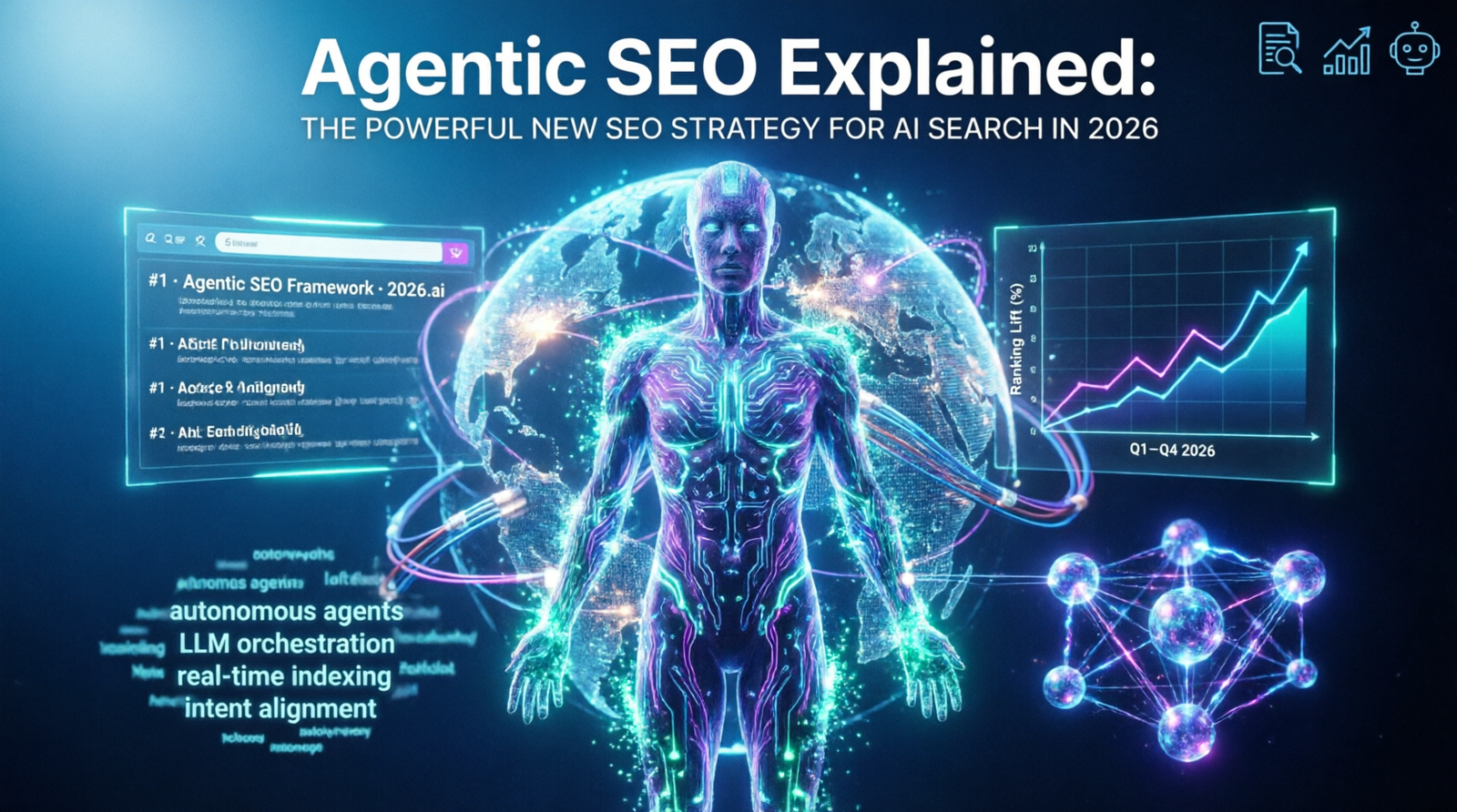
🔥 Agentic SEO Explained: The Powerful New SEO Strategy for AI Search in 2026
SEO is changing—but not in the way many headlines suggest.
For years, the basic model was straightforward:
Create a page → target a search intent → build relevance and authority → earn visibility → receive clicks.
That model still matters.
What is changing is what happens around the search result.
Google now uses generative AI experiences such as AI Overviews and AI Mode, where systems can interpret a complex question, retrieve information from multiple sources, and synthesize an answer. Google says these experiences continue to rely on its core Search systems and established SEO fundamentals.
At the same time, AI agents are becoming capable of performing multi-step tasks rather than simply generating an answer. In SEO, that creates a new workflow model: instead of manually completing every research, auditing, monitoring, and optimization step, an agent can increasingly plan tasks, use connected tools, analyze information, and return recommendations or actions for human review. Ahrefs describes this approach as agentic SEO.
There is therefore an important distinction:
Agentic SEO can mean using AI agents to perform SEO work, while the broader “AI search optimization” conversation is about making websites useful and understandable in AI-driven search experiences.
These ideas overlap, but they are not identical.
This guide explains both sides, without treating “Agentic SEO” as a secret Google ranking factor or another collection of SEO hacks.
Table of Contents
- What Is Agentic SEO?
- Agentic SEO vs AI Search Optimization
- Why Agentic SEO Matters in 2026
- Traditional SEO vs Agentic SEO
- How AI Search Systems Understand Web Content
- 10 Practical Strategies for AI-Ready SEO
- What About llms.txt?
- Agentic SEO Does Not Mean Publishing More AI Content
- The Biggest Opportunity: Decision Content
- Build Topic Clusters Instead of Isolated Articles
- E-E-A-T and First-Hand Experience
- How to Measure AI Search Visibility
- 10 Agentic SEO Mistakes to Avoid
- A Practical 30-Day Agentic SEO Plan
- Is Agentic SEO the Future?
- Final Verdict
- Frequently Asked Questions
- Related Articles
What Is Agentic SEO?
Agentic SEO is the use of AI agents to plan, execute, monitor, and adapt SEO workflows with less manual intervention.
Traditional AI-assisted SEO might look like:
“Write a keyword brief for this topic.”
An agentic workflow is closer to:
“Find pages that lost organic traffic, investigate the likely causes, prioritize the problems, recommend fixes, and prepare the changes for review.”
The difference is not simply that one uses AI.
The difference is who performs the workflow.
A conventional workflow might look like:
SEO → Research → Analyze → Decide → Execute → Monitor
A workflow automation might look like:
Trigger
  ↓
Step 1
  ↓
Step 2
  ↓
Step 3
  ↓
Report
An agentic workflow can look more like:
Goal
 ↓
AI Agent
 ↓
Plan
 ↓
Use tools and data
 ↓
Analyze results
 ↓
Adapt when necessary
 ↓
Recommend or execute actions
 ↓
Human review
This is why agentic SEO is more than “AI writing.”
An agent may be able to:
- analyze SEO data
- identify declining pages
- detect keyword cannibalization
- investigate technical issues
- research competitors
- discover content gaps
- monitor AI visibility
- prepare content briefs
- update information
- connect multiple SEO tools
- report results
Ahrefs describes agentic SEO as applying AI agents to SEO workflows so they can act, adapt, and recover, rather than simply generate text. It also emphasizes that human oversight remains important because agents can make incorrect inferences, struggle with large datasets, or fail during long workflows.
That distinction is important.
Agentic SEO is not fully autonomous SEO.
It is better understood as:
Human-directed SEO with increasingly capable AI systems handling parts of the workflow.
Agentic SEO vs AI Search Optimization
These terms are increasingly mixed together, but they describe different things.
Agentic SEO
Focuses on how SEO work gets done.
Examples:
- An agent audits your website.
- An agent analyzes Search Console data.
- An agent identifies declining content.
- An agent researches competitors.
- An agent prepares optimization recommendations.
AI Search Optimization
Focuses on how your content performs in AI-driven search experiences.
Examples:
- Making information clear and useful.
- Providing original analysis.
- Structuring content logically.
- Supporting important claims with evidence.
- Maintaining crawlability and indexability.
- Creating content that can satisfy complex search intents.
Google currently frames optimization for AI Overviews and AI Mode as an extension of SEO rather than a completely separate discipline. Its official guidance emphasizes valuable, non-commodity content, technical accessibility, good page experience, and other established SEO fundamentals.
So think of them as two related layers:
                 Modern SEO
                     │
          ┌──────────┴──────────┐
          ▼                     ▼
   AI Search Visibility    Agentic SEO Workflows
          │                     │
          ▼                     ▼
Better content, structure   AI agents execute,
and discoverability         analyze, monitor, adapt
You can use both.
Why Agentic SEO Matters in 2026
Search is no longer limited to a simple:
Query → Ten blue links
Google’s AI experiences can use techniques such as retrieval-augmented generation and query fan-out to retrieve information from multiple searches and sources before constructing an answer. Google says these AI experiences remain grounded in its Search systems and can provide prominent links to supporting web pages.
That creates a more complex discovery environment.
A user might ask:
“What is the best AI video generator for a small marketing team with a limited budget?”
Instead of one simple keyword, the underlying task contains several dimensions:
- AI video generation
- marketing
- team size
- budget
- ease of use
- quality
- features
- limitations
A strong page therefore needs to do more than mention:
“AI video generator”
It needs to actually help solve the problem.
At the same time, AI agents are changing how SEO professionals themselves perform research and optimization. Agentic workflows can connect models with SEO data, CMS platforms, analytics systems, and other tools, allowing the agent to work through multi-step tasks rather than simply produce text.
The opportunity is therefore two-sided:
Build content that is useful in AI-driven discovery, and use AI agents to improve the work required to produce and maintain that content.
Traditional SEO vs Agentic SEO
| Traditional SEO | Agentic SEO |
|---|---|
| Human performs most workflow steps | AI agent can perform multiple connected steps |
| Keyword research is often manual | Agent can research and cluster opportunities |
| Audits generate reports | Agent can prioritize findings and recommend actions |
| Human checks pages individually | Agent can monitor large sets of URLs |
| Automation follows predefined rules | Agents can adapt their next step based on results |
| Content production is often manual or AI-assisted | Agents can coordinate research, briefs, analysis, and workflows |
| Human remains responsible for decisions | Human oversight remains important |
This does not mean traditional SEO is obsolete.
Google explicitly states that SEO fundamentals continue to matter for generative AI experiences because those systems are built on its existing Search systems.
The better model is:
Agentic SEO changes how you perform SEO more than it changes what makes a website valuable.
That distinction prevents a lot of unnecessary hype.
How AI Search Systems Understand Web Content
Whether the system is a search engine, an AI-powered search experience, or a browser-based agent, it needs to extract useful information from your website.
Depending on the system and task, that can involve:
- visible text
- headings
- links
- page structure
- metadata
- structured data
- images
- accessible page elements
- information retrieved from other sources
But there is an important warning:
You do not need to write a strange “AI-only” version of your content.
Google’s current guidance specifically says there is no need to rewrite content solely for AI systems, create tiny content chunks, or chase every possible long-tail variation. Instead, site owners should focus on useful content and clear technical foundations.
The goal is simple:
Make the important information easy for a person to understand—and consequently easier for systems to interpret.
10 Practical Strategies for AI-Ready SEO
1. Target the Problem Behind the Keyword
Keyword research is still useful.
But don’t stop at the keyword.
For example:
Keyword:
AI video generator
Underlying problem:
“Which AI video generator can help a small marketing team create product videos quickly without hiring a video editor?”
The second question reveals the actual decision.
A strong article can then address:
- what the tools do
- who they are for
- differences
- pricing
- limitations
- use cases
- recommendation criteria
Google’s guidance notes that people are asking more complex questions in AI search experiences, making it increasingly important to satisfy the underlying information need rather than simply matching a phrase.
2. Give Important Answers Early
Don’t force readers through 2,000 words before revealing the conclusion.
For a comparison article, consider opening with something like:
Best overall: Tool A
Best for beginners: Tool B
Best for teams: Tool C
Best budget option: Tool D
Then explain the reasoning.
This improves usability because readers can immediately understand the conclusion.
It also creates clear relationships between:
option → use case → reason → limitation
3. Remove Generic Introductions
Avoid openings such as:
“Artificial intelligence is changing the world.”
Or:
“In today’s rapidly evolving digital landscape…”
These sentences rarely help the reader.
Start with the problem.
Instead:
“If you need an AI video generator for product demonstrations, the right choice depends on realism, editing control, speed, and budget.”
That tells the reader immediately:
- what the article covers
- what decision it helps make
- what criteria matter
Every paragraph should earn its place.
4. Add Information That Others Don’t Have
This is one of the strongest ways to improve content quality.
Ask:
What does this page add that a basic AI-generated summary would not?
Useful answers include:
- original testing
- first-hand observations
- screenshots
- detailed comparisons
- specific limitations
- real workflows
- transparent methodology
- updated pricing checks
- practical recommendations
- examples from actual use
Compare:
“Tool X is a powerful AI writing platform.”
with:
“Tool X is a stronger option for teams that need brand-specific workflows, but it may be unnecessary for individuals who only need occasional blog drafts.”
The second statement helps someone make a decision.
Google’s current AI-search guidance explicitly recommends creating unique, non-commodity content and warns against simply recycling information that is already widely available.
5. Support Important Claims With Evidence
Avoid unsupported superlatives:
“The best AI image generator.”
Instead explain the basis:
“We recommend this tool for marketers who prioritize fast commercial visuals because it combines X, Y, and Z. However, users who need precise character consistency may prefer another option.”
Depending on the claim, evidence can include:
- official documentation
- product documentation
- original testing
- research papers
- transparent methodology
- current pricing pages
- credible statistics
- screenshots
Primary sources should be preferred whenever possible.
For Google’s recommendations about AI search, for example, link directly to Google rather than relying on another SEO blog summarizing Google.
6. Use Internal and External Links With Purpose
A link should help the reader continue their research.
Instead of:
“Read our other AI articles.”
Write:
“AI agents also need ways to communicate with other agents. Our guide to the A2A Protocol explains how agent-to-agent communication works.”
That is a contextual relationship.
External links should work the same way.
If you make a claim about Google Search, cite Google.
If you describe an AI tool’s current feature, cite its official documentation where appropriate.
Good linking creates a knowledge network instead of a collection of random URLs.
7. Structure Information Clearly
Think of each important section as a compact information model.
For example:
Tool: Example Tool
Best for: Small marketing teams
Main strength: Fast campaign content
Main limitation: Limited customization
Pricing: Current plan information
Choose it when: Speed matters more than advanced control
Avoid it when: You need deep customization
This is more useful than several paragraphs of promotional language.
It also makes the important relationships obvious.
8. Use Comparison Tables Only When They Add Value
Tables are useful when readers genuinely need to compare attributes.
For example:
| Tool | Best For | Main Strength | Main Limitation |
|---|---|---|---|
| Tool A | Beginners | Ease of use | Limited control |
| Tool B | Professionals | Advanced features | Steeper learning curve |
| Tool C | Teams | Collaboration | Higher cost |
But don’t create a table simply because SEO articles commonly use tables.
A table should answer a real question.
If the information is too nuanced for a table, explain it in prose instead.
9. Use Structured Data Correctly
Structured data can help Google understand pages and may make eligible pages available for certain search features.
But it is not a special “AI ranking button.”
Google’s current guidance says structured data is not required for appearance in generative AI search features. It remains useful as part of a broader SEO strategy, but it should accurately represent the visible content on the page.
Depending on the page, relevant types may include:
- Article
- Organization
- Person
- Product
- Review
- BreadcrumbList
Use only markup that accurately describes the page.
Never add structured data simply because a schema type sounds beneficial.
10. Make Images Useful and Understandable
Images should support the article rather than interrupt it.
Useful examples include:
- original screenshots
- diagrams
- comparison graphics
- workflow illustrations
- product interfaces
- explanatory visuals
Use descriptive filenames and alt text where appropriate.
For example:
Filename:
agentic-seo-workflow.png
Alt text:
Agentic SEO workflow showing research, analysis, execution, and monitoring
Google recommends using high-quality, relevant images and videos where they genuinely help users, including in the context of generative AI search.
The key word is relevant.
You do not need six decorative images between every two sections.
What About llms.txt?
llms.txt has received significant attention in the SEO and AI community.
The basic idea is to provide AI systems with a simplified machine-readable representation of website information.
But there is an important distinction between industry experimentation and Google-supported SEO practice.
Google’s current official guidance says that Google Search does not use llms.txt as a special file for improving visibility in Google Search, including its generative AI experiences. Google says creating such files is optional for other services or systems, but it does not help or hurt Google Search rankings.
So don’t make this your first optimization task.
If your website has:
- weak content
- poor internal linking
- outdated information
- indexing problems
- thin pages
- duplicate topics
then llms.txt is not the solution.
Fix the fundamentals first.
Agentic SEO Does Not Mean Publishing More AI Content
This is one of the easiest mistakes to make.
You might think:
“AI agents are becoming important, so I’ll publish 50 AI-generated articles every week.”
That’s not the lesson.
Google’s policies focus on the value of the content, not whether a human or AI typed every sentence. Google specifically warns that generating many pages with generative AI without adding value can violate its scaled-content-abuse policy.
The problem is therefore not simply:
AI-generated = bad
or:
Human-written = good
The more useful distinction is:
Original and useful = valuable
Mass-produced and unoriginal = risky
A site with 30 excellent resources can be stronger than one with 300 interchangeable articles.
The goal should be:
Create more useful information—not simply more pages.
The Biggest Opportunity: Decision Content
This is especially important for websites that review or compare AI tools.
A weak article says:
“Here are 10 AI tools.”
The reader still asks:
“Which one should I choose?”
That is where decision content becomes valuable.
For each recommendation, answer:
Choose Tool A if…
Explain the ideal situation.
Don’t choose Tool A if…
Explain the limitation.
Best for…
Define the user.
Main trade-off…
Explain what the reader gives up.
Alternative…
Tell the reader what to consider if their needs differ.
For example:
Choose Tool A if: you prioritize ease of use and fast output.
Don’t choose Tool A if: you need detailed control over every stage of the workflow.
That is far more useful than:
“Tool A is powerful and easy to use.”
Decision content transforms an article from a list into a decision-making resource.
Improve Existing Articles Before Creating More
One of the biggest opportunities for an established website is often sitting inside its existing content library.
Suppose you already have:
Best AI Image Generators in 2026
Before publishing another similar article, improve the existing one.
Add:
Quick recommendation
Best overall: X
Best for beginners
Y
Best for professionals
Z
Don’t choose X if…
Explain the weakness.
Real use cases
- Blog graphics
- Product images
- Advertising
- Social media
- Concept development
Methodology
Explain how you evaluated the tools.
Current information
Verify pricing and important features.
Original observations
Explain what you learned from testing or comparing the tools.
This is content improvement rather than content multiplication.
And it aligns closely with Google’s current recommendation to focus on useful, non-commodity content rather than producing large numbers of pages simply to target search variations.
Build Topic Clusters Instead of Isolated Articles
A strong website should not feel like:
Article 1
Article 2
Article 3
Article 4
Article 5
It should look more like a connected knowledge base:
                 AI Agents
                     │
          ┌──────────┼──────────┐
          ▼          ▼          ▼
         MCP        A2A      Agent Memory
          │                     │
          └──────────┬──────────┘
                     ▼
                Agentic SEO
Each page answers a distinct question.
Internal links explain how the concepts relate.
For example:
“AI agents need communication protocols to interact with other agents. See our A2A Protocol Explained guide for a deeper explanation.”
Then:
“Agents may also need persistent information across tasks. Our guide to AI Agent Memory explains the different approaches.”
This creates topical depth.
More importantly, it creates a better experience for the reader.
Internal Linking Should Create Meaning
Avoid generic links such as:
“Read more.”
Instead create contextual connections.
Weak
Read our A2A article.
Better
AI agents can communicate through specialized protocols such as A2A. Our A2A Protocol Explained guide covers how this architecture works.
The second link tells the reader why the page matters.
This is how internal linking can turn individual articles into a coherent knowledge graph.
E-E-A-T and First-Hand Experience
E-E-A-T should not become a collection of badges.
Simply writing:
“Written by an AI expert.”
doesn’t demonstrate expertise.
Show it.
For AI tool content, useful evidence can include:
- original testing
- screenshots
- documented methodology
- comparison criteria
- observed limitations
- current pricing checks
- feature verification
- examples of actual workflows
- clear authorship
- update dates
- transparent affiliate disclosures where applicable
For example, instead of:
“Tool X is the best AI writing tool.”
write:
“We recommend Tool X for marketing teams that need brand-focused workflows. During our evaluation, its strongest advantage was X, while its main limitation was Y.”
That gives the recommendation a reason.
It also gives readers something they cannot get from a generic product description.
A New Layer of SEO Visibility to Monitor
Traditional SEO metrics remain important:
- impressions
- clicks
- rankings
- CTR
- conversions
But AI-driven search creates additional questions.
For example:
Is my brand appearing in AI-generated answers?
Which pages are being cited?
Is the information being represented accurately?
Which competitors are repeatedly mentioned?
What topics does AI associate with my brand?
Google now provides a Generative AI performance report in Search Console for monitoring how content performs in Google’s generative AI search experiences.
Third-party platforms are also developing AI visibility datasets and monitoring systems. Ahrefs, for example, publishes research tracking citations across AI search systems.
These tools can be useful for monitoring trends, but they should not be treated as access to Google’s private ranking systems.
Google itself warns that third-party tools claiming access to internal ranking or AI metrics should be treated cautiously.
How to Measure Your Progress
Use three layers.
1. Traditional SEO
Monitor:
- impressions
- clicks
- CTR
- average position
- indexed pages
- organic traffic
2. Business Performance
Track:
- affiliate clicks
- conversions
- signups
- revenue
- engaged sessions
3. AI Search Visibility
Track where appropriate:
- AI Overviews
- AI Mode
- ChatGPT
- Gemini
- Perplexity
- Copilot
Ask questions related to your actual topics.
Then record:
- which brands appear
- which websites are cited
- what information is used
- whether your site appears
- whether the information is accurate
- which competitors appear repeatedly
The goal isn’t simply:
“Did AI mention me?”
A better question is:
“Does AI understand my website correctly, and does it consider my content useful for the problems I want to solve?”
10 Agentic SEO Mistakes to Avoid
❌ 1. Thinking Agentic SEO replaces traditional SEO
It doesn’t.
Google says the fundamental SEO practices underlying Search continue to apply to generative AI experiences.
❌ 2. Treating llms.txt as a ranking shortcut
Google currently says it does not use llms.txt as a special optimization mechanism for Search.
❌ 3. Publishing hundreds of AI-generated pages
Large-scale unoriginal content can create quality problems and may fall under Google’s scaled-content-abuse policy.
❌ 4. Writing for machines instead of people
Your content still needs to satisfy humans.
Clear writing and good organization should come first.
❌ 5. Repeating information that already exists everywhere
A new page should have a reason to exist.
Ask:
What does this page add?
If the answer is “nothing,” reconsider publishing it.
❌ 6. Inventing statistics
Never use AI-generated numbers simply because they sound convincing.
Verify important statistics against the original source.
❌ 7. Removing external sources
Primary sources can strengthen factual claims and give readers a path to verify information.
❌ 8. Adding images just to make an article look longer
Every image should help explain, demonstrate, compare, or document something.
❌ 9. Creating multiple pages for nearly identical search intents
If five pages solve essentially the same problem, consider whether they should be consolidated or differentiated.
Google explicitly warns against creating large quantities of pages primarily to target variations of queries rather than helping users.
❌ 10. Letting old information remain indefinitely
AI tools change quickly.
Pricing, features, models, integrations, and limitations can become outdated.
A strong AI website needs a maintenance process—not just a publishing process.
A Practical 30-Day Agentic SEO Plan
You don’t need to rebuild your entire website.
Use a focused process.
Week 1 — Audit
Identify:
- your strongest articles
- declining pages
- duplicate search intent
- weak introductions
- missing internal links
- outdated claims
- unsupported statistics
- thin sections
- orphan pages
Select 10 priority articles.
Week 2 — Upgrade the 10 Priority Articles
For each article:
- rewrite the introduction
- answer the main question early
- add decision-focused recommendations
- add strengths and limitations
- add first-hand observations where available
- verify important claims
- add primary sources
- improve internal links
- remove repetitive sections
- update outdated information
- improve relevant images
Don’t simply make the articles longer.
Make them better.
Week 3 — Build Topic Clusters
Map related articles.
For example:
AI Agents
   │
   ├── MCP
   ├── A2A
   ├── AI Agent Memory
   ├── Multi-Agent AI
   └── Agentic SEO
Then create contextual links between them.
Each article should have a clear role in the cluster.
Week 4 — Establish an AI Visibility Baseline
Choose 20–30 questions that your target audience might realistically ask.
For example:
“What are the best AI automation tools for marketers?”
“How does MCP work?”
“What is agentic SEO?”
“Which AI tools are best for content marketing?”
Record:
- which websites appear
- which brands appear
- which sources are cited
- what claims are repeated
- whether your site appears
- whether your site is represented accurately
Then repeat the process after several weeks of content improvements.
The objective is not to manufacture mentions.
It’s to understand how your content and brand are being discovered and represented.
Is Agentic SEO the Future?
Probably—but the future is more nuanced than the hype suggests.
There are really two changes happening at once.
Change 1: Search is becoming more AI-driven
Google is expanding AI-powered experiences and explicitly recommends continuing to apply strong SEO fundamentals while creating useful, original content.
Change 2: SEO work is becoming more agentic
AI agents can increasingly connect to data and tools, perform multi-step research, identify problems, and execute or prepare actions. This is the area commonly described as agentic SEO.
Neither change means that SEO fundamentals have disappeared.
In fact, they make fundamentals more important.
A useful way to think about the future is:
Better content
      +
Better technical foundations
      +
Better internal knowledge structure
      +
Better measurement
      +
AI-assisted workflows
      +
Human judgment
      =
Stronger modern SEO
Final Verdict
🔥 Should You Start Doing Agentic SEO in 2026?
Yes—but don’t treat it as another SEO hack.
Agentic SEO is valuable because AI agents can increasingly handle parts of the SEO workflow that previously required repetitive manual work.
AI-driven search is also changing how users discover information.
But neither trend eliminates the fundamentals.
The strongest strategy is still to build content that deserves to be discovered.
Old mindset
“How do I rank this keyword?”
Better mindset
“How do I become the most useful source for this problem?”
The strongest mindset
“If someone—or an AI system helping that person—needs to understand this topic, is my website one of the clearest, most useful, and most trustworthy places to get the answer?”
That is the real opportunity.
Don’t chase every new AI SEO acronym.
Don’t publish hundreds of generic pages.
Don’t spend your first week building files that Google says it doesn’t use for Search.
Instead:
Create original information.
Show your reasoning.
Document your experience.
Connect related knowledge.
Keep important information current.
Make your site technically accessible.
Use AI agents where they genuinely improve your workflow.
Google’s current guidance strongly reinforces this direction: focus on useful, non-commodity, people-first content; maintain a clear technical structure; use relevant images and video; and continue applying established SEO practices to generative AI search.
The technology may change quickly.
The fundamental advantage remains much simpler:
Be more useful than the alternatives.
Frequently Asked Questions
What is Agentic SEO?
Agentic SEO is an emerging term for using AI agents to perform, coordinate, monitor, and adapt SEO workflows with less manual intervention. The term is not an official Google ranking factor. Ahrefs uses it to describe applying AI agents to SEO workflows so they can act and adapt rather than simply generate content.
Is Agentic SEO a Google ranking factor?
No.
There is no official Google ranking factor called “Agentic SEO.”
Google’s current guidance instead emphasizes established SEO fundamentals, useful content, technical accessibility, and other quality signals for generative AI search experiences.
Is Agentic SEO the same as GEO?
Not exactly.
GEO, or Generative Engine Optimization, generally refers to efforts intended to improve visibility in generative AI search experiences.
Agentic SEO more commonly refers to applying AI agents to SEO workflows.
The terminology is still evolving, so definitions can vary between practitioners.
Should I create an llms.txt file?
You can experiment with it for systems that support the format, but you should not treat it as a Google SEO requirement.
Google’s current documentation says Google Search does not use llms.txt as a special file for improving Search visibility or rankings.
Does AI-generated content hurt SEO?
Not automatically.
Google’s guidance focuses on the quality, accuracy, relevance, and value of the resulting content. However, using generative AI to produce large numbers of pages without adding value can fall under Google’s scaled-content-abuse policy.
Are backlinks still important?
Agentic SEO does not eliminate traditional SEO.
Links, relevance, crawlability, authority, useful content, and other established SEO principles continue to matter.
Should I optimize content for AI instead of humans?
No.
Write for your audience first.
Clear structure, direct answers, useful organization, and accurate information can benefit both humans and systems that process web content.
What should I change first on my website?
Start with your strongest existing pages.
Improve:
- usefulness
- originality
- clarity
- evidence
- internal linking
- first-hand experience
- outdated information
- decision-making value
Only after that should you focus heavily on producing additional pages.