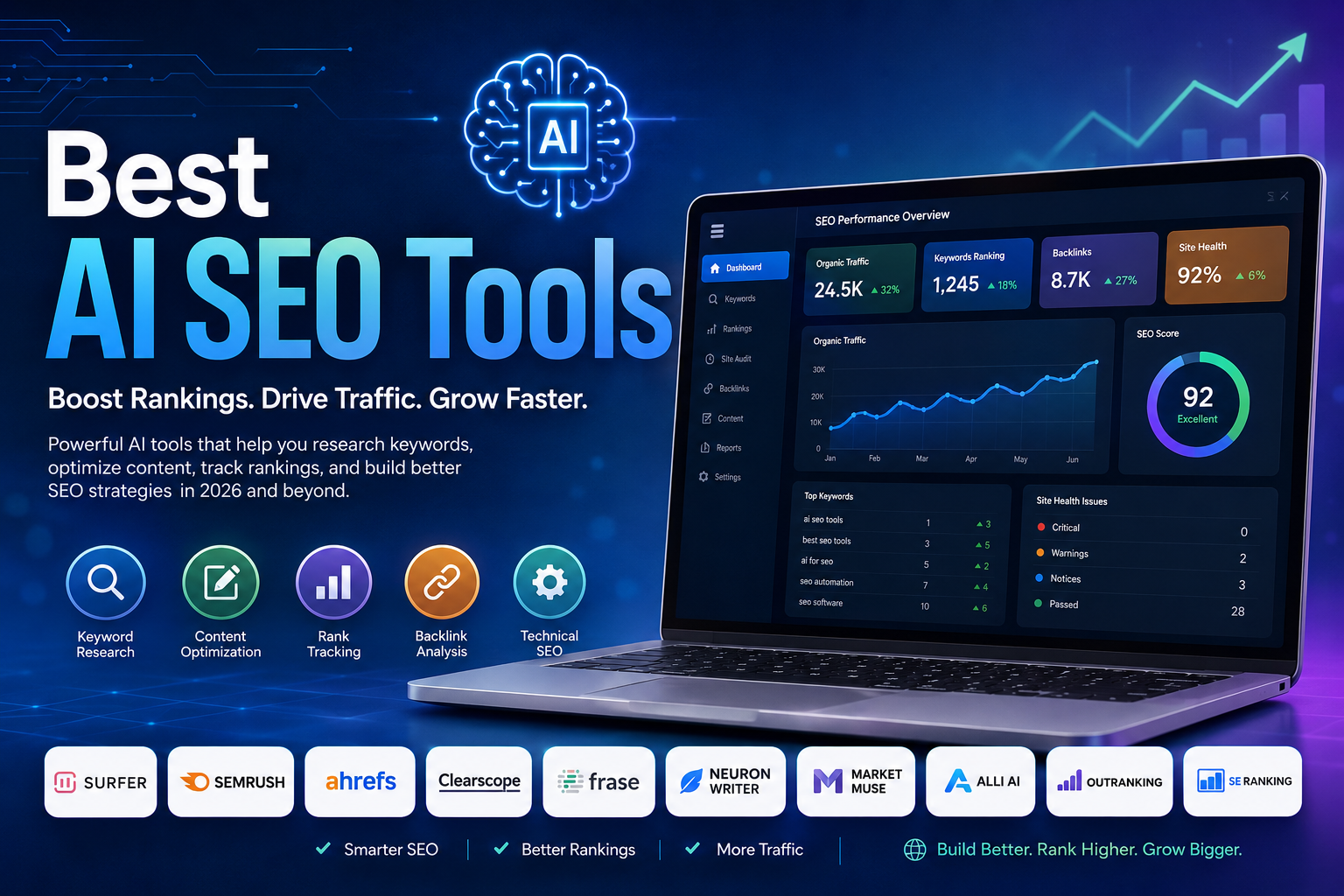
Best AI SEO Tools in 2026: 10 Platforms Compared for Content, Keywords, Technical SEO, and AI Search
Last updated: September 2026
Search engine optimization in 2026 is no longer limited to finding keywords and adding them to an article. Modern SEO involves understanding search intent, analyzing competitors, improving technical performance, building topical coverage, optimizing existing content, monitoring rankings, and increasingly understanding how brands appear in AI-powered search experiences.
AI SEO tools can make many of these tasks faster. But they are not interchangeable, and more automation does not automatically mean better SEO.
Some platforms are primarily built for content optimization, while others are stronger at keyword research, backlinks, technical SEO, rank tracking, content planning, or AI-search visibility.
This guide compares 10 widely used AI-assisted SEO platforms and explains what each one is actually good at, where it falls short, and which type of website is most likely to benefit from it.
Important: Features and pricing change frequently. The recommendations below focus on the role each platform plays in an SEO workflow rather than treating temporary features or prices as permanent.
Quick Answer: Which AI SEO Tool Is Best?
There is no single best AI SEO tool for every website.
| Tool | Best suited for | Main strength | Main limitation |
|---|---|---|---|
| Surfer | Content teams and bloggers | Content optimization | Less comprehensive than full SEO suites |
| Semrush | Full SEO workflows | Keywords, competitors, technical SEO, rankings | Can be overwhelming for beginners |
| Ahrefs | SEO research | Backlinks, keywords, competitors | Premium pricing for deeper usage |
| Clearscope | Editorial teams | Content optimization and topical relevance | Less focused on technical SEO |
| Frase | Content planning and optimization | Research, briefs, content workflow | Not a replacement for a full SEO suite |
| MarketMuse | Content strategy | Topic authority and content planning | Better suited to larger content operations |
| NeuronWriter | Budget-conscious content teams | SEO content optimization and AI writing | Smaller overall SEO ecosystem |
| Alli AI | Technical SEO automation | Deploying SEO changes at scale | More advanced than most beginner tools |
| Outranking | SEO content workflows | Research, optimization, and content production | Primarily content-focused |
| SE Ranking | Small businesses and agencies | Balanced all-in-one SEO toolkit | Some advanced capabilities require higher plans |
My practical picks
- Best overall SEO platform: Semrush
- Best for backlink and competitor research: Ahrefs
- Best for content optimization: Surfer
- Best for content research and workflow: Frase
- Best for enterprise content strategy: MarketMuse
- Best for technical SEO automation: Alli AI
- Best balanced option for smaller teams: SE Ranking
- Best lower-cost content optimization option: NeuronWriter
These are not absolute rankings. The right choice depends on the specific SEO problem you are trying to solve.
What Are AI SEO Tools?
AI SEO tools are software platforms that use artificial intelligence, machine learning, large datasets, or automated workflows to assist with search engine optimization.
Depending on the platform, they can help with:
- Keyword research
- Search-intent analysis
- SERP analysis
- Content briefs
- Content optimization
- Competitor research
- Backlink analysis
- Technical SEO audits
- Rank tracking
- Internal linking
- Content gap analysis
- Topic clustering
- SEO reporting
- AI-search visibility
The important distinction is that AI SEO software is not one specific category of tool.
For example, Ahrefs and Semrush are broad SEO platforms with large research databases, while Surfer and Clearscope focus more heavily on content optimization. Alli AI takes a different approach by emphasizing automated technical and on-page changes.
That difference matters when choosing a platform.
How We Compare AI SEO Tools
Rather than ranking tools simply by the number of features they advertise, this comparison looks at the practical role each platform can play in an SEO workflow.
The main criteria are:
1. Keyword and search research
Can the platform help identify relevant queries, understand competitors, and discover potential opportunities?
2. Content optimization
Does it provide useful recommendations for improving existing or new content?
3. Technical SEO
Can it identify or help resolve issues related to crawling, indexing, site structure, performance, or other technical areas?
4. Competitive intelligence
How useful is the platform for understanding competing websites, keywords, backlinks, and content?
5. Automation
Can repetitive SEO tasks be automated, or does the tool mainly provide data and recommendations?
6. Ease of use
A powerful SEO platform is less useful if its data is difficult to interpret or apply.
7. Overall fit
The final question is simple: what type of SEO team or website gets the most value from the tool?
This is a feature-based comparison rather than a claim that every platform was personally tested in an identical laboratory environment.
1. Surfer
Surfer is particularly focused on content optimization.
Instead of trying to be everything for everyone, its core value is helping content creators understand how a page compares with relevant search results and what can be improved.
It can be useful when you already know the topic you want to target and need help improving the page’s topical coverage, structure, and optimization.
What Surfer Is Best At
- Content optimization
- On-page SEO
- Content briefs
- Keyword and topic recommendations
- Content planning
- AI-assisted SEO workflows
Surfer’s current plans include features related to content optimization and AI-search visibility, with pricing changing according to the plan and billing arrangement.
Strengths
- Strong content-focused workflow
- Useful optimization recommendations
- Easy for content teams to understand
- Good fit for bloggers and SEO writers
- More focused than broad enterprise SEO suites
Limitations
Surfer should not be treated as a complete replacement for a platform such as Semrush or Ahrefs when your workflow depends heavily on backlinks, large-scale competitive research, or broader SEO intelligence.
Best For
Bloggers, affiliate publishers, content marketers, and teams producing SEO-focused articles.
2. Semrush
Semrush is one of the most comprehensive platforms in this comparison.
Its SEO ecosystem covers areas such as keyword research, competitor analysis, position tracking, site auditing, content, and increasingly visibility across AI-powered search.
The important point is that Semrush is not simply an “AI SEO writer.” Its strength comes from combining SEO data, research, monitoring, and AI-assisted workflows.
Current Semrush SEO plans include keyword tracking, site auditing, competitor research, and AI-search visibility capabilities, while separate content tools provide AI-assisted content optimization.
Strengths
- Broad SEO toolkit
- Strong keyword research
- Competitor analysis
- Position tracking
- Technical SEO auditing
- Content tools
- AI-search visibility features
- Suitable for agencies and larger websites
Limitations
The platform can feel complicated if you only need a simple content optimizer.
It can also become expensive as your requirements, tracked keywords, websites, and additional tools increase.
Best For
SEO professionals, agencies, businesses, publishers, and websites that need one broad SEO ecosystem.
Choose Semrush if:
You want to research keywords, analyze competitors, audit your website, track rankings, and manage multiple SEO activities from one platform.
3. Ahrefs
Ahrefs is particularly well known for SEO research, especially backlinks, competitors, keywords, site analysis, and content opportunities.
Its current platform has also expanded into AI-search visibility, including Brand Radar and AI prompt tracking.
Where Ahrefs Stands Out
Ahrefs is particularly useful when your SEO strategy depends on understanding:
- Which sites link to competitors
- Which pages attract backlinks
- Which keywords competitors rank for
- How websites perform organically
- Where content opportunities exist
- How a site’s backlink profile changes
Strengths
- Strong backlink research
- Powerful competitor analysis
- Keyword research
- Site auditing
- Rank tracking
- Large-scale SEO datasets
- AI-search visibility features
Limitations
Ahrefs is not primarily a simple AI article-writing platform.
Its current pricing also reflects its positioning as a professional SEO research platform. The current official pricing page lists a Starter plan from $29/month, with higher professional plans beginning at $129/month, depending on plan and billing arrangement.
Best For
SEO professionals, agencies, publishers, businesses, and anyone who considers backlinks and competitor research a major part of their strategy.
Choose Ahrefs if:
Your biggest SEO questions are about backlinks, competitors, keywords, and organic search opportunities.
4. Clearscope
Clearscope is designed primarily around content optimization and search visibility.
It is particularly suitable for editorial teams that want a structured way to improve content around a topic instead of relying on arbitrary keyword repetition.
Its current Essentials plan is listed at $129/month and includes tracked prompts, pages, topic explorations, and drafts, while higher plans are designed for larger teams.
Strengths
- Clear content optimization workflow
- Topic and content analysis
- Useful for editorial teams
- SEO and AI-search visibility features
- Straightforward reporting
Limitations
Clearscope is not designed to replace the complete functionality of an enterprise SEO suite.
It is a stronger choice when the central problem is content quality and topical coverage, rather than technical SEO or extensive backlink research.
Best For
Content teams, publishers, SEO writers, and businesses with a strong editorial operation.
5. Frase
Frase combines SEO research, content planning, optimization, and AI-assisted content workflows.
It is particularly interesting for publishers that want to move from keyword research to content creation and optimization within one workflow.
Current Frase plans include SEO/GEO scoring, AI visibility features, content audits, internal linking suggestions, and different levels of automated content workflows. Its Starter plan is currently listed at $39/month when billed yearly or $49 month-to-month.
Strengths
- Content research
- SEO content briefs
- Content optimization
- Internal linking suggestions
- AI-assisted workflows
- AI-search visibility features
- Useful for smaller content teams
Limitations
Frase is primarily a content-focused platform. If you need deep backlink research or a broad enterprise SEO database, a platform such as Ahrefs or Semrush may be a better fit.
Best For
Bloggers, publishers, content marketers, freelancers, and small content teams.
Choose Frase if:
Your biggest challenge is moving efficiently from search research → content brief → article → optimization → update.
6. MarketMuse
MarketMuse takes a more strategic approach to content.
Rather than focusing only on optimizing individual articles, it can help organizations understand their broader content coverage, topic opportunities, and content planning.
Its current platform includes different levels of topic tracking, content briefs, and strategy documents, including a limited free plan.
Strengths
- Content strategy
- Topic analysis
- Content gap identification
- Content planning
- Topic authority workflows
- Useful for large content libraries
Limitations
MarketMuse can be more than a small website needs.
A site publishing a few articles per month may get more practical value from a simpler content optimizer.
Best For
Enterprise publishers, large websites, content strategists, and teams managing substantial content libraries.
7. NeuronWriter
NEURONwriter combines SEO content optimization with AI-assisted writing.
Its approach makes it attractive to bloggers and smaller publishers that want content-focused SEO features without immediately moving to a large enterprise SEO platform.
The official documentation currently lists plans ranging from Bronze through Diamond, with pricing based on projects, content analyses, AI credits, and features. Bronze is listed at $23/month or $19/month when paid annually.
Strengths
- SEO content optimization
- AI writing assistance
- Content scoring
- NLP/topic recommendations
- Accessible to smaller publishers
- Multiple pricing levels
Limitations
Its overall SEO ecosystem is not as broad as Semrush or Ahrefs.
That matters if you need extensive backlink intelligence, competitive research, or advanced technical SEO monitoring.
Best For
Bloggers, affiliate publishers, freelance writers, and smaller content teams.
8. Alli AI
Alli AI takes a very different approach from tools that primarily help you write articles.
Its main value is SEO automation and implementation at scale.
The platform is designed to deploy SEO changes across websites and includes capabilities around technical SEO, site optimization, link building, site speed, and AI-search visibility.
Its current plans include a 10-day free trial, with Business and Agency plans designed for different website and keyword volumes.
Strengths
- Technical SEO automation
- Bulk optimization
- Large-scale implementation
- Site speed optimization
- SEO recommendations
- AI-search visibility
- Multiple CMS integrations
Limitations
Alli AI is more advanced than many beginner-oriented content tools.
Automating changes across a website also means you should understand what the platform is changing before deploying large-scale modifications.
Best For
SEO agencies, e-commerce websites, large websites, and teams managing many pages.
Choose Alli AI if:
Your biggest problem is not generating SEO ideas but implementing SEO improvements across a large website efficiently.
9. Outranking
Outranking focuses heavily on the SEO content workflow.
It combines keyword research, content briefs, AI-assisted drafting, optimization, and internal linking into a workflow designed around creating search-focused content.
Its current pricing page lists Starter at $19/month, SEO Writer at $79/month, and SEO Wizard at $159/month, although pricing and promotional offers can change.
Strengths
- SEO content planning
- Content briefs
- AI-assisted drafts
- Optimization
- Internal linking
- Content workflow automation
Limitations
Outranking is more specialized around content workflows than broad SEO research.
If backlink intelligence or comprehensive technical SEO is your priority, another platform may be more appropriate.
Best For
SEO writers, bloggers, content teams, and agencies focused on publishing optimized content.
10. SE Ranking
SE Ranking is a broad SEO platform designed to cover several core areas of SEO rather than focusing exclusively on AI writing.
Depending on the plan, its ecosystem includes keyword research, rank tracking, website audits, competitor analysis, backlink tools, and content-related capabilities.
This makes it a potentially useful middle ground for smaller businesses and agencies that need more than a content optimizer but may not need the scale of an enterprise platform.
Strengths
- Rank tracking
- Keyword research
- Website audits
- Competitor analysis
- Backlink tools
- Content and SEO workflows
- Suitable for agencies and smaller businesses
Limitations
Some advanced capabilities depend on plan level and usage limits.
The platform is also broader than a dedicated content optimizer, so users primarily interested in article optimization may prefer Surfer, Clearscope, or Frase.
Best For
Small businesses, agencies, freelancers, bloggers, and growing websites.
Which AI SEO Tool Should You Choose?
Instead of asking which tool is “number one,” start with the SEO problem you are trying to solve.
| Your main goal | Best starting point |
|---|---|
| Optimize blog articles | Surfer |
| Full SEO research | Semrush |
| Backlink research | Ahrefs |
| Editorial content optimization | Clearscope |
| Content research and workflow | Frase |
| Large-scale content strategy | MarketMuse |
| Affordable SEO content workflow | NeuronWriter |
| Technical SEO automation | Alli AI |
| AI-assisted SEO content production | Outranking |
| Balanced SEO platform | SE Ranking |
This approach is more useful than choosing a tool simply because it appears first on a “top 10” list.
AI SEO Tool Pricing: What You Should Know
SEO software pricing changes regularly, and many platforms use different limits for keywords, projects, pages, AI credits, tracked prompts, users, or crawls.
For that reason, a static “cheapest to most expensive” table can become inaccurate quickly.
Some current examples illustrate the difference:
- Ahrefs: current plans range from a Starter option at $29/month to higher professional and enterprise tiers.
- Semrush: its current SEO Classic pricing starts at $139.95/month, while other SEO + AI Search packages have different starting prices and limits.
- Clearscope: Essentials currently starts at $129/month.
- Frase: Starter currently starts at $39/month when billed yearly.
- NeuronWriter: Bronze is currently listed at $23/month or $19/month with annual payment.
- Outranking: its current pricing page lists plans beginning at $19/month.
- Alli AI: current plans are aimed at businesses and agencies and include a 10-day trial.
Always verify the official pricing page before purchasing, especially when comparing plans based on monthly limits.
The cheapest subscription is not necessarily the cheapest solution. A tool that solves your main SEO bottleneck can provide more value than a cheaper platform with features you never use.
AI SEO Tools: Feature Comparison
| Tool | Content SEO | Keywords | Technical SEO | Backlinks | Rank Tracking | AI/Search Visibility |
|---|---|---|---|---|---|---|
| Surfer | Excellent | Good | Limited | Limited | Limited | Yes |
| Semrush | Excellent | Excellent | Excellent | Excellent | Excellent | Yes |
| Ahrefs | Good | Excellent | Excellent | Excellent | Excellent | Yes |
| Clearscope | Excellent | Good | Limited | Limited | Limited | Yes |
| Frase | Excellent | Good | Limited | Limited | Limited | Yes |
| MarketMuse | Excellent | Good | Limited | Limited | Limited | Focused on content strategy |
| NeuronWriter | Excellent | Good | Limited | Limited | Limited | Content-focused |
| Alli AI | Good | Good | Excellent | Good | Good | Yes |
| Outranking | Excellent | Good | Limited | Limited | Limited | Content-focused |
| SE Ranking | Good | Excellent | Excellent | Good | Excellent | Yes |
Note: “Excellent,” “Good,” and “Limited” describe the platform’s relative role in this comparison, not a universal quality score.
When AI SEO Tools Actually Help
AI SEO software is most valuable when it helps you make better decisions, not simply produce more content.
For example, an SEO tool can help you discover that:
- A keyword has strong commercial intent.
- Competitors are ranking with a different type of content than you expected.
- An older article has lost visibility.
- Several pages on your website compete for the same search intent.
- Important topics are missing from your content.
- Internal links could be improved.
- Technical problems are preventing search engines from accessing pages efficiently.
Those insights are often more valuable than asking AI to generate another generic article.
A Better AI SEO Workflow
You do not necessarily need ten SEO subscriptions.
A practical workflow can look like this:
Step 1: Find the Search Opportunity
Use a keyword research platform to identify relevant queries and understand competition.
Step 2: Analyze Search Intent
Look at the pages currently ranking and determine what users actually expect.
Is the query looking for:
- A tutorial?
- A comparison?
- A product?
- A definition?
- A list?
- A local service?
- A detailed guide?
Step 3: Build a Better Content Brief
Use a content optimization platform to identify important subtopics, questions, entities, and gaps.
Step 4: Add Original Value
This is the step many AI-generated SEO articles miss.
Add:
- Your own analysis
- Examples
- Comparisons
- Original explanations
- Real-world use cases
- Data where available
- Relevant sources
- Clear limitations
Step 5: Optimize the Finished Article
Use an SEO content tool to check structure, topical coverage, headings, internal links, and other on-page factors.
Step 6: Publish and Measure
Track:
- Impressions
- Click-through rate
- Rankings
- Organic traffic
- Indexed pages
- Conversions
Step 7: Update
SEO is not finished when an article is published.
If an article loses traffic or becomes outdated, investigate why and update it where necessary.
How to Use AI Without Creating Low-Value SEO Content
This is especially important in 2026.
Google does not say that using AI automatically makes a page ineligible for search. The issue is whether the resulting content is useful, original, accurate, and created for people rather than primarily to manipulate rankings.
Google specifically recommends asking whether content provides original information, research, or analysis; whether it adds substantial value beyond other pages; and whether it simply rewrites information from other sources.
Google also warns that generating many pages with AI without adding value can fall under its spam policies concerning scaled content abuse.
A weak AI SEO workflow
Keyword → AI → publish → repeat
This can produce a large amount of content without creating a meaningful reason for someone to choose your website.
A stronger workflow
Search research → intent analysis → original research → expert/first-hand insight → AI assistance → human editing → fact checking → optimization → publication → performance review
The second workflow takes more effort, but it creates a much stronger foundation for long-term SEO.
What Google Wants From Helpful SEO Content
Google’s guidance emphasizes people-first content rather than pages created primarily to manipulate search rankings.
Its self-assessment questions include whether content provides original analysis, a substantial description of the subject, information beyond the obvious, accurate information, and clear authorship.
For an AI tools website, that means an article such as this should not simply list ten products and repeat their marketing descriptions.
A stronger comparison should explain:
- Why the tools are different
- Which problem each one solves
- Who should use each platform
- Where each platform is weak
- How pricing models differ
- When a cheaper tool is sufficient
- When a full SEO suite is justified
That is where editorial judgment adds value.
Free vs Paid AI SEO Tools
Free SEO tools can be useful when you are building a small website or learning the fundamentals.
They can help with:
- Basic keyword research
- Limited audits
- Small content projects
- Testing a workflow
- Learning SEO concepts
Paid tools become more useful when you need:
- Larger keyword databases
- More projects
- More tracked keywords
- Historical data
- Competitor analysis
- Backlink research
- Automated workflows
- Advanced reporting
- Higher usage limits
You do not need to pay for every tool.
For a small website, one broad SEO platform plus one specialized content tool can be more practical than maintaining five or six overlapping subscriptions.
SEO Tips That Still Matter in the AI Era
1. Start With Search Intent
Do not choose keywords only because they have high search volume.
A lower-volume keyword with clear intent can be more valuable than a broad keyword that attracts visitors who are unlikely to become customers.
2. Improve Existing Content
Updating an established article can be more useful than constantly publishing new pages.
Look for pages with:
- Declining impressions
- Falling rankings
- Outdated information
- Missing sections
- Weak internal links
- Poor click-through rates
3. Build Useful Internal Links
Internal links help visitors discover related information and help search engines understand relationships between pages.
Do not add links simply to increase the number of links. Use descriptive anchor text and link where the destination genuinely helps the reader.
4. Create Topic Depth
If your website covers a subject, build a useful collection of related content rather than publishing isolated articles around random keywords.
For example, an AI marketing website could cover:
- AI writing tools
- AI marketing platforms
- AI SEO tools
- AI image generators
- AI video tools
- AI email tools
- AI productivity software
These topics can support one another through relevant internal links.
5. Monitor Performance
Use search performance data to understand what actually happens after publication.
Do not assume that a high optimization score means an article will rank.
SEO tools provide recommendations. Search engines determine rankings.
6. Keep Information Current
AI software changes quickly.
Features, plans, pricing, limits, branding, and integrations can change within months.
If you publish an article about software, add an update date and review important claims periodically.
Common AI SEO Mistakes
Mistake 1: Treating an SEO Score as a Ranking Guarantee
A high content score does not guarantee a first-page ranking.
Search visibility depends on many factors, including relevance, content quality, competition, site authority, technical accessibility, and the searcher’s intent.
Mistake 2: Publishing Hundreds of AI Articles
More pages do not automatically mean more traffic.
Publishing large quantities of pages without adding useful value can create a weaker website rather than a stronger one. Google specifically warns against scaled content created without sufficient value.
Mistake 3: Copying Competitors
Competitor research should help you understand the search landscape.
It should not become a blueprint for rewriting their articles.
Use competitor pages to identify gaps, then provide your own explanation, examples, research, and perspective.
Mistake 4: Keyword Stuffing
Repeating a keyword unnaturally does not make an article more useful.
Write naturally and cover the subject comprehensively.
Mistake 5: Ignoring Technical SEO
Excellent content cannot compensate for every technical problem.
Monitor:
- Indexing
- Crawlability
- Broken links
- Canonicalization
- Site speed
- Mobile usability
- Structured data where appropriate
- Redirects
- HTTPS
Mistake 6: Using AI Without Fact Checking
AI can generate incorrect information confidently.
This is especially dangerous for:
- Pricing
- Product features
- Statistics
- Legal information
- Medical information
- Financial information
- Software capabilities
For software comparison articles, verify important claims against official documentation before publication.
Do AI SEO Tools Replace SEO Experts?
No.
They automate parts of SEO, but they do not eliminate the need for judgment.
A tool can identify keywords, compare pages, detect technical issues, or suggest improvements.
A human still needs to decide:
- Which opportunity matters?
- What does the audience actually need?
- Is the recommendation correct?
- Is the content genuinely better?
- Is the information current?
- Which technical change is safe?
- What should be prioritized?
The strongest SEO teams therefore use AI as an assistant and automation layer, not as a substitute for strategy.
How Many AI SEO Tools Do You Actually Need?
Probably fewer than you think.
For a small blog
One general SEO platform plus a content optimizer may be enough.
For an affiliate website
Keyword research, competitor analysis, content optimization, and rank tracking are usually more important than enterprise-level automation.
For an SEO agency
A broader platform such as Semrush, Ahrefs, or SE Ranking can become more valuable because of reporting, multiple projects, competitor research, and client management requirements.
For a large publisher
Content strategy, content optimization, internal linking, technical SEO, and large-scale monitoring become more important.
For a large technical website
Automation can provide significant value because manually implementing thousands of SEO changes is inefficient.
Frequently Asked Questions
What are AI SEO tools?
AI SEO tools are platforms that use artificial intelligence and automated data analysis to assist with SEO tasks such as keyword research, content optimization, competitor analysis, technical audits, rank tracking, and content planning.
Which AI SEO tool is best overall?
There is no universal winner. Semrush is one of the strongest choices for an all-around SEO workflow, while Ahrefs is particularly strong for backlinks and competitive research and Surfer is especially useful for content optimization.
Which AI SEO tool is best for content optimization?
Surfer and Clearscope are strong options for content optimization. Frase and NeuronWriter are also useful when you want content research and AI-assisted workflows alongside optimization.
Which tool is best for keyword research?
Semrush and Ahrefs are strong choices for comprehensive keyword and competitor research. SE Ranking is another option for users looking for a broader SEO platform.
Is AI-generated content bad for SEO?
Not automatically.
The important question is whether the resulting content provides genuine value. Google says generative AI can be useful, but generating many pages without adding value can violate its spam policies.
Can AI guarantee higher Google rankings?
No.
AI SEO tools can help you research opportunities, identify problems, and improve content, but no legitimate SEO tool can guarantee a specific Google ranking.
Are AI SEO tools worth paying for?
They can be, especially when they save significant research time or help identify opportunities you would otherwise miss.
The best way to evaluate one is to compare the subscription cost with the amount of useful work it replaces or improves.
Do beginners need Semrush or Ahrefs?
Not necessarily.
A beginner may get more value from a simpler content optimization platform or a more affordable all-in-one solution.
As a website grows, the additional research and competitive data provided by larger platforms can become more valuable.
Can AI SEO tools replace SEO agencies?
Generally, no.
They can automate research and repetitive tasks, but strategy, prioritization, technical judgment, content quality, and business decisions still require human input.
How often should SEO content be updated?
There is no universal schedule.
Review important pages when their information becomes outdated, their rankings decline, search intent changes, or competitors provide substantially better information.
Final Verdict
The best AI SEO tool is not necessarily the platform with the longest feature list.
The right choice depends on the problem you need to solve.
Choose Surfer if your priority is content optimization.
Choose Semrush if you want a broad SEO ecosystem covering keywords, competitors, technical SEO, rankings, and AI-search visibility.
Choose Ahrefs if backlinks, competitor research, and keyword intelligence are central to your strategy.
Choose Clearscope if your organization is heavily focused on editorial content quality and optimization.
Choose Frase if you want a connected workflow for researching, planning, optimizing, and updating content.
Choose MarketMuse if you manage a large content library and need deeper content strategy.
Choose NeuronWriter if you want an SEO-focused writing and optimization platform with lower entry pricing.
Choose Alli AI if your biggest challenge is implementing SEO changes across a large website.
Choose Outranking if you want an AI-assisted SEO content workflow.
Choose SE Ranking if you want a balanced SEO platform for a growing business, agency, or website.
Most importantly, remember that the software is only part of the equation.
A successful SEO strategy still depends on understanding your audience, choosing the right topics, producing genuinely useful content, maintaining a technically healthy website, earning relevant authority, and improving your pages based on real performance data.
AI can make that process faster.
It cannot replace the need to make good SEO decisions.
Official Sources and Further Reading
The following official resources are useful when evaluating SEO software and publishing AI-assisted content:
- Google Search Central — Creating Helpful, Reliable, People-First Content
- Google Search Central — Guidance on Generative AI Content
- Google AdSense — Make Sure Your Site’s Pages Are Ready for AdSense
- Semrush SEO Toolkit
- Ahrefs
- Surfer
- Clearscope
- Frase
- MarketMuse
- NEURONwriter
- Alli AI
- Outranking
- SE Ranking
Related Articles
Continue building your AI toolkit with these helpful guides: