
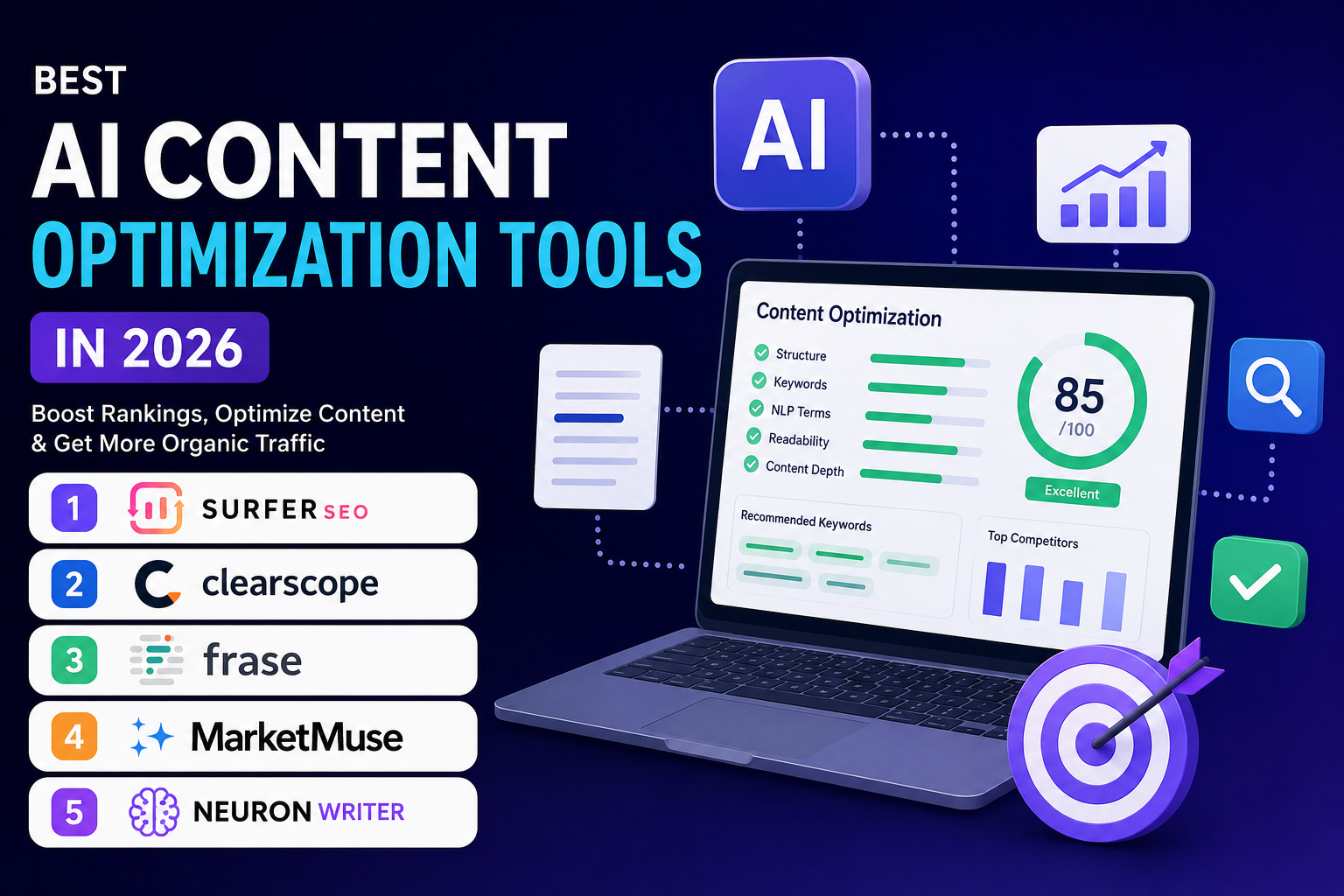
Best AI Content Optimization Tools in 2026: 5 Tools Compared
| September 2026
Creating an article is only the beginning of an SEO content strategy. The harder part is making sure the page clearly answers the searcher’s question, covers the important aspects of the topic, and remains useful after it is published.
That is where content optimization software can help.
Modern AI SEO platforms can analyze search results, identify related topics and entities, suggest content improvements, create briefs, monitor existing pages, and help writers work through large content libraries more efficiently. Some tools focus mainly on on-page optimization, while others combine research, writing, content audits, and AI-search visibility.
However, an important distinction is often missed: a higher optimization score does not guarantee a higher Google ranking.
Search performance depends on many factors, including search intent, content quality, originality, site authority, links, technical SEO, competition, and how well the page actually satisfies users. AI tools are best viewed as decision-support systems rather than ranking machines.
In this guide, we compare five established platforms:
- Surfer
- Clearscope
- Frase
- MarketMuse
- NEURONwriter
The goal is not to declare one universal winner. Instead, each tool is evaluated according to the type of SEO workflow it is best suited for.
Quick Comparison
| Tool | Best For | Free Access | Starting Price* | Main Strength |
|---|---|---|---|---|
| Surfer | On-page optimization | 7-day trial | $49/month annually | Content optimization and AI SEO workflow |
| Clearscope | Professional content teams | 14-day trial | $129/month | Content optimization and AI-search visibility |
| Frase | Research + writing + optimization | 7-day trial | $39/month annually | End-to-end content workflow |
| MarketMuse | Topic planning and content strategy | Yes | Contact for paid plans | Topic modeling and content planning |
| NEURONwriter | Budget-conscious creators | 7-day trial | $23/month | SEO optimization at a lower price |
*Prices are based on official pricing pages checked in September 2026 and can change. Annual and monthly billing may have different rates.
How We Compared These AI Content Optimization Tools
Instead of assigning arbitrary star ratings, this comparison focuses on practical differences that matter when choosing SEO software.
We considered:
1. Content optimization
Does the platform help identify missing topics, relevant terms, content structure, and other on-page opportunities?
2. Search-result analysis
Does it provide information about competing pages or the search landscape?
3. Content planning
Can it help turn keyword research into outlines, briefs, topic clusters, or a larger content strategy?
4. AI capabilities
How much does AI actually contribute to research, writing, optimization, monitoring, or workflow automation?
5. Existing-content optimization
Can you import an existing page and identify opportunities for improvement?
6. Workflow and integrations
Can the tool fit naturally into a WordPress, Google Docs, CMS, or team workflow?
7. Cost and limits
What does the entry-level plan actually provide, and who is likely to get enough value from it?
Editorial note: This comparison is based primarily on current official product documentation and pricing information. It is not presented as a controlled first-hand performance test, so we do not claim that one platform produces better rankings for every website.
1. Surfer
Best for: On-page content optimization and integrated AI SEO workflows
Surfer is one of the better-known platforms in the content optimization category. Its Content Editor analyzes search results and provides real-time guidance while you write or update a page.
The important advantage is that the tool connects research and optimization instead of treating them as completely separate tasks.
Surfer’s Content Editor provides recommendations based on competing pages, including relevant terms, content structure, topic coverage, and other signals. Its Content Score gives writers a live indication of how closely their draft follows the optimization guidelines generated for the target query.
Surfer has also expanded beyond traditional SEO optimization. Its current platform includes AI SEO features, content auditing, internal linking, topical planning, AI visibility tracking, and AI-assisted writing.
Key Features
- Content Editor
- Real-time Content Score
- AI SEO optimization
- SERP analysis
- Content Audit
- Keyword Research
- Topical Map
- Internal linking
- AI writing assistant
- AI Search tracking
- Google Docs integration
- WordPress integration
- Content collaboration
One useful feature is the ability to import an existing URL into Content Editor. This makes Surfer useful not only for new articles but also for refreshing older content.
Pricing
Surfer currently lists several plans.
- Discovery: $49/month when billed annually
- Standard: $99/month when billed annually
- Pro: $182/month when billed annually
- Peace of Mind: $299/month when billed annually
- Enterprise: custom pricing
A 7-day free trial is available for new accounts.
Pros
- Strong real-time optimization workflow
- Useful competitor-based content guidance
- Content auditing and refreshing features
- AI writing and optimization capabilities
- Internal-linking automation
- Multiple integrations
- Useful for both new and existing content
Cons
- Costs can become significant for larger teams
- Higher-level features require more expensive plans
- Optimization scores should not be treated as ranking guarantees
- Beginners can encounter many features at once
Best For
Surfer is a strong choice for bloggers, SEO professionals, agencies, publishers, SaaS companies, and content teams that want research, optimization, auditing, and AI-search features in one platform.
Bottom Line
Surfer is the strongest all-around choice in this comparison for users who want a dedicated content optimization workflow. Its biggest advantage is the combination of real-time content guidance, content auditing, AI features, and broader SEO planning.
2. Clearscope
Best for: Professional content teams that prioritize structured optimization
Clearscope takes a more focused approach to content optimization. Instead of trying to become an all-purpose SEO suite, it concentrates heavily on helping teams research, optimize, and monitor content.
Its current platform has also expanded into AI-search visibility. The Essentials plan includes tracked AI prompts, content pages, topic explorations, and drafts, while higher plans increase those limits and add more team-oriented capabilities.
This makes Clearscope particularly interesting for companies that want their content workflow to cover both traditional search and emerging AI-search visibility.
Key Features
- Content optimization
- Topic exploration
- AI-assisted drafts
- AI prompt tracking
- Content inventory
- Search-intent recommendations
- AI-search visibility monitoring
- Content reporting
- Team workflows
- Enterprise options
The interface is designed around making recommendations understandable to writers and editors rather than forcing them to work with raw SEO data.
Pricing
Current official pricing starts at:
- Essentials: $129/month
- Business: $399/month
- Enterprise: Custom
Clearscope also offers a 14-day free trial.
Pros
- Focused content optimization workflow
- Useful for editorial teams
- AI-search visibility features
- Topic exploration
- Content inventory
- Unlimited users on listed plans
- Enterprise support options
Cons
- More expensive than budget-focused alternatives
- May be excessive for a small personal blog
- Best value is generally for teams publishing consistently
Best For
Clearscope is better suited to professional publishers, agencies, brands, and content teams that need a structured optimization and monitoring system rather than a simple keyword-density checker.
Bottom Line
Clearscope is a premium option for teams that care about content quality, structured optimization, and visibility across both search engines and AI platforms.
3. Frase
Best for: Combining research, writing, optimization, and content maintenance
Frase has evolved considerably beyond being simply an AI writing assistant.
The current platform combines content research, SEO and GEO scoring, AI-assisted writing, content auditing, internal linking, publishing, and AI visibility monitoring.
Its biggest advantage is the breadth of the workflow. Instead of moving between separate tools for research, writing, optimization, and monitoring, users can perform much of that process inside one platform.
Frase can also monitor existing pages for ranking or traffic decay and help draft potential fixes. Human approval remains part of the default workflow for these changes.
Key Features
- SEO content research
- AI content writing
- Content briefs
- SEO scoring
- GEO scoring
- AI visibility monitoring
- Content audits
- Internal linking suggestions
- Content calendar
- WordPress publishing
- Webflow publishing
- Wix publishing
- Google Search-related workflows
- Content decay monitoring
Pricing
Frase currently lists:
- Starter: $39/month when billed annually, or $49 month-to-month
- Professional: $103/month annually, or $129 monthly
- Scale: $239/month annually, or $299 monthly
- Enterprise: Custom
A 7-day free trial is available without a credit card.
Pros
- Broad content workflow
- Strong research-to-writing process
- AI-assisted content creation
- SEO and GEO scoring
- Content monitoring
- Publishing integrations
- Useful for small teams and agencies
Cons
- Higher plans become expensive
- AI automation still requires editorial judgment
- Users wanting only basic optimization may not need the entire platform
Best For
Frase is particularly suitable for bloggers, affiliate publishers, content marketers, freelancers, agencies, and small-to-medium content teams that want one platform for research, creation, optimization, and monitoring.
Bottom Line
Frase is one of the most complete choices if you want content research and production to happen inside the same workflow.
4. MarketMuse
Best for: Topic modeling, content planning, and broader topical strategy
MarketMuse is different from tools that focus primarily on optimizing a single article.
Its approach is centered more heavily on topic modeling, content inventory, competitive analysis, and strategic content planning.
The platform analyzes topics and relationships between related subjects to help content teams understand what they already cover, where gaps exist, and what content opportunities may deserve attention.
MarketMuse currently offers a free tier with limited usage, while paid plans expand tracked topics, content briefs, strategy documents, and research capacity.
Key Features
- Topic modeling
- Content inventory
- Topic research
- Content gap analysis
- Content briefs
- Strategy documents
- SERP analysis
- Site-level analysis
- Topic Navigator
- Content planning
- Competitive research
One reason to consider MarketMuse is its focus on content decisions rather than only keyword decisions.
For a large website, deciding which pages to create, update, consolidate, or prioritize can be more valuable than simply finding another list of related keywords.
Pricing
MarketMuse currently offers a Free tier with limited queries.
Paid plans include:
- Optimize
- Research
- Strategy
The company currently directs users toward its plan options and sales process rather than presenting the same simple fixed starting price used by some competitors.
Pros
- Strong topic modeling
- Useful for large content libraries
- Strategic content planning
- Content gap analysis
- Content briefs
- Free entry-level option
Cons
- More strategic than beginner-oriented
- Can be excessive for a small website
- Paid-plan pricing is less straightforward than some competitors
Best For
MarketMuse is a particularly good fit for publishers, enterprise SEO teams, agencies, and websites with enough existing content to benefit from site-level strategic analysis.
Bottom Line
MarketMuse makes the most sense when your SEO problem is bigger than one article. If you need to understand an entire content library and decide where to invest your next publishing or optimization effort, it is worth considering.
5. NEURONwriter
Best for: Affordable content optimization and AI-assisted SEO workflows
NEURONwriter is aimed at users who want many of the core capabilities found in premium content optimization platforms without starting at enterprise-level pricing.
Its current platform combines SEO optimization, AI-assisted writing, content planning, AI visibility monitoring, integrations, and content management.
The pricing structure is one of its clearest advantages.
Key Features
- SEO content optimization
- AI writing assistant
- Semantic recommendations
- Content planning
- AI-generated content ideas
- AI visibility monitoring
- Internal linking
- Google Search Console integration
- WordPress integration
- Shopify integration
- AI templates
- Content management
Pricing
Current monthly pricing starts at:
- Bronze: $23/month
- Silver: $45/month
- Gold: $69/month
- Platinum: $93/month
- Diamond: $117/month
Annual billing reduces the effective monthly price on each plan. NEURONwriter also offers a 7-day trial under Gold-plan terms.
Pros
- Lower entry price
- Useful SEO optimization features
- AI writing capabilities
- Content planning
- WordPress and Google Search Console integrations on higher plans
- Flexible plan structure
Cons
- Not as broad as some enterprise platforms
- Feature availability varies considerably by plan
- AI credits and content analyses have limits
Best For
NEURONwriter is a practical option for bloggers, freelancers, affiliate publishers, small businesses, and smaller agencies that need SEO content optimization without committing to a high-priced enterprise platform.
Bottom Line
NEURONwriter is the strongest budget-oriented option in this comparison. It provides a broad set of SEO and AI features while keeping the entry price considerably below many premium competitors.
Surfer vs. Clearscope vs. Frase vs. MarketMuse vs. NEURONwriter
There is no single tool that is best for every content team.
| If you need… | Consider |
|---|---|
| Real-time content optimization | Surfer |
| Premium editorial optimization | Clearscope |
| Research + writing + optimization | Frase |
| Topic strategy and content planning | MarketMuse |
| Lower-cost SEO optimization | NEURONwriter |
The important question is not which platform has the longest feature list.
The better question is:
Which tool solves the biggest problem in your current content workflow?
How to Choose the Right AI Content Optimization Tool
1. Start With Your Actual SEO Problem
Before buying anything, identify the bottleneck.
Are you struggling with:
- Finding content gaps?
- Optimizing existing articles?
- Creating detailed briefs?
- Understanding search intent?
- Planning topic clusters?
- Managing hundreds of pages?
- Producing content faster?
- Monitoring content decay?
The answer can immediately eliminate several tools from your shortlist.
2. Don’t Buy a Tool Just for an Optimization Score
A content score is useful as a checklist.
It is not a Google ranking score.
A page can receive an excellent optimization score and still fail to perform because the content does not satisfy the searcher’s needs, the site lacks authority, the SERP is dominated by stronger competitors, or the page offers nothing original.
Use scores to identify potential gaps—not to decide whether an article is automatically “good.”
3. Look at How the Tool Handles Search Intent
The best optimization workflow begins with understanding the query.
For example, someone searching:
“best running shoes”
has a different intent from someone searching:
“how to clean running shoes.”
The first query may require comparisons, recommendations, and buying considerations.
The second requires instructions.
An optimization tool can help identify patterns in the search results, but you should still inspect the SERP yourself.
4. Consider Existing Content
If your website already has 100 or 500 articles, content auditing may be more valuable than generating another 500 keywords.
Look for software that helps you answer:
- Which pages are losing traffic?
- Which pages overlap?
- Which pages need updating?
- Which pages have content gaps?
- Which pages deserve internal links?
- Which pages could be consolidated?
This is where platforms such as Frase, MarketMuse, and Surfer become particularly interesting.
5. Check Usage Limits
The cheapest plan is not always the cheapest option.
Look at:
- Number of content analyses
- Number of documents
- AI credits
- Tracked pages
- Team seats
- Domains
- Audit limits
- AI-search tracking
- Additional usage costs
A plan that looks inexpensive can become costly if your publishing volume quickly exceeds its included limits.
How to Use AI Content Optimization Without Over-Optimizing
AI tools are most useful when they support your judgment rather than replace it.
A practical workflow looks like this:
Step 1: Understand the query
Identify what the searcher actually wants.
Step 2: Study the SERP
Look at the current ranking pages, formats, subtopics, and unanswered questions.
Step 3: Build the outline
Use your research and the tool’s recommendations to create a useful structure.
Step 4: Write the article
Focus on solving the reader’s problem rather than hitting a target word count.
Step 5: Optimize
Use the tool to identify potentially missing topics, terms, questions, or structural improvements.
Step 6: Add original value
Include examples, comparisons, screenshots, calculations, original observations, expert commentary, or other information that competing pages do not provide.
Step 7: Edit manually
Check factual accuracy, readability, claims, links, and unnecessary repetition.
Step 8: Publish and monitor
Use Google Search Console and your analytics data to see how the page performs.
Step 9: Update based on evidence
Don’t refresh an article simply because an AI tool says you should. Update it when the information, SERP, user needs, or performance data justify the change.
Common Mistakes to Avoid
Chasing the Highest Content Score
A score is a tool-generated metric, not a ranking guarantee.
Stuffing Semantic Keywords
Related terms should appear naturally when they help explain the subject.
Adding irrelevant words simply to increase a score can make an article worse.
Copying the Top Results
Competitor analysis should help you understand the search landscape.
It should not turn your article into a rewritten version of existing pages.
Writing to a Word Count
A 2,500-word article is not automatically better than a 900-word article.
The right length depends on the topic and the information users need.
Publishing AI Drafts Without Review
AI can introduce factual errors, repetitive language, unsupported claims, and generic explanations.
Human editing remains essential.
Ignoring Originality
If ten competing pages already answer the same question in the same way, another nearly identical article adds little value.
Look for a reason for the reader to choose your page.
Are AI Content Optimization Tools Worth It?
They can be—but the answer depends on your publishing volume and workflow.
For someone publishing two articles a month, manually reviewing the SERP may be enough.
For an agency managing hundreds of pages, automated research, optimization, auditing, and reporting can save substantial time.
The biggest benefit is therefore not necessarily “higher rankings.”
It is better decision-making and a more repeatable content workflow.
Advantages and Disadvantages
Advantages
- Faster content research
- Easier competitor analysis
- Better content briefs
- More structured optimization
- Content-gap discovery
- Existing-page auditing
- Topic planning
- Internal-linking opportunities
- AI-assisted writing
- More scalable workflows
Disadvantages
- Subscription costs
- AI recommendations can be imperfect
- Optimization scores can create false confidence
- Learning curves vary
- Some features are locked behind higher plans
- Tools cannot replace subject expertise
- None can guarantee Google rankings
Frequently Asked Questions
What is an AI content optimization tool?
It is software that uses search data, language analysis, machine learning, or generative AI to help improve content.
Depending on the platform, it may analyze competing pages, suggest topics and terms, create briefs, score content, identify gaps, monitor existing pages, or assist with writing.
Do these tools guarantee higher Google rankings?
No.
No legitimate content optimization platform can guarantee a Google ranking.
These tools provide data and recommendations. Your final results still depend on the quality and usefulness of the content, competition, site authority, technical SEO, links, search intent, and many other factors.
Which tool is best for beginners?
NEURONwriter is worth considering if price is a major concern and you want a relatively broad set of SEO content features.
Surfer is another strong option if you prefer a more established optimization workflow and are comfortable with a higher subscription cost.
Which tool is best for agencies?
For agencies, the answer depends on workflow.
Surfer is useful when content optimization and SEO workflows are the priority.
Frase becomes interesting when research, writing, monitoring, and publishing need to work together.
MarketMuse is better suited to agencies handling larger content strategies and topic portfolios.
Is Clearscope still worth it in 2026?
It can be, particularly for professional content teams that value structured optimization, topic exploration, content inventory, and AI-search visibility.
Its $129/month Essentials plan is considerably more expensive than budget options, so the economics make more sense for businesses publishing content consistently.
Can these tools optimize old articles?
Yes.
Several platforms support workflows for existing content.
For example, Surfer allows users to import a URL into Content Editor for analysis and optimization, while Frase provides auditing and monitoring capabilities for existing pages.
Should I use multiple content optimization tools?
Usually, you don’t need five.
For most websites, one primary optimization platform combined with Google Search Console, analytics, and manual SERP research is enough.
Multiple tools become useful when they solve different problems—for example, one platform for content optimization and another for large-scale content strategy.
Final Verdict
AI content optimization software has become much more than a keyword-density checker.
The best platforms now combine content research, semantic analysis, optimization, AI writing, content auditing, topic planning, and—increasingly—visibility across AI search experiences.
But the software itself is not the strategy.
A strong workflow still starts with understanding the searcher’s problem, studying the SERP, creating genuinely useful content, adding original information, and reviewing the final article carefully.
Among the five platforms covered here:
- Surfer is the best all-around choice for dedicated content optimization.
- Clearscope is a strong premium option for professional content teams.
- Frase is especially useful when research, writing, optimization, and monitoring need to live together.
- MarketMuse is better suited to site-level topic strategy and larger content libraries.
- NEURONwriter offers one of the more accessible entry points for smaller publishers and budget-conscious users.
The right choice is ultimately the one that improves your workflow without encouraging you to write for a score instead of writing for people.
Use AI to find opportunities. Use human judgment to decide what deserves to be published.
Editorial and Pricing Note
Product features and prices change frequently. The pricing information in this article was checked against official product pages in September 2026. Readers should verify the current price and feature limits before purchasing.
This article does not claim that any particular tool guarantees rankings, traffic, or AI citations.
Related Articles
Continue building your AI marketing toolkit with these expert guides:






2 Comments