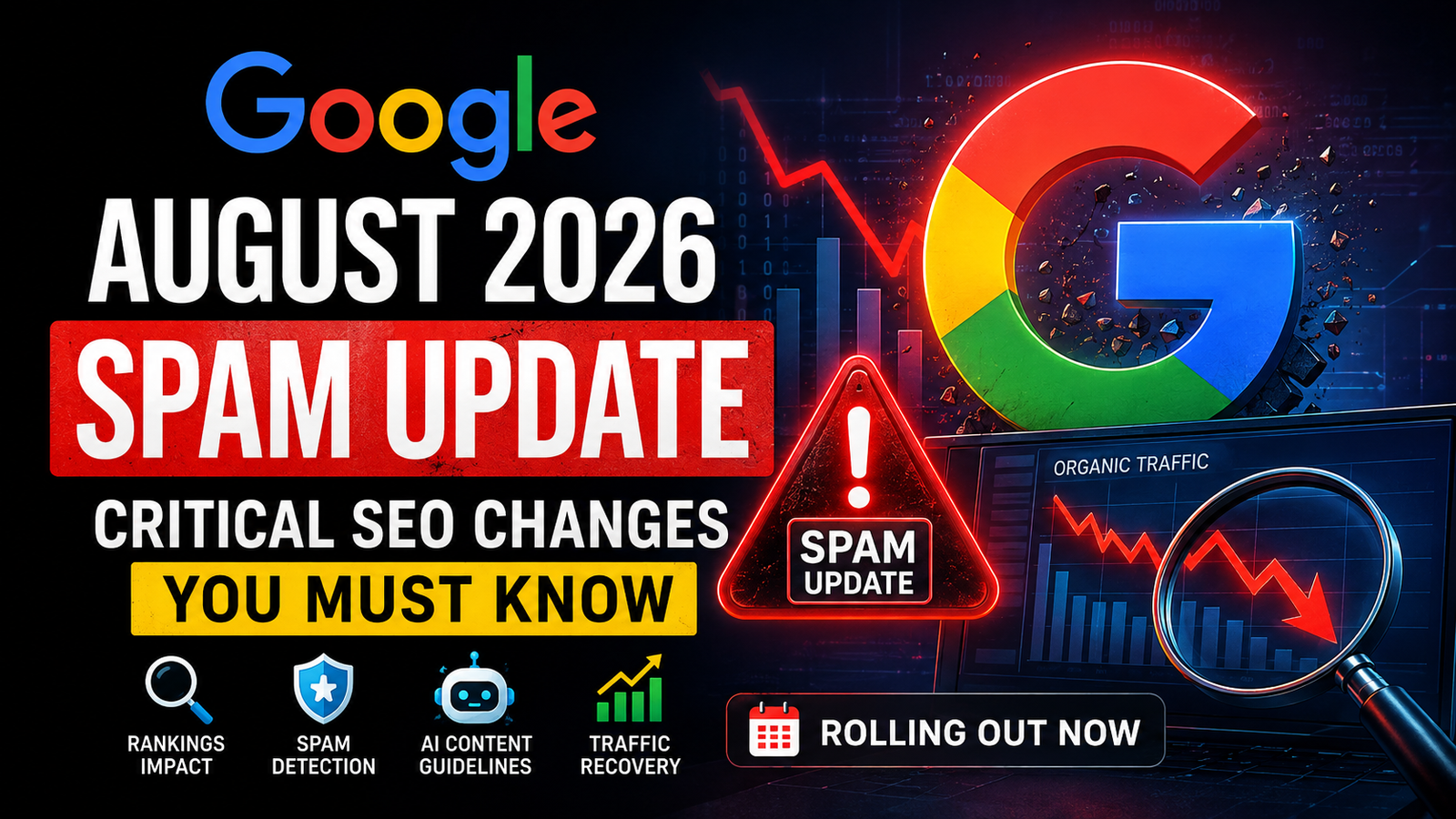
🔥 Google August 2026 Spam Update: Critical SEO Changes Every Website Owner Must Know
Google has started rolling out a new August 2026 Spam Update, and this time there is an important detail that website owners should not ignore:
The update is already live.
Google’s Search Status Dashboard says the update began on August 18, 2026, applies globally and to all languages, and may take several days to complete.
That means this is not the right moment to panic.
It is the right moment to look at your website carefully.
If your traffic changes during the rollout, you need to know whether the cause is the update, normal search volatility, technical problems, or something else.
And there is an especially important question for websites publishing AI-assisted content:
Does using AI to write articles mean Google will consider my website spam?
The answer is no—not automatically.
The real issue is whether your content provides value and follows Google’s spam policies.
In this guide, we’ll explain what Google has actually announced, what we know, what we don’t know yet, what types of websites should pay attention, and exactly what you should do while the update is rolling out.


Table of Contents
What Is the Google August 2026 Spam Update?
The August 2026 Spam Update is a Google Search ranking update designed to improve Google’s ability to detect and deal with spam in its search results.
Google’s official status dashboard confirms three important facts:
- It began on August 18, 2026
- It applies globally
- It applies to all languages
- The rollout may take several days to complete
There is another important detail.
Google has not announced a new spam policy specifically for this update.
Search Engine Journal reports that this is the third spam update of 2026, following the March and June spam updates, and that Google did not publish a new accompanying spam-policy announcement with the August rollout.
That distinction matters.
It means we should not invent a list of “new penalties” that Google has never announced.
Instead, the intelligent approach is to understand Google’s existing spam systems and evaluate whether your site could be vulnerable.Google August 2026 Spam Update
🚨 First: Don’t Panic If Your Traffic Drops Today
This is probably the most important thing to understand.
The update has only just started.
Google says the rollout may take several days.
Therefore, if you look at Google Search Console and see:
Clicks ↓
Impressions ↓
Average position ↓
that does not automatically mean your website has been penalized.
You need to wait for the rollout to develop before drawing conclusions.
There is a second problem:
Search rankings naturally fluctuate.
A page can lose impressions today and recover tomorrow without any manual action.
So don’t make a destructive decision such as:
“Google hates my website. I’m deleting 30 articles.”
That would be a serious mistake.


What Makes a Spam Update Different From a Core Update?
This distinction is extremely important.
A core update is a broad improvement to Google’s ranking systems.
A spam update specifically focuses on detecting and neutralizing spam.
Google maintains separate documentation for its spam systems and core ranking updates.
Think of it like this:
Core Update
Google asks:
“Which results are most useful and relevant for this query?”
Spam Update
Google asks more directly:
“Are there pages here that are manipulating Search or violating our spam policies?”
That’s why you shouldn’t react to a spam update by blindly rewriting every article.
First determine whether there is actually a spam-related problem.
Does AI-Generated Content Automatically Become Spam?
No.
This is one of the biggest myths surrounding SEO in 2026.
Google’s guidance says that using generative AI or automation is not automatically against its policies.
The problem occurs when AI is used to generate large amounts of content primarily to manipulate Search rankings without adding sufficient value. Google explicitly discusses this under its policies concerning scaled content abuse.
So there is a huge difference between:
Scenario A
You use AI to help research, structure, draft, and improve an article.
Then you:
- Verify facts
- Add original analysis
- Add useful examples
- Compare products
- Explain limitations
- Add trustworthy sources
- Edit the article
- Make the article genuinely useful
Scenario B
You tell AI:
“Write 1,000 articles targeting 1,000 keywords.”
Then automatically publish them with:
- Generic introductions
- Repeated information
- No original insight
- No verification
- No real expertise
- No useful differentiation
The second approach is much more dangerous.
The Real Problem Isn’t AI — It’s “AI Slop”
The phrase AI slop has become increasingly relevant because the web is filling with content that looks complete but contains very little original value.
For example:
“AI is revolutionizing digital marketing. In today’s rapidly changing world, businesses can leverage AI to improve efficiency…”
Then 2,000 words later, the reader still doesn’t know what to do.
That is the problem.
Not the fact that AI helped write it.
A useful article should make the reader say:
“I learned something here.”
or:
“Now I know what to do.”
or:
“This saved me time.”
That’s the standard you should aim for.


What Google Actually Wants From Your Content
Google’s long-standing guidance emphasizes a people-first approach.
The question isn’t:
“How many keywords are on this page?”
It’s:
“Does this page actually satisfy the person who searched for it?”
Google has previously explained that content created primarily to attract search-engine traffic, rather than to help people, tends to be unsatisfying to users.
This creates a useful test.
After finishing an article, ask:
If Google disappeared tomorrow, would I still publish this article?
If the answer is:
Yes, because it genuinely helps readers
that’s a good sign.
If the answer is:
No, I only wrote it because the keyword has search volume
that’s a warning.
7 Types of Content You Should Examine During This Update
Don’t assume these categories are automatically being penalized.
Instead, consider them areas worth auditing.
Google August 2026 Spam Update
1. Mass-Produced AI Content
If your website suddenly published hundreds of similar AI-generated pages, examine them carefully.
Look for:
- Repeated wording
- Identical structures
- Generic advice
- No original examples
- Unsupported claims
- Thin sections
- Little differentiation between articles
2. Keyword-Stuffed Articles
If the article sounds unnatural because the keyword appears everywhere, fix it.
For example:
“The best AI SEO tool is the best AI SEO tool for businesses looking for the best AI SEO tool…”
This is not optimization.
It’s noise.
3. Automatically Generated Pages
Be especially careful with pages generated from:
- Databases
- Feeds
- Templates
- Product variations
- Location combinations
- Keyword combinations
If every page is essentially the same, ask whether each page deserves to exist independently.
4. Scraped or Rewritten Content
Copying information from other websites and changing a few words doesn’t create meaningful originality.
Your article needs to add something.
5. Doorway Pages
These are pages created primarily to rank for specific queries while offering little unique value.
For example:
Best AI tools in New York
Best AI tools in Chicago
Best AI tools in Miami
If the actual content is identical except for the city name, there is a problem.
6. Manipulative Links
Unnatural link-building practices can create risk.
Don’t build thousands of meaningless backlinks simply because a service promises:
“Guaranteed Google ranking.”
SEO doesn’t work that way.
7. Pages Created Only for Search Traffic
This is the most important category.
If you wouldn’t want a real person reading the page, why would you want Google to rank it?
What About Affiliate Websites?
This is particularly important.
Affiliate content is not automatically spam.
But affiliate sites need to provide actual value.
Imagine two articles:
Site A
Best 10 AI tools
Each tool receives:
“Tool X is powerful and easy to use.”
That’s it.
Site B
For every tool:
- Who should use it
- Who shouldn’t use it
- Real strengths
- Real weaknesses
- Pricing
- Important limitations
- Alternatives
- Best use case
- Comparison with competitors
Site B is much more useful.
If you’re running an affiliate website, your goal should not be:
“How can I put more affiliate links on the page?”
It should be:
“How can I help the reader make the right decision?”
That difference matters enormously.
Your Biggest Advantage: Tell People When NOT to Buy
This is something many affiliate websites don’t do.
Suppose you’re reviewing an AI tool.
Don’t only write:
“This tool is excellent for marketers.”
Also write:
Don’t choose this tool if:
- You need X
- Your budget is below Y
- You require Z
- You need a specific integration
This makes your article much more trustworthy.
And it gives the reader information that generic affiliate pages often don’t provide.
How to Check Whether Your Website Was Affected
Don’t rely on your emotions.
Use data.
Step 1 — Open Google Search Console
Look at:
Performance → Search results
Compare:
Before update
with
During update
and later:
After rollout
Do not judge the site based on one day.
Step 2 — Check Impressions
If impressions suddenly decline, investigate.
But don’t immediately assume spam.
Step 3 — Check Clicks
A traffic decline can happen because:
- Rankings changed
- Search demand changed
- SERP layout changed
- AI features changed clicks
- A technical problem occurred
Step 4 — Check Average Position
If many pages suddenly lose positions at the same time, that’s more significant than one page fluctuating.
Step 5 — Check Indexed Pages
If important pages disappear from Google’s index, investigate immediately.
Google explains that Search is automated and crawlers continuously discover and process pages for indexing.
Don’t Confuse a Ranking Change With a Manual Action
This is critical.
A manual action is different from an algorithmic ranking change.
If Google Search Console shows a manual action, that’s a specific issue requiring attention.
If traffic simply moves during an algorithm update, that does not necessarily mean Google issued a penalty.
So check:
Google Search Console → Security & Manual Actions → Manual Actions
If there is no manual action, don’t automatically assume you have been manually penalized.
What Should You Do While the Update Is Rolling Out?
❌ Don’t do this
Don’t:
- Delete your entire site
- Change every URL
- Rewrite every title
- Remove all AI-assisted articles
- Buy backlinks
- Increase keyword density
- Publish 100 new articles to compensate
- Panic
The update is still rolling out. Google says it may take several days.
✅ Do This Instead
1. Keep Publishing — But Raise the Quality
You don’t necessarily need to stop publishing.
But don’t publish simply to increase the article count.
Before publishing, ask:
What will the reader learn here that they won’t get from 10 other pages?
If you don’t have a good answer, improve the article first.
2. Audit Your Existing Articles
Create three categories:
🟢 Strong
Keep and improve.
🟡 Average
Expand with useful information.
🔴 Weak
Rewrite heavily or consider whether the page deserves to exist.
This is much smarter than deleting everything.


3. Improve Your Introductions
A weak introduction:
“Artificial intelligence has changed the world…”
A strong introduction:
“If you’re choosing an AI automation platform in 2026, the biggest mistake is comparing features alone. The right tool depends on your workflow, integrations, technical ability, and budget.”
The second immediately addresses the problem.
4. Add Original Analysis
This is where you can make your articles much stronger.
Don’t just tell people:
“Tool A has feature X.”
Tell them:
“Feature X matters if you’re doing Y. But if your workflow depends on Z, Tool B is probably a better choice.”
That’s analysis.
5. Add Real Comparisons
Don’t compare tools using only:
- Price
- Number of features
- Star ratings
Compare them according to user situations.
Example:
| User Situation | Better Choice |
|---|---|
| Beginner | Tool A |
| Marketing team | Tool B |
| Advanced automation | Tool C |
| Low budget | Tool D |
| Enterprise | Tool E |
This is much more useful.
6. Strengthen Internal Linking
Your articles shouldn’t exist as isolated islands.
Create relationships.
For example:
AI Agents
↓
MCP
↓
A2A
↓
Agent Memory
↓
Agentic SEO
↓
AI Automation
This creates a coherent knowledge structure.
And it gives readers a path to continue learning.
7. Use Primary Sources
When discussing:
- Google updates
- AI products
- Pricing
- APIs
- Technical standards
- New features
go to the original source whenever possible.
For Google’s August 2026 Spam Update, the best source is Google’s own Search Status Dashboard.
For Google’s search documentation, use Google Search Central.
Don’t build an article about a Google update using only another SEO blog.
A Very Important Point About This Update
At the moment, Google has not published a detailed explanation saying “we changed X, Y and Z in this August 2026 spam update.”
That’s important.
Some websites will inevitably publish headlines such as:
“Google just changed AI content forever!”
or:
“These 7 types of websites are definitely being penalized!”
Treat those claims carefully.
The official announcement currently confirms the rollout, global scope, and language coverage, but does not provide a new detailed list of spam-policy changes for this update.
Therefore, a responsible SEO strategy should separate:
Confirmed
from
Observed
from
Speculated
This distinction is incredibly important when writing about algorithm updates.
What We Know vs What We Don’t Know
| Question | Current Answer |
|---|---|
| Has the update started? | Yes |
| Start date | August 18, 2026 |
| Global? | Yes |
| All languages? | Yes |
| Finished? | No, rollout is ongoing |
| Exact new spam signals announced? | No detailed new list announced |
| Does AI content automatically equal spam? | No |
| Should you panic? | No |
| Should you audit your site? | Absolutely |
The confirmed rollout information comes directly from Google’s Search Status Dashboard.
The 7-Day SEO Action Plan
Instead of waiting nervously for rankings to move, use the next seven days intelligently.
Day 1 — Baseline
Record:
- Organic clicks
- Impressions
- CTR
- Average position
- Top 20 pages
- Top keywords
Day 2 — Content Audit
Find articles with:
- Little traffic
- Low engagement
- Duplicate information
- Generic content
- Weak introductions
Day 3 — Improve Your Best Pages
Don’t start with your worst pages.
Start with pages that already have:
- Impressions
- Rankings
- Clicks
- Business value
Improve them.
Day 4 — Add Original Information
Add:
- Comparisons
- Examples
- Testing
- Limitations
- Sources
- Decision guidance
Day 5 — Internal Links
Connect relevant articles.
Make sure every important page can be reached through your site’s navigation and internal links.
Day 6 — Technical Check
Review:
- Indexing
- Robots.txt
- Sitemap
- Canonicals
- Broken links
- Mobile usability
- Page speed
Day 7 — Review
Compare your data.
But remember:
Seven days does not necessarily mean the update is finished.
Google has said this rollout may take several days.
So treat this as a baseline, not a final verdict.
What This Means for AI-Focused Websites
This update comes at an interesting moment.
Google Search is becoming increasingly AI-driven, while publishers are simultaneously producing more AI-assisted content.
That creates a dangerous temptation:
“Since AI can create articles quickly, let’s create more articles quickly.”
I would strongly recommend against that strategy.
The better strategy is:
AI → productivity
not:
AI → content factory
Use AI to help you:
- Research
- Organize
- Find gaps
- Generate ideas
- Improve clarity
- Analyze information
But the final article should still have a reason to exist.
The New Standard for Your Articles
Before publishing an article, ask these 10 questions:
1. Does this answer a real problem?
2. Does it provide information beyond the obvious?
3. Is the information accurate?
4. Are important claims supported?
5. Does the article explain weaknesses?
6. Does it tell readers what to choose?
7. Does it tell them when NOT to choose something?
8. Does it contain useful internal links?
9. Does the page have a clear structure?
10. Would a real reader say:
“This was worth my time.”
If the answer to several questions is no, the article isn’t finished.
Final Verdict
🔥 Should You Be Worried About Google’s August 2026 Spam Update?
If your website is built around useful, original, people-first content: don’t panic.
But if your strategy is:
publish as many pages as possible → insert keywords → add affiliate links → wait for Google traffic
then this is a very good moment to rethink the strategy.
The August 2026 Spam Update is currently rolling out globally and across all languages. Google has not announced a new detailed spam-policy list with this rollout, so it would be irresponsible to claim that a particular new technique is definitely being targeted without evidence.
What we do know is that Google’s broader direction continues to favor content that genuinely helps people and systems that identify and neutralize spam.
So the best response isn’t to publish more.
It’s to make what you already publish harder to replace.
That means:
More original analysis.
Better sources.
Better comparisons.
Clearer explanations.
Honest weaknesses.
Useful recommendations.
Less filler.
Less repetition.
Less content created only for keywords.
And perhaps the most important rule for 2026:
Don’t ask how much content you can produce with AI. Ask how much value you can create with AI.
That is the difference between using AI as a productivity tool and turning your website into an AI content factory.
Frequently Asked Questions
When did Google’s August 2026 Spam Update start?
Google began the rollout on August 18, 2026.
Is the August 2026 Spam Update global?
Yes. Google says it applies globally and to all languages.
Is the update finished?
No. Google says the rollout may take several days to complete.
Does Google penalize websites for using AI?
Not simply because AI was used. Google’s guidance focuses on whether content is useful and whether automation is being used to generate content at scale without adding value.
Should I delete AI-generated articles?
No—not automatically.
Audit them first.
If an article is useful, accurate, original, and genuinely helps readers, there is no reason to delete it simply because AI assisted in creating it.
Should I stop publishing during the update?
Not necessarily.
Continue publishing, but prioritize quality over volume.
How can I know whether my website was affected?
Monitor Google Search Console and compare your traffic, impressions, CTR, rankings, and important pages before and during the rollout.
What should I do if my rankings fall?
Don’t immediately make drastic changes.
First determine whether the decline is widespread, whether it coincides with the update, and whether your pages have genuine quality or spam-related weaknesses.
Is this a core update?
No. Google has identified it specifically as a spam update.
Is this the first Google spam update of 2026?
No. Search Engine Journal reports that the August update is the third spam update of 2026, following March and June.
Related Articles
🔗 Agentic SEO Explained
How AI agents and AI-powered search are changing the way websites need to think about visibility.
🔗 A2A Protocol Explained
Understand how AI agents communicate with each other and why multi-agent systems are becoming important.
🔗 AI Agent Memory Explained
Learn how AI agents store and retrieve information across tasks.
🔗 Best AI SEO Tools in 2026
Practical tools for researching, optimizing, auditing, and improving SEO.
Google Search Status Dashboard — August 2026 Spam Update
Google Search Status Dashboard
Google Search Central — Latest Search Updates
Google Search Updates
Google Search Central — How Google Search Works
How Google Search Works
Search Engine Journal — August 2026 Spam Update
Google Begins Rolling Out the August 2026 Spam Update
Search Engine Land — August 2026 Spam Update
Google Releases August 2026 Spam Update