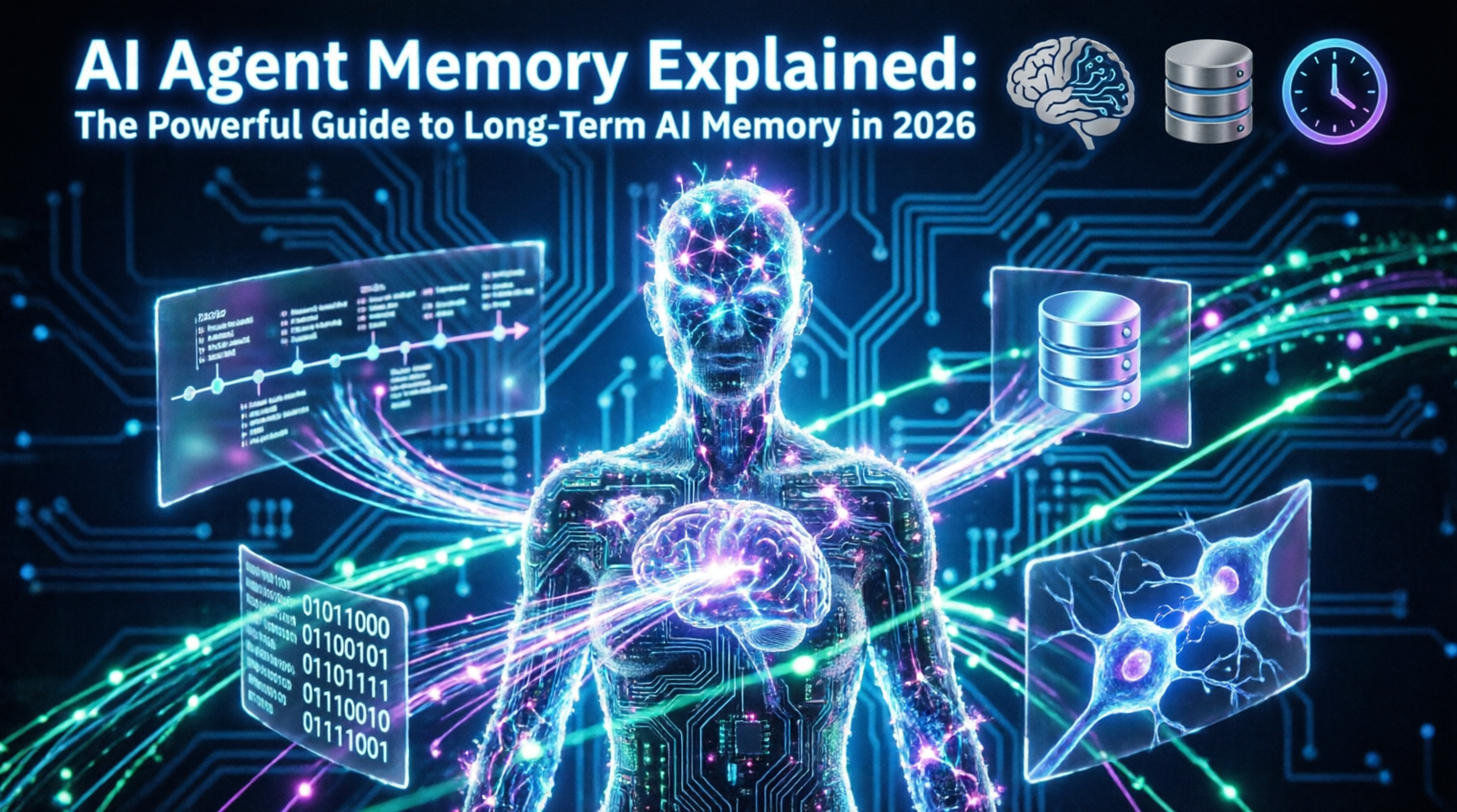
🔥 AI Agent Memory Explained: The Powerful Guide to Long-Term AI Memory in 2026
AI agents can now research, use tools, write code, interact with applications, and even collaborate with other agents.
But there is still a fundamental problem:
What happens when the agent needs to remember something tomorrow?
A normal conversation gives an AI model a temporary context. A serious AI agent, however, may need to work with the same user, customer, project, or business for weeks or months.
That creates a completely different problem:
How can an AI agent remember the right information, retrieve it at the right moment, update it when reality changes, and forget what is no longer useful?
This is the problem AI Agent Memory is trying to solve.
And in 2026, research is moving beyond the simplistic idea of “save the conversation in a vector database.” New systems are exploring structured memory, temporal relationships, episodic experiences, memory revision, reflection, and even agent-controlled decisions about what to store or discard. (ACL Anthology)


Table of Contents
What Is AI Agent Memory?
AI Agent Memory is the system that allows an AI agent to retain, retrieve, update, and use information from previous interactions or experiences.
A simple AI chatbot might work like this:
User
 ↓
Message
 ↓
AI Model
 ↓
Answer
An agent with persistent memory can work more like this:
                    User
                      ↓
                 Current Task
                      ↓
                 AI Agent
                 ↙       ↘
        Current Context   Memory
                           ↓
                    Relevant History
                           ↓
                     Agent Decision
                           ↓
                     New Experience
                           ↓
                    Memory Update
The important point is that memory isn’t simply storage.
A useful memory system needs to determine:
- What information is important
- What should be stored
- What should be retrieved
- What information is outdated
- What should be updated
- What should be forgotten
A 2026 ACL paper called AgeMem takes this idea further by making memory operations part of the agent’s behavior. The agent can decide when to store, retrieve, update, summarize, or discard information. (ACL Anthology)


Image Alt Text: AI agent memory lifecycle showing storing, retrieving, updating, summarizing, and forgetting information
Context Window Is NOT Long-Term Memory
This is one of the most important distinctions to understand.
Suppose you tell an AI agent:
“I prefer concise reports.”
During the current conversation, the model can use that information.
That’s context.
But if you return several weeks later and the agent still knows that preference, that’s persistent memory.
The difference can be simplified like this:
| Context | Memory |
|---|---|
| Usually temporary | Persistent |
| Used for the current task | Used across tasks |
| Limited by the current context | Stored separately |
| Contains current information | Can contain historical information |
| Doesn’t necessarily survive a session | Designed to survive sessions |
Long-term memory is particularly important for agents performing tasks across extended interactions because a finite context window cannot simply contain an unlimited history. This limitation is one of the motivations behind recent agent-memory research. (ACL Anthology)


Why Saving Every Conversation Doesn’t Solve the Problem
At first, the obvious solution seems simple:
Save every conversation.
But imagine an AI assistant that has worked with a customer for three years.
Its history might contain:
- Old preferences
- Temporary requests
- Outdated information
- Contradictory instructions
- Failed attempts
- Irrelevant conversations
- Corrected information
- Sensitive information
If you retrieve everything, the agent receives too much irrelevant information.
If you retrieve too little, it may miss something important.
So the real problem isn’t:
How do we store more information?
It’s:
How do we maintain useful memory over time?
This distinction is becoming increasingly important in current research. HeLa-Mem, for example, argues that representing memories only as independent embedding vectors misses associative relationships between experiences and proposes a dynamic memory graph with episodic and semantic components. (ACL Anthology)


Image Alt Text: AI agent selecting relevant memories instead of retrieving an entire conversation history
The 4 Types of AI Agent Memory You Should Understand
You don’t need dozens of complicated categories.
Four concepts are particularly useful:
- Working Memory
- Episodic Memory
- Semantic Memory
- Procedural Memory
Each answers a different question.


1. Working Memory
Working memory contains the information the agent needs right now.
Imagine asking an agent:
“Compare these five AI writing tools for a small marketing agency.”
The agent may temporarily keep:
- Your budget
- The five tools
- Your requirements
- Comparison criteria
- Information discovered during the task
This is working memory.
You can think of it as:
The agent’s desk.
The agent places the documents it currently needs on the desk.
When the task is finished, most of them don’t need to become permanent memories.
2. Episodic Memory
Episodic memory stores events and experiences.
For example:
“The customer rejected the annual plan because the price was too high.”
That’s an event.
Another example:
“The agent previously tried method X and it failed because the API returned invalid data.”
This can be extremely useful for autonomous agents.
Why?
Because the agent can potentially avoid repeating the same mistake.
Recent work such as HeLa-Mem explores dynamic episodic memory graphs where relationships between experiences can strengthen through repeated associations. (ACL Anthology)


Image Alt Text: AI agent using episodic memory to learn from previous experiences
3. Semantic Memory
Semantic memory stores general facts and knowledge.
For example:
“The customer prefers monthly billing.”
Or:
“This company uses HubSpot.”
The original conversation that produced the information may no longer matter.
The fact itself matters.
A useful distinction is:
| Type | Example |
|---|---|
| Episodic | “The customer rejected the annual plan yesterday.” |
| Semantic | “The customer prefers monthly billing.” |
This distinction becomes especially important when an agent has to convert many individual experiences into reusable knowledge.
HeLa-Mem, for example, uses an episodic memory graph and a semantic memory store, with a reflective process that distills recurring patterns into structured knowledge. (ACL Anthology)
4. Procedural Memory
Procedural memory is about how to perform something.
For example:
“When processing a refund request, first verify the order, then check the refund policy, then request approval.”
The agent can potentially reuse that procedure when a similar task appears later.
This is different from remembering a fact.
It is remembering:
How to do something.
Recent 2026 research is exploring memory systems that combine semantic, episodic, and procedural knowledge so agents can reuse successful experience rather than repeatedly starting from zero. (ACL Anthology)


The Real AI Agent Memory Loop
A weak memory architecture looks like:
Save
 ↓
Search
 ↓
Answer
A stronger architecture looks more like:
Experience
    ↓
Decide What Matters
    ↓
Store
    ↓
Retrieve When Needed
    ↓
Use
    ↓
Evaluate
    ↓
Update / Consolidate / Forget
This final step is critical.
Memory changes.
Imagine a user tells an assistant:
“I prefer email.”
Six months later:
“I don’t use email anymore. Contact me through Slack.”
A useful memory system should not blindly treat both statements as equally current.
It needs some mechanism for revision.
AgeMem explicitly explores agent-controlled memory operations including storing, retrieving, updating, summarizing, and discarding information. (ACL Anthology)


How Does an AI Agent Decide What to Remember?
This is harder than it appears.
Consider four statements.
A
“I’m drinking coffee right now.”
Probably not useful long-term.
B
“My company uses HubSpot.”
Potentially useful.
C
“I prefer short reports.”
Potentially useful.
D
“Strategy X failed because our landing page had a broken checkout.”
Potentially valuable episodic memory.
So the agent needs a memory policy.
It may consider:
- Relevance
- Importance
- Recency
- Future usefulness
- Confidence
- Frequency
- Whether the information has changed
- Privacy considerations
This is one of the major differences between memory and simply saving logs.
AgeMem is particularly interesting here because it treats memory operations as actions the agent can learn to perform rather than forcing every memory decision through a fixed external rule. (ACL Anthology)
How Does Memory Retrieval Work?
Suppose an agent has accumulated 100,000 memories.
The user asks:
“Which marketing strategy worked best for us last time?”
You don’t want to send all 100,000 memories to the model.
A retrieval layer is needed:
User Question
     ↓
Memory Query
     ↓
Candidate Memories
     ↓
Ranking / Filtering
     ↓
Relevant Memories
     ↓
Context Construction
     ↓
AI Agent
This makes retrieval quality one of the most important parts of an agent-memory system.
If the wrong memory is retrieved, the agent may give a confident answer based on irrelevant evidence.
Why Vector Search Isn’t Enough
Many memory systems use embeddings.
The basic idea:
Memory → Embedding
Question → Embedding
       ↓
Similarity Search
       ↓
Closest Memories
This can be very useful.
But semantic similarity doesn’t capture every relationship.
Consider:
“The customer started using Product A in January.”
and:
“The customer stopped using Product A in March.”
Both are semantically related.
But the time relationship changes the meaning.
Other questions also matter:
- Who did it?
- When did it happen?
- What caused it?
- What happened afterward?
- Is the information still valid?
This is exactly why MAGMA proposes representing memories across separate semantic, temporal, causal, and entity graphs, then retrieving through those relationships instead of relying only on one similarity store. (ACL Anthology)


Vector Database vs Structured Memory
This leads to another important point:
You don’t need a vector database for every type of memory.
Different information can require different storage approaches.
User preference
user_id: 123
preference: concise_reports
A structured database can handle this very well.
Similar past experiences
A vector index can be useful.
Relationships
Customer
   ↓
owns
   ↓
Company
   ↓
uses
   ↓
Software
A graph can be more appropriate.
Historical events
An event store may be useful.
The right question isn’t:
“Which vector database should I use?”
It’s:
“What kind of memory am I storing, and how will I retrieve it?”
MAGMA’s multi-graph approach is an example of research moving toward different relationship structures rather than treating all memory as one homogeneous collection. (ACL Anthology)
A Practical AI Agent Memory Architecture
A useful architecture could look like this:
                         AI AGENT
                            │
              ┌─────────────┴─────────────┐
              ▼                           ▼
       Working Context              Memory Manager
                                           │
                    ┌──────────────────────┼──────────────────────┐
                    ▼                      ▼                      ▼
               Episodic                Semantic              Procedural
                Memory                  Memory                 Memory
                    │                      │                      │
                    └──────────────────────┼──────────────────────┘
                                           ▼
                                    Retrieval Layer
                                           │
                                           ▼
                                    Relevant Context
                                           │
                                           ▼
                                       AI Model
The important component is the Memory Manager.
It shouldn’t simply dump every conversation into storage.
It should help determine:
- What gets retained
- What gets retrieved
- What gets updated
- What gets consolidated
- What gets removed
This direction is reflected in recent research. Hindsight, for example, organizes long-term agent memory into four logical networks—world, experience, observation, and opinion—and uses retain, recall, and reflect operations. (ACL Anthology)


AI Agent Memory Can Actually Make the Agent Worse
This is one of the most important warnings in the entire topic.
Imagine the agent remembers:
“The customer likes Product A.”
Six months later, the customer switched to Product B.
If the old memory is retrieved without considering time or validity, the agent may recommend Product A.
That’s a memory failure.
Another example:
“Always use Strategy X.”
But the company changed its process.
The agent continues following the old instruction because the memory was never revised.
This creates problems such as:
- Stale information
- Contradictory memories
- Incorrect assumptions
- Retrieval noise
- Privacy risks
- Behavioral drift
A 2026 paper proposing Governed Evolving Memory (GEM) specifically argues that long-term agent memory needs operations for ingestion, revision, forgetting, and retrieval because treating memory as ordinary static records creates recurring problems such as uncontrolled growth and missing semantic revision. (arXiv)


Why AI Agents Need Forgetting
This sounds strange.
Why would we want an AI agent to forget?
Because remembering everything isn’t the objective.
The objective is:
Remember what remains useful.
Consider:
“I’m traveling to Paris this week.”
That could be useful for several days.
But storing it forever may be pointless.
Other information may need to disappear because:
- It is outdated
- It was incorrect
- The user requested deletion
- It was temporary
- It creates unnecessary privacy risk
Therefore, serious memory architecture needs:
Retention + Revision + Forgetting
not simply:
Storage + Search
This is exactly the direction explored by recent work on evolving agent memory. (arXiv)
Privacy: The Problem People Often Ignore
Agent memory can contain information users never expected to persist.
Imagine an AI assistant remembering:
- Personal preferences
- Customer information
- Business decisions
- Internal documents
- Financial information
- Conversations
- Private instructions
Now ask:
Who can access those memories?
And:
How long are they stored?
And:
Can the user delete them?
And:
Can another AI agent retrieve them?
These aren’t secondary questions.
They are architectural requirements.
A serious memory system should define:
- What can be stored
- What must not be stored
- Retention periods
- Access controls
- Deletion mechanisms
- Auditability
- Encryption
- Agent permissions
The more autonomous the agent becomes, the more important these controls become.
AI Agent Memory + Multi-Agent AI
This connects directly with the Multi-Agent AI architecture we discussed earlier.
Imagine three agents:
                 Coordinator
                /     |      \
               ▼      ▼       ▼
            Sales   Research  Finance
             Agent    Agent    Agent
               │        │        │
               ▼        ▼        ▼
            Private   Private   Private
            Memory    Memory    Memory
Should every agent share one giant memory?
Not necessarily.
The sales agent may need customer history.
The research agent may need research experiences.
The finance agent may need financial records.
Giving all three agents unrestricted access could create unnecessary security and privacy problems.
A better architecture may contain:
Private memory
Information belonging to one agent.
Shared memory
Information deliberately made available to several agents.
Task memory
Temporary information needed only for a particular workflow.
This becomes increasingly important as multi-agent systems grow.
AI Agent Memory vs RAG
These concepts are often confused.
RAG
Retrieval-Augmented Generation usually retrieves information from an external knowledge source.
Question
   ↓
Search Documents
   ↓
Retrieve Information
   ↓
LLM
Agent Memory
Memory is more focused on persistent information about:
- Previous experiences
- User preferences
- Past decisions
- Learned procedures
- Historical events
- Agent state
They can work together:
                    AI Agent
                   /        \
                  ▼          ▼
                RAG        Memory
                 │           │
          External Docs   Past Experience
                 │           │
                 └─────┬─────┘
                       ▼
                     LLM
A simple mental model:
RAG asks: “What does my external knowledge contain?”
Memory asks: “What do I know from previous interactions and experiences?”
The boundary isn’t always absolute, but this distinction is useful when designing agent systems.
A Real Example: A Personal AI Assistant
Let’s make the concept practical.
Imagine an AI assistant that works with you every day.
Day 1
You say:
“I prefer concise reports.”
The system stores the preference.
Day 20
You ask:
“Summarize this research.”
The agent retrieves:
Preference → concise reports.
The response is short.
Day 50
You say:
“For research reports, I now want detailed explanations.”
The system should update the previous preference.
Day 100
You request another research report.
The agent should retrieve the current preference, not simply the first matching memory.
That’s the difference between:
memory storage
and
memory management.
The Interesting Direction in 2026: Memory That Manages Itself
This is where things get particularly interesting.
Older-style architecture:
Store
 ↓
Retrieve
More advanced architectures increasingly look like:
Experience
    ↓
Reflect
    ↓
Organize
    ↓
Consolidate
    ↓
Retrieve
    ↓
Update
    ↓
Forget
For example:
AgeMem
Allows the agent to make memory operations part of its policy, including storing, retrieving, updating, summarizing, and discarding information. (ACL Anthology)
Hindsight
Separates different types of knowledge and adds retain, recall, and reflect operations. (ACL Anthology)
HeLa-Mem
Uses dynamic associative memory graphs and separates episodic and semantic memory. (ACL Anthology)
MAGMA
Uses semantic, temporal, causal, and entity graphs to make retrieval more structured. (ACL Anthology)
Together, these approaches show a broader shift:
AI agent memory is moving from passive storage toward active memory management.


How to Build AI Agent Memory Without Overengineering
You don’t need the most advanced research architecture for every application.
Start with the simplest useful level.
Level 1 — Session Memory
Use information only during the current task.
Best for:
- Simple chatbots
- One-off workflows
- Document analysis
Level 2 — User Preferences
Store durable preferences.
Examples:
- Preferred language
- Preferred format
- Communication style
- Business preferences
Level 3 — Episodic Memory
Store meaningful events.
Examples:
- Previous decisions
- Successful attempts
- Failed attempts
- Important interactions
Level 4 — Procedural Memory
Store reusable workflows.
Examples:
- How to process a refund
- How to prepare a report
- How to execute a recurring operation
Level 5 — Adaptive Memory
The agent decides:
- What to remember
- What to retrieve
- What to update
- What to consolidate
- What to forget
This is the most sophisticated level.
And it should be introduced only when simpler memory isn’t enough.
7 Common AI Agent Memory Mistakes
1. Saving Everything
More memories don’t automatically mean a smarter agent.
2. Never Updating Old Information
Old memories eventually become wrong.
3. Treating Every Memory as Equally Important
A temporary event shouldn’t necessarily have the same lifetime as a permanent preference.
4. Trusting Retrieved Memories Blindly
A retrieved memory can be wrong, outdated, or incorrectly interpreted.
5. Giving Every Agent Access to Every Memory
This increases privacy and security risks.
6. Using a Vector Database for Everything
Different information may require different storage and retrieval methods.
7. Ignoring Deletion
A serious memory system needs a way to remove information.
When Should You Use AI Agent Memory?
Persistent memory makes sense when:
The same user interacts repeatedly
A personal assistant or customer-support agent can benefit significantly.
Tasks span multiple sessions
For example, a research project lasting several weeks.
Past experiences influence future decisions
This is particularly useful for autonomous agents.
Personalization matters
The agent needs to understand stable user preferences.
The system improves through experience
Previous successes and failures can become reusable knowledge.
When Should You NOT Use Persistent Memory?
This is just as important.
You probably don’t need it when:
The task is one-off
For example:
“Summarize this PDF.”
Current information can already be retrieved reliably
If a trusted source contains the current information, storing an old copy may create unnecessary maintenance.
The information changes constantly
Memory without a strong update strategy can become stale.
Retrieval quality is poor
Bad memory retrieval can make an agent less reliable than an agent with no memory.
The complexity isn’t justified
If adding memory costs more than the benefit it creates, don’t add it.
The Best Mental Model for AI Agent Memory
Don’t think:
“I need a database where my AI remembers everything.”
Think:
“I need a controlled system that maintains useful knowledge about previous interactions and experiences.”
A good memory system should answer four questions:
1. What should I remember?
Retention
2. What should I retrieve?
Recall
3. What should I change?
Revision
4. What should I remove?
Forgetting
This way of thinking is much closer to the direction of current agent-memory research than simply adding a vector database to an AI application. (ACL Anthology)
Final Verdict
Is AI Agent Memory Worth Building?
Yes—but not for every AI agent.
Memory becomes valuable when an agent must operate over long periods and learn from previous interactions, decisions, preferences, or experiences.
But the biggest mistake is assuming:
More memory = smarter AI.
That’s not necessarily true.
A poorly designed memory system can introduce:
- Outdated information
- Contradictions
- Retrieval errors
- Higher costs
- Privacy risks
- Unwanted behavior
The better goal is:
Remember the right information, retrieve it at the right time, update it when reality changes, and remove it when it no longer belongs.
And this is where 2026 research becomes particularly interesting.
AgeMem is exploring agents that actively manage memory operations. Hindsight explores structured memory with distinct knowledge networks and retain/recall/reflect operations. HeLa-Mem explores associative episodic-semantic memory graphs. MAGMA explores multiple relational graphs for semantic, temporal, causal, and entity-aware retrieval. (ACL Anthology)
The future isn’t:
AI that remembers everything.
It’s:
AI that knows what is worth remembering.
Frequently Asked Questions
Does an AI automatically remember previous conversations?
Not necessarily. Persistent memory requires a mechanism that stores and retrieves information across sessions.
Is a larger context window the same as long-term memory?
No. A context window provides information for the current interaction. Persistent memory is designed to survive beyond the current context.
What are the main types of AI agent memory?
Four useful categories are working memory, episodic memory, semantic memory, and procedural memory.
Does every AI agent need memory?
No. Simple, one-off tasks often don’t need persistent memory.
Is a vector database required?
No. Vector databases are useful for semantic retrieval, but structured databases, graphs, event stores, and other architectures can be better depending on the type of information.
Can AI memory become incorrect?
Yes. Memories can become outdated, contradictory, incomplete, or incorrectly retrieved.
Should an AI agent remember everything?
No. Selective memory is usually more useful than indiscriminate storage.
Can multiple AI agents share memory?
Yes, but access should be deliberately controlled. Some memories may need to remain private to individual agents.
What is the difference between RAG and AI memory?
RAG generally retrieves external knowledge for a task, while agent memory focuses on persistent information from previous interactions, experiences, preferences, and learned procedures.
What is the future of AI Agent Memory?
Research is moving toward structured, adaptive memory systems that can retrieve, revise, consolidate, reflect on, and forget information instead of simply storing conversation embeddings. (ACL Anthology)
Related Articles
1. AI Agents Explained
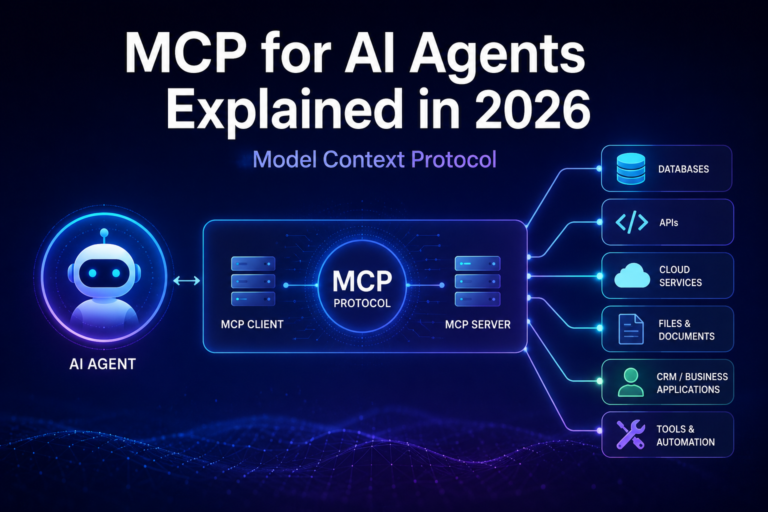
2. MCP Explained
3. A2A Protocol Explained
4. Multi-Agent AI Explained
5. Best AI Automation Tools in 2026
Research Sources
AgeMem — Agentic Memory
Read the AgeMem research paper — ACL 2026
Hindsight — Structured Agent Memory
Read the Hindsight research paper — ACL 2026
HeLa-Mem
Read the HeLa-Mem research paper — ACL 2026
MAGMA
Read the MAGMA research paper — ACL 2026
Governed Evolving Memory
Read “Is Agent Memory a Database?” — 2026