Best AI Marketing Automation Tools in 2026
AI marketing automation is no longer limited to sending scheduled emails. Modern platforms can help marketers analyze customer data, build segments, create campaigns, personalize messages, connect applications, and optimize repetitive workflows.
But there is an important distinction between tools that automate marketing execution and tools that simply generate marketing content.
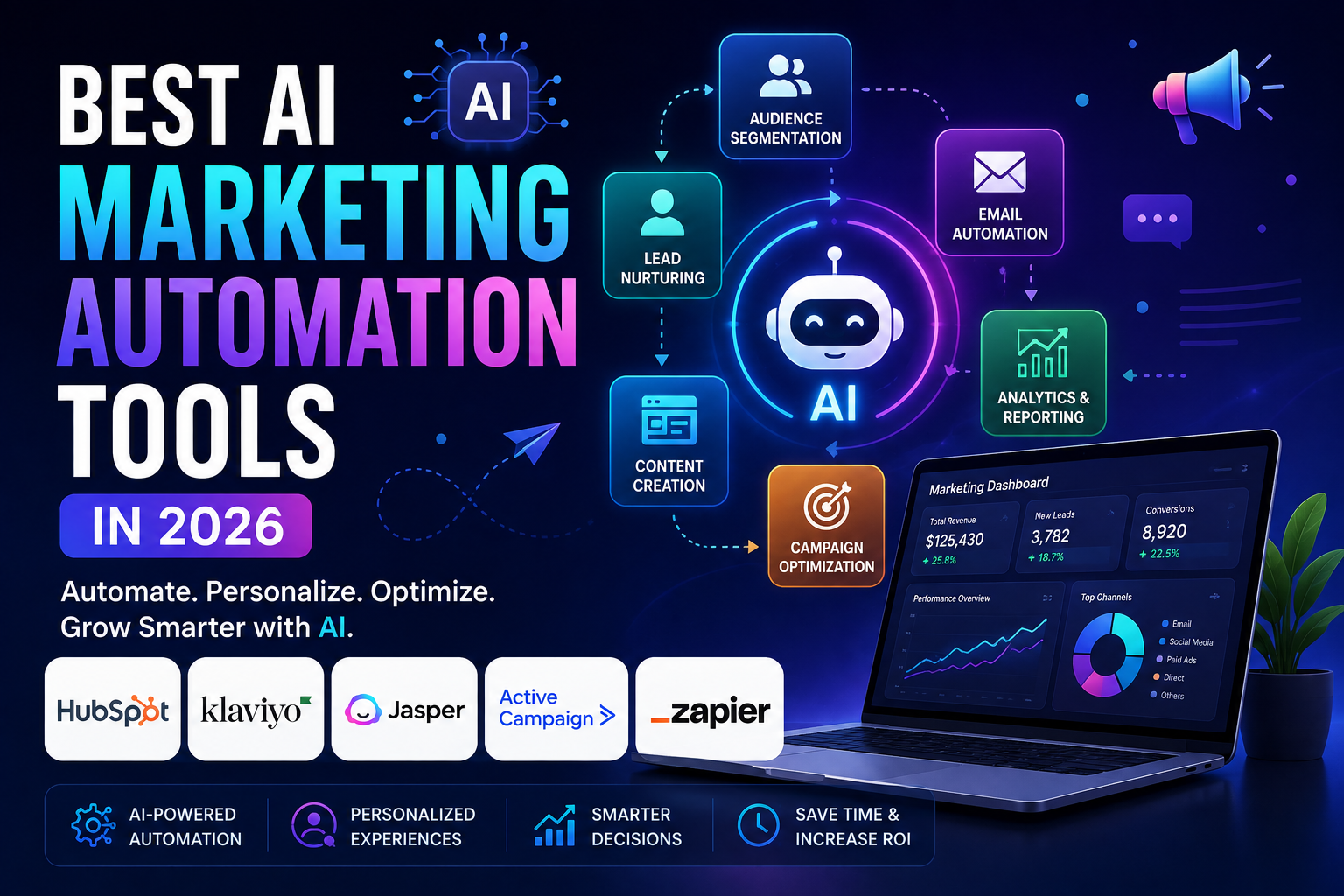
In this guide, we compare five platforms that approach AI marketing automation from different angles:
- HubSpot — best for CRM-connected marketing automation
- Klaviyo — best for ecommerce and customer lifecycle marketing
- Jasper — best for AI-powered marketing execution and content workflows
- ActiveCampaign — best for email automation and customer journeys
- Zapier — best for connecting marketing tools and building custom workflows
Rather than ranking them only by the number of AI features they advertise, we look at what each platform is actually designed to automate, where it fits in a marketing stack, and when another tool may be a better choice.
Quick answer: HubSpot is our best overall choice for businesses that want CRM, marketing automation, and AI in one ecosystem. Klaviyo is stronger for ecommerce lifecycle marketing, Jasper for AI-assisted marketing execution, ActiveCampaign for sophisticated customer journeys, and Zapier for connecting an existing stack.
What Is AI Marketing Automation?
AI marketing automation combines traditional marketing automation with artificial intelligence.
Traditional automation generally follows predefined rules:
A visitor submits a form
↓
Add the contact to a list
↓
Send email #1
↓
Wait three days
↓
Send email #2
AI can add another layer of analysis and assistance.
For example:
A visitor submits a form
↓
Customer information is analyzed
↓
The contact is segmented
↓
The system identifies relevant signals
↓
A suitable campaign or workflow is recommended
↓
The marketer reviews and approves the action
↓
Performance is measured
The practical difference is that AI can help with classification, personalization, content generation, analysis, recommendations, and workflow creation rather than simply following a fixed sequence.
However, AI does not eliminate the need for good marketing strategy or human oversight. The quality of the customer data, rules, goals, and campaign strategy still matters.
What Can AI Marketing Automation Actually Do?
Depending on the platform, AI can assist with:
- Customer segmentation
- Lead qualification
- Lead scoring
- Email campaign creation
- Customer journeys
- Personalization
- Content creation
- Campaign analysis
- Marketing reporting
- Workflow creation
- Customer re-engagement
- Product recommendations
- Lead routing
- Data enrichment
- Cross-platform automation
- Content repurposing
- Campaign optimization
Not every platform does all of these things equally well.
That is why comparing AI marketing tools by a single feature list can be misleading.
A CRM-focused platform may be excellent at connecting marketing activity with customer records but unnecessary for someone who only needs to connect two applications.
Likewise, an AI content platform may be excellent for campaign production but not replace a customer-data platform.
The best tool depends on what you actually want to automate.
Best AI Marketing Automation Tools in 2026
| Tool | Best for | Main strength |
|---|---|---|
| HubSpot | Overall marketing automation | CRM + marketing + AI |
| Klaviyo | Ecommerce | Customer data + lifecycle marketing |
| Jasper | Marketing content and execution | AI agents + content workflows |
| ActiveCampaign | Email and customer journeys | Automation + segmentation |
| Zapier | Custom automation | Connecting different applications |
These are not five identical products. They solve different problems, which is important when deciding between them.
1. HubSpot — Best Overall for CRM-Connected Marketing Automation
HubSpot
Best for: Businesses that want CRM, marketing automation, sales, customer data, and AI in one ecosystem.
HubSpot is our best overall choice because its biggest advantage is not simply the amount of AI it offers. It is the connection between AI capabilities and the company’s CRM data.
HubSpot’s current AI ecosystem, including Breeze, can work with CRM information and assist with tasks such as customer research, content, campaign planning, and custom agents. HubSpot also offers an Agent Builder for creating custom agents and workflows using CRM data and business rules.
Why HubSpot Stands Out
Consider a typical B2B lead workflow:
New lead arrives
↓
Customer information is stored in CRM
↓
Lead is evaluated
↓
Relevant information is researched
↓
Lead is assigned to the appropriate team
↓
Personalized follow-up begins
↓
Sales activity is tracked
The advantage is that these activities can happen within a connected customer-data environment instead of being spread across unrelated applications.
HubSpot’s AI Data Agent, for example, is designed to research contacts, customers, and prospects in the CRM and surface information that teams would otherwise have to research manually.
Key Features
- CRM
- Marketing automation
- Email marketing
- Lead management
- Customer data
- AI assistance
- AI agents
- Workflow automation
- Customer research
- Marketing analytics
- Content creation
- Sales automation
Best Use Cases
HubSpot makes the most sense if you:
- Need CRM and marketing automation together
- Run B2B marketing campaigns
- Want sales and marketing to share customer data
- Need lead management and nurturing
- Want AI connected to CRM information
- Prefer an integrated platform instead of many separate tools
When HubSpot May Not Be the Best Choice
HubSpot can be more platform than you need if your requirements are very narrow.
For example, a small business that only wants to automate a few application-to-application tasks may not need a full CRM ecosystem.
An ecommerce company primarily focused on highly specialized lifecycle marketing may also prefer a platform such as Klaviyo.
Our Verdict
HubSpot is the strongest overall choice when CRM-connected marketing automation is the priority.
Its main advantage is the combination of customer data, marketing workflows, sales processes, and AI assistance.
Visit HubSpot’s official website
2. Klaviyo — Best for Ecommerce and Customer Lifecycle Marketing
Klaviyo
Best for: Ecommerce brands that rely on customer behavior, segmentation, email, SMS, and repeat purchases.
Klaviyo is particularly strong when marketing depends on what customers do before, during, and after a purchase.
Its platform combines customer data, segmentation, messaging, automation, and AI capabilities.
In 2026, Klaviyo introduced Composer, an AI marketing agent that can analyze account data and help create campaigns, flows, and segments from natural-language instructions. Importantly, Klaviyo states that Composer does not independently launch campaigns; marketers review, edit, and approve its work.
Why Klaviyo Stands Out
Imagine an online store with customers who:
- Purchased recently
- Added products to their cart
- Have not purchased for six months
- Frequently buy a particular product category
- Open emails but rarely purchase
A lifecycle marketing platform can use this behavioral information to create different audiences and campaigns.
For example:
Customer purchases
↓
Customer enters post-purchase flow
↓
Relevant follow-up message
↓
Product recommendation
↓
Customer engagement is measured
↓
Customer enters another segment
This is where Klaviyo becomes particularly useful.
Key Features
- Email marketing
- SMS marketing
- Customer segmentation
- Ecommerce integrations
- Personalized campaigns
- Customer journeys
- Product recommendations
- AI campaign creation
- AI-assisted segmentation
- Composer
- Customer Agent
- Campaign analysis
Best Use Cases
Choose Klaviyo if you:
- Run an ecommerce store
- Depend heavily on repeat purchases
- Need advanced customer segmentation
- Use email and SMS together
- Want behavioral marketing
- Need personalized lifecycle campaigns
When Klaviyo May Not Be the Best Choice
If you need a broad CRM covering sales, service, marketing, and other business functions, HubSpot may be a better fit.
If your main requirement is simply connecting multiple applications, Zapier may be more appropriate.
Our Verdict
Klaviyo is our top choice for ecommerce brands where customer behavior and lifecycle marketing are central to growth.
Its strength is the combination of customer data + segmentation + messaging + automation + AI assistance.
Visit Klaviyo’s official website
3. Jasper — Best for AI Marketing Execution and Content Workflows
Jasper
Best for: Marketing teams that want AI agents to assist with research, content creation, personalization, activation, and optimization.
Jasper is different from HubSpot and Klaviyo.
It is not primarily a CRM or ecommerce customer-data platform. Its focus is marketing execution.
Jasper currently positions its platform around specialized AI agents, content pipelines, shared brand context, and human oversight. Its agents are designed for different stages of marketing work, including planning, creation, adaptation, activation, and optimization.
Why Jasper Stands Out
Suppose a marketing team is preparing a product launch.
Instead of treating every asset as an isolated task, a workflow can look like:
Campaign research
↓
Campaign brief
↓
Blog content
↓
Email campaign
↓
Social content
↓
Ad variations
↓
Optimization
The value comes from creating a connected marketing process rather than asking an AI chatbot to generate individual pieces of copy.
Jasper also provides tools for creating custom AI agents and workflows without requiring traditional development work.
Key Features
- AI marketing agents
- Content workflows
- Campaign planning
- Marketing research
- Content creation
- Brand voice
- Personalization
- Content optimization
- SEO-related workflows
- AI search visibility tools
- Custom agents
- Marketing automation
Best Use Cases
Jasper is particularly suitable for teams that:
- Produce content across multiple channels
- Need consistent brand voice
- Run content-heavy marketing campaigns
- Want specialized marketing AI agents
- Need repeatable content workflows
- Want to scale marketing execution without treating every task as a separate prompt
When Jasper May Not Be the Best Choice
If your main challenge is CRM management or ecommerce customer retention, Jasper may not be the first platform to consider.
Likewise, if you simply need to connect applications, Zapier addresses a different problem.
Our Verdict
Jasper is our preferred choice for marketing teams whose biggest automation opportunity is AI-assisted marketing execution and content workflows.
Its differentiator is the combination of agents, content pipelines, brand context, and human-controlled execution.
Visit Jasper’s official website
4. ActiveCampaign — Best for Email Automation and Customer Journeys
ActiveCampaign
Best for: Businesses that rely heavily on email automation, segmentation, lead nurturing, and customer journeys.
ActiveCampaign has a long-standing focus on marketing automation, particularly email campaigns and customer journeys.
Its current AI offering, Active Intelligence, is designed to assist with campaign creation, automation building, performance analysis, and optimization. ActiveCampaign’s documentation says the system can help users create campaigns, build automations, analyze insights, and develop improved versions of underperforming content.
Why ActiveCampaign Stands Out
Consider a lead nurturing sequence:
New lead
↓
Segment based on behavior
↓
Send relevant email
↓
Track engagement
↓
Adjust customer journey
↓
Score the lead
↓
Trigger another action
The platform is especially useful when your marketing strategy depends on these types of conditional journeys.
Key Features
- Email marketing
- Marketing automation
- Customer journeys
- Segmentation
- Lead scoring
- Personalization
- CRM
- AI campaign assistance
- Automation building
- Campaign analysis
- Customer engagement
Best Use Cases
ActiveCampaign is a strong fit if you:
- Build complex email sequences
- Need behavioral segmentation
- Run lead-nurturing campaigns
- Want automated customer journeys
- Need automation beyond simple newsletters
- Want AI assistance for campaign analysis
When ActiveCampaign May Not Be the Best Choice
For ecommerce brands whose marketing depends heavily on product-level customer behavior, Klaviyo may be a more natural fit.
For organizations looking for an extensive CRM and broader business platform, HubSpot may make more sense.
For general app-to-app automation, Zapier is the more specialized option.
Our Verdict
ActiveCampaign remains one of the strongest choices when email automation and customer journeys are at the center of your marketing strategy.
Visit ActiveCampaign’s official website
5. Zapier — Best for Connecting Marketing Tools
Zapier
Best for: Marketers who already use several applications and want to connect them through automated workflows.
Zapier is different from the other four tools.
It is primarily an automation and integration platform, not a complete marketing suite.
That distinction is important.
Suppose your marketing stack contains:
- A CRM
- An email platform
- WordPress
- Google Sheets
- Slack
- An ecommerce platform
- Advertising platforms
- AI tools
Instead of replacing those applications, Zapier can connect them.
A workflow could look like:
New lead
↓
AI classifies lead
↓
High-value lead?
↓
Yes → CRM + sales notification
No → nurture workflow
This makes Zapier particularly useful when the problem is fragmentation between tools.
Key Features
- App integrations
- Workflow automation
- AI-powered steps
- Data processing
- Lead routing
- Content workflows
- Classification
- Custom automations
- AI agents
- Marketing integrations
Best Use Cases
Choose Zapier if you:
- Already use multiple marketing applications
- Need custom workflows
- Want no-code integrations
- Need to move information between platforms
- Want to add AI steps to existing processes
- Do not want to replace your current marketing stack
When Zapier May Not Be the Best Choice
Zapier should not be your first choice if you are looking for a complete CRM and marketing platform.
It is most valuable when you already have the tools you need but want them to work together automatically.
Our Verdict
Zapier is our top choice for connecting an existing marketing stack and adding custom automation between applications.
Visit Zapier’s official website
AI Marketing Automation: A Practical Workflow
The most effective setup is not always one platform.
A company may use different tools for different jobs.
For example:
CRM
→ Stores customer information
Marketing automation platform
→ Manages customer journeys
AI marketing platform
→ Assists with content and campaign production
Automation platform
→ Connects the applications
The important question is not:
“How many AI tools can I use?”
It is:
“Which parts of my workflow are repetitive enough to automate, and which decisions still require human judgment?”
What Should You Automate First?
Trying to automate an entire marketing department at once usually creates unnecessary complexity.
A better approach is to start with repetitive processes that have a clear objective.
1. Lead Capture and Routing
A simple workflow can be:
Form submission
↓
Store lead
↓
Enrich or classify information
↓
Assign segment
↓
Route lead
↓
Start relevant follow-up
This can reduce manual administrative work.
2. Email Nurturing
Email is one of the clearest areas for automation.
A typical journey could be:
New subscriber
↓
Welcome message
↓
Engagement tracking
↓
Audience segmentation
↓
Relevant follow-up
↓
Conversion or re-engagement
The important part is not sending more emails.
It is sending more relevant emails based on meaningful customer behavior.
3. Content Repurposing
A single useful piece of content can often become several formats.
For example:
Original article
↓
Email summary
↓
LinkedIn post
↓
Short-form social content
↓
Video script
↓
Sales enablement material
AI can accelerate this process, but human review is still important for accuracy, tone, and originality.
4. Customer Re-Engagement
Automation can identify customers or subscribers who have become inactive.
A workflow might be:
No engagement
↓
Identify inactive segment
↓
Determine appropriate message
↓
Send re-engagement campaign
↓
Measure response
↓
Update customer segment
This can be particularly useful for subscription and ecommerce businesses.
5. Marketing Reporting
Reporting is another area where AI can reduce repetitive work.
Instead of manually compiling every metric:
Campaign data
↓
AI-assisted analysis
↓
Performance summary
↓
Potential problems
↓
Recommended areas for investigation
The final business decision should still be made by a person who understands the broader context.
AI Marketing Automation vs. Traditional Automation
| Traditional automation | AI-assisted automation |
|---|---|
| Fixed rules | Rules plus AI assistance |
| Predefined sequences | More flexible workflows |
| Manual segmentation | AI-assisted segmentation |
| Manual content drafting | AI-assisted content generation |
| Manual reporting | AI-assisted analysis |
| Static personalization | Data-driven personalization |
| Manually built workflows | AI can help design workflows |
| Human executes many repetitive tasks | AI can handle more routine execution |
The difference should not be exaggerated.
AI marketing automation is still automation.
The additional value comes from using AI for tasks such as classification, analysis, content generation, recommendations, and workflow construction.
How to Choose the Best AI Marketing Automation Tool
Instead of asking which platform has the most AI features, start with your biggest marketing problem.
Choose HubSpot if…
Your main problem is:
CRM + marketing + customer data + automation
HubSpot is the strongest fit when these functions need to work together.
Choose Klaviyo if…
Your main problem is:
Ecommerce retention + customer segmentation + lifecycle marketing
Klaviyo is particularly strong when customer behavior and repeat purchases drive the marketing strategy.
Choose Jasper if…
Your main problem is:
Marketing content + campaign execution
Jasper is designed around AI-assisted marketing execution, agents, and structured content workflows.
Choose ActiveCampaign if…
Your main problem is:
Email automation + customer journeys
ActiveCampaign is particularly useful when marketing depends on sophisticated sequences and behavioral automation.
Choose Zapier if…
Your main problem is:
Connecting different applications
Zapier is the strongest choice when your marketing stack already exists but the tools do not communicate effectively.
AI Marketing Automation Decision Table
| If you need… | Best fit | Why |
|---|---|---|
| CRM-connected marketing automation | HubSpot | Customer data and marketing workflows in one ecosystem |
| Ecommerce lifecycle marketing | Klaviyo | Segmentation, messaging, and customer behavior |
| AI marketing execution | Jasper | Agents and structured marketing workflows |
| Email and customer journeys | ActiveCampaign | Strong automation and segmentation |
| Cross-platform automation | Zapier | Connects existing applications |
Which Tool Would We Choose?
There is no universal winner.
Our choice depends on the marketing problem.
Best overall: HubSpot
Choose HubSpot when you want CRM, marketing automation, customer data, and AI capabilities connected in one environment.
Best for ecommerce: Klaviyo
Choose Klaviyo when customer behavior, retention, email, SMS, and lifecycle marketing are central to your business.
Best for AI marketing execution: Jasper
Choose Jasper when your biggest challenge is producing, adapting, and optimizing marketing content and campaigns at scale.
Best for email automation: ActiveCampaign
Choose ActiveCampaign when sophisticated customer journeys and email automation are the foundation of your marketing strategy.
Best for custom automation: Zapier
Choose Zapier when you already have a collection of tools and need them to work together.
Common AI Marketing Automation Mistakes
1. Automating a Bad Process
Automation does not automatically make a poor process better.
Before automating, understand:
- What triggers the workflow?
- What outcome do you want?
- Who is the customer?
- What should happen if the workflow fails?
2. Treating Every Customer the Same
AI personalization is only useful when the underlying customer data is meaningful.
A generic message with a customer’s first name is not necessarily meaningful personalization.
Useful personalization can be based on:
- Purchase history
- Customer lifecycle stage
- Product interest
- Engagement
- Previous interactions
- Business needs
3. Giving AI Unlimited Control
AI can be useful for repetitive and low-risk tasks.
But important decisions should have appropriate human oversight.
Examples include:
- Major advertising budgets
- Brand positioning
- Sensitive customer communications
- Important pricing decisions
- Public claims
- High-impact campaign changes
4. Using Too Many Tools
More automation platforms do not necessarily produce a better marketing system.
Every additional tool can introduce:
- More complexity
- More integrations
- More costs
- More data synchronization problems
- More maintenance
Start with the smallest stack that solves the problem.
5. Ignoring Data Quality
AI cannot compensate for fundamentally unreliable data.
If customer records are incomplete or duplicated, automated decisions can become less useful.
Before increasing AI automation, improve the quality of the data feeding the workflows.
6. Automating Without Measuring Results
Every important automation should have a measurable purpose.
Depending on the workflow, useful metrics may include:
- Conversion rate
- Revenue
- Customer retention
- Lead response time
- Email engagement
- Cost per acquisition
- Time saved
- Workflow error rate
Automation is successful when it improves an outcome—not simply because it runs automatically.
How Much Marketing Can AI Actually Automate?
AI can automate or accelerate a substantial amount of repetitive marketing work.
But 100% automation should not be the goal.
A better model is:
AI researches
↓
AI analyzes
↓
AI drafts
↓
AI performs approved routine tasks
↓
Human reviews important decisions
↓
AI monitors performance
↓
Human decides strategic changes
This approach combines automation with accountability.
The goal is not to remove humans from marketing.
The goal is to give marketers more time for strategy, creativity, customer understanding, and decisions that require context.
Frequently Asked Questions
What is AI marketing automation?
AI marketing automation combines traditional marketing automation with artificial intelligence to assist with tasks such as segmentation, personalization, content creation, workflow building, customer analysis, campaign optimization, and reporting.
What is the best AI marketing automation tool in 2026?
There is no single best platform for every business.
HubSpot is our best overall choice for CRM-connected marketing automation.
Klaviyo is our preferred choice for ecommerce lifecycle marketing.
Jasper is best suited to AI-powered marketing execution and content workflows.
ActiveCampaign is a strong option for email and customer journeys.
Zapier is best when the main requirement is connecting multiple applications.
Can AI automate email marketing?
Yes.
AI can assist with audience segmentation, campaign creation, personalization, content drafting, testing, and performance analysis.
However, marketers should still review important campaigns before they are sent.
Can AI automate lead generation?
AI can assist with lead research, enrichment, qualification, segmentation, lead scoring, and follow-up workflows.
The exact capabilities depend on the platform and the quality of the available customer data.
Is Zapier an AI marketing platform?
Zapier is primarily an automation and integration platform rather than a traditional all-in-one marketing suite.
Its main advantage is connecting applications and adding automated or AI-assisted steps to workflows.
Is Jasper a marketing automation tool?
Jasper is primarily an AI marketing platform focused on marketing execution, including AI agents, content workflows, research, personalization, and optimization. Its current platform is designed around structured marketing pipelines and human-controlled AI execution.
Which AI marketing automation tool is best for ecommerce?
Klaviyo is our preferred option when ecommerce customer behavior, segmentation, retention, and lifecycle marketing are the primary requirements.
Its Composer can help marketers analyze account data and create campaign components, while marketers remain responsible for reviewing and approving the resulting work.
Should AI completely control my marketing campaigns?
No.
AI can handle many repetitive tasks, but important decisions should remain under appropriate human supervision.
Marketing strategy, brand positioning, major budgets, sensitive communications, and important business decisions require context that automation may not have.
Final Verdict
AI marketing automation is moving beyond simple:
IF → THEN
workflows.
But the most useful systems are not necessarily the ones with the largest number of AI features.
A strong marketing automation system connects:
Customer data
AI assistance
Workflows
Execution
Measurement
The right platform depends on the problem you are trying to solve.
Our Final Picks
Best Overall — HubSpot
Best for businesses that want CRM-connected marketing automation and AI capabilities in one ecosystem.
Best for Ecommerce — Klaviyo
Best for customer segmentation, lifecycle marketing, email, SMS, and AI-assisted campaign workflows.
Best for AI Marketing Execution — Jasper
Best for teams that want AI agents, content pipelines, brand context, and structured marketing workflows.
Best for Email Automation — ActiveCampaign
Best for businesses where customer journeys, email automation, and AI-assisted campaign analysis are central.
Best for Custom Automation — Zapier
Best for connecting existing applications and building custom workflows around an existing marketing stack.
The best AI marketing automation strategy is not to automate everything. It is to automate repetitive work while keeping humans responsible for the decisions that require judgment, context, and strategy.
Official Resources
For readers who want to verify current capabilities directly from the vendors:
- HubSpot AI
- Klaviyo AI
- Jasper AI Platform
- ActiveCampaign Active Intelligence
- Zapier Marketing Automation
Related Articles
- How to Automate SEO With AI in 2026
- Best AI Marketing Tools in 2026
- Best AI Automation Tools in 2026