Multi-Agent AI Explained: How AI Agents Collaborate in 2026
Artificial intelligence is moving beyond the idea of a single chatbot answering one question at a time.
Modern AI agents can research information, use tools, analyze data, write content, interact with business systems, and complete multi-step tasks. But as an agent gains more responsibilities, the architecture can become difficult to manage.
It may need dozens of tools, large instructions, multiple sources of context, different permissions, and several types of reasoning.
At that point, an important architectural question appears:
Should one AI agent do everything, or should the work be divided among specialized agents?
That is where Multi-Agent AI becomes useful.
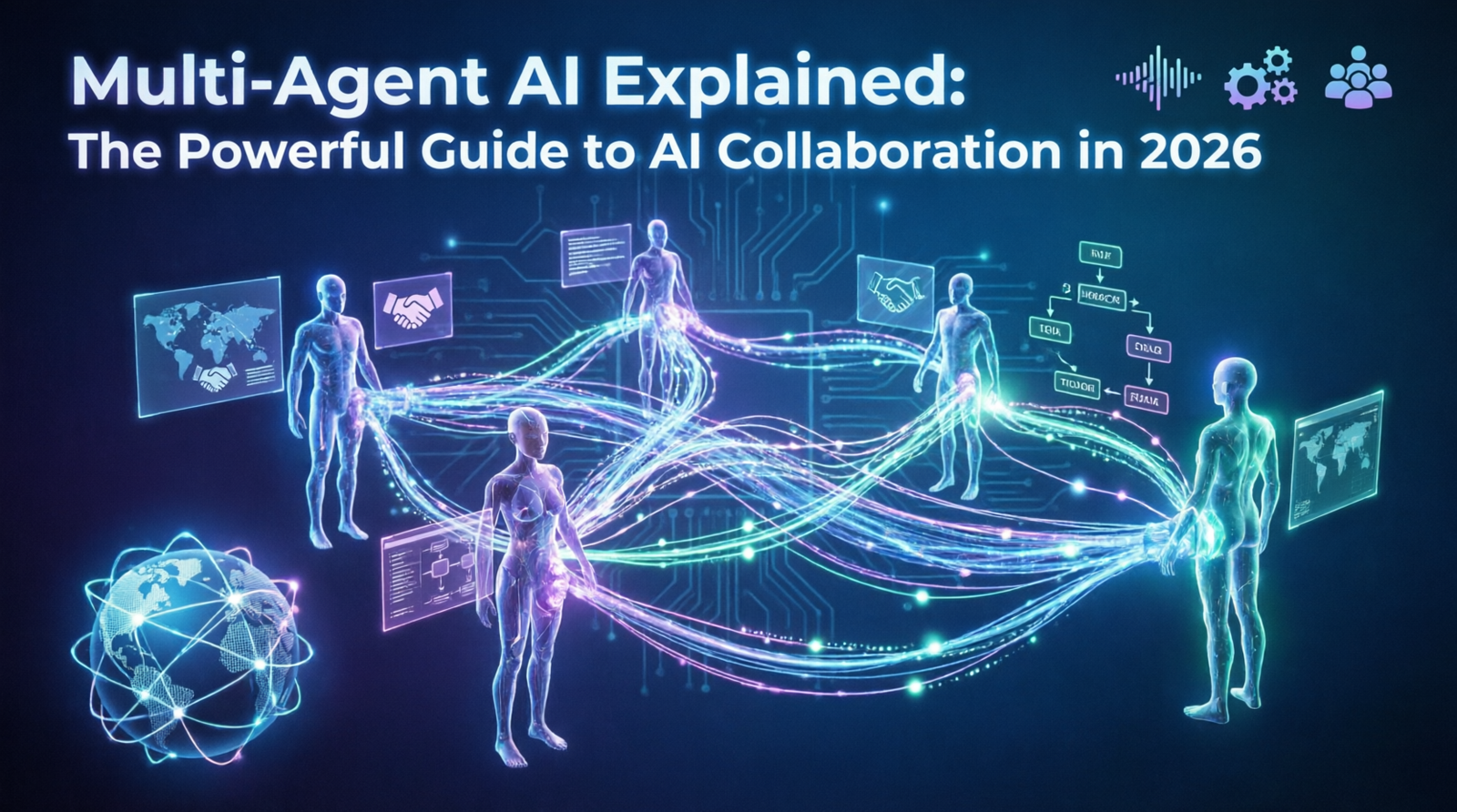
A multi-agent system uses multiple AI agents that cooperate on a larger objective. Each agent may have a different role, model, toolset, context, or permission level.
However, there is an important distinction:
Using more AI agents does not automatically make an AI system better.
Multiple agents can increase specialization and parallelism, but they can also increase cost, latency, coordination complexity, and failure points.
Microsoft’s current guidance describes several multi-agent orchestration patterns and emphasizes choosing an architecture that matches the problem rather than adding complexity for its own sake.
This guide explains how Multi-Agent AI works, the most useful architecture patterns, how it differs from single-agent systems and automation, how it relates to MCP and A2A, and how to decide whether you actually need more than one agent.
What Is Multi-Agent AI?
Multi-Agent AI is an AI architecture in which multiple agents cooperate to accomplish a larger task or objective.
Each agent can specialize in a particular responsibility.
For example, imagine an AI system that needs to produce a detailed market research report.
A single-agent architecture could look like this:
User Request
     ↓
One AI Agent
     ├── Research
     ├── Data Analysis
     ├── Competitor Analysis
     ├── Fact Checking
     └── Report Writing
          ↓
      Final Report
A multi-agent architecture could divide those responsibilities:
                    Coordinator
                  /      |       \
                 ↓       ↓        ↓
            Research   Data    Fact-Check
             Agent     Agent      Agent
                 \       |        /
                  \      |       /
                   ↓     ↓      ↓
                    Synthesis
                       Agent
                         ↓
                    Final Report
The second architecture does not automatically produce a better answer.
Its advantage is that different parts of the problem can be handled independently by agents designed for those specific jobs.
That distinction is fundamental.
A multi-agent system is not simply several chatbots running simultaneously. There needs to be some mechanism for assigning work, passing information, managing state, and deciding when the overall task is complete.
Anthropic’s description of its own multi-agent research system follows an orchestrator-worker approach: a lead agent plans the work and delegates specialized research tasks to subagents that can operate in parallel.
Why Use More Than One AI Agent?
The best reason to create a second agent is not that the technology is available.
It is that separating responsibilities solves a real problem.
There are several situations where this can make sense.
1. Different areas of expertise
A financial-analysis task and a customer-support task require very different instructions, tools, and constraints.
Instead of building one enormous agent that understands everything, you could create:
- Financial Agent
- Research Agent
- Customer Support Agent
- Marketing Agent
Each one focuses on a narrower responsibility.
2. Different tools
One agent may need access to a database.
Another may need web research tools.
Another may need a CRM.
Another may need a code execution environment.
Separating those capabilities can make each agent easier to configure and control.
3. Different permissions
Not every agent should be allowed to perform every action.
For example:
| Agent | Example access |
|---|---|
| Research Agent | Public information |
| Analytics Agent | Business analytics |
| Finance Agent | Financial data |
| Support Agent | Customer information |
| Execution Agent | Approved business actions |
This is especially important when agents can modify information or trigger external actions.
Microsoft’s current multi-agent guidance recommends principles including least privilege, simplicity, auditability, and governance when designing agent interactions.
4. Parallel work
Some problems naturally contain independent subtasks.
For example, a market research system could investigate:
- Competitors
- Industry trends
- Customer feedback
- Recent news
at the same time.
Anthropic reported that its multi-agent research architecture benefits particularly from breadth-first research tasks where independent directions can be explored in parallel.
5. Context isolation
A large agent can become difficult to manage when it has too many responsibilities and too much context.
A specialist agent can receive only the information relevant to its task.
For example:
Research Agent
→ research instructions
→ search tools
→ research sources

Financial Agent
→ financial instructions
→ financial data
→ calculation tools

Support Agent
→ customer context
→ support rules
→ CRM tools
This separation can make individual components easier to test and maintain.
Single-Agent vs Multi-Agent AI
Consider a request:
“Analyze this company and identify its biggest growth opportunities.”
A single agent might:
- Research the company.
- Analyze financial information.
- Study competitors.
- Research the market.
- Review customer information.
- Produce recommendations.
This can work perfectly well.
A multi-agent architecture might instead use:
                    Coordinator
                  /      |       \
                 ↓       ↓        ↓
             Financial  Market  Competitor
               Agent     Agent    Agent
                  \       |       /
                   \      |      /
                    ↓     ↓     ↓
                    Review Agent
                         ↓
                  Final Analysis
The important question is not:
“Which architecture has more agents?”
It is:
“Does separating the work produce a measurable improvement?”
If a single agent already performs reliably, introducing additional agents may simply make the system more expensive and complicated.
The Most Important Concept: Orchestration
If there is one technical concept you should understand when learning Multi-Agent AI, it is orchestration.
Orchestration determines:
- Which agent performs a task
- When an agent should run
- What information it receives
- What happens after it finishes
- Whether another agent should be called
- How results are combined
- When the overall workflow is complete
A simple workflow might look like:
User Request
     ↓
Coordinator
     ↓
Research Agent
     ↓
Analysis Agent
     ↓
Review Agent
     ↓
Final Answer
But another task might benefit from parallel execution:
                 Coordinator
              /      |       \
             ↓       ↓        ↓
        Research  Finance  Competitor
          Agent     Agent     Agent
             \       |        /
              \      |       /
               ↓     ↓      ↓
                  Review
                    ↓
               Final Answer
Microsoft documents several orchestration patterns, including sequential, concurrent, handoff, group-chat, and magentic approaches.
The correct pattern depends on the structure of the problem.
5 Practical Multi-Agent Patterns
You do not need dozens of architectural patterns to understand multi-agent systems.
Five are particularly useful.
1. Sequential Agents
Each agent completes its task before the next agent starts.
Agent A
   ↓
Agent B
   ↓
Agent C
   ↓
Final Result
Example
Research → Analysis → Review → Report
This works well when each stage depends on the previous stage.
Good for:
- Document processing
- Research pipelines
- Content workflows
- Data transformation
- Compliance reviews
Main weakness
Latency can increase because each stage waits for the previous one.
2. Parallel or Concurrent Agents
Independent agents work at the same time.
                  Coordinator
                /      |       \
               ↓       ↓        ↓
          Research   Finance  Competitor
             Agent     Agent     Agent
                \       |       /
                 \      |      /
                  ↓     ↓     ↓
                  Final Synthesis
This architecture is especially useful when the subtasks do not depend on one another.
Example
A company research system could simultaneously investigate:
- Competitor pricing
- Industry trends
- Recent announcements
- Customer sentiment
Advantage
Potentially lower completion time and broader coverage.
Weakness
The system still needs to reconcile conflicting or duplicated results.
Anthropic’s production research system uses parallel subagents for independent research directions and found this especially useful for broad research problems.
3. Handoff
In a handoff architecture, one agent transfers responsibility to another.
Customer Support Agent
          ↓
    Technical Agent
          ↓
     Billing Agent
For example, a customer could begin with a general support agent.
If the problem is identified as technical, the conversation can be transferred to a technical specialist.
Useful for:
- Customer service
- Troubleshooting
- Sales qualification
- Specialist support
The advantage is that the system does not require every agent to handle every possible situation.
4. Supervisor or Coordinator
A supervisor controls several specialist agents.
                    Supervisor
                 /      |       \
                ↓       ↓        ↓
            Research  Finance  Support
              Agent    Agent     Agent
The supervisor can determine:
- Which specialist is needed
- What task to send
- What information to provide
- Whether another specialist is necessary
- How to combine the results
Microsoft describes orchestrator-and-subagent architectures in which a primary orchestrator delegates work to subordinate specialist agents.
This pattern is useful when the overall task has clear domains or functional areas.
5. Generator and Reviewer
One agent creates an output and another evaluates it.
Generator Agent
       ↓
Reviewer Agent
       ↓
 ┌─────┴─────┐
 ↓           ↓
Pass        Revise
 ↓           ↓
Final     Generator
For example:
- Writing agent → review agent
- Coding agent → testing agent
- Research agent → verification agent
- Marketing agent → compliance reviewer
However, there is an important limitation:
An AI reviewer is not automatically an independent source of truth.
If both agents rely on the same incorrect information, the reviewer can repeat the original mistake.
For high-impact decisions, combine AI review with deterministic checks, authoritative sources, or human approval where appropriate.
How Does a Multi-Agent System Actually Work?
Consider a practical example.
A company asks:
“Analyze our competitors and recommend three areas where we could improve.”
A possible architecture is:
Step 1: Coordinator receives the request
The coordinator breaks the objective into meaningful subtasks.
Step 2: Specialist agents perform the work
                 Coordinator
                /     |      \
               ↓      ↓       ↓
          Market   Competitor  Customer
          Agent      Agent     Agent
Step 3: Results are collected
Each specialist returns structured findings.
Step 4: The system checks the results
A review stage can identify:
- Contradictions
- Missing information
- Unsupported conclusions
- Duplicate findings
Step 5: A synthesis agent produces the answer
The final agent combines the verified information into a coherent result.
This architecture works because the problem has naturally separable research directions.
Context Isolation: An Underappreciated Benefit
One of the strongest reasons for multi-agent design is context isolation.
Imagine a single agent has:
- 30 tools
- 15 responsibilities
- Large system instructions
- Multiple databases
- Different business rules
- Several permission levels
That agent has to reason about all of those possibilities.
Instead, you can give each specialist a narrower environment.
Research Agent
Research instructions
Search tools
Research sources
Finance Agent
Financial instructions
Financial data
Calculation tools
Support Agent
Customer context
Support policies
CRM tools
This does not magically eliminate context problems, but it can make the individual agents simpler and reduce unnecessary capability exposure.
Anthropic’s multi-agent research architecture specifically describes separate agent contexts and independent exploration as useful for reducing path dependency and expanding the amount of research that can be performed in parallel.
Multi-Agent AI + MCP
Multi-Agent AI and MCP (Model Context Protocol) solve different problems.
A useful mental model is:
Multi-Agent Architecture
          │
     ┌────┴────┐
     ↓         ↓
  Agent A    Agent B
     │         │
    MCP       MCP
     │         │
  Tools/Data Tools/Data
MCP can standardize how an AI application connects to tools and data.
Multi-Agent AI describes how multiple agents cooperate.
Therefore, they can be complementary.
For example:
                 Coordinator
                /           \
               ↓             ↓
       Research Agent    Finance Agent
              │                 │
             MCP               MCP
              │                 │
        Search/Data        Database/Tools
An agent does not need MCP simply because it is part of a multi-agent system. But MCP can be useful when agents need standardized access to external tools, APIs, or resources.
Microsoft’s current architecture guidance recommends MCP for tool and data access and A2A for cross-platform agent-to-agent communication.
Multi-Agent AI + A2A
This distinction is equally important.
Multi-Agent AI is an architectural approach.
A2A (Agent2Agent) is a protocol designed to enable communication and interoperability between independent AI agents.
The official A2A documentation describes A2A as an open standard for agents to discover capabilities, delegate work, and collaborate across different frameworks and vendors.
A simplified architecture is:
             User
              ↓
        Main Agent
          /     \
         ↓       ↓
    Agent A    Agent B
       │          │
      MCP        MCP
       │          │
     Tools      Data
A2A becomes particularly useful when the agents themselves need to communicate across system or organizational boundaries.
A useful rule is:
MCP connects agents to tools and data. A2A connects agents to other agents.
The two protocols are designed to be complementary rather than direct competitors.
A Practical Example: An AI Marketing Team
Multi-Agent AI becomes easier to understand when we apply it to marketing.
Imagine an AI system responsible for planning and evaluating a marketing campaign.
Instead of one enormous marketing agent, you could use:
Strategy Agent
Responsible for:
- Campaign objectives
- Positioning
- Target audience
- Messaging direction
Research Agent
Responsible for:
- Competitor research
- Market trends
- Customer questions
- Supporting evidence
Copy Agent
Responsible for:
- Headlines
- Ad copy
- Landing-page messaging
- Content variations
Analytics Agent
Responsible for:
- Performance data
- Conversion metrics
- Campaign comparisons
- Opportunity identification
Review Agent
Responsible for:
- Claim verification
- Brand consistency
- Quality checks
- Formatting
The architecture might look like:
                  Marketing Coordinator
                  /    |     |       \
                 ↓     ↓     ↓        ↓
            Strategy Research Copy  Analytics
               Agent    Agent  Agent    Agent
                  \       |     |       /
                   \      |     |      /
                    ↓     ↓     ↓     ↓
                       Review Agent
                            ↓
                     Final Campaign
The benefit comes from specialization.
The strategy agent does not need to become a database analyst.
The analytics agent does not need to write every piece of marketing copy.
The research agent does not need permission to modify campaign systems.
This creates clearer boundaries.
When Multi-Agent AI Can Make Things Worse
This is one of the most important parts of understanding the technology.
Multi-agent systems introduce additional moving parts.
Suppose:
Agent A
   ↓
Agent B
   ↓
Agent C
   ↓
Agent D
   ↓
Final Result
If Agent B produces incorrect information, Agent C may treat that information as reliable.
Agent D then builds on it.
The final answer may therefore contain an error that was introduced several steps earlier.
This creates a potential chain:
Error
  ↓
Propagation
  ↓
Additional reasoning
  ↓
Amplification
  ↓
Incorrect final result
Anthropic’s production experience highlights coordination and reliability as important challenges in multi-agent systems, while its 2026 research has also examined emerging problems created by interactions between multiple agents.
The lesson is simple:
More agents create more opportunities for coordination errors.
The Cost Problem
Multi-agent systems can require substantially more model usage than a simple single-agent interaction.
Imagine a workflow containing:
- 1 coordinator call
- 3 research calls
- 3 analysis calls
- 2 review calls
- 1 synthesis call
That is already 10 model interactions, before retries or additional tool calls.
The actual cost depends on the models, context sizes, tool usage, caching, and architecture.
Anthropic reported that its multi-agent research system used substantially more tokens than ordinary chat interactions and emphasized that the additional cost is justified mainly for tasks where the extra performance has sufficient value.
Therefore:
More agents do not mean more intelligence for free.
Before deploying a multi-agent workflow, measure whether the improvement justifies:
- Token costs
- Model costs
- Infrastructure
- Tool calls
- Monitoring
- Latency
- Engineering complexity
The Latency Problem
Multi-agent systems can sometimes reduce latency through parallel execution.
But they can also make a workflow slower.
Compare:
Parallel
             Coordinator
            /     |      \
           ↓      ↓       ↓
        Agent A Agent B Agent C
           \      |      /
            \     |     /
              Final
The independent tasks can run simultaneously.
Now compare that with:
Sequential
Agent A
   ↓
Agent B
   ↓
Agent C
   ↓
Agent D
   ↓
Final
Here every stage waits for the previous one.
The important design question is:
Can these tasks actually run independently?
If yes, concurrency may help.
If no, adding more agents may simply introduce more waiting.
The Security Problem
Security becomes increasingly important when agents can access private data or perform actions.
Imagine five agents:
| Agent | Access |
|---|---|
| Research Agent | Public sources |
| Analytics Agent | Business analytics |
| Finance Agent | Financial information |
| Support Agent | Customer information |
| Execution Agent | Approved system actions |
There is little reason to give every agent every permission.
A stronger architecture follows the principle of least privilege:
Give each agent only the access it actually needs.
This can reduce the potential impact of mistakes or compromised instructions.
Microsoft’s current multi-agent guidance specifically recommends least privilege, auditability, and governance when agents interact with one another and with tools.
For production systems, also consider:
- Authentication
- Authorization
- Audit logs
- Human approval
- Tool restrictions
- Data isolation
- Secret management
- Monitoring
- Failure recovery
Multi-Agent AI vs AI Automation
These concepts overlap, but they are not identical.
AI Automation
A typical automation might look like:
Trigger
   ↓
AI Processing
   ↓
Action
   ↓
Result
Example:
New customer email → AI summarizes it → CRM record is updated.
The workflow is usually relatively predictable.
Multi-Agent AI
A multi-agent system can look like:
User Request
     ↓
Coordinator
     ↓
Research Agent
     ↓
Analysis Agent
     ↓
Reviewer
     ↓
Execution Agent
     ↓
Result
The agents may dynamically determine which steps are needed.
The key distinction is dynamic agent coordination and specialization, rather than simply automating a sequence of fixed actions.
For many business tasks, conventional automation can still be the better choice.
You do not need a multi-agent system just because AI is involved.
Multi-Agent AI vs A2A
These terms are often confused.
Multi-Agent AI
Describes an architecture or system containing multiple AI agents.
A2A
Describes a protocol for communication and interoperability between AI agents.
A useful analogy is:
Multi-Agent AI = the architecture

A2A = one possible communication protocol
You can build a multi-agent system without A2A.
A2A becomes more relevant when independently developed or separately managed agents need to communicate using a common protocol.
The A2A project is now an open standard under the Agentic AI Foundation ecosystem, with version 1.0 released in 2026.
When Should You Use Multi-Agent AI?
Multi-Agent AI is worth considering when the problem naturally benefits from specialization.
1. The problem contains genuinely different domains
For example:
Legal + Finance + Market Research
may be easier to manage as separate specialist responsibilities.
2. Tasks can run independently
If several research questions can be answered without waiting for each other, parallel agents can make sense.
3. Agents require different tools
One agent may need:
- Search
- Another database
- A CRM
- A code execution environment
- A specialized API
Separating those responsibilities can simplify the architecture.
4. Different permissions are required
If one agent only needs read access while another can execute actions, separate permission boundaries can be useful.
5. One agent has become overloaded
If one agent has accumulated too many unrelated instructions, tools, and responsibilities, specialization may improve maintainability.
When Should You NOT Use Multi-Agent AI?
Knowing when not to use multi-agent architecture is just as important.
One agent already works reliably
If a single agent produces strong results at acceptable cost and latency, there may be no reason to introduce more agents.
The task is simple
For:
“Summarize this article.”
you probably do not need:
Planner
   ↓
Researcher
   ↓
Reviewer
   ↓
Writer
That is likely unnecessary complexity.
Agents must communicate constantly
If Agent A repeatedly asks Agent B for tiny pieces of information, the communication overhead can outweigh the benefits of specialization.
There is no measurable improvement
This is the most important test.
Compare:
Single Agent
       vs
Multi-Agent System
Measure:
- Accuracy
- Quality
- Cost
- Latency
- Reliability
- Failure rate
If the multi-agent system does not produce a meaningful improvement, simplify it.
How to Build a Good Multi-Agent System
The best approach is to start with the problem rather than the architecture.
Step 1: Define the outcome
Start with:
“What should the system accomplish?”
For example:
Produce a verified competitor analysis.
Do not start with:
Build a five-agent system.
The first is a business objective.
The second is merely a technical implementation choice.
Step 2: Build a Single-Agent Baseline
Before creating multiple agents, see how well one agent performs.
Measure:
- Accuracy
- Completion rate
- Cost
- Latency
- Error rate
This gives you a baseline for comparison.
Step 3: Identify the Actual Bottleneck
Ask why the current system is struggling.
Is it because:
- The agent has too many tools?
- The task contains independent subtasks?
- Different expertise is required?
- Different permissions are needed?
- The context is too large?
- Verification is weak?
- The workflow is too slow?
Only introduce another agent if it addresses an actual bottleneck.
Step 4: Give Each Agent a Clear Responsibility
Avoid vague roles such as:
“You are a powerful AI assistant that researches, writes, analyzes, manages customers, checks information, and executes business operations.”
Instead:
“You are a financial-analysis agent. Analyze the provided financial data and return structured findings.”
A narrow role makes the agent easier to test and evaluate.
Step 5: Define the Communication Contract
Agents need to know what information they receive and what they should return.
For example:
{
  "company": "Example Inc.",
  "revenue_growth": 18,
  "risk_level": "medium",
  "confidence": 0.82
}
Structured outputs can make downstream processing more predictable than relying entirely on free-form responses.
Step 6: Add Verification Where It Matters
Not every task needs another AI reviewer.
For higher-impact workflows, consider:
- Rule-based validation
- Independent data sources
- Human approval
- Automated tests
- Schema validation
- Policy checks
The more consequential the action, the stronger the verification should be.
Step 7: Measure the Entire System
A multi-agent architecture should be evaluated as a system.
Quality
Did the final answer improve?
Cost
How much did the workflow consume?
Latency
How long did completion take?
Reliability
How often did the system fail?
Recovery
Can the system recover from an individual agent failure?
Observability
Can you determine what happened when the system produces a bad result?
Anthropic’s experience moving its multi-agent research system toward production highlights evaluation, observability, prompt design, tool design, and failure handling as important parts of reliable deployment.
5 Common Multi-Agent AI Mistakes
1. Creating agents just to look advanced
A system with eight agents is not automatically more sophisticated in a useful sense.
Every additional agent should have a reason to exist.
2. Giving every agent every tool
If every agent can access everything, specialization loses much of its value.
Tool access should match the agent’s responsibilities.
3. No clear orchestration strategy
Someone needs to determine:
- What happens first
- Which agent handles each task
- What information is passed
- When another agent is called
- When the task is complete
4. Trusting AI reviewers blindly
Two agents agreeing does not prove that the information is correct.
For important decisions, use independent evidence or deterministic verification where possible.
5. Ignoring failure recovery
What happens if:
Research Agent
      ↓
     FAIL
Can the system:
- Retry?
- Use another agent?
- Return a partial result?
- Ask for human intervention?
- Record the failure for later analysis?
Production systems need explicit answers.
What Does a Production-Ready Multi-Agent System Need?
Agents are only one part of the architecture.
A serious system may also require:
                  Multi-Agent System
                         │
        ┌────────────────┼────────────────┐
        ↓                ↓                ↓
  Orchestration      Security       Observability
        ↓                ↓                ↓
    Evaluation         Memory        Governance
        │                │                │
        └────────────────┼────────────────┘
                         ↓
                      Agents
Important components can include:
- Orchestration — controls workflow
- Security — controls access
- Observability — records system behavior
- Evaluation — measures quality
- Memory — preserves relevant state
- Governance — defines operational rules
- Communication — controls agent interaction
- Failure recovery — handles errors and retries
Microsoft’s current architecture guidance identifies orchestration, communication, memory, observability, evaluation, security, and governance as important concerns for production agent systems.
Multi-Agent AI in 2026: What Is Actually Changing?
The important development in 2026 is not simply that companies are adding more agents.
The larger trend is toward structured agent ecosystems.
Three concepts are becoming increasingly important:
1. Specialized agents
Instead of one general-purpose agent doing everything, organizations can create agents around clearly defined capabilities.
2. Standardized connectivity
Protocols such as MCP help agents interact with tools and data through standardized interfaces.
3. Agent interoperability
A2A provides a standardized way for independent agents to communicate and collaborate.
This creates a useful conceptual stack:
                    AI Application
                         │
                  Orchestration
                         │
             ┌───────────┴───────────┐
             ↓                       ↓
       Agent-to-Agent             Agents
            A2A                     │
                                    │
                                   MCP
                                    │
                           Tools / Data / APIs
The technologies are complementary rather than interchangeable. Microsoft’s current guidance similarly distinguishes MCP for tool/data access from A2A for cross-platform agent communication.
The Future of Multi-Agent AI
The future probably isn’t about putting hundreds of agents into every application.
A more useful direction is specialized collaboration where specialization produces measurable value.
Consider an enterprise system:
                    AI Coordinator
                         │
             ┌───────────┼───────────┐
             ↓           ↓           ↓
           Sales       Finance    Operations
           Agent        Agent        Agent
             │           │           │
             └───────────┼───────────┘
                         ↓
                    Human Review
The important characteristics are not the number of agents.
They are:
- Clear responsibilities
- Controlled permissions
- Reliable communication
- Useful specialization
- Measurable outcomes
- Strong evaluation
Anthropic’s research into production multi-agent systems shows that these architectures can be particularly valuable for open-ended, parallelizable research problems, but also that they require substantially more engineering and token usage than simple interactions.
The Most Important Lesson
The future of Multi-Agent AI is not:
More agents.
It is:
The right agents for the right problems.
A poorly designed system might contain:
10 Agents
50 Tools
100 Prompts
Thousands of Model Calls
and still perform worse than a carefully designed single-agent workflow.
A better architecture might contain:
1 Coordinator
+
2–4 Specialists
+
Clear Communication
+
Appropriate Verification
The objective is not architectural complexity.
The objective is reliable task completion.
Final Verdict: Is Multi-Agent AI Worth It?
Yes—but not for every AI application.
Multi-Agent AI can be valuable when a problem naturally breaks into specialized, parallel, or permission-separated tasks.
Potential advantages include:
- Specialization
- Parallel execution
- Context isolation
- Different tools for different agents
- Different permission boundaries
- Component-level testing
- More flexible architectures
But multi-agent systems also introduce:
- Higher model usage
- Additional latency
- More coordination complexity
- More failure points
- Security challenges
- Debugging difficulty
- Potential error propagation
The best rule is therefore:
Use the simplest architecture that reliably solves the problem.
If one agent works, keep one.
If the task genuinely benefits from specialization, introduce additional agents gradually and measure the improvement.
If agents need standardized access to tools and data, MCP may be useful.
If independent agents need to communicate across system or vendor boundaries, A2A may be relevant.
Multi-Agent AI is not about creating the largest possible network of AI agents.
It is about creating useful collaboration between specialized agents when that collaboration actually improves the outcome.
Frequently Asked Questions
What is Multi-Agent AI?
Multi-Agent AI is an architecture in which multiple AI agents cooperate to accomplish a larger objective. Agents can have different roles, tools, models, context, and permissions.
Is Multi-Agent AI better than a single AI agent?
Not necessarily.
A multi-agent system can improve specialization and parallel execution, but it can also increase cost, latency, and coordination complexity.
How many agents should a multi-agent system have?
There is no universal number.
Use the smallest number of agents that produces a measurable improvement over a simpler architecture.
What is an AI orchestrator?
An AI orchestrator coordinates multiple agents. It can decide which agent should perform a task, provide the required context, collect results, and determine what happens next.
Can multiple AI agents work simultaneously?
Yes.
When tasks are independent, agents can often work concurrently. This is one of the main reasons multi-agent architectures can be useful for broad research and analysis tasks.
What is the difference between A2A and Multi-Agent AI?
Multi-Agent AI describes an architecture involving multiple agents.
A2A is an open protocol designed to enable communication and interoperability between independent AI agents.
What is the difference between MCP and Multi-Agent AI?
Multi-Agent AI describes an architecture.
MCP is a protocol for standardized interaction between AI applications and external tools, data, and resources.
They solve different problems and can be used together.
Is Multi-Agent AI expensive?
It can be.
Multiple agents can increase model calls, token consumption, tool usage, infrastructure requirements, and monitoring costs.
The actual cost depends on the architecture and models used.
Can Multi-Agent AI work with MCP?
Yes.
An individual agent can use MCP to access tools or data while the larger multi-agent system uses an orchestration mechanism or agent-to-agent protocol to coordinate agents.
Does every AI application need multiple agents?
No.
Many tasks are better handled by a single agent or conventional automation.
Multi-Agent AI is most useful when specialization, parallelization, different permissions, or independent contexts provide a measurable benefit.
Related Articles
Build this article into your site’s AI-agent topic cluster with contextual internal links:
- AI Agents Explained
/what-are-ai-agents/ - MCP for AI Agents Explained
/mcp-for-ai-agents/ - A2A Protocol Explained
/a2a-protocol-explained/ - Best AI Agent Frameworks in 2026
Link to your dedicated agent-framework article when available. - Best AI Automation Tools in 2026
/category/ai-automation/
A logical topic cluster is:
                     AI Agents
                         │
          ┌──────────────┼──────────────┐
          ↓              ↓              ↓
         MCP            A2A       Multi-Agent AI
          │              │              │
          └──────────────┼──────────────┘
                         ↓
                  AI Automation
Use descriptive anchor text rather than repeatedly using the exact same keyword.
A Note on This Guide
Multi-Agent AI is a rapidly evolving area. Specific frameworks, APIs, model capabilities, pricing, and implementation details can change quickly. The architectural principles in this guide—specialization, orchestration, least privilege, evaluation, observability, and choosing the simplest architecture that meets the requirement—are more durable than any particular vendor implementation.