Best AI Contract Management Software in 2026: 5 Tools Compared
Contracts are involved in almost every important business relationship.
A company may have sales agreements, vendor contracts, employment agreements, NDAs, statements of work, renewal agreements, and many other documents to create, review, approve, sign, and store.
Managing all of those agreements through email folders and spreadsheets can become difficult as a company grows.
That’s where AI contract management software can help.
Modern contract management platforms can use artificial intelligence to search agreements, extract important information, summarize documents, identify clauses, assist with contract review, automate workflows, and help teams keep track of important dates and obligations.
But there is an important distinction between these products.
Some platforms are designed for enterprise contract lifecycle management (CLM) and complex legal operations. Others focus more on document creation, electronic signatures, sales agreements, and simpler workflows.
In this guide, we’ll compare five AI-powered contract and agreement management platforms and explain what each one is best suited for.
The goal isn’t to find a single product that is “best” for everyone. It’s to help you identify the platform that matches your contract volume, workflow, budget, and level of complexity.
Pricing and features can change. Always verify the provider’s current plans before making a purchasing decision.
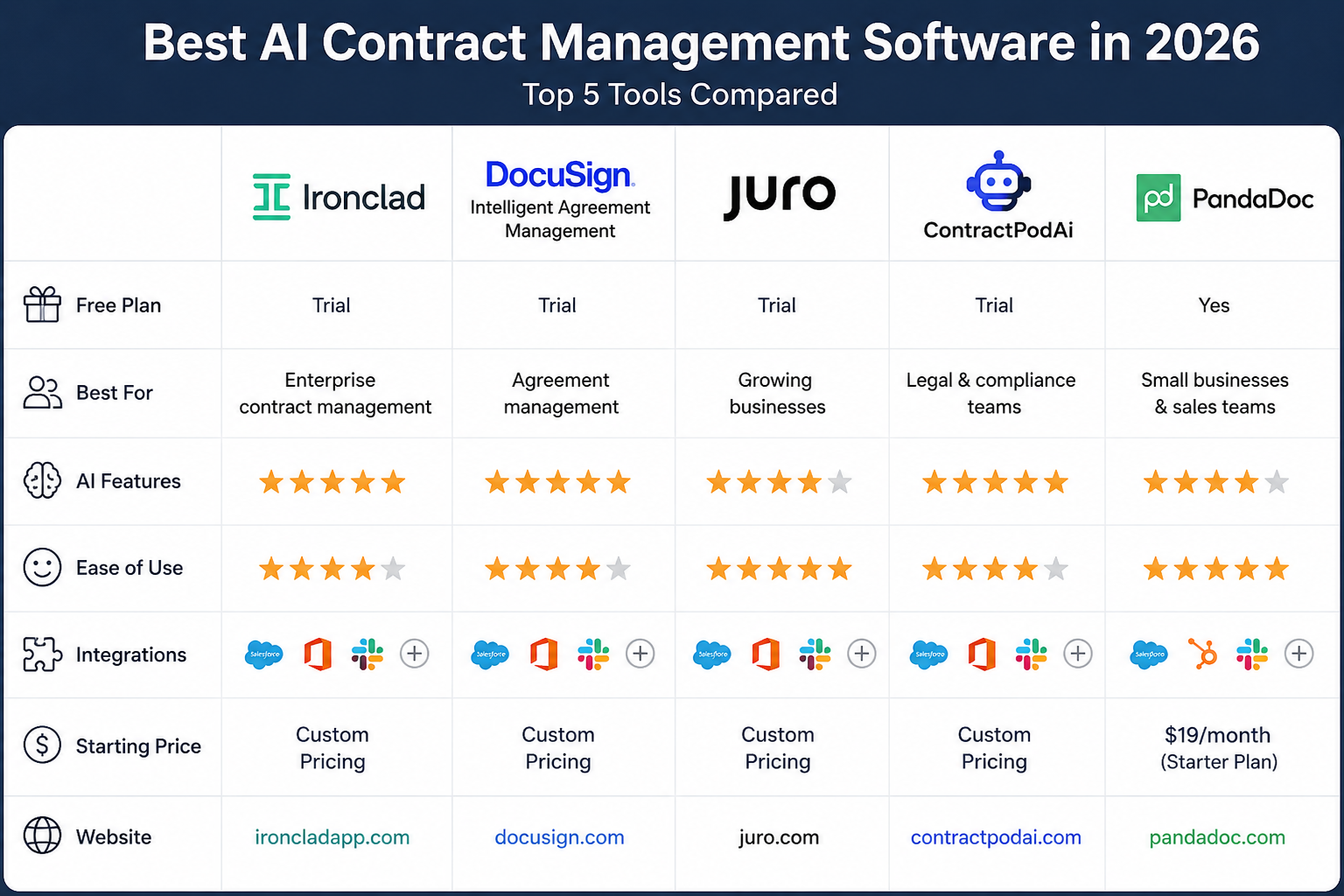
Quick Comparison
| Software | Best For | AI Capabilities | Pricing Approach |
|---|---|---|---|
| Ironclad | Enterprise CLM and legal teams | Contract analysis, drafting, review, intelligence | Custom |
| Docusign IAM | Agreement management + eSignatures | AI search, analysis, extraction and agreement intelligence | From $40/user/month annually in the U.S. |
| Juro | Growing companies | AI drafting, extraction and review | Custom |
| Leah | Enterprise legal operations | AI-powered legal and contract workflows | Custom |
| PandaDoc | SMBs, sales and document workflows | AI-assisted document workflows | Free; paid plans from $19/user/month |
Quick Picks
- Best for enterprise CLM: Ironclad
- Best for eSignatures + agreement management: Docusign IAM
- Best for growing companies: Juro
- Best for enterprise legal operations: Leah
- Best for small businesses: PandaDoc
These are use-case recommendations, not universal rankings. A platform that is ideal for a multinational legal department may be unnecessary for a small agency handling a few contracts each month.
What Is AI Contract Management Software?
AI contract management software is technology that uses artificial intelligence to assist with different stages of the contract lifecycle.
Traditional contract management often involves manually:
- Creating documents
- Searching contracts
- Reviewing clauses
- Requesting approvals
- Sending documents for signatures
- Recording contract information
- Monitoring expiration dates
- Tracking renewals
- Finding obligations
AI can assist with some of these tasks.
Depending on the platform, AI functionality may include:
- Contract summarization
- Clause identification
- Contract search
- Data extraction
- Contract drafting
- AI-assisted review
- Risk identification
- Redlining assistance
- Obligation extraction
- Renewal intelligence
- Contract analytics
- Workflow recommendations
The exact capabilities vary significantly between providers.
For example, a simple document platform may use AI to help create or analyze a document, while an enterprise CLM platform may use AI throughout intake, review, approval, storage, and renewal workflows.
AI Contract Management vs. Electronic Signatures
These terms are sometimes used interchangeably, but they are not the same thing.
Electronic signature software primarily helps people sign documents electronically.
Contract management software goes further by helping organizations manage agreements before and after signing.
A contract management platform may provide:
- Contract requests
- Drafting
- Negotiation
- Approval
- Electronic signature
- Contract storage
- Search
- Obligation tracking
- Renewal management
- Reporting
Some products combine both categories.
Docusign is a good example: its Intelligent Agreement Management offering combines eSignature capabilities with agreement storage, workflows, AI search, and agreement analysis.
Best AI Contract Management Software in 2026
1. Ironclad — Best for Enterprise Contract Lifecycle Management
Ironclad is designed primarily for organizations that need a structured contract lifecycle management system rather than a simple document editor or signing application.
The platform is particularly relevant to legal, procurement, sales, finance, and operations teams that manage large numbers of agreements.
Why Consider Ironclad?
The main advantage of an enterprise CLM platform is that contracts don’t have to live in isolated folders.
A structured CLM system can connect different stages of the process:
Request → Draft → Review → Negotiate → Approve → Sign → Store → Monitor → Renew
That approach becomes increasingly valuable as contract volume and organizational complexity increase.
Key Capabilities
Depending on the configuration and plan, Ironclad can support:
- Contract creation
- Contract intake
- Workflow automation
- AI-assisted contract review
- Clause analysis
- Contract search
- Contract data extraction
- Approval workflows
- Negotiation workflows
- Contract repository
- Renewal management
- Analytics
- Integrations
Pros
- Designed for enterprise CLM
- Strong workflow capabilities
- Centralized contract repository
- Useful for complex approval processes
- Suitable for large contract volumes
- Integrates with broader business systems
Cons
- Enterprise-oriented
- Custom pricing
- More complex than a basic contract tool
- May require implementation and training
Pricing
Ironclad uses a sales-led pricing model rather than a simple public monthly plan.
The final cost can depend on factors such as organization size, contract volume, products selected, integrations, and implementation requirements.
Best For
Enterprise legal departments, procurement teams, large sales organizations, and companies managing substantial contract volumes.
When Should You Choose Ironclad?
Consider Ironclad if your organization needs true contract lifecycle management rather than simply creating and signing documents.
When Is Ironclad Overkill?
If you are a freelancer, small agency, or small business that handles only a few agreements each month, an enterprise CLM platform may introduce more complexity than you need.
2. Docusign Intelligent Agreement Management — Best for eSignatures + Agreement Management
Docusign is widely known for electronic signatures, but its Intelligent Agreement Management platform extends beyond signing.
IAM combines electronic signatures with agreement management, workflows, AI-powered search and analysis, and centralized agreement data.
Why Consider Docusign IAM?
The biggest advantage is the connection between signing and agreement management.
For businesses already using Docusign, moving into IAM can provide a more centralized way to manage agreements after they have been created and signed.
Docusign describes IAM as an AI-assisted platform designed to connect and optimize agreement processes. Its Agreement Manager can centralize agreements, track commitments and deadlines, and use AI to extract information and provide agreement insights.
Key Capabilities
- Electronic signatures
- AI agreement search
- Agreement analysis
- AI-assisted data extraction
- Agreement repository
- Workflow automation
- Agreement tracking
- Notifications
- Templates
- Approval workflows
- Agreement analytics
- Identity verification on supported plans
Current Pricing Snapshot
Docusign currently lists U.S. IAM plans beginning at:
- IAM Starter: $40/user/month when billed annually
- IAM Standard: $45/user/month when billed annually
- IAM Professional: $75/user/month when billed annually
- IAM Enterprise: Contact sales
The Starter plan includes 100 envelope sends per user per year, one workflow, and AI search, management, and analysis. Higher plans add more workflows and additional agreement-management capabilities.
Pros
- Strong eSignature ecosystem
- AI agreement management
- Centralized agreement repository
- Workflow automation
- Familiar platform for existing Docusign users
- Strong agreement-focused functionality
Cons
- Advanced plans can become expensive
- Some features depend on the selected plan
- More functionality may be unnecessary for very small businesses
Best For
Companies that already use Docusign or want electronic signatures combined with broader agreement management.
When Should You Choose Docusign IAM?
Choose it when electronic signatures are an important part of your workflow and you also need to search, analyze, organize, and manage agreements.
3. Juro — Best for Growing Businesses
Juro is an AI-powered contract management platform designed to bring contract creation, collaboration, review, and management into one workflow.
Unlike traditional enterprise CLM platforms that can require extensive configuration, Juro positions itself as a more accessible contract environment for business teams.
Why Consider Juro?
Juro’s current pricing process is based on factors such as contract volume, contract types, AI requirements, and integrations rather than a simple fixed public price.
Its pricing configurator currently highlights AI capabilities including:
- AI Extract
- AI Draft
- AI Review
It also supports integrations with systems such as Salesforce, HubSpot, Docusign, Pipedrive, Google Drive, SharePoint, and others.
Key Capabilities
- AI contract drafting
- AI contract review
- AI extraction
- Contract templates
- Contract collaboration
- Approval workflows
- Electronic signatures
- Contract repository
- Contract search
- Workflow automation
- Business integrations
Pros
- Modern contract workflow
- Strong AI focus
- Useful for business teams
- Contract creation and management in one platform
- Flexible integration options
Cons
- Pricing is customized
- Not necessarily the cheapest option for very small businesses
- Advanced workflows may require configuration
Best For
Startups, SaaS companies, agencies, HR teams, sales organizations, and growing businesses.
When Should You Choose Juro?
Juro is worth considering when multiple departments need to create and manage contracts without building a highly specialized enterprise legal operation.
When Should You Look Elsewhere?
If your organization has extremely complex legal operations and enterprise-scale CLM requirements, a platform such as Ironclad or Leah may be a better fit.
4. Leah — Best for Enterprise Legal Operations
Leah is positioned toward organizations that need enterprise-level legal and contract operations.
Its focus is broader than simply storing contracts. The platform is designed around automating legal workflows and managing contract processes across departments.
Why Consider Leah?
Large organizations often have contracts moving between:
- Legal
- Procurement
- Finance
- Sales
- HR
- Operations
- Compliance
The more departments involved, the more important structured workflows and centralized contract information become.
Key Capabilities
Depending on the implementation, Leah can support areas such as:
- Contract lifecycle management
- AI-assisted contract review
- Contract analysis
- Clause management
- Risk identification
- Contract repositories
- Approval workflows
- Obligation management
- Renewal tracking
- Legal operations
- Enterprise integrations
Pros
- Enterprise-focused
- Designed for complex legal operations
- Strong workflow orientation
- Suitable for large contract environments
- Broader legal operations focus
Cons
- Enterprise-oriented
- Custom pricing
- Implementation can be more involved
- Not intended primarily for freelancers or very small businesses
Pricing
Leah follows an enterprise sales model, so businesses generally need to contact the company to determine pricing for their specific requirements.
Best For
Enterprise legal departments, procurement organizations, multinational companies, and businesses with complex legal workflows.
When Should You Choose Leah?
Consider Leah when contract management is part of a larger enterprise legal-operations strategy.
5. PandaDoc — Best for Small Businesses and Sales Teams
PandaDoc is different from enterprise-focused CLM platforms.
It combines document creation, proposals, contracts, electronic signatures, approvals, tracking, and sales workflows in one platform.
That makes it particularly useful for businesses where contracts are closely connected to proposals, quotes, and customer sales documents.
Why Consider PandaDoc?
For a small business, a full enterprise CLM platform can be unnecessary.
You may simply need to:
- Create a contract
- Send it to a customer
- Get it signed
- Track the document
- Store the agreement
PandaDoc is designed around this type of workflow.
Key Capabilities
- Document creation
- Contract templates
- Electronic signatures
- Document tracking
- Approval workflows
- CRM integrations
- Content libraries
- Sales agreements
- Deal rooms
- Payment-related workflows
- Document automation
- Analytics
Current Pricing
PandaDoc currently offers:
- Free: $0, with up to 60 documents per year
- Starter: $19/user/month
- Business: $49/user/month
- Enterprise: Custom pricing
The listed prices are subject to applicable taxes and plan conditions. The Business plan adds features such as CRM integrations, custom branding, content libraries, deal rooms, approval workflows, and web forms.
Pros
- Free option
- Relatively accessible paid plans
- Easy document workflow
- Strong eSignature functionality
- Useful for sales teams
- Proposals and contracts can be managed together
- CRM integrations
Cons
- Not a replacement for a deep enterprise CLM in every scenario
- Advanced functionality requires higher plans
- Less focused on specialized legal operations
Best For
Small businesses, agencies, consultants, freelancers, sales teams, and growing companies.
When Should You Choose PandaDoc?
Choose PandaDoc if you need contracts + proposals + documents + electronic signatures without adopting a complex enterprise CLM platform.
AI Contract Management Software by Use Case
Instead of asking which product is number one, start with your actual requirement.
| Your Situation | Recommended Option | Why |
|---|---|---|
| Enterprise legal department | Ironclad | Strong CLM and workflow capabilities |
| Complex enterprise legal operations | Leah | Enterprise legal workflow focus |
| Heavy Docusign user | Docusign IAM | eSignatures + agreement management |
| Growing startup | Juro | AI-focused contract workflow |
| Small business | PandaDoc | Accessible document and signing workflow |
| Sales organization | PandaDoc | Contracts connected to proposals and sales |
| Large procurement team | Ironclad / Leah | Structured workflows and contract visibility |
How to Choose the Right AI Contract Management Software
Choosing contract software should begin with your workflow, not the product’s AI marketing page.
1. Estimate Your Contract Volume
Start by asking:
- How many contracts do we create each month?
- How many agreements do we store?
- How many employees need access?
- How many contracts require approval?
- How many agreements renew each year?
A business handling 20 contracts a year has very different requirements from an organization managing thousands.
2. Identify the Main Problem
What are you trying to fix?
Perhaps your company struggles with:
- Lost documents
- Slow approvals
- Manual contract review
- Missed renewal dates
- Poor contract visibility
- Repetitive drafting
- Lack of centralized storage
- Difficult contract searches
The right software should directly address the biggest problem.
3. Decide Which AI Features Matter
AI features can differ significantly between platforms.
Look for capabilities such as:
- AI drafting
- AI review
- Clause extraction
- Contract summarization
- Risk identification
- AI search
- Metadata extraction
- Obligation extraction
- Renewal intelligence
Don’t choose a product simply because it has more AI features.
Choose the features that solve a real problem for your team.
4. Consider the Difference Between CLM and Document Software
This distinction can save you money.
If you primarily need:
- Documents
- Proposals
- Quotes
- eSignatures
a platform such as PandaDoc may be sufficient.
If you need:
- Contract intake
- Complex approvals
- Legal workflows
- Obligation management
- Large repositories
- Enterprise integrations
you should evaluate dedicated CLM platforms.
5. Review Integrations
Contract information rarely exists in isolation.
Depending on your organization, integrations may be important for:
- Salesforce
- HubSpot
- Microsoft tools
- Google Workspace
- Docusign
- CRM platforms
- ERP systems
- Cloud storage
- HR systems
Before purchasing, make sure your important systems can exchange the information you need.
6. Evaluate Security
Contracts may contain confidential business information.
Before choosing a platform, review:
- Encryption
- Access controls
- User permissions
- Audit logs
- Compliance certifications
- Data retention
- Data processing
- AI data policies
- Integration security
Don’t assume that every AI contract platform handles sensitive information in exactly the same way.
How to Use AI in Contract Management Responsibly
AI can make contract work faster, but it should not remove human responsibility.
Use AI for First-Pass Analysis
AI can help identify potentially relevant clauses, summarize documents, and extract important information.
A person should review important findings before acting on them.
Standardize Templates
Use approved templates for recurring agreements.
This can reduce unnecessary drafting work and make contracts more consistent.
Automate Approval Routing
Instead of forwarding documents manually, create workflows based on factors such as:
- Contract value
- Department
- Agreement type
- Risk level
- Counterparty
- Approval authority
Monitor Renewals
A centralized system can help your team identify upcoming renewal dates and other deadlines.
This is particularly useful for recurring vendor agreements and subscriptions.
Keep Human Review in the Process
AI-generated analysis can contain mistakes.
For high-value, unusual, or legally significant agreements, qualified professionals should review important decisions and language.
AI should be treated as an assistant—not as a replacement for legal judgment.
Common Mistakes to Avoid
Buying Enterprise Software for a Small Contract Volume
A powerful CLM platform may be unnecessary if your business only handles a small number of standard agreements.
Start with your actual requirements.
Choosing a Platform Based Only on AI
AI is only one part of contract management.
Workflow design, security, integrations, usability, pricing, and support can be equally important.
Ignoring Contract Renewals
A contract can continue creating costs or obligations after the original signing date.
Make sure your system can help your team monitor important deadlines.
Assuming AI Review Is Always Correct
AI can misunderstand language or miss context.
Important legal decisions should not rely solely on automated analysis.
Ignoring Total Cost
The advertised subscription price isn’t always the complete cost.
Consider:
- Implementation
- Users
- Contract volume
- AI usage
- Integrations
- Storage
- Support
- Additional modules
Pros and Cons of AI Contract Management Software
Advantages
- Faster contract workflows
- Easier contract search
- Automated document processing
- Better organization
- Faster information extraction
- Workflow automation
- Renewal monitoring
- Centralized contract data
- Reduced administrative work
- Better contract visibility
Disadvantages
- Enterprise systems can be expensive
- Implementation can take time
- AI can make mistakes
- Some platforms use custom pricing
- Advanced features may require higher plans
- Teams need training
- Human legal review remains important
Frequently Asked Questions
What Is AI Contract Management Software?
AI contract management software uses artificial intelligence to assist with activities such as contract creation, review, analysis, search, data extraction, workflow automation, and contract lifecycle management.
Is AI Contract Management Software Free?
Some platforms offer free plans or trials, but advanced contract lifecycle management is generally a paid service.
PandaDoc currently offers a free plan with a limit of 60 documents per year, while its paid plans begin at $19 per user per month.
Enterprise CLM platforms such as Ironclad and Leah generally use customized pricing.
What Is the Best AI Contract Management Software?
There is no single best platform for every organization.
Ironclad is a strong choice for enterprise CLM.
Docusign IAM is particularly attractive for organizations that want agreement management alongside electronic signatures.
Juro is worth considering for growing companies.
Leah targets complex enterprise legal operations.
PandaDoc is a practical choice for smaller businesses that need documents, contracts, proposals, and eSignatures.
What Is the Best Option for Small Businesses?
PandaDoc is one of the most accessible choices in this comparison because it offers a free plan and relatively straightforward paid plans.
It is particularly useful when contracts are connected to proposals, quotes, sales documents, and electronic signatures.
Is Juro Good for Startups?
Juro can be a strong option for startups and growing businesses that want contract creation, AI-assisted workflows, collaboration, and contract management in one platform.
Its current pricing process takes contract volume, contract types, AI requirements, and integrations into account.
Is Docusign More Than an eSignature Tool?
Yes.
Docusign’s Intelligent Agreement Management platform extends beyond electronic signatures into agreement storage, workflows, AI-powered search, agreement analysis, and data extraction.
Can AI Review Legal Contracts?
AI can assist with contract review by summarizing documents, identifying clauses, extracting information, and highlighting potentially important language.
However, AI output should not automatically be treated as legal advice or as a substitute for qualified legal review.
Is AI Contract Management Secure?
Security varies by provider and plan.
Before uploading confidential agreements, review the provider’s security documentation, access controls, compliance information, data-processing policies, and AI-specific data handling.
Final Verdict
The best AI contract management software depends on the size and complexity of your contract operation.
Ironclad — Best for Enterprise CLM
Choose Ironclad when your organization needs structured contract lifecycle management, workflow automation, centralized contract data, and enterprise-level capabilities.
Docusign IAM — Best for Agreement Management + eSignatures
Docusign IAM is particularly attractive when electronic signatures are already central to your business and you want to add AI-powered agreement management.
Juro — Best for Growing Businesses
Juro is a strong candidate for growing companies that want AI-assisted contract creation, review, extraction, and management.
Leah — Best for Enterprise Legal Operations
Leah is aimed at organizations with sophisticated legal and contract operations that require enterprise-level workflows.
PandaDoc — Best for Small Businesses
PandaDoc is the most accessible option in this list for businesses that mainly need documents, contracts, proposals, approvals, tracking, and electronic signatures.
The Bottom Line
Don’t choose contract software because it has the longest AI feature list.
Instead, identify the biggest problem in your contract workflow.
If you need enterprise CLM, start with Ironclad or Leah.
If you need eSignatures plus agreement intelligence, evaluate Docusign IAM.
If you need a modern contract workflow for a growing business, consider Juro.
If you need contracts, proposals, documents, and signatures without enterprise-level complexity, PandaDoc may be the better fit.
The best platform is the one that solves your actual contract-management problems while remaining practical for your team to adopt and maintain.
How We Evaluated These Tools
For this comparison, we considered:
- Contract lifecycle capabilities
- AI functionality
- Contract creation
- Contract review
- Workflow automation
- Agreement storage
- Search and data extraction
- eSignatures
- Integrations
- Pricing structure
- Scalability
- Intended customer size
- Ease of use
- Potential implementation complexity
We also distinguish between contract lifecycle management platforms and document/eSignature platforms, because they solve overlapping but different problems.
Features and prices can change, so readers should verify current information directly with the provider before purchasing.