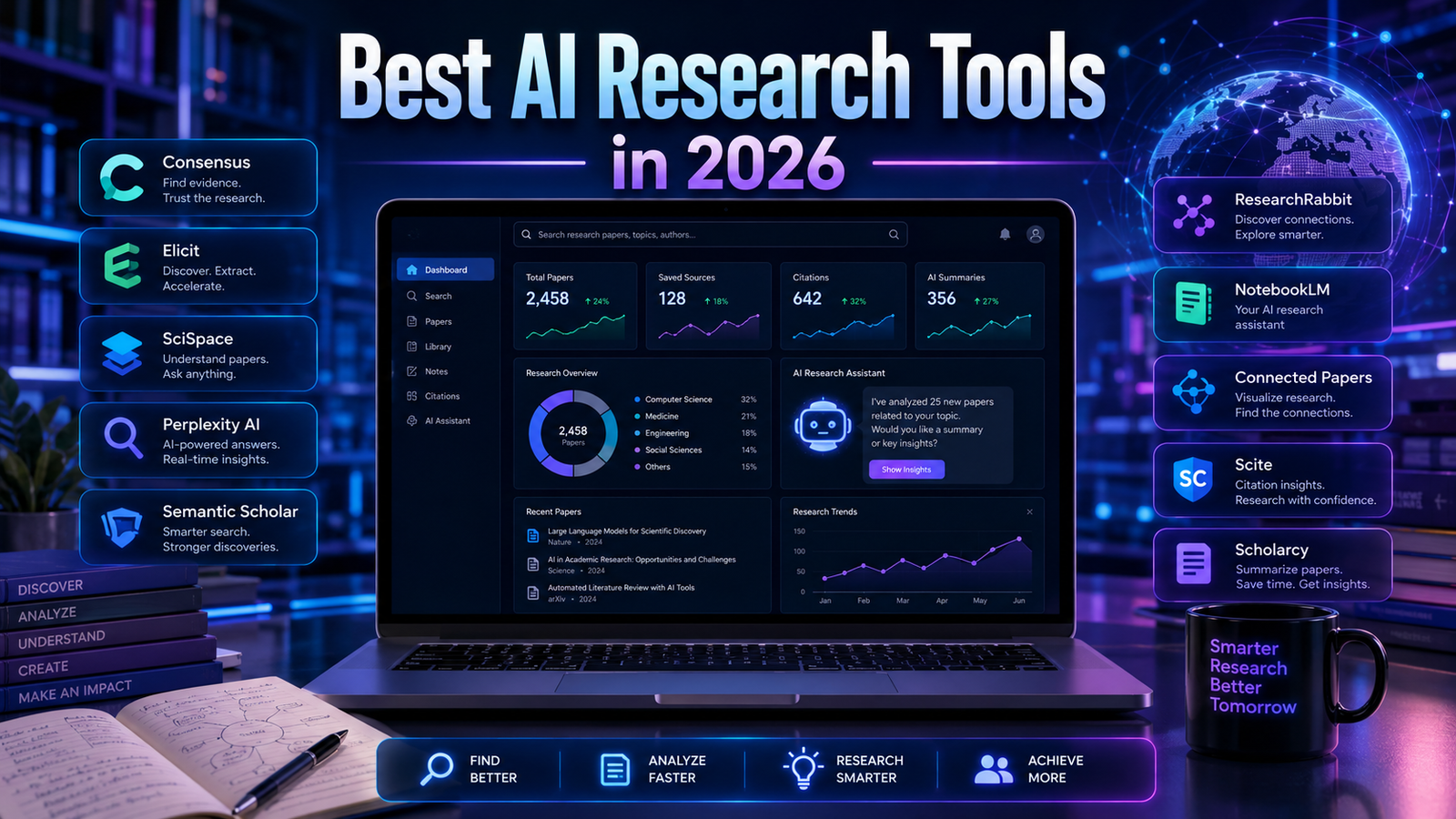
Best AI Research Tools in 2026: 10 Tools for Smarter Research
Last updated: September 2026
Researching a topic used to mean opening dozens of browser tabs, searching academic databases, downloading papers, taking notes, and manually comparing sources.
AI research tools are changing parts of that workflow.
Modern research platforms can help you discover academic papers, summarize documents, map connections between studies, analyze citations, search the web, organize notes, and answer questions about sources you provide.
But there is an important distinction: an AI research tool is not automatically a reliable source of truth.
Some platforms are designed specifically for academic literature. Others are better for web research, document analysis, citation discovery, or literature mapping. The best tool therefore depends on what you are researching and how you intend to use the information.
In this guide, we compare 10 useful AI research tools in 2026, explain what each one does best, identify its limitations, and show which type of researcher or student should consider it.
Important: Features, usage limits, and pricing can change. Pricing and product information in this guide were checked against official sources in September 2026. Always verify the current plan before subscribing.
Quick Comparison
| Tool | Best For | Free Option | Main Strength |
|---|---|---|---|
| Consensus | Evidence-based research | Yes | Research answers and paper summaries |
| Elicit | Literature reviews | Yes | Research reports and paper extraction |
| SciSpace | Understanding papers | Yes | AI-assisted paper reading |
| Perplexity | Web research | Yes | Search with cited sources |
| Semantic Scholar | Academic discovery | Yes | Paper search and recommendations |
| ResearchRabbit | Literature discovery | Yes | Visual exploration of related papers |
| NotebookLM | Research from your own sources | Yes | Source-grounded document analysis |
| Connected Papers | Literature mapping | Yes | Visual paper graphs |
| Scite | Citation analysis | Free tier | Citation context and research credibility |
| Scholarcy | Paper summarization | Yes | Structured summaries and flashcards |
These tools should not be treated as interchangeable.
For example, Elicit is much more specialized for literature reviews than a general AI search engine, while ResearchRabbit and Connected Papers are particularly useful when you want to discover relationships between academic papers.
What Are AI Research Tools?
AI research tools are software platforms that use artificial intelligence to help with one or more stages of the research process.
Depending on the tool, this can include:
- Finding relevant papers
- Searching the web
- Summarizing research
- Extracting information from papers
- Comparing studies
- Exploring citations
- Analyzing uploaded documents
- Organizing research materials
- Discovering related publications
- Generating research questions
- Creating citation information
- Answering questions about provided sources
Traditional search engines are primarily designed to help you find information.
AI research tools increasingly try to help you understand, organize, and evaluate information as well.
That does not mean the AI output should automatically be considered correct. A good research workflow still requires checking the underlying sources.
AI Research Tools vs. Traditional Search Engines
A traditional search engine usually gives you a list of pages, papers, or websites that may answer your query.
An AI research tool may instead provide a synthesized answer, summarize multiple papers, extract findings, or show relationships between sources.
For example, imagine you want to research:
“Does regular exercise improve sleep quality?”
A traditional search might give you hundreds of pages to investigate.
A research-focused AI platform may help you:
- Find relevant studies.
- Identify recurring findings.
- Compare study characteristics.
- Read summaries.
- Locate supporting or conflicting evidence.
- Open the original papers for verification.
This can reduce the amount of manual searching involved, but it does not eliminate the need to evaluate the evidence.
How We Evaluated These AI Research Tools
Rather than ranking the platforms solely by the number of AI features they advertise, this comparison considers the research workflow they support.
The main criteria were:
- Research discovery
- Quality and transparency of sources
- Literature-review capabilities
- AI summaries and explanations
- Citation features
- Document and PDF analysis
- Research organization
- Discovery of related studies
- Free availability
- Pricing structure
- Practical limitations
We also considered the type of research each platform is designed for.
That matters because comparing a general web research assistant with an academic citation-analysis platform on exactly the same criteria would not produce a useful comparison.
1. Consensus
Best for: Evidence-based academic research
Consensus is an AI-powered academic search platform focused on scientific literature.
Instead of treating the open web as its primary source, Consensus is designed around research papers and provides AI-assisted ways to understand findings from the academic literature.
Its current free tier provides access to core search functionality, while paid plans add capabilities such as deeper research reviews, expanded AI interactions, and study snapshots. Consensus says its Pro plan costs $20/month or $144/year when billed annually.
Why Consensus Stands Out
Consensus is particularly useful when your question can be answered by examining published research rather than general websites.
For example, it can be useful for questions involving:
- Health research
- Psychology
- Education
- Scientific findings
- Social science research
- Evidence-based questions
Best For
- University students
- Researchers
- Evidence-based research
- Literature exploration
- Professionals who need research-backed information
Limitations
Consensus is primarily focused on academic literature. It is therefore not the best replacement for a general-purpose web search engine when your research requires current news, company information, product pages, or other web sources.
It should also not be treated as proof that a scientific claim is correct simply because an AI summary presents it confidently.
2. Elicit
Best for: Literature reviews and structured research
Elicit is one of the more specialized platforms in this list.
It is designed to help researchers search academic literature, summarize papers, extract information into structured tables, and conduct more systematic research workflows.
Its current Basic plan is free and includes unlimited searches across more than 138 million papers, unlimited summaries, paper chat where full text is available, source viewing, and Zotero import. Paid plans add more extensive research-agent usage, systematic-review workflows, exports, custom extraction, and collaboration features.
Why Elicit Stands Out
The biggest advantage of Elicit is that it is designed around the research process, rather than simply answering questions.
Researchers can use it to organize findings from multiple papers and compare information systematically.
Higher-tier plans are specifically designed for systematic reviews and can screen thousands of papers according to the plan.
Best For
- Literature reviews
- Graduate students
- Academic researchers
- Systematic research
- Research-heavy organizations
Limitations
Elicit can be more complex than necessary for someone who only wants a quick answer.
Its most advanced research workflows are also tied to paid plans.
3. SciSpace
Best for: Understanding academic papers
SciSpace is designed to make scientific and academic literature easier to read and understand.
Its AI-powered research environment can help users interact with papers, ask questions, and work with academic documents.
SciSpace also offers separate products for academic writing and formatting, so it is important to distinguish those services from its AI research features. Its current pricing pages show a free option and paid tiers for its research and academic-writing products.
Why SciSpace Stands Out
Reading an academic paper can be difficult when it contains unfamiliar terminology, complicated methodology, equations, or dense explanations.
SciSpace is useful because it focuses heavily on helping users understand research papers, rather than simply finding them.
Best For
- Students
- Researchers
- Scientific reading
- Technical papers
- People new to academic literature
Limitations
AI explanations are interpretations of the source. For important research, users should still inspect the relevant section of the original paper.
SciSpace also offers several different products, so users should check exactly which plan and feature set they are purchasing.
4. Perplexity
Best for: Fast web research with sources
Perplexity is different from most of the academic-focused platforms in this list.
It works primarily as an AI-powered search and answer engine, making it useful when your research extends beyond academic papers.
You can use it to investigate:
- Companies
- Products
- Technology
- Current events
- Market information
- Public websites
- General questions
- Recent developments
Why Perplexity Stands Out
Its major advantage is breadth.
Instead of restricting research to academic publications, Perplexity can search and synthesize information from the wider web.
That makes it particularly useful during the initial research phase, when you want to understand a topic before moving into more specialized sources.
Best For
- General research
- Market research
- Current information
- Technology research
- Students
- Professionals
Limitations
A cited answer is not automatically a verified answer.
Sources should still be opened and checked, especially when the information is:
- Medical
- Financial
- Legal
- Scientific
- Highly technical
- Time-sensitive
Perplexity also has paid and enterprise offerings, with enterprise pricing varying by plan and organization.
5. Semantic Scholar
Best for: Discovering scientific literature
Semantic Scholar is a free, AI-powered research tool focused on scientific literature.
Its search system covers a very large collection of academic papers and provides features such as paper recommendations, citation information, research feeds, alerts, and AI-assisted paper understanding.
Why Semantic Scholar Stands Out
Semantic Scholar is particularly useful as a research discovery layer.
You can use it to:
- Find papers
- Identify influential citations
- Follow authors
- Create research feeds
- Organize papers
- Discover related studies
- Export citations
Its citation tools support formats including BibTeX, MLA, APA, and Chicago.
Semantic Scholar also offers AI-powered features such as TLDR summaries and an experimental “Ask This Paper” feature for supported papers.
Best For
- Scientific research
- Academic students
- Researchers
- Professors
- Literature discovery
Limitations
Semantic Scholar is primarily a scientific literature discovery platform.
It is not designed to replace a general-purpose AI writing assistant or a broad web research engine.
6. ResearchRabbit
Best for: Exploring relationships between research papers
ResearchRabbit takes a different approach to academic discovery.
Instead of simply returning a list of search results, it helps researchers explore connections between papers, authors, and research topics.
Its free tier currently includes unlimited searches across more than 310 million articles, unlimited collections, collaboration, and the ability to use up to 50 seed articles. ResearchRabbit+ adds larger seed limits, advanced search controls, multiple projects, and research alerts.
Why ResearchRabbit Stands Out
ResearchRabbit is especially useful when you already have a few relevant papers and want to discover what else is connected to them.
A typical workflow could be:
Find one strong paper → add it to ResearchRabbit → explore related research → identify important authors and studies → expand your literature review.
Best For
- Literature reviews
- PhD students
- Researchers
- Academic discovery
- Finding related studies
Limitations
ResearchRabbit is not primarily an AI writing assistant.
Its value is in research discovery and organization, rather than generating finished academic writing.
7. NotebookLM
Best for: Researching your own documents
NotebookLM is particularly different from search-focused research tools because it can work around a collection of sources that you provide.
This makes it useful when your research already exists in:
- PDFs
- Documents
- Notes
- Reports
- Research materials
- Other supported source formats
Instead of asking an AI to answer from the entire internet, you can use a notebook to work with a defined collection of material.
Why NotebookLM Stands Out
The key advantage is source-focused research.
For example, imagine you have 15 research papers about one topic.
Rather than repeatedly opening each document, you can organize them in a notebook and ask questions that relate to those sources.
This makes NotebookLM particularly useful for:
- Studying
- Research projects
- Reports
- Document analysis
- Course materials
- Personal knowledge bases
Best For
- Students
- Researchers
- Writers
- Professionals working with reports
- Source-based research
Limitations
NotebookLM is most useful when you have a clear collection of source material.
It should not be treated as a substitute for discovering authoritative sources when you have not yet established your research base.
8. Connected Papers
Best for: Visual literature mapping
Connected Papers helps researchers explore relationships between academic papers through visual graphs.
The platform is particularly useful when you have identified an important paper and want to discover related research around it.
Its free plan currently provides five graphs per month, while paid Academic and Business plans remove that restriction. All plans include features such as similarity graphs, prior and derivative works, multi-origin graphs, saved papers, and graph history.
Why Connected Papers Stands Out
Some research problems are easier to understand visually.
Instead of scrolling through a long list of search results, you can see how papers relate to one another and identify clusters of research.
Best For
- Literature reviews
- Academic discovery
- Finding related papers
- Research mapping
- Exploring a new research field
Limitations
Connected Papers is primarily a discovery and visualization tool.
It does not replace a full academic search database or an AI writing assistant.
9. Scite
Best for: Understanding how research is cited
Scite focuses on citation analysis.
Rather than simply telling you that Paper A cites Paper B, Scite can help researchers understand the context in which research has been cited.
Its current platform includes Smart Citation reports, citation alerts, collections, and an AI research assistant. The free tier provides limited access, while the Basic plan currently costs $20/month when billed annually and the Pro plan costs $50/month when billed annually.
Why Scite Stands Out
Citation counts alone can be misleading.
A paper may be cited because another researcher:
- Supports its conclusion
- Disagrees with it
- Mentions it as background
- Uses its methodology
- Criticizes its findings
Understanding citation context can therefore provide more information than simply counting citations.
Best For
- Academic researchers
- Literature reviews
- Scientific validation
- Citation analysis
- Research credibility checks
Limitations
Scite is more specialized than general AI search tools.
Its strongest features are most useful when you are working with scholarly literature and citations.
10. Scholarcy
Best for: Quickly summarizing research papers
Scholarcy is an AI-powered research summarization platform.
It converts lengthy documents into structured summaries and can help extract key information, organize flashcards, take notes, and build literature-review materials.
Scholarcy currently offers a free article summarizer with usage limits. Paid plans add unlimited summarization, enhanced summaries, saved flashcards, notes, collections, literature matrices, and bibliography features.
Why Scholarcy Stands Out
Scholarcy is useful when you have a large reading list and need to identify which papers deserve deeper attention.
A summary can help you quickly understand:
- The research question
- Main findings
- Important concepts
- References
- Key sections
You can then return to the original paper for detailed reading.
Best For
- Students
- Researchers
- Literature reviews
- Academic reading
- Large reading lists
Limitations
A summary is still a summary.
Important methodological details, limitations, contradictory findings, or contextual information may require reading the original paper.
Best AI Research Tool by Research Task
Rather than asking which platform is universally “number one,” it is more useful to match the tool to the task.
| Research Task | Recommended Tool |
|---|---|
| Evidence-based questions | Consensus |
| Literature reviews | Elicit |
| Understanding difficult papers | SciSpace |
| General web research | Perplexity |
| Academic paper discovery | Semantic Scholar |
| Discovering related studies | ResearchRabbit |
| Researching your own documents | NotebookLM |
| Visual literature mapping | Connected Papers |
| Citation analysis | Scite |
| Fast paper summaries | Scholarcy |
This approach is more useful than declaring one platform the “best” because the tools solve different research problems.
Free AI Research Tools vs. Paid Tools
Many of the platforms in this guide offer a free option.
Some are genuinely free for core research tasks, while others use free tiers with limits on advanced features or usage.
Strong Free Options
Semantic Scholar is free and provides academic search, recommendations, citation information, and research-management features.
ResearchRabbit has a permanent free tier with unlimited searches, collections, collaboration, and up to 50 seed articles.
Connected Papers offers five free graphs per month with all core graph features included.
Elicit also has a free Basic plan with unlimited paper search and summaries, although its advanced research workflows have usage limits.
When Paid Plans Make Sense
A paid plan may be worthwhile when you need:
- Larger research projects
- Systematic literature reviews
- Higher AI usage limits
- Advanced document analysis
- Citation alerts
- Larger collections
- Collaboration
- Research automation
- Advanced exports
For occasional research, however, paying for several overlapping tools can be unnecessary.
How to Choose the Right AI Research Tool
1. Start With the Type of Research
First decide what you are actually researching.
Academic literature
Prioritize:
- Elicit
- Consensus
- Semantic Scholar
- ResearchRabbit
- Scite
General web research
Consider:
- Perplexity
Research from existing documents
Consider:
- NotebookLM
- SciSpace
- Scholarcy
Literature discovery
Consider:
- ResearchRabbit
- Connected Papers
- Semantic Scholar
This simple classification can eliminate many unsuitable options immediately.
2. Check the Sources
Do not judge a research platform only by how impressive its AI answer sounds.
Ask:
- Where does the information come from?
- Can I open the original source?
- Does the tool show citations?
- Can I inspect the relevant paper?
- Is the source current?
- Is the source appropriate for my question?
Source transparency is one of the most important differences between a useful research assistant and a generic chatbot.
3. Check the AI’s Role
AI can perform different research tasks.
One platform may summarize papers.
Another may compare them.
Another may map citations.
Another may search the web.
Another may answer questions about documents you upload.
Determine which task is actually consuming most of your time before choosing a subscription.
4. Consider Research Volume
Someone researching one university assignment does not have the same needs as someone conducting a systematic review.
For occasional research, a free plan may be sufficient.
For large projects, check:
- Search limits
- Paper limits
- AI usage
- Upload limits
- Export limits
- Collaboration features
- Number of projects
- Citation alerts
5. Consider the Original Source Access
A research platform is most useful when it helps you get back to the source.
For example, Semantic Scholar provides links to available full text or publisher pages when possible. If a paper is not freely accessible, the platform may direct you to the publisher or an institutional access route.
That distinction matters because an AI-generated summary should not become the only evidence behind an important claim.
How to Use AI Research Tools Correctly
AI can make research faster, but the quality of your workflow still matters.
Step 1: Define the Research Question
Avoid starting with a vague prompt such as:
“Tell me everything about artificial intelligence.”
Instead, define a narrower question.
For example:
“How has generative AI affected software developer productivity according to studies published since 2023?”
A specific question makes it easier to identify appropriate sources.
Step 2: Discover Sources
Use a research tool to find relevant papers, reports, or websites.
At this stage, focus on breadth.
You want to discover the important sources before forming a conclusion.
Step 3: Identify the Strongest Sources
Do not treat every result equally.
Look for:
- Primary research
- Peer-reviewed studies
- Reputable institutions
- Original datasets
- Official documentation
- Recent research when recency matters
Step 4: Use AI to Summarize
Once you have credible sources, AI can help you understand them faster.
Ask questions such as:
- What was the research question?
- What methodology was used?
- What were the main findings?
- What limitations did the authors identify?
- How does this paper differ from another study?
Step 5: Verify Important Claims
Open the original source.
Check whether the paper actually supports the statement you intend to make.
This is especially important for numerical claims, scientific conclusions, medical information, and controversial findings.
Step 6: Compare Sources
One paper rarely provides the complete answer.
Look for:
- Agreement
- Contradictions
- Different methodologies
- Different populations
- Different time periods
- Different interpretations
This is where AI can help organize information, but the researcher must still make the final judgment.
Why AI Research Tools Can Give Wrong Answers
AI systems can make mistakes.
A tool may:
- Misinterpret a paper
- Oversimplify a conclusion
- Miss an important limitation
- Cite an unsuitable source
- Confuse two studies
- Present an uncertain claim too confidently
- Fail to account for newer research
This is why citation does not equal verification.
A response containing five citations can still contain a misleading interpretation.
For serious research, treat AI as a research assistant—not as the final authority.
AI Research Tools and Academic Integrity
Students should also check their university or instructor’s rules before using AI in academic work.
Different institutions can have different policies regarding:
- AI-assisted research
- AI-generated writing
- Citation generation
- Paraphrasing
- Assignment assistance
- Disclosure of AI use
Using AI to locate or understand sources is not necessarily the same thing as submitting AI-generated writing as your own.
When academic rules apply, follow the specific requirements of your institution.
Common Mistakes to Avoid
Relying on AI Summaries Alone
A summary can help you decide what to read, but it should not automatically replace the original paper.
Trusting Every Citation
Open important citations and confirm that they actually support the claim.
Using Only One Source
Research becomes stronger when you compare multiple credible sources.
Ignoring Publication Dates
A highly cited paper may still be outdated for a rapidly changing field.
Confusing Citation Count With Evidence Quality
A paper being cited frequently does not automatically mean every conclusion in it is correct.
Using General Web Sources for Specialized Questions
For scientific questions, academic databases and original research may be more appropriate than generic web pages.
Frequently Asked Questions
What is the best AI research tool in 2026?
There is no universal winner.
Elicit is particularly strong for literature reviews, Consensus for evidence-based academic questions, Perplexity for broad web research, Semantic Scholar for academic discovery, and ResearchRabbit for exploring connections between papers.
What is the best free AI research tool?
It depends on your research task.
For academic literature, Semantic Scholar is a strong free option. ResearchRabbit also offers a permanent free tier with extensive literature-discovery functionality, while Elicit provides a free Basic plan with substantial paper-search and summarization capabilities.
Can AI research tools summarize PDFs?
Yes.
Several tools can work with research documents or papers, including SciSpace, NotebookLM, and Scholarcy.
However, summaries should be treated as a starting point rather than a substitute for the original document.
Can AI research tools find academic papers?
Yes.
Academic-focused platforms such as Semantic Scholar, Consensus, Elicit, ResearchRabbit, and Connected Papers are specifically designed to help users discover scholarly literature.
Can AI research tools generate citations?
Many research platforms provide citation information or citation-management features.
Semantic Scholar, for example, provides citation formats including BibTeX, MLA, APA, and Chicago.
However, generated citation information should still be checked before it is included in academic work.
Are AI research tools accurate?
They can be useful, but none should be treated as infallible.
The quality of the answer depends on factors such as the underlying sources, the question, the available evidence, and how the AI interprets that evidence.
For important claims, always verify the original source.
Are AI research tools useful for students?
Yes.
Students can use them to:
- Discover papers
- Understand difficult concepts
- Summarize readings
- Organize sources
- Explore related research
- Prepare literature reviews
Students should also follow their institution’s rules regarding acceptable AI use.
Which AI research tool is best for literature reviews?
Elicit is one of the strongest options for structured literature-review workflows.
ResearchRabbit and Connected Papers are useful complements because they help discover relationships between papers.
Scite can then help investigate citation context.
For a large project, combining specialized tools can be more effective than expecting one platform to do everything.
Final Verdict
The best AI research tool is not necessarily the platform with the most impressive AI features.
It is the platform that fits the stage of research you are working on.
- Best for evidence-based research: Consensus
- Best for literature reviews: Elicit
- Best for understanding academic papers: SciSpace
- Best for general web research: Perplexity
- Best for academic discovery: Semantic Scholar
- Best for discovering connected research: ResearchRabbit
- Best for working with your own sources: NotebookLM
- Best for visual literature mapping: Connected Papers
- Best for citation analysis: Scite
- Best for paper summaries: Scholarcy
For many researchers, the most effective workflow is not to choose one tool and use it for everything.
Instead, you can combine tools according to the research process:
Discover → Evaluate → Read → Compare → Verify → Organize
For example, you might discover papers with Semantic Scholar or ResearchRabbit, conduct a structured literature search with Elicit, examine citation context with Scite, and use NotebookLM or SciSpace to work through documents in greater depth.
Most importantly, AI should accelerate research rather than replace research judgment.
The strongest research still comes from credible sources, careful verification, comparison of evidence, and a clear understanding of the original material.
Related Articles
Continue exploring AI productivity and research with these related guides:
- Best AI Productivity Tools
- Best AI Grammar Checkers
- Best AI Chatbots
- Best AI Automation Tools
- Best AI Presentation Tools
We hope this guide to the Best AI Research Tools helps you choose the perfect platform for your needs in 2026.