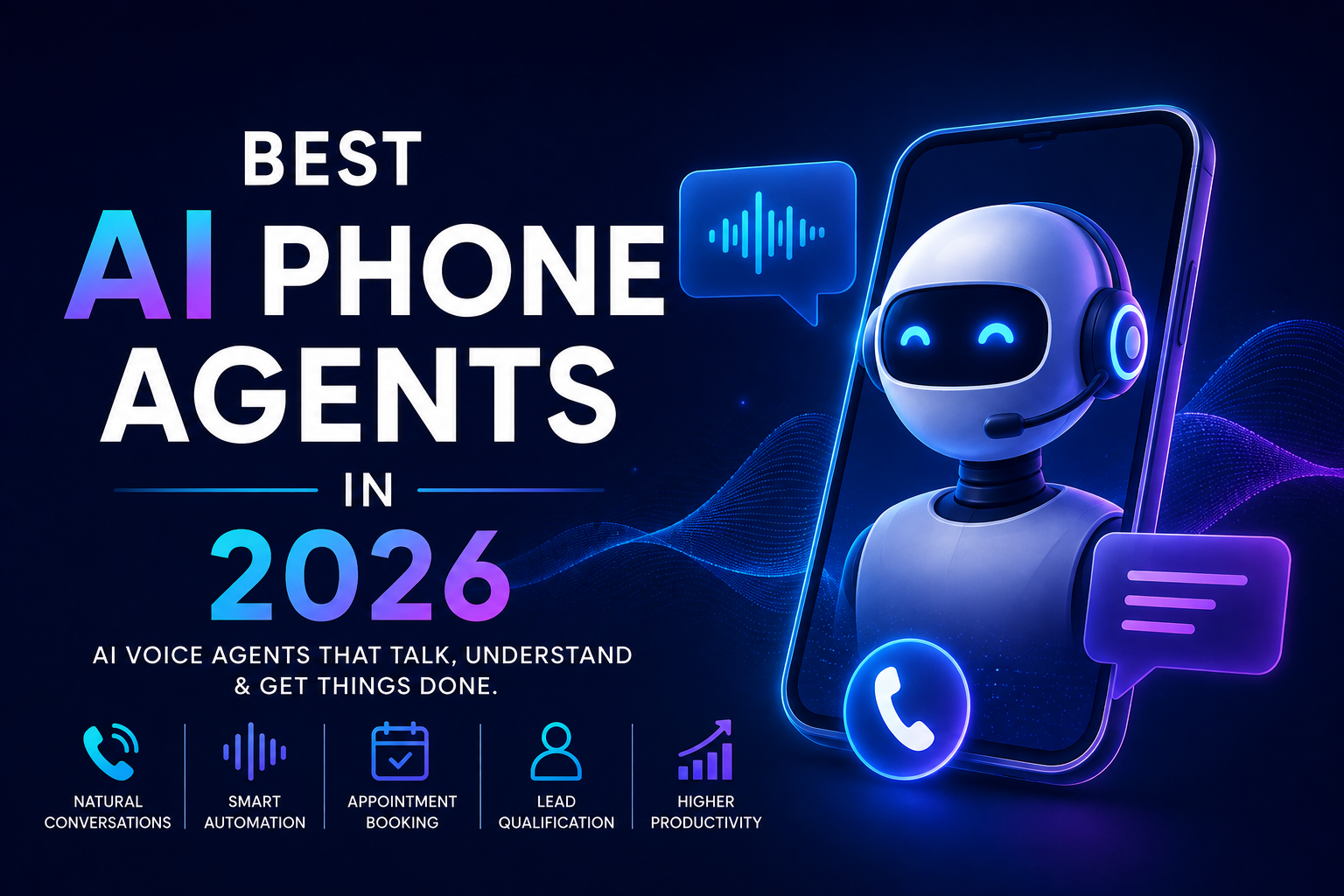
Best AI Phone Agents in 2026: 5 Voice AI Platforms Compared
AI phone agents have become much more capable than traditional automated phone menus.
Modern voice AI platforms can handle inbound calls, answer routine questions, qualify leads, schedule appointments, collect information, update business systems, and transfer conversations to human employees when necessary.
But choosing an AI phone agent is not simply about finding the voice that sounds the most realistic.
For a real business, factors such as response latency, interruption handling, workflow control, integrations, call quality, scalability, pricing, analytics, and human handoffs can be just as important as voice quality.
This guide compares five leading AI phone-agent platforms in 2026 and explains what each one is best suited for.
Editorial note: Features, pricing, supported models, and integrations can change frequently. Pricing information in this guide reflects the providers’ published information reviewed in September 2026. Always confirm current pricing and availability before purchasing.
Quick Comparison: Best AI Phone Agents in 2026
| Platform | Best For | Main Strength | Pricing Model | Technical Flexibility |
|---|---|---|---|---|
| Retell AI | Overall use | Balance of voice quality, development tools, and analytics | Usage-based | High |
| Vapi | Developers | Control over models, providers, and infrastructure | Usage-based | Very high |
| Synthflow | Business teams | Visual voice-agent workflows | Sales-led/custom | Medium |
| Bland AI | High-volume calling | Simple usage model and outbound scale | Per-minute + platform plans | High |
| ElevenLabs Agents | Voice quality and multilingual use | Natural and expressive voices | Subscription + usage | High |
Our picks at a glance
- Best overall: Retell AI
- Best for developers: Vapi
- Best for visual/no-code-style workflows: Synthflow
- Best for high-volume calling: Bland AI
- Best for natural voice and multilingual experiences: ElevenLabs Agents
These recommendations are based on the platforms’ documented capabilities and their fit for different business requirements rather than on a claim that one service is objectively best for every company.
What Is an AI Phone Agent?
An AI phone agent is software that can conduct a telephone conversation using artificial intelligence.
A typical system combines several technologies:
- Speech recognition to understand what the caller says
- A language model to interpret requests and generate responses
- Text-to-speech or speech-to-speech technology to produce the agent’s voice
- Telephony infrastructure to make or receive calls
- Tools and integrations that allow the agent to perform actions
- Workflows that determine what the agent should do in different situations
The important distinction between a basic voice bot and a modern AI phone agent is action.
A useful agent should not only answer:
“What are your opening hours?”
It may also be able to check a calendar, schedule an appointment, update a CRM record, send information, or transfer the caller to the appropriate employee.
That makes AI phone agents particularly useful for repetitive, well-defined business processes.
How We Evaluated These AI Phone Agents
There is no universal benchmark that determines the best AI phone agent.
Instead, we evaluated these platforms around practical business requirements:
Conversation quality
How well can the system handle natural conversations, interruptions, pauses, and follow-up questions?
Deployment
How quickly can a business move from an idea to a working phone agent?
Customization
Can developers control the models, prompts, tools, workflows, telephony, and integrations?
Business integrations
Can the platform connect with CRMs, calendars, APIs, webhooks, knowledge bases, and other business systems?
Analytics and testing
Can teams review calls, transcripts, outcomes, and agent performance?
Scalability
Can the platform support increasing call volumes and concurrent conversations?
Pricing transparency
Is it reasonably clear what the business will pay as usage increases?
Because these platforms target different customers, the rankings below should be viewed as use-case recommendations, not a universal leaderboard.
1. Retell AI — Best Overall AI Phone Agent
Retell AI is our top overall choice for businesses that want a combination of real-time voice capabilities, developer flexibility, testing tools, analytics, and usage-based pricing.
The platform supports AI voice agents for inbound and outbound calls and provides features such as agent templates, call analytics, transcripts, simulation testing, webhooks, APIs, knowledge bases, and telephony integrations.
Why We Picked Retell AI
Retell’s biggest advantage is balance.
A business can start with relatively straightforward agent creation while still having access to APIs and deeper customization when the project becomes more sophisticated.
That makes it suitable for both smaller deployments and teams building more customized voice applications.
Its testing and analytics capabilities are also important because a phone agent should be evaluated using real conversations rather than a single impressive demonstration.
Key Features
- Inbound AI phone agents
- Outbound calling
- Real-time voice conversations
- Call analytics
- Call transcripts
- Simulation testing
- Knowledge bases
- Webhooks
- API access
- Telephony integrations
- Human call transfers
- Multiple voice options
- Custom LLM support
- AI quality-assurance tools
- Enterprise security options
Pricing
Retell currently offers usage-based pricing rather than requiring a traditional annual contract for its standard plan.
Its published AI voice-agent pricing is approximately $0.07–$0.31 per minute, depending on the configuration. The company also provides free credits for getting started and includes 20 concurrent calls on its pay-as-you-go plan. Additional costs can apply for models, telephony, voices, and optional features. [1]
Because the final cost depends on the technology stack selected, businesses should use Retell’s current pricing calculator rather than assuming one fixed per-minute rate.
Pros
- Strong balance between simplicity and customization
- Real-time voice conversations
- Inbound and outbound support
- Useful testing and analytics
- API and webhook support
- Usage-based pricing
- Suitable for production deployments
Cons
- Costs vary depending on the underlying configuration
- Advanced implementations require technical knowledge
- Premium models and features can increase the effective cost per minute
Best For
Retell AI is a strong choice if you want one platform that balances development flexibility, conversational quality, testing, analytics, and production deployment.
2. Vapi — Best AI Phone Agent for Developers
Vapi is designed for developers who want significant control over the architecture behind their voice applications.
Rather than forcing every customer into one fixed technology stack, Vapi allows developers to work with different speech, language, voice, and telephony providers.
That flexibility is its main attraction.
Why We Picked Vapi
Vapi makes the most sense when your team already has software-development experience.
Developers can build voice applications around their preferred models and providers while using Vapi for the orchestration layer.
This approach can be especially useful when a company wants to experiment with different LLMs, speech-to-text systems, text-to-speech providers, or custom application logic.
The tradeoff is that greater control also means greater responsibility.
A nontechnical business owner may find Vapi considerably more complicated than a business-oriented visual platform.
Key Features
- Voice AI agents
- Custom LLM support
- Speech-to-text integrations
- Text-to-speech integrations
- Telephony support
- API access
- Webhooks
- Custom tools
- Function calling
- Custom workflows
- Developer infrastructure
- Multiple provider options
- Concurrency management
Pricing
Vapi’s current Build plan uses usage-based pricing.
Vapi lists its hosting cost at $0.05 per minute, while model-provider and other component costs are charged separately. The Build plan includes 10 concurrent calls, with additional concurrency available at an additional monthly cost. [2]
This distinction is important.
A business should not interpret the $0.05 figure as the complete cost of running a production voice agent. The actual bill can also include the language model, speech recognition, voice provider, and transport or telephony costs.
Pros
- Very high developer control
- Multiple model and provider options
- Flexible architecture
- Strong API approach
- Good for custom applications
- Usage-based infrastructure
Cons
- More technical than business-focused platforms
- Costs can involve multiple components
- Requires engineering knowledge
- More configuration decisions for the development team
Best For
Choose Vapi when your development team wants maximum control over the technology stack behind the voice agent.
3. Synthflow — Best Visual AI Phone Agent Platform
Synthflow focuses on making sophisticated voice-agent workflows easier to deploy without requiring businesses to build every component themselves.
The platform is aimed heavily at business applications such as customer service, appointment booking, lead qualification, AI receptionists, and call automation.
Why We Picked Synthflow
Synthflow’s main advantage is its focus on business-oriented deployment.
Instead of assembling speech recognition, language models, telephony, workflows, integrations, and other components independently, teams can build their voice applications within a more centralized environment.
The platform also supports integrations and enterprise capabilities designed around business workflows.
This makes it particularly attractive to agencies and operations teams that want to deploy voice automation without building an entire voice infrastructure internally.
Key Features
- Visual AI-agent workflows
- AI receptionist use cases
- Appointment scheduling
- Customer-service automation
- Lead qualification
- Outbound calling
- CRM integrations
- Calendar integrations
- Webhooks
- API access
- SIP support
- Call routing
- Human handoffs
- Knowledge sources
- Enterprise deployment options
Pricing
Synthflow currently uses sales-led pricing for new deployments.
Its published information says packages are scoped according to factors such as expected call volume, concurrency, telephony, integrations, security requirements, and launch support. Synthflow’s enterprise contracts currently start at $30,000 annually. [3]
That makes Synthflow more difficult to compare directly with platforms that publish simple per-minute rates.
Pros
- Strong business focus
- Visual workflow approach
- Useful for agencies and operations teams
- Appointment and customer-service use cases
- CRM and calendar integrations
- Enterprise deployment options
Cons
- Pricing is less transparent than simple pay-as-you-go platforms
- Larger deployments can require significant budgets
- Developers may prefer the lower-level control of Vapi
- Advanced workflows can still require technical planning
Best For
Choose Synthflow if your priority is building business-oriented voice workflows visually rather than assembling the entire voice infrastructure yourself.
4. Bland AI — Best for High-Volume Calling
Bland AI is particularly interesting for organizations that need to handle a large number of automated calls.
Its pricing model combines per-minute usage with platform plans for teams that need greater capacity and functionality.
Why We Picked Bland AI
Bland’s main strength is operational simplicity.
The company says its pricing does not pass separate model-provider charges directly to customers in the same way that some developer-focused platforms do.
Its current pricing includes a Start plan at $0.14 per minute, while the Build plan is listed at $0.12 per minute plus a $299 monthly platform fee. Enterprise pricing is customized. [4]
This can make budgeting easier for businesses that prefer a more consolidated voice-AI pricing structure.
Key Features
- Inbound calling
- Outbound calling
- Conversational workflows
- Automated calling campaigns
- Knowledge bases
- Call transfers
- Custom dialing
- Appointment scheduling
- SMS capabilities
- Web chat
- Custom integrations
- High concurrency
- Enterprise infrastructure
Pros
- Strong focus on large-scale calling
- Straightforward pricing structure
- AI infrastructure included in platform pricing
- Strong outbound use cases
- High concurrency options
- Developer capabilities
- Enterprise deployment options
Cons
- Higher plans include platform fees
- Less provider-level flexibility than Vapi
- High-volume plans may not make sense for very small businesses
- Telephony and other requirements should still be included in the total cost calculation
Pricing
The current Start plan is listed at $0.14/minute with no platform fee.
The Build plan is $0.12/minute plus $299/month.
Enterprise pricing is customized according to the organization’s requirements. [4]
Best For
Choose Bland AI when your business expects significant outbound or inbound call volume and wants a relatively consolidated pricing model.
5. ElevenLabs Agents — Best for Natural Voice Quality
ElevenLabs is well known for its voice technology, and ElevenLabs Agents extends that technology into conversational AI applications.
The platform combines voice capabilities with agent workflows, knowledge bases, tools, telephony, testing, and multilingual functionality.
Why We Picked ElevenLabs Agents
Voice quality matters because callers form an impression of a business within the first few seconds of a conversation.
A technically capable agent can still create a poor experience if its speech sounds unnatural, poorly paced, or difficult to understand.
ElevenLabs is particularly compelling when voice realism and multilingual communication are major requirements.
Its agent platform supports knowledge bases, tools, workflows, phone deployment, and multiple languages.
Key Features
- AI voice agents
- Inbound calling
- Outbound calling
- Natural voice generation
- Multilingual agents
- Knowledge bases
- RAG
- Tool calling
- Workflow builder
- Telephony integrations
- SIP support
- CRM integrations
- Appointment workflows
- Conversation analytics
- Voice customization
- Voice cloning capabilities
Pricing
ElevenAgents currently offers a free plan with 15 minutes of calls and paid plans starting at $6/month.
Its published plans include:
- Free: 15 included call minutes
- Starter: $6/month
- Creator: $22/month
- Pro: $99/month
- Scale: $299/month
- Business: $990/month
- Enterprise: Custom pricing
Additional call minutes are currently listed at $0.08 per minute, while LLM and telephony costs can be charged separately depending on the configuration. [5]
ElevenLabs also introduced updated Agents pricing and pay-as-you-go options in 2026, so users should verify the current pricing page before deployment. [6]
Pros
- Highly natural voice technology
- Strong multilingual capabilities
- Voice customization
- Good developer tools
- Agent workflows
- Knowledge-base support
- Inbound and outbound capabilities
- Broad voice ecosystem
Cons
- Total cost can involve several components
- LLM and telephony costs may be separate
- Advanced enterprise deployments can become expensive
- Businesses that do not prioritize voice quality may find simpler platforms sufficient
Best For
Choose ElevenLabs Agents when natural, expressive, and multilingual voice interaction is one of your most important requirements.
AI Phone Agent Comparison by Use Case
The best platform changes depending on what you are trying to accomplish.
| Business Need | Recommended Platform | Why |
|---|---|---|
| General business voice automation | Retell AI | Strong overall balance |
| Custom software application | Vapi | High developer control |
| Visual business workflows | Synthflow | Business-oriented deployment |
| Large calling operations | Bland AI | Designed around call volume |
| Natural multilingual voice | ElevenLabs Agents | Strong voice technology |
| Developer experimentation | Vapi | Flexible model/provider architecture |
| Call analytics and testing | Retell AI | Strong built-in tooling |
| Enterprise voice deployment | Synthflow / Retell / Bland | Enterprise-oriented options |
What Can an AI Phone Agent Actually Do?
The best way to evaluate a voice agent is not by asking how many features it has.
Ask what business outcome it can reliably produce.
1. Customer Support
An AI agent can answer frequently asked questions, collect customer information, explain policies, and route complicated requests.
For example, a customer might call a business and ask:
“What time do you close today?”
The agent can provide the answer immediately.
For more complex requests, it can collect the necessary information and transfer the caller to an employee.
2. Appointment Scheduling
Appointment automation is one of the clearest use cases for voice AI.
Depending on the integrations available, an agent can:
- Ask what service the customer needs
- Check availability
- Offer appointment times
- Schedule the appointment
- Reschedule an existing appointment
- Confirm booking information
- Transfer unusual requests to staff
The important part is that the AI should be connected to the actual scheduling system rather than simply pretending to book an appointment.
3. Lead Qualification
A sales team can use a phone agent to ask initial qualification questions before sending a prospect to a human representative.
For example:
- What service are you interested in?
- What is your approximate budget?
- When are you looking to start?
- What type of project do you need?
- Would you like to speak with a specialist?
The agent can then route qualified prospects according to predefined rules.
4. Missed-Call Recovery
A missed call can represent a lost opportunity.
Businesses can use automated voice systems to respond to eligible missed calls, identify the reason for the call, and route the customer appropriately.
This can be particularly useful for businesses where phone calls frequently represent new leads, such as:
- Dental practices
- Medical offices
- Home-service companies
- Law firms
- Real-estate businesses
- Automotive services
- Local contractors
The exact workflow should depend on the business and the applicable privacy and communications requirements.
5. Outbound Sales and Follow-Up
Voice AI can also be used for outbound workflows such as:
- Lead follow-up
- Appointment reminders
- Qualification
- Meeting scheduling
- Customer re-engagement
- Certain sales workflows
However, outbound calling requires significantly more attention to compliance than an inbound receptionist-style agent.
Businesses should verify applicable rules before making automated calls.
How to Build a Better AI Phone Agent
Buying a platform is only the beginning.
The quality of the final agent depends heavily on how it is configured.
1. Give the Agent Reliable Information
Create a controlled knowledge source containing information such as:
- Products
- Services
- Prices
- Opening hours
- Locations
- Policies
- Frequently asked questions
- Booking rules
- Escalation procedures
Avoid giving the agent outdated documents or contradictory information.
2. Start With One Business Problem
Do not attempt to automate every phone interaction on day one.
A better first project might be:
Answer calls → identify the request → provide information → perform one action → transfer when necessary.
Once the workflow performs reliably, add more capabilities.
3. Build Clear Human Handoffs
A good AI agent should know when it should stop.
Define transfer rules for situations such as:
- Angry or distressed customers
- Complex negotiations
- Sensitive cases
- High-value sales
- Complaints
- Requests outside the knowledge base
- Situations requiring human judgment
The goal is not to eliminate humans.
The goal is to let humans focus on conversations where their involvement adds the most value.
4. Test Interruptions
Real callers do not always wait for the AI to finish speaking.
They may:
- Interrupt
- Correct themselves
- Change the subject
- Speak quickly
- Pause
- Ask multiple questions
- Talk over the agent
Test these situations before deploying the system widely.
5. Monitor Business Outcomes
Do not judge an AI phone agent only by how human it sounds.
Track metrics such as:
- Call completion rate
- Transfer rate
- Resolution rate
- Appointment-booking rate
- Qualified-lead rate
- Average call duration
- Customer satisfaction
- Cost per completed task
- Escalation rate
The most important metric depends on the business objective.
For example, a sales team may care more about qualified meetings booked than total call duration.
Common AI Phone Agent Mistakes
Automating the Wrong Calls
Some conversations require empathy, judgment, negotiation, or professional expertise.
Automating those calls simply because the technology can handle them may create a worse customer experience.
Making the Agent Too Verbose
Callers generally want useful answers quickly.
An effective voice agent should avoid long explanations when a short answer will solve the problem.
Pretending to Be Human
Businesses should consider transparency when deploying AI voice systems.
The appropriate disclosure can depend on the use case, jurisdiction, and applicable laws.
Forgetting Human Escalation
An AI agent should always have a clear path to human assistance when it reaches the limits of its knowledge or authority.
Ignoring Compliance
This is particularly important for outbound calling.
In the United States, the FCC has stated that AI-generated voices fall within the Telephone Consumer Protection Act’s restrictions on artificial or prerecorded voices. Certain calls therefore require prior express consent or may be subject to other legal requirements. The FTC also enforces rules covering telemarketing and robocalls. [7]
Requirements can differ by country, state, call type, recipient, and purpose.
Businesses should obtain appropriate legal advice before launching large-scale automated calling campaigns.
Measuring Activity Instead of Results
A system making 10,000 calls is not necessarily successful.
The better question is:
What happened because of those calls?
For example:
- How many appointments were booked?
- How many leads were qualified?
- How many customer issues were resolved?
- How many calls required human intervention?
- What was the cost per successful outcome?
Pros and Cons of AI Phone Agents
Advantages
- 24/7 availability
- Faster response to routine calls
- Reduced repetitive workload
- Automated appointment scheduling
- Lead qualification
- Customer-service automation
- Scalable calling operations
- Consistent responses
- CRM and business-system integrations
- Multilingual communication
- Call transcripts and analytics
- Human handoff capabilities
Disadvantages
- AI can misunderstand unusual requests
- Initial setup requires testing
- Costs increase with usage
- Complex workflows may require developers
- Voice quality differs between platforms
- Integrations can introduce additional costs or complexity
- Outbound calling may involve significant compliance obligations
- Human employees are still necessary for sensitive and complex situations
Which AI Phone Agent Should You Choose?
Choose Retell AI if…
You want a balanced platform with voice infrastructure, analytics, testing, APIs, and relatively straightforward usage-based pricing.
Best for: Most businesses and teams building production voice agents.
Choose Vapi if…
You have developers and want to control the models, speech providers, telephony, tools, and application architecture.
Best for: Developers and technical teams.
Choose Synthflow if…
You want to build sophisticated business workflows visually and prefer a platform-oriented approach instead of assembling every component yourself.
Best for: Businesses, agencies, and operations teams.
Choose Bland AI if…
Your priority is handling significant calling volume and you prefer a consolidated voice-AI pricing structure.
Best for: High-volume calling operations.
Choose ElevenLabs Agents if…
Voice realism, expressiveness, or multilingual communication is a major part of your customer experience.
Best for: Voice-focused and multilingual applications.
Frequently Asked Questions
What is an AI phone agent?
An AI phone agent is software that can communicate with people over telephone calls using speech recognition, language models, voice generation, telephony infrastructure, and business tools.
Unlike a traditional phone menu, an AI agent can interpret natural language and, when properly integrated, perform actions such as scheduling appointments or updating business systems.
What is the best AI phone agent in 2026?
There is no single best platform for every business.
For a broad range of production use cases, Retell AI is our overall pick because it combines voice infrastructure, APIs, testing, analytics, inbound and outbound capabilities, and usage-based pricing.
Businesses with different requirements may be better served by Vapi, Synthflow, Bland AI, or ElevenLabs Agents.
What is the best AI phone agent for developers?
Vapi is our top developer-focused choice because it gives technical teams substantial control over the models, speech providers, telephony, and application architecture.
What is the best no-code AI phone agent?
Synthflow is one of the strongest choices for businesses that prefer visual workflows and business-oriented deployment.
However, “no-code” should not be interpreted as “no configuration required.” Complex integrations and production deployments may still require technical expertise.
What is the best AI phone agent for outbound calls?
Bland AI is particularly attractive for organizations focused on high-volume calling.
However, the right platform depends on call volume, workflow complexity, integrations, pricing, and compliance requirements.
Which AI phone agent has the most natural voice?
ElevenLabs Agents is one of the strongest choices when natural and expressive voice quality is a priority.
Voice quality is subjective, however, so businesses should test the actual voices, languages, latency, and call experience relevant to their audience before making a final decision.
Can AI phone agents book appointments?
Yes.
AI phone agents can be connected to calendars and scheduling systems so they can collect appointment details and, where supported by the integration, schedule or modify appointments.
The important distinction is between an agent that can actually perform the booking and one that merely tells the caller that it has booked something.
Can AI phone agents make sales calls?
Yes, some platforms support outbound sales and lead-qualification workflows.
However, businesses must consider applicable telecommunications, telemarketing, consent, privacy, recording, and Do Not Call requirements before using AI for outbound campaigns.
In the United States, AI-generated voice calls can fall under existing restrictions on artificial or prerecorded voices. [7]
Are AI phone agents expensive?
It depends on the platform and the architecture.
Some providers use simple usage-based pricing, while others separate the costs of the platform, LLM, speech recognition, voice generation, and telephony.
For example, Retell publishes usage-based AI voice pricing, Vapi separates hosting from provider costs, and ElevenLabs charges for agent minutes while some external provider costs are separate. [1][2][5]
The best way to compare platforms is therefore to calculate the total cost per completed business outcome, not simply the advertised platform rate.
Final Verdict
AI phone agents in 2026 are becoming practical tools for real business workflows.
The strongest platforms can do much more than answer scripted questions. They can understand callers, maintain conversational context, access business information, use tools, schedule appointments, qualify leads, analyze conversations, and transfer calls to humans when necessary.
Our five picks are:
Retell AI — Best Overall
A strong balance of voice capabilities, development flexibility, testing, analytics, and production readiness.
Vapi — Best for Developers
The strongest choice in this list when technical control and customization are the highest priorities.
Synthflow — Best for Visual Business Workflows
A good fit for teams that want to build business-oriented voice automation without assembling every component themselves.
Bland AI — Best for High-Volume Calling
A strong option for organizations that need large-scale calling and a relatively consolidated pricing model.
ElevenLabs Agents — Best for Voice Quality
A compelling choice when natural, expressive, and multilingual voice interaction is central to the customer experience.
The most important lesson is simple:
Do not choose an AI phone agent because it sounds impressive in a demo. Choose it because it reliably completes the business task you need.
A system that consistently books appointments, qualifies leads, resolves routine support requests, or routes calls correctly can create far more value than one that simply sounds human.
Sources and Editorial References
- Retell AI — Official Pricing and Voice Agent Documentation
- Vapi — Official Pricing and Cost Documentation
- Synthflow — Official Billing and Pricing Documentation
- Bland AI — Official Pricing
- ElevenLabs — Official ElevenAgents Pricing
- ElevenLabs — 2026 Agents Pricing Update
- Federal Communications Commission and Federal Trade Commission — AI Voice, Robocall, and Telemarketing Guidance
Related Articles
- Best AI Sales Tools in 2026
- Best AI CRM Tools in 2026
- Best AI Automation Tools in 2026
- Best AI Business Tools in 2026
- Best AI Productivity Tools in 2026

One Comment