Best AI Receptionist Tools in 2026: 5 AI Front Desk Platforms Compared
Last reviewed: September 2026
An AI receptionist is no longer just an automated system that answers the phone and takes a message.
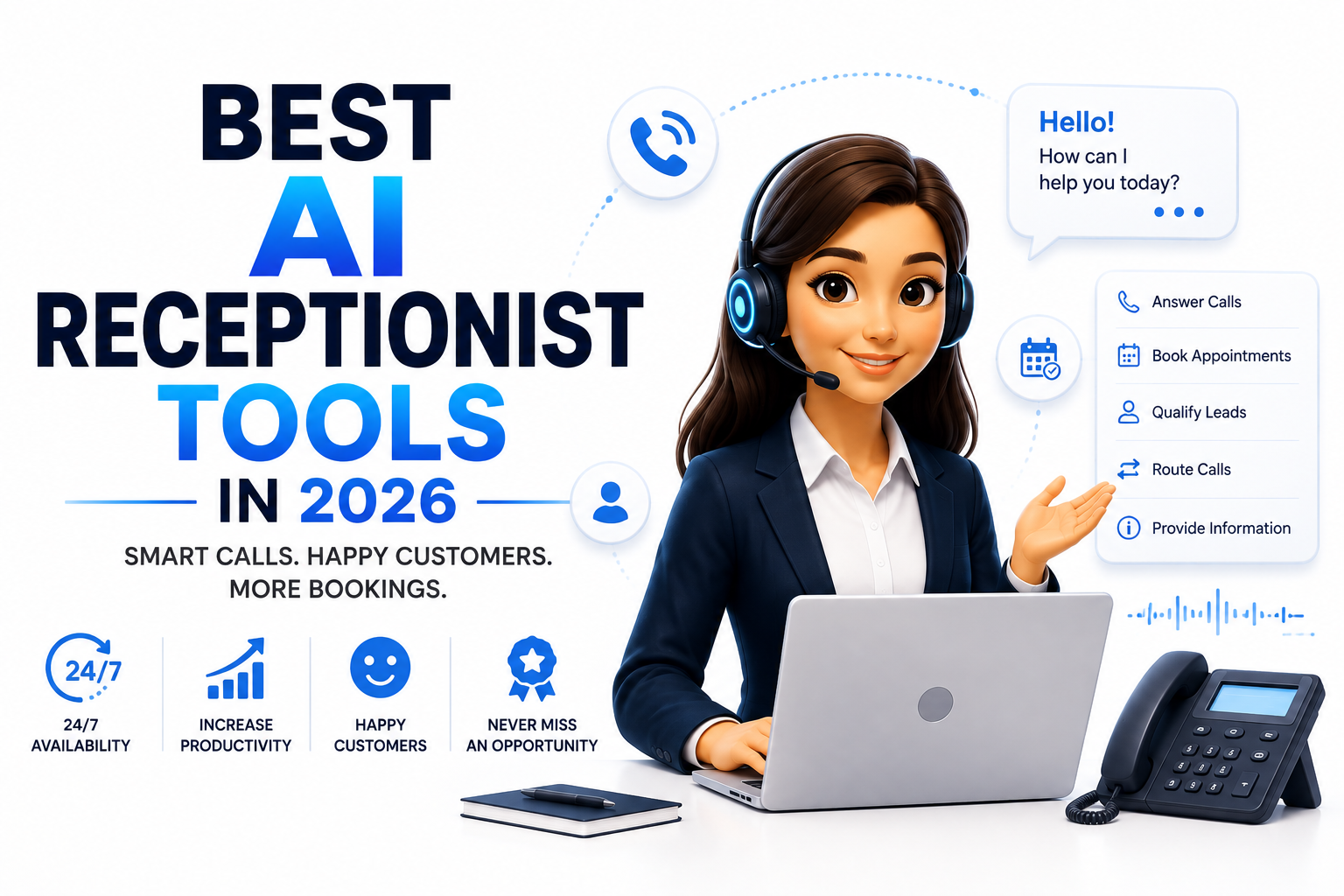
Modern AI receptionist platforms can answer inbound calls, understand what a caller needs, answer questions from business information, collect customer details, qualify leads, schedule appointments, route calls, and transfer conversations to a human when necessary.
The important difference between platforms is therefore not simply whether they can answer a call. It is how reliably they can complete the entire front-desk workflow after answering it.
For this comparison, we looked at receptionist-specific capabilities, call handling, appointment workflows, integrations, human handoff, pricing structure, scalability, ease of deployment, and the practical trade-offs businesses should understand before choosing a platform.
Our five picks for 2026 are:
- Retell AI — Best Overall
- Goodcall — Best for Small Businesses
- Smith.ai — Best AI + Human Receptionist
- CloudTalk — Best for Business Phone Teams
- RingCentral AI Receptionist — Best for RingCentral Users
Editorial note: Pricing and features can change. The information below was reviewed in September 2026 using publicly available product and pricing information. “Best” means the strongest fit for a particular use case, not an objective ranking that applies to every business.
Quick Comparison: Best AI Receptionist Tools in 2026
| Platform | Best for | Main strength | Pricing model | Main trade-off |
|---|---|---|---|---|
| Retell AI | Most businesses | Flexible AI receptionist workflows | Usage-based, per minute | Costs vary by configuration |
| Goodcall | Small businesses | Predictable customer-based pricing | Monthly per-agent plans | Less developer-focused |
| Smith.ai | Businesses needing human escalation | AI receptionist with live-agent backup | Monthly + per-call pricing | Can cost more than pure AI |
| CloudTalk | Growing phone teams | AI receptionist + business phone system | AI plans and phone-system pricing | More than some small businesses need |
| RingCentral AIR | RingCentral users | Native business communications ecosystem | Monthly license + included minutes | Best value inside its ecosystem |
1. Retell AI — Best AI Receptionist Overall
Retell AI is our top overall choice for businesses that want an AI receptionist capable of doing more than answering basic questions.
Its receptionist product can answer calls, use a business knowledge base, qualify callers, schedule appointments, route conversations, and transfer callers to employees with context. Retell also supports integrations with calendars, CRMs, telephony providers, and other business systems.
Why Retell AI Stands Out
The strongest part of Retell is the combination of conversation handling and actions.
A useful AI receptionist should be able to follow a workflow such as:
Caller → Understand intent → Check information → Take action → Confirm → Escalate if necessary
For example, if someone calls a dental practice asking for an appointment, the receptionist should not merely say, “Someone will call you back.”
It should be able to check availability, schedule the appointment, confirm the details, and transfer the call if the request falls outside its instructions.
Retell’s receptionist product supports this type of workflow, including calendar booking, lead qualification, call transfer, knowledge-base answers, and post-call analysis.
Key Features
- 24/7 inbound call answering
- Business knowledge base
- Appointment booking
- Calendar integrations
- Lead qualification
- Call routing
- Warm transfers
- Call transcripts
- Call summaries and analytics
- CRM integrations
- Custom workflows
- Multilingual conversations
- Call simulation and testing
- Existing-number deployment options
Pros
- Strong balance between ease of deployment and customization
- Designed specifically for voice-agent workflows
- Appointment booking and routing capabilities
- Useful testing and analytics features
- Supports integrations with business systems
- Suitable for small businesses and larger deployments
- Usage-based pricing can work well for variable call volume
Cons
- Usage-based billing requires monitoring
- Final cost depends on the configuration and services used
- Advanced workflows may require more technical knowledge
Pricing
Retell currently offers pay-as-you-go voice-agent pricing of approximately $0.07–$0.31 per minute, with $10 in free credits to get started. The platform also advertises 20 concurrent calls on its standard offering, while enterprise deployments can receive custom pricing and capacity.
The actual cost can vary according to the voice, language model, telephony configuration, and other components used by an agent.
Best For
Choose Retell AI if you want a flexible AI receptionist that can answer calls, take actions, book appointments, qualify leads, and hand important conversations to your team.
2. Goodcall — Best AI Receptionist for Small Businesses
Goodcall takes a different approach to pricing and workflow management.
It is particularly interesting for small businesses that want an AI receptionist without building a technically complex voice-agent system.
Goodcall focuses on inbound call answering, customer information, appointment workflows, routing, logic flows, and integrations.
Why We Picked Goodcall
The biggest advantage is its customer-based pricing model.
Instead of charging according to every minute of conversation, Goodcall’s plans include a number of unique customers each month. The company says calls, minutes, and AI tokens themselves are not separately charged within the plan structure.
That can make monthly budgeting easier for businesses that receive repeat calls from the same customers.
Key Features
- 24/7 AI call answering
- Appointment workflows
- Lead capture
- Logic flows
- Customer information collection
- Call routing
- Knowledge documents
- Team management
- Call history
- Call recordings
- Zapier integration
- Multiple business locations
- Customer-based usage model
Pros
- Simple pricing structure
- Unlimited minutes and tokens within the plans
- Designed for business call workflows
- Good fit for local businesses
- Easy-to-understand monthly plans
- Useful logic-flow functionality
Cons
- Less developer-oriented than platforms such as Retell
- Customer-based pricing may not be ideal for every business model
- Advanced enterprise requirements may require a custom plan
Pricing
Goodcall currently lists:
- Starter: $79/month per agent
- Growth: $129/month per agent
- Scale: $249/month per agent
Each plan includes a specific number of unique monthly customers, with additional customers charged at $0.50 each above the included allowance. Annual billing is discounted.
Best For
Choose Goodcall if you run a small or local business and prefer predictable customer-based pricing over per-minute billing.
3. Smith.ai — Best AI Receptionist With Human Backup
Smith.ai is different from a pure AI receptionist platform because it combines AI call handling with access to live human receptionists.
That makes it particularly useful when a business wants automation but does not want every difficult conversation to end with an AI agent.
Why We Picked Smith.ai
Some calls are straightforward:
- “What are your opening hours?”
- “Can I book an appointment?”
- “Where are you located?”
- “Can someone call me back?”
Other calls require more judgment.
A caller might have a complicated request, be frustrated, need detailed intake, or ask to speak with a specific employee.
Smith.ai’s AI-first service can handle routine calls and, according to the company, transfer complex conversations to a live North America-based receptionist when human assistance is needed.
This hybrid approach can be particularly valuable for professional services and businesses where a missed or poorly handled lead can be expensive.
Key Features
- 24/7 AI call answering
- Human receptionist escalation
- Lead qualification
- Call routing
- Appointment scheduling
- Call recording
- Transcription
- Call summaries
- CRM integrations
- Zapier
- Spam filtering
- Lead intake
- Analytics and call history
Pros
- AI plus human escalation
- Strong lead-intake focus
- Useful for high-value inbound calls
- Appointment scheduling
- Professional-service use cases
- Month-to-month AI plans
- Human assistance when the AI reaches its limits
Cons
- More expensive than some pure AI alternatives
- Per-call pricing can become significant at higher volumes
- Businesses wanting complete technical control may prefer a developer-focused platform
Pricing
Smith.ai currently offers an AI Receptionist Free plan with 25 calls per month, followed by a Pro plan at $150/month with 75 included calls and an Enterprise plan starting at $500/month with 300 included calls. Additional call pricing varies by plan and volume.
Smith.ai also states that live-agent involvement can be added when a call requires human assistance.
Best For
Choose Smith.ai if you want AI automation but also want a clear human escalation path for complicated or high-value calls.
4. CloudTalk — Best AI Receptionist for Growing Phone Teams
CloudTalk is a strong option for businesses that want their AI receptionist connected to a broader business phone system.
Rather than treating the AI receptionist as an isolated tool, CloudTalk combines AI voice capabilities with telephony, routing, analytics, numbers, and business integrations.
Why We Picked CloudTalk
CloudTalk’s AI Receptionist is designed primarily around inbound front-desk coverage.
Its current AI Receptionist offering includes 50 minutes free for the first month and focuses on answering calls, routing callers, collecting contact information, answering basic business questions, and blocking spam and robocalls.
The platform also offers broader AI Voice Agent capabilities for businesses that need more complex workflows.
Key Features
- 24/7 AI receptionist
- Inbound call answering
- Conversational call routing
- Contact-data collection
- Message taking
- Business FAQ handling
- Spam and robocall blocking
- Call transcription
- Call summaries
- Conversation analytics
- CRM integrations
- International phone numbers
- Multilingual support
- Business phone system
Pros
- Combines AI with a full phone system
- Strong option for growing teams
- International coverage
- Useful analytics
- Business telephony and AI in one ecosystem
- Simple self-guided AI receptionist setup
Cons
- May offer more infrastructure than a very small business needs
- The broader phone system adds complexity compared with a standalone receptionist
- Some advanced workflows are positioned under the more capable AI Specialist offering
Pricing
CloudTalk currently lists its AI Receptionist at €0/month with 50 included minutes for the first month. Its broader AI Voice Agent offering starts at €99 for 200 minutes, while more advanced AI Specialist capabilities are offered separately.
Because CloudTalk sells both phone-system and AI products, businesses should compare the complete monthly cost rather than looking only at the receptionist component.
Best For
Choose CloudTalk if you want an AI receptionist as part of a broader business phone and communication system.
5. RingCentral AI Receptionist — Best for RingCentral Users
RingCentral AIR is particularly compelling for businesses already using RingCentral or looking for a business communications platform with AI receptionist capabilities.
RingCentral AIR can answer calls, route callers, handle common questions, and provide front-desk automation. The company has also expanded AIR into additional workflows and channels during 2026.
Why We Picked RingCentral AIR
The biggest advantage is ecosystem integration.
If a company already relies on RingCentral for business communications, adding an AI receptionist can be simpler than introducing a separate voice platform.
RingCentral’s current offering supports features such as customizable greetings, configurable AI voices, call transfers, contextual routing, call analytics, transcripts, and testing tools.
Key Features
- 24/7 AI call answering
- Call routing
- Intelligent transfers
- Business-hours handling
- Appointment-related workflows
- Call analytics
- Call transcripts
- Spam filtering
- Configurable greetings
- Existing-number support
- Multilingual capabilities
- RingCentral ecosystem integration
Pros
- Strong business communications ecosystem
- Good choice for existing RingCentral customers
- Straightforward deployment
- Call routing and transfer capabilities
- Useful analytics
- Suitable for SMB and larger business environments
Cons
- Less attractive if you do not need the RingCentral ecosystem
- Included-minute limits affect pricing at higher call volumes
- Highly customized voice-agent workflows may be better suited to specialist platforms
Pricing
RingCentral currently lists AI Receptionist starting at $39 per month, with 100 minutes included when added to a RingCentral plan. Its standalone AIR offering is currently listed at $49/month with 100 minutes included.
Pricing and packaging can vary according to whether AIR is purchased as an add-on or as a standalone service.
Best For
Choose RingCentral AIR if your business already uses RingCentral or wants an AI receptionist integrated into a broader business communications environment.
How to Choose the Right AI Receptionist
The best AI receptionist is not necessarily the one with the most impressive demo.
Start with your actual phone workflow.
Ask:
- How many calls do we receive each month?
- How many callers need appointments?
- Do we need inbound calls only, or outbound follow-up too?
- Which CRM or calendar do we use?
- How often should calls be transferred to humans?
- How important are multilingual conversations?
- Do we need a complete phone system or just an AI receptionist?
- How much control do we need over the AI workflow?
- What information can the AI safely access?
- What happens when the AI does not know the answer?
Choose Retell AI for Flexibility
Retell is the strongest choice when you want:
- Appointment automation
- Lead qualification
- Custom workflows
- CRM integrations
- Human transfers
- Developer flexibility
- Detailed testing and analytics
Choose Goodcall for Simplicity
Goodcall is attractive when you want:
- Simple setup
- Local-business workflows
- Customer-based pricing
- Appointment handling
- Logic flows
- Less technical configuration
Choose Smith.ai for Human Escalation
Smith.ai makes the most sense when:
- Calls can become complicated
- Leads are valuable
- Human judgment matters
- You want live receptionist support
- You want AI to handle routine work first
Choose CloudTalk for Business Phone Infrastructure
CloudTalk is a good fit when you need:
- AI receptionist
- Business phone numbers
- Call routing
- Analytics
- CRM integrations
- International calling infrastructure
Choose RingCentral AIR for the RingCentral Ecosystem
RingCentral becomes especially attractive when your company already uses its communications products and wants to add AI without introducing another major phone platform.
What Should an AI Receptionist Actually Do?
A useful AI receptionist should do more than answer frequently asked questions.
Depending on the business, it can perform several different jobs.
1. Answer Common Questions
For example:
- What are your opening hours?
- Where are you located?
- What services do you offer?
- What does a consultation cost?
- Do you serve my area?
2. Book Appointments
The receptionist can connect to a supported calendar, check availability, and schedule appointments.
This is particularly useful for:
- Clinics
- Dental practices
- Salons
- Gyms
- Law firms
- Home-service businesses
- Consultants
- Real-estate companies
3. Qualify Leads
Instead of simply taking a name and phone number, an AI receptionist can ask predefined qualification questions.
For example:
“What service are you interested in?”
“When would you like the work completed?”
“What is the best number to reach you?”
The answers can then be sent to the appropriate team.
4. Route Calls
The AI can determine whether the caller needs:
- Sales
- Support
- Billing
- Scheduling
- A particular employee
- An emergency contact
5. Handle After-Hours Calls
An AI receptionist can provide coverage outside normal business hours.
That can be particularly useful for businesses where customers may call in the evening or on weekends.
6. Escalate to Humans
A good AI receptionist should know when not to continue.
That is one of the most important differences between a useful AI front desk and a frustrating automated phone system.
How to Get Better Results From an AI Receptionist
1. Give It Accurate Business Information
Provide current information about:
- Opening hours
- Services
- Locations
- Pricing
- Policies
- Appointment rules
- Cancellation policies
- Contact details
- Frequently asked questions
An AI cannot reliably answer questions that are missing, outdated, or contradictory in its knowledge source.
2. Give the AI Clear Boundaries
Do not tell an AI receptionist to “answer everything.”
Define what it is allowed to do.
For example:
- It can provide opening hours.
- It can schedule appointments.
- It can collect contact details.
- It can transfer calls.
- It cannot provide medical advice.
- It cannot make promises about refunds.
- It must transfer emergencies to a human-defined process.
Clear boundaries reduce the risk of incorrect or overconfident answers.
3. Connect the Tools It Actually Needs
The most useful AI receptionists can take action.
Depending on the business, that may mean connecting:
- Calendar
- CRM
- Help desk
- Booking system
- Customer database
- Order system
- Business phone system
The goal is simple:
Understand → Act → Confirm
rather than:
Understand → Take a message
4. Build Human Handoff Rules
Create explicit escalation rules.
Examples include:
- Angry customers
- Emergencies
- High-value leads
- Complex billing issues
- Legal questions
- Medical situations
- Requests for a specific employee
- Questions outside the AI’s knowledge
5. Test Difficult Conversations
Do not test only easy questions.
Test:
“I need to change my appointment, but I am not sure what day works yet.”
Test:
“I have already spoken with John and need to continue that conversation.”
Test:
“Your website says one thing but your employee told me something different.”
Test:
“I need someone urgently.”
The goal is to discover what happens when the conversation does not follow the ideal script.
Common AI Receptionist Mistakes
Automating Everything
AI should not automatically handle every situation.
Some conversations require human judgment.
No Human Escape Route
Every production receptionist should have a clearly defined escalation path.
Outdated Business Information
An AI receptionist with incorrect opening hours or pricing can create more problems than a voicemail system.
No Real Calendar Integration
If customers still have to wait for someone to call them back, much of the value of an AI receptionist disappears.
Choosing Only by Voice Quality
A natural-sounding voice is useful, but it is not the main measure of a good receptionist.
A better question is:
Can it complete the customer’s task accurately?
Ignoring the Pricing Model
Do not compare $0.10 per minute with $99 per month without calculating actual usage.
Different billing models can produce very different monthly costs.
How to Calculate the Real Cost
The advertised price is only the starting point.
For each platform, estimate:
Monthly cost = platform fee + usage + phone/telephony costs + optional integrations or add-ons
Then compare that with the value generated.
For example, if an AI receptionist costs $200 per month but recovers several missed leads and books additional appointments, its value cannot be judged by the software bill alone.
Useful metrics include:
- Calls answered
- Missed calls recovered
- Appointments booked
- Qualified leads
- Transfer success rate
- Call resolution rate
- Customer satisfaction
- Cost per completed task
- AI error rate
- Human escalation rate
The most useful metric is often cost per successful outcome, not cost per minute.
Privacy, Security, and Compliance
This is one of the most important sections to consider before deploying an AI receptionist.
Phone conversations may contain names, phone numbers, addresses, payment information, medical information, legal information, or other sensitive data.
Before launching an AI receptionist, check:
- Where call recordings are stored
- How long transcripts are retained
- Whether recordings can be disabled
- What data is sent to third-party AI providers
- Whether the vendor offers appropriate security agreements
- Whether your industry has additional requirements
- Who can access recordings and transcripts
- How customers can request deletion where applicable
For healthcare, legal, financial, and other sensitive industries, do not assume that an AI platform’s general security claims automatically make your particular implementation compliant.
You should evaluate the complete workflow, including telephony, integrations, data retention, employees, and third-party services.
Outbound Calling Requires Extra Care
AI receptionists are primarily associated with inbound calls, but some platforms also support outbound reminders, follow-ups, or campaigns.
Businesses making automated or AI-generated outbound calls need to pay particular attention to applicable laws.
In the United States, the FCC has confirmed that AI-generated voices fall under the TCPA’s restrictions on artificial or prerecorded voice calls. Certain calls require prior consent, and telemarketing calls can have additional requirements.
The FTC’s Telemarketing Sales Rule also contains requirements concerning disclosures, calling times, do-not-call requests, misrepresentations, and other telemarketing practices.
Rules can differ depending on the country, state, industry, type of call, and whether the call is informational or telemarketing.
An AI receptionist platform does not automatically make a calling campaign legally compliant.
If you plan to use AI for outbound calling, obtain appropriate legal guidance for your jurisdiction and use case.
Advantages and Disadvantages of AI Receptionists
Advantages
- 24/7 call coverage
- Faster response to inbound calls
- Appointment scheduling
- Lead qualification
- Automated call routing
- Customer information collection
- After-hours coverage
- Reduced repetitive workload
- Scalable call handling
- Multilingual capabilities on supported platforms
- CRM and calendar integrations
- Consistent handling of routine questions
Disadvantages
- AI can misunderstand unusual requests
- Initial setup and testing are required
- Usage costs can increase with call volume
- Human judgment is still necessary for complex situations
- Integrations may require additional work
- Background noise and unusual speech patterns can affect conversations
- Incorrect business information can produce incorrect answers
- Sensitive industries require additional privacy and compliance planning
- Some platforms provide less customization than developer-oriented voice-agent platforms
Who Should Not Use an AI Receptionist?
An AI receptionist is not automatically useful for every business.
You may not need one if:
- Your business receives very few calls
- Most calls require expert human judgment
- Your existing receptionist already handles the volume efficiently
- You do not have reliable business information for the AI to use
- You cannot provide a human escalation path for important conversations
- Your expected return is too small to justify the setup
In these situations, a conventional phone system, voicemail, or human receptionist may still be the better solution.
Frequently Asked Questions
What Is an AI Receptionist?
An AI receptionist is a voice-based software agent that answers business calls, understands caller intent, provides information, collects details, routes calls, and can perform tasks such as appointment scheduling.
Unlike a traditional phone tree, an AI receptionist can understand natural-language conversations and respond dynamically.
What Is the Best AI Receptionist in 2026?
For this comparison, Retell AI is our best overall pick because it combines receptionist-specific workflows with appointment booking, lead qualification, call routing, integrations, testing, and usage-based pricing.
However, the best choice depends on the business. Goodcall may be better for predictable customer-based pricing, Smith.ai for human backup, CloudTalk for a broader phone system, and RingCentral AIR for companies already using RingCentral.
What Is the Best AI Receptionist for Small Businesses?
Goodcall is a strong option for small businesses that want simple workflows and customer-based pricing. Its current plans start at $79 per month per agent and include a defined number of unique customers.
Can AI Receptionists Book Appointments?
Yes.
Depending on the platform and integrations, an AI receptionist can check calendar availability, book appointments, confirm details, and sometimes handle rescheduling or cancellation.
Retell, for example, supports calendar-based appointment workflows.
Can an AI Receptionist Transfer Calls to Humans?
Yes.
Call routing and human escalation are core features of modern AI receptionist systems. Retell supports warm transfers, while Smith.ai combines AI answering with access to live receptionists for more complex conversations.
How Much Does an AI Receptionist Cost?
There is no single standard price.
Current examples include:
- Retell AI: approximately $0.07–$0.31 per minute
- Goodcall: from $79/month per agent
- Smith.ai: free tier, with paid AI plans starting at $150/month
- CloudTalk: AI Receptionist currently includes 50 minutes free for the first month
- RingCentral AIR: starts at $39/month as an add-on, with standalone pricing currently starting at $49/month
Pricing structures are different, so businesses should calculate expected monthly usage before comparing providers.
Are AI Receptionists Better Than Human Receptionists?
Not in every situation.
AI receptionists are strong at:
- Availability
- Routine questions
- Scheduling
- Routing
- Lead capture
- High-volume repetitive work
Humans remain better suited to many situations involving judgment, emotion, unusual requests, sensitive conversations, and complex problem-solving.
For many businesses, the strongest model is AI first + human escalation.
Can an AI Receptionist Replace a Human Receptionist?
Sometimes it can automate a significant portion of a receptionist’s workload, but complete replacement is not always the best goal.
The better question is:
Which parts of the front-desk workflow should be automated, and which should remain human?
For many businesses, AI is most valuable when it handles repetitive calls while employees focus on higher-value conversations.
Final Verdict
The best AI receptionist platforms in 2026 have moved well beyond simple automated answering.
A capable AI receptionist can:
- Answer calls
- Understand caller intent
- Answer business questions
- Capture customer information
- Qualify leads
- Book appointments
- Route calls
- Transfer important conversations
- Provide after-hours coverage
- Record useful call outcomes
Our five picks are:
Retell AI — Best Overall
Best combination of AI receptionist workflows, flexibility, appointment automation, integrations, testing, and scalability.
Goodcall — Best for Small Businesses
A strong choice for businesses that want simple workflows and customer-based pricing.
Smith.ai — Best AI + Human Receptionist
The standout option if you want AI efficiency combined with access to live human receptionists.
CloudTalk — Best for Business Phone Teams
A strong fit for businesses that want AI receptionist functionality alongside a broader business phone platform.
RingCentral AI Receptionist — Best for RingCentral Users
The natural choice for companies that already rely on RingCentral’s communications ecosystem.
The most important lesson is simple:
Do not choose an AI receptionist because it merely sounds human. Choose one because it can reliably complete the work your customers actually need.
A good AI front desk should do more than answer the phone.
It should understand the caller, take the appropriate action, confirm the result, and know when a human needs to take over.
Editorial Sources
The factual and pricing information in this article was reviewed against official product documentation and regulatory sources, including:
- Retell AI — AI Receptionist and pricing documentation
- Goodcall — pricing and product documentation
- Smith.ai — AI Receptionist pricing and product documentation
- CloudTalk — AI Receptionist and pricing documentation
- RingCentral — AIR product, pricing, and service documentation
- Federal Communications Commission — AI-generated voices and TCPA
- Federal Trade Commission — Telemarketing Sales Rule