A2A Protocol Explained in 2026: How AI Agents Communicate and Collaborate
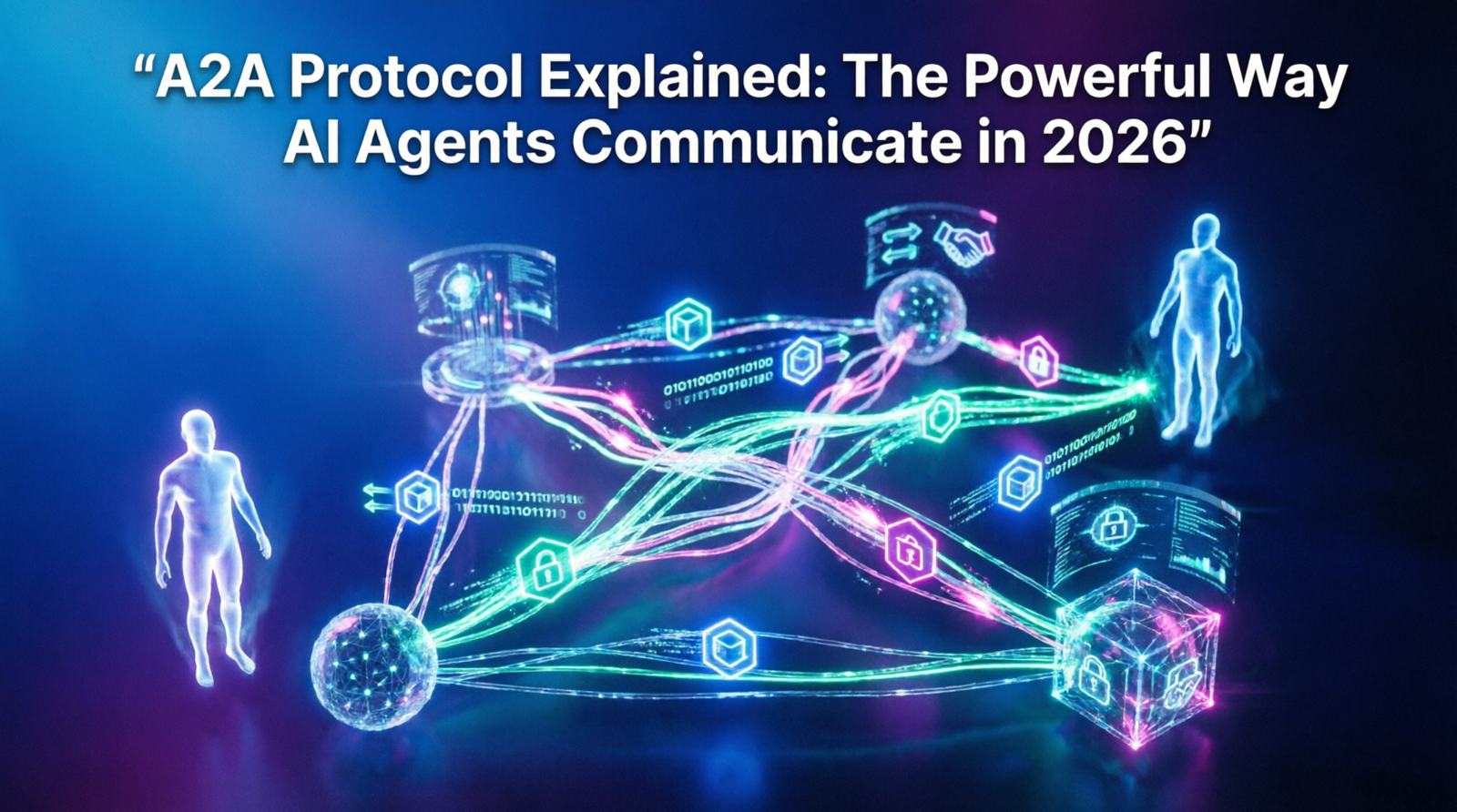
A2A (Agent2Agent) is an open protocol designed to help AI agents communicate, delegate tasks, exchange information, and collaborate across different applications, frameworks, and vendors.
As AI systems become more capable, businesses are increasingly moving from single-purpose chatbots toward agentic systems. One agent might handle customer support, another might analyze financial information, and another might manage logistics.
That creates an important architectural question:
How can independently built AI agents work together without requiring a custom integration for every possible pair?
A2A is designed to address that problem.
Originally introduced by Google in April 2025, A2A was later donated to the Linux Foundation ecosystem. In March 2026, the project released A2A v1.0, its first stable production-ready specification. In August 2026, A2A was accepted as a Growth Stage project at the Agentic AI Foundation (AAIF).
This guide explains what A2A is, how it works, what Agent Cards and Tasks do, how A2A compares with MCP, where it can be useful, and where it may simply add unnecessary complexity.
What Is the A2A Protocol?
A2A stands for Agent2Agent.
It is an open standard for communication and interoperability between independent AI agent systems.
The key word is independent.
Two agents communicating through A2A do not necessarily need to:
- Use the same AI model
- Use the same programming language
- Use the same framework
- Come from the same company
- Expose their internal memory
- Expose their internal tools
- Share the same implementation
Instead, A2A provides a common interaction model through which one agent can communicate with another.
The official A2A specification describes the protocol as a way for independent, potentially opaque agent systems to discover capabilities, negotiate interaction modalities, manage collaborative tasks, and exchange information without requiring access to each other’s internal state, memory, or tools.
A simple example
Imagine an AI customer-service system.
The main support agent receives:
“Where is my order, and am I eligible for a refund?”
Rather than performing every operation itself, it could delegate work to specialized agents:
                    Customer
                       │
                       ▼
                Support Agent
                  /         \
                A2A         A2A
                /             \
               ▼               ▼
       Logistics Agent    Payment Agent
               │               │
               ▼               ▼
        Shipping System    Payment System
The customer still experiences one conversation.
Behind the scenes, specialized agents perform different parts of the job.
That is the basic idea behind agent-to-agent interoperability.
Why Was A2A Created?
Traditional APIs already allow software systems to communicate.
So why introduce another protocol?
The problem becomes more complicated when the number of independent AI agents grows.
Imagine a business with:
- A sales agent
- A finance agent
- A research agent
- A support agent
- A logistics agent
- A compliance agent
If every agent has a proprietary communication interface, developers may need custom integrations between many different systems.
Each integration can introduce its own:
- Authentication mechanism
- Data structures
- Error handling
- Documentation
- Deployment requirements
- Monitoring
- Maintenance
A common protocol can reduce the amount of agent-specific integration logic.
This was one of the motivations behind Google’s original A2A announcement in April 2025. Google described A2A as a protocol intended to allow agents built by different vendors and using different frameworks to collaborate across organizational and technological boundaries.
The project was subsequently moved into the Linux Foundation ecosystem, giving it a more neutral governance structure.
How Does A2A Work?
A2A can be understood through two primary roles.
1. A2A Client
The A2A client is the application, service, or agent that initiates communication.
It might ask another agent to:
- Analyze a document
- Research a topic
- Calculate a result
- Check inventory
- Create a report
- Perform a business task
The client does not necessarily need to know how the remote agent performs the work.
2. A2A Server
The A2A server exposes an AI agent or agentic system through an A2A-compatible interface.
From the client’s perspective, the remote agent can remain largely opaque.
The client needs to understand what the agent can do and how to communicate with it—not necessarily how the agent reasons internally or which tools it uses.
A simplified architecture looks like this:
User
 │
 ▼
Client Agent
 │
 │ A2A
 ▼
Remote Agent
 │
 ├── Internal Model
 ├── Internal Tools
 ├── Internal Data
 └── Internal Workflow
The important boundary is that the remote agent can expose a useful capability without exposing its internal implementation.
Agent Cards: How Agents Describe Their Capabilities
One of A2A’s most important concepts is the Agent Card.
An Agent Card is a structured JSON document that describes an agent and tells potential clients how to interact with it.
You can think of it as a combination of:
- Digital business card
- Capability profile
- Service description
- Integration metadata
An Agent Card can describe information such as:
- Agent identity
- Description
- Service endpoint
- Supported protocol interfaces
- Capabilities
- Skills
- Supported input and output modalities
- Authentication requirements
- Extensions
The official documentation describes Agent Cards as a discovery mechanism that allows clients to determine whether an agent is appropriate for a particular task and understand how to interact with it.
Example concept
Imagine a company operates a financial-analysis agent.
Its capabilities might be described conceptually as:
Financial Analysis Agent

Skills:
- Financial report analysis
- Revenue analysis
- Risk assessment
- Forecasting

Input:
- Text
- Files
- Structured data

Output:
- Text
- Structured data
- Reports

Authentication:
- OAuth 2.0
Another compatible agent can use this information to determine whether the financial agent is suitable for a particular job.
Agent Discovery
Agent Cards become especially useful when an ecosystem contains many independent agents.
Suppose an AI system needs an agent capable of:
“Analyze European VAT compliance documents.”
Instead of hard-coding every possible specialist, an agent ecosystem can use discovery mechanisms to identify available agents and inspect their advertised capabilities.
This doesn’t mean that A2A automatically creates a global marketplace of trustworthy agents.
Discovery still requires appropriate infrastructure, trust models, authentication, authorization, and governance.
But the protocol provides standardized information that makes agent discovery possible.
A2A Tasks: The Unit of Work
A2A is not simply a protocol for sending chat messages between bots.
One of its central concepts is the Task.
A Task represents a stateful unit of work.
For example:
“Analyze this 500-page financial report and produce a risk summary.”
That work might not finish immediately.
A task can move through different states during its lifecycle.
A simplified example:
Submitted
    │
    ▼
Working
    │
    ▼
Input Required
    │
    ▼
Working
    │
    ▼
Completed
A task could also fail or be canceled depending on the workflow.
This model is useful because many real-world agent operations are not simple request-and-response interactions.
Examples include:
- Processing large documents
- Generating reports
- Research workflows
- Compliance analysis
- Complex business automation
- Data processing
The current A2A documentation defines Tasks as stateful units of work with a lifecycle and unique identifiers.
Messages, Parts, and Artifacts
A2A separates communication from the actual deliverables produced during a task.
Messages
A Message represents a turn of communication between a client and an agent.
For example:
“Analyze this company’s financial performance.”
The response could contain another message explaining what the agent is doing or asking for additional information.
Parts
Messages and artifacts contain Parts.
A Part can carry different types of content, including:
- Text
- File data
- URLs
- Structured data
This allows A2A interactions to go beyond plain natural-language text.
Artifacts
An Artifact is a concrete output generated during a task.
For example:
Task
│
├── Messages
│
└── Artifacts
    ├── Financial Report.pdf
    ├── Risk Analysis.json
    └── Forecast.xlsx
An artifact could represent a document, image, spreadsheet, structured result, or another tangible output.
This distinction is important because production AI systems often need to exchange actual data and files—not just conversational responses.
What Can A2A Agents Exchange?
A2A is designed to support multiple content types.
Depending on the implementation, agents can exchange information such as:
- Text
- Files
- URLs
- Structured JSON data
- Binary data
- Metadata
For example, one agent might return:
{
  "customer_score": 87,
  "risk_level": "low",
  "approved": true
}
Another agent can consume that structured information without having to parse a natural-language paragraph.
This is particularly useful for automated workflows where the output of one agent becomes the input to another.
A2A Is More Than AI Agents “Chatting”
A common mistake is to imagine A2A as two chatbots having a conversation.
The more useful mental model is:
A2A enables agents to delegate and collaborate on work.
Consider an investment research system.
A main research agent might delegate:
                    Research Agent
                    /      |       \
                  A2A     A2A      A2A
                  /        |         \
                 ▼         ▼          ▼
           Market Agent  Finance   News Agent
                          Agent
The specialized agents might produce:
- Market information
- Financial analysis
- News summaries
The main agent can then combine those outputs into a final research product.
The advantage isn’t that the agents “talk.”
The advantage is that different agents can specialize in different responsibilities.
A2A vs MCP: What Is the Difference?
This is one of the most important distinctions for anyone learning about modern AI infrastructure.
A simple rule is:
MCP connects AI applications and agents with tools and data.
A2A connects AI agents with other agents.
The two protocols therefore solve different problems.
MCP
Think:
Agent → Tools/Data
Examples can include:
- Databases
- Files
- Search systems
- Business applications
- Internal services
A2A
Think:
Agent → Agent
Examples include:
- Research Agent
- Finance Agent
- Legal Agent
- Support Agent
- Logistics Agent
A2A and MCP can also appear in the same architecture.
                         Main Agent
                        /          \
                      A2A          A2A
                      /              \
                     ▼                ▼
              Research Agent     Finance Agent
                     │                │
                    MCP              MCP
                     │                │
                     ▼                ▼
                Search/Data      Business Tools
The official A2A project itself describes MCP as a way for agents to access tools and data while A2A provides communication between agents.
The easiest way to remember it
MCP equips the agent.
A2A connects the agent.
A2A vs Traditional APIs
A2A does not make traditional APIs obsolete.
APIs remain fundamental to software architecture.
The difference is that A2A defines an interaction model specifically designed for agent interoperability.
A conventional API might expose:
POST /analyze
The caller needs to know:
- The endpoint
- The request schema
- Authentication
- Expected response
- Error behavior
A2A introduces additional concepts relevant to agents, including:
- Agent Cards
- Skills
- Tasks
- Messages
- Parts
- Artifacts
- Capability negotiation
- Streaming
- Push notifications
- Agent discovery
The protocol therefore operates at a different abstraction level than a simple application endpoint.
A2A can also be implemented using different protocol bindings. The current documentation lists JSON-RPC, gRPC, and HTTP+JSON/REST as standard bindings.
A2A vs Multi-Agent Frameworks
A2A is also different from a multi-agent framework.
A framework helps developers build and orchestrate agents.
A protocol helps independently built systems communicate with each other.
Think of the distinction like this:
Multi-Agent Framework
        │
        ▼
Builds / Orchestrates Agents
        │
        ▼
       A2A
        │
        ▼
Communicates With Other Agents
You can therefore build an agent using a particular framework and expose that agent through A2A.
The remote agent does not necessarily need to use the same framework.
That is where interoperability becomes valuable.
Real-World Example: AI Customer Support
Consider an online retailer receiving:
“Where is my order, and can I get a refund?”
A possible multi-agent architecture could look like this:
                         Customer
                            │
                            ▼
                    Support Agent
                       /       \
                     A2A       A2A
                     /           \
                    ▼             ▼
           Logistics Agent   Payment Agent
                    │             │
                   MCP           MCP
                    │             │
                    ▼             ▼
             Shipping Data    Payment Data
Step 1: Support Agent
The support agent interprets the customer’s request.
It determines that it needs two types of information.
Step 2: Logistics Agent
It delegates the shipping question:
“What is the current status of order #12345?”
The logistics agent retrieves the relevant information.
Step 3: Payment Agent
The support agent delegates the refund question:
“Does this order qualify for a refund under the applicable policy?”
The payment or financial agent evaluates the request.
Step 4: Final Response
The support agent combines the results and provides the customer with one answer.
The customer doesn’t need to know how many agents participated.
This illustrates the practical distinction:
A2A handles agent-to-agent collaboration.
MCP can help individual agents access their underlying tools and data.
Why Businesses Should Care About A2A
The strongest argument for A2A is not simply “AI agents can communicate.”
It is specialization without complete isolation.
A company can potentially create different agents for different business functions.
Sales Agent
Handles sales workflows and customer qualification.
Finance Agent
Handles financial analysis and related business processes.
Logistics Agent
Works with inventory, shipping, and fulfillment information.
Support Agent
Handles customer-facing interactions.
Compliance Agent
Reviews workflows against applicable policies and requirements.
Instead of one enormous AI system attempting to understand every business process, specialized systems can collaborate where necessary.
1. Interoperability
A2A is particularly relevant when agents are developed by different teams or vendors.
The official project explicitly targets interoperability across different frameworks, languages, and vendors.
That can reduce dependence on a single implementation.
2. Specialization
A narrow agent can focus on a specific responsibility.
This can make system boundaries clearer and allow teams to manage capabilities independently.
However, specialization should be intentional.
Adding an agent merely because the architecture is “multi-agent” does not automatically improve the system.
3. Long-Running Workflows
Some business operations require more than an immediate response.
Examples include:
- Large document analysis
- Research
- Compliance workflows
- Report generation
- Data processing
- Enterprise automation
A2A provides mechanisms for tracking tasks and receiving updates during longer-running operations.
4. Cross-Organization Collaboration
One of the more ambitious possibilities is collaboration between agents controlled by different organizations.
For example:
Retailer Agent
      │
      ▼
Supplier Agent
      │
      ▼
Shipping Agent
      │
      ▼
Payment Agent
Each organization could maintain control over its own agent and internal systems while exposing a standardized interface for specific interactions.
This does not eliminate trust, legal, security, or governance problems.
It simply provides a technical foundation for interoperability.
How A2A Handles Long-Running Tasks
A2A supports several interaction patterns.
Request and Response / Polling
A client can send a request and receive a response.
For longer-running work, the client can retrieve task status and results as the task progresses.
This is useful when the operation does not require a continuously open connection.
Streaming
For supported agents, streaming allows clients to receive incremental task updates.
For example:
Task Started
     ↓
Analyzing Document
     ↓
Extracting Data
     ↓
Generating Report
     ↓
Completed
This can make long-running workflows more observable.
Push Notifications
For asynchronous workflows, an agent can send updates through a configured notification mechanism.
This can be useful when:
- A task takes a long time
- The client doesn’t want to maintain a continuous connection
- The result may arrive significantly later
The official A2A documentation lists polling, streaming, and push notifications among its interaction mechanisms.
A2A in 2026: What Has Changed?
A2A is no longer simply an experimental proposal.
Several developments are important for understanding its position in 2026.
A2A 1.0
In March 2026, the project released A2A v1.0, the first stable production-ready version of the protocol.
The v1.0 specification introduced structural changes and clarified areas including Agent Cards, protocol interfaces, streaming events, and OAuth security.
For example, v1.0 uses supportedInterfaces in the Agent Card to describe the interfaces an agent exposes, rather than relying on the older v0.x structure. It also modernized OAuth support, including PKCE-related security improvements.
This matters because older A2A tutorials may describe v0.x fields or APIs that no longer represent the current specification.
A2A and the Agentic AI Foundation
On August 27, 2026, the A2A project announced that it had been accepted as a Growth Stage project within the Agentic AI Foundation (AAIF).
The project describes A2A as a horizontal orchestration layer for communication and collaboration between agents.
For developers, this is a more meaningful signal than simply seeing another protocol announcement: governance and interoperability matter when a protocol is intended to connect systems from multiple organizations.
What Could A2A Enable?
A2A does not guarantee that all of these scenarios will become mainstream, but the protocol makes several architectures easier to imagine.
Agent Discovery
An AI system could identify specialized agents based on their declared capabilities.
For example:
“Find an agent capable of analyzing VAT compliance documents.”
The Agent Card provides standardized metadata that can support this kind of discovery.
Cross-Company Automation
Imagine:
Company A Agent
      │
      ▼
Company B Agent
      │
      ▼
Company C Agent
Instead of building a completely proprietary integration for every interaction, companies could potentially expose selected capabilities through a common protocol.
Security and authorization would remain essential.
AI Research Networks
A research system could delegate work to specialized agents:
- Literature research
- Data analysis
- Market research
- Fact checking
- Report generation
The main agent could then combine the outputs.
Agentic Commerce
A shopping workflow could eventually involve several specialized agents:
Shopping Agent
     │
     ├── Product Research Agent
     ├── Price Agent
     ├── Inventory Agent
     └── Payment Agent
A2A could be one component in such an architecture.
It would not, by itself, solve payment security, identity, commerce rules, fraud prevention, or transaction authorization.
How Developers Can Start With A2A
You don’t need dozens of agents to experiment with the protocol.
A small project is often a better starting point.
Step 1: Define One Specialized Agent
Choose a narrow capability.
For example:
Invoice Analysis Agent
Its responsibility:
Analyze invoices and extract useful financial information.
Keep the scope small.
Step 2: Define Its Skills and Inputs
Document:
- What the agent can do
- What inputs it accepts
- What outputs it produces
- Which modalities it supports
- What authentication is required
- Which operations may take longer to complete
This information becomes part of the agent’s public contract.
Step 3: Create an Agent Card
The Agent Card tells clients what the agent is and how to communicate with it.
The current v1.0 specification uses supportedInterfaces to describe protocol interfaces and versions.
Step 4: Implement the A2A Interface
Use the official specification and SDK resources rather than copying an old tutorial that may target an earlier protocol version.
The current A2A documentation provides implementation resources and SDKs for multiple programming languages.
Step 5: Add a Second Agent
For example:
Accounting Agent
The Accounting Agent could delegate invoice analysis to the Invoice Agent.
Accounting Agent
       │
       │ A2A
       ▼
Invoice Agent
       │
       │
      MCP
       │
       ▼
Business Data / Tools
This is a useful example of how A2A and MCP can complement each other rather than compete.
When Should You Actually Use A2A?
This is probably the most practical question.
Don’t use A2A simply because it is becoming popular.
Use it when you have a real interoperability or agent-collaboration problem.
A2A makes sense when:
- Multiple independent agents need to collaborate
- Agents are built by different teams
- Agents use different frameworks
- Agents may come from different vendors
- You need task delegation between agents
- Some operations are long-running
- You expect the agent ecosystem to grow
- You need a standardized boundary between agent systems
A2A may be unnecessary when:
- You have one agent
- You have a few simple tools
- Everything is inside one application
- There is no agent-to-agent delegation
- A normal internal API already solves the problem
A useful engineering rule is:
If a simple API solves the problem, don’t add A2A just for the sake of using A2A.
Protocols add value when standardization solves a genuine problem.
5 Common A2A Mistakes
Mistake #1: Thinking A2A Replaces MCP
It doesn’t.
The simplest distinction is:
MCP → agent-to-tools/data
A2A → agent-to-agent
They can be used together.
Mistake #2: Creating Too Many Agents
More agents do not automatically mean a better architecture.
Every additional agent can introduce:
- Network calls
- Latency
- Failure points
- Authentication requirements
- Monitoring requirements
- Debugging complexity
- Infrastructure costs
Use specialization where it creates a clear benefit.
Mistake #3: Ignoring Security
A2A does not automatically secure an application.
The current A2A enterprise guidance emphasizes standard web security mechanisms, including TLS, OAuth 2.0, OpenID Connect, authentication, authorization, monitoring, and least-privilege access.
Developers should carefully consider:
- Who can invoke an agent
- Which skills each caller can access
- What data the agent can retrieve
- Which actions the agent can perform
- How credentials are handled
- How interactions are logged
- How agents are monitored
Authentication and authorization are separate concerns.
A caller being authenticated does not automatically mean it should have permission to perform every available operation.
Mistake #4: Treating Everything as Text
AI systems increasingly work with structured information and files.
A2A supports Parts containing text, files, URLs, and structured data, while Artifacts can represent concrete outputs generated during a task.
Design workflows around the actual data being exchanged rather than converting everything into natural language unnecessarily.
Mistake #5: Assuming Open Protocol Means No Vendor Lock-In
An open protocol can improve interoperability, but it does not magically eliminate vendor dependence.
A system may still depend on:
- Proprietary models
- Proprietary databases
- Proprietary tools
- Cloud infrastructure
- Vendor-specific extensions
A2A can reduce one form of integration lock-in, but overall architecture still matters.
A2A Security: What Developers Should Know
Security deserves special attention because agent-to-agent communication can cross organizational and trust boundaries.
A2A’s current enterprise guidance separates authentication from authorization.
Authentication answers:
Who is making this request?
Authorization answers:
What is that caller allowed to do?
The protocol’s security guidance recommends using established web mechanisms rather than embedding identity directly into normal A2A payloads. Authentication requirements are advertised by the Agent Card, while credentials are generally handled at the HTTP/transport layer.
A production implementation should also consider:
Least privilege
Give an agent only the access it actually needs.
Agent identity
Know which application or agent is making the request.
Skill-level authorization
Not every authenticated caller should necessarily be allowed to invoke every skill.
Data protection
Avoid exposing sensitive information to agents that don’t require it.
Observability
Log and monitor important agent interactions.
Extension security
Treat extension-provided data and behavior as untrusted until properly validated. The A2A documentation specifically warns that extensions must not bypass existing authentication and authorization controls.
The Biggest Advantage of A2A
If you remember only one concept from this article, remember this:
An agent should be able to collaborate with another agent without needing to know how that agent was built internally.
A sales agent does not need to know whether a financial agent uses Python, Java, Go, or another language.
It does not need to know which model powers it.
It does not need access to its private memory.
It needs to know:
- What the agent can do
- How to communicate with it
- What information it accepts
- What it can return
- What authentication is required
That separation is the heart of interoperability.
A2A’s Limitations
A2A is useful, but it is not a magic solution for every AI architecture.
Complexity
A multi-agent system can be considerably harder to debug than a single-agent application.
When something goes wrong, the failure could originate from:
- The client
- The remote agent
- Authentication
- Authorization
- Networking
- Task management
- External tools
- Model behavior
- Incorrect delegation
More components mean more possible failure points.
Latency
Consider:
Agent A
   ↓
Agent B
   ↓
Agent C
   ↓
Agent D
Every additional network interaction can introduce latency.
A carefully designed single-agent workflow may therefore outperform an unnecessarily complex multi-agent architecture.
Reliability
Agent systems can produce incorrect results.
Adding additional agents can create additional opportunities for:
- Incorrect delegation
- Conflicting outputs
- Failed requests
- Invalid assumptions
- Partial failures
The important question isn’t simply:
“Can the agents communicate?”
It is:
“Can the overall workflow communicate reliably enough for the business requirement?”
Governance
Organizations also need clear answers to questions such as:
- Which agents are trusted?
- Who owns each agent?
- Who can invoke it?
- Which data can it access?
- Which actions can it perform?
- How are interactions audited?
- How are protocol changes managed?
These questions become increasingly important as agent ecosystems grow.
A2A vs MCP vs APIs: Quick Comparison
| Technology | Primary purpose | Typical relationship |
|---|---|---|
| A2A | Agent interoperability | Agent ↔ Agent |
| MCP | Access to tools and data | Agent ↔ Tool/Data |
| Traditional API | Software/service integration | Application ↔ Service |
| Multi-agent framework | Building/orchestrating agents | Developer → Agent System |
These technologies are not necessarily alternatives.
A production architecture could use all four.
For example:
                    Main Agent
                   /          \
                 A2A          A2A
                 /              \
                ▼                ▼
        Research Agent      Finance Agent
                │                │
               MCP              MCP
                │                │
                ▼                ▼
          Search / DB        Business APIs
The framework builds the agents.
A2A connects the agents.
MCP connects agents to tools and data.
APIs can connect the underlying software systems.
Frequently Asked Questions
What does A2A stand for?
A2A stands for Agent2Agent.
It is an open protocol designed to support communication and interoperability between AI agents.
Is A2A made by Google?
A2A was originally introduced by Google in April 2025.
The project was later donated to the Linux Foundation ecosystem and is now developed as an open project with broader industry participation.
What is the latest A2A version?
As of September 2026, the current released specification is A2A v1.0.0. The official documentation identifies 1.0.0 as the latest released version.
Is A2A the same as MCP?
No.
MCP focuses on connecting AI applications and agents with tools and data.
A2A focuses on communication between independent agents.
They can be complementary.
Does A2A require the same AI model?
No.
A2A is designed for interoperability between independently built agent systems, including systems using different frameworks, languages, and vendors.
Does A2A expose an agent’s internal memory?
Not necessarily.
A remote agent can operate as an opaque system. Its internal memory, tools, and implementation do not need to be exposed to the client.
Can A2A exchange files?
Yes.
A2A Parts can carry text, file data, URLs, and structured data. Artifacts can represent generated documents, images, structured results, and other outputs.
Can A2A handle long-running tasks?
Yes.
Tasks are stateful units of work, and A2A supports mechanisms including polling, streaming, and push notifications for different workflow requirements.
Is A2A useful for small AI projects?
Sometimes, but it may be unnecessary.
If you have one agent and a few internal tools, an ordinary API or MCP integration may be simpler.
A2A becomes more interesting when independent agents need to communicate or delegate work.
Final Verdict: Is A2A Important in 2026?
Yes—but its importance should be understood correctly.
A2A is not valuable simply because “AI agents are the future.”
Its value comes from solving a concrete engineering problem:
How can independently built AI agents communicate and collaborate without requiring every integration to be custom-built?
That problem becomes more significant as organizations build larger agent ecosystems.
A future architecture might look like:
                           USER
                             │
                             ▼
                       Main Agent
                      /          \
                    A2A          A2A
                    /              \
                   ▼                ▼
           Research Agent      Finance Agent
                  │                  │
                 MCP                MCP
                  │                  │
                  ▼                  ▼
             Search/Data       Business Tools
                  │                  │
                  └────────┬─────────┘
                           ▼
                     Final Result
                           │
                           ▼
                          USER
The key distinction is simple:
MCP helps an agent work with tools and data.
A2A helps agents work with other agents.
A2A v1.0 and its continued development in 2026 make the protocol more significant than it was when Google first announced it in 2025. The project’s move into the Agentic AI Foundation also reinforces its focus on open, interoperable agent infrastructure.
But A2A is not something every application needs.
The best architecture is still the simplest one that reliably solves the problem.
If one agent and a normal API are enough, use them.
If multiple independent agents need to discover capabilities, delegate tasks, exchange structured information, and collaborate across technology boundaries, A2A becomes much more compelling.
Official A2A Resources
For readers who want to explore the protocol directly, start with the primary documentation rather than older third-party tutorials:
- A2A Protocol — Official Documentation A2A Protocol Documentation
- A2A v1.0 Specification A2A v1.0 Specification
- A2A Core Concepts A2A Core Concepts
- A2A Enterprise Features and Security A2A Enterprise Features
- A2A v1.0 Changes What’s New in A2A v1.0
- Google’s Original A2A Announcement Google Developers — A2A Announcement
Related Articles
If you want to build a strong content cluster around this topic, these are the logical next articles:
- MCP Explained: What Is Model Context Protocol?
- What Are AI Agents and How Do They Work?
- Best AI Automation Tools in 2026