How to Evaluate AI Marketing Tools: A Practical Framework for Choosing the Right Tool
Choosing an AI marketing tool is becoming harder, not easier.
There are now AI platforms for content creation, SEO, customer research, advertising, analytics, automation, email marketing, social media, personalization, and many other marketing tasks. New products also appear frequently, while established platforms continue to add AI features.
The problem is that a long feature list does not necessarily tell you whether a tool is right for your marketing workflow.
A tool can have dozens of AI features and still be a poor fit for a small business. Another platform with fewer features may save a marketing team more time because it integrates better with the tools they already use.
This guide presents a practical framework for evaluating AI marketing tools based on use case, output quality, workflow fit, integrations, cost, reliability, data handling, and measurable business value.
The goal is not to find the tool with the most features. It is to find the tool that solves the right problem with an acceptable combination of quality, cost, effort, and risk.
How We Evaluate AI Marketing Tools
At AI Tools for Marketers, we evaluate AI marketing software from a practical, evidence-based perspective. Our assessments focus on factors that can directly affect a marketer’s workflow, including output quality, available features, integrations, ease of use, pricing, scalability, reliability, and limitations.
When information can change over time—such as pricing, product features, usage limits, or integrations—we prioritize current information from official product documentation and websites. We also distinguish between factual product information and our analysis so readers can understand the basis of each recommendation.
We do not assume that a tool is valuable simply because it offers more AI features. The usefulness of a platform depends on the specific marketing problem, the workflow in which it is used, the quality of its results, and the amount of human review required.
Our goal is to help marketers make informed software decisions based on practical requirements and verifiable information rather than marketing claims alone.
Why Choosing an AI Marketing Tool Requires More Than a Feature Comparison
Traditional software comparisons often focus on features and price.
AI marketing tools require a broader evaluation because the quality of the output can vary depending on the task, input, model, workflow, and amount of human review required.
For example, an AI writing platform might generate content quickly, but that does not automatically mean the content is accurate, original, or ready to publish.
Similarly, an AI analytics tool may provide sophisticated insights, but those insights are less useful if the platform cannot access the data your team actually needs.
Google’s current guidance for website owners emphasizes creating useful, reliable, people-first content and adding original value rather than simply producing content for search engines. That principle is also useful when evaluating AI tools: automation should improve the work, not replace quality control.
1. Start With the Marketing Problem, Not the AI Tool
The first question should not be:
“Which AI marketing tool should I buy?”
Instead, ask:
“Which marketing problem am I trying to solve?”
This distinction can prevent unnecessary software purchases.
Consider these examples:
| Marketing problem | Possible AI solution |
|---|---|
| Spending too much time researching competitors | AI research or analysis tool |
| Producing repetitive social posts | AI social media workflow |
| Difficulty analyzing customer feedback | AI text analysis |
| Slow content ideation | AI research and ideation workflow |
| Manual reporting | AI-assisted reporting and analytics |
| Large volumes of product descriptions | AI content workflow |
| Difficulty identifying search opportunities | AI SEO research tool |
| Repetitive campaign tasks | AI automation platform |
The same company may need several different tools, but it does not necessarily need a separate platform for every task.
Before testing a product, define the specific problem, the current workflow, and what a successful result would look like.
2. Define the Job the Tool Must Perform
Once you identify the problem, describe the actual job.
For example:
Weak requirement:
We need an AI SEO tool.
Better requirement:
We need a tool that can identify relevant search opportunities, analyze competing pages, group related keywords, and help our team prioritize topics.
The second description gives you criteria that can actually be tested.
A useful requirement should answer four questions:
- What task should the tool perform?
- Who will use it?
- What information will it need?
- What output should it produce?
This prevents the evaluation from being driven by marketing claims.
3. Evaluate Output Quality Before Counting Features
AI tools are often marketed with long lists of capabilities.
However, ten features that produce mediocre results may be less useful than three features that consistently solve an important problem.
Test the actual output whenever possible.
For a content tool, evaluate:
- Accuracy
- Relevance
- Clarity
- Originality
- Editing requirements
- Ability to follow instructions
- Consistency
For an AI research tool, evaluate:
- Source quality
- Citation accuracy
- Coverage
- Ability to distinguish facts from assumptions
- Handling of conflicting information
- Ease of verifying results
For an AI analytics tool, evaluate:
- Data interpretation
- Clarity of explanations
- Ability to identify meaningful patterns
- False positives
- Ease of validating recommendations
The important question is not simply:
“Can this tool do it?”
Ask:
“How much useful work does the tool actually produce without creating additional problems?”
4. Measure Human Editing Time
One of the easiest mistakes is to measure AI productivity only by generation speed.
A tool might create an article in seconds but require extensive editing afterward.
In that situation, the real workflow is:
Generate → Fact-check → Rewrite → Edit → Verify → Publish
The generation step may be fast, but the complete process may not be.
A better metric is time to acceptable output.
For example:
| Workflow | Time |
|---|---|
| Manual research and first draft | 180 minutes |
| AI generation | 10 minutes |
| Fact-checking | 30 minutes |
| Editing | 40 minutes |
| Final review | 20 minutes |
| Total AI-assisted workflow | 100 minutes |
In this example, the AI tool did not eliminate the work. It reduced the overall process from 180 minutes to approximately 100 minutes.
That is a more useful way to evaluate productivity.
5. Check Whether the Tool Fits Your Existing Workflow
A powerful tool can still be inconvenient if it forces your team to change everything around it.
Check whether the platform works with the systems you already use.
Depending on your business, this could include:
- Google Analytics
- Google Ads
- Search Console
- CRM platforms
- Email marketing software
- Content management systems
- Spreadsheets
- Project management platforms
- Social media platforms
- Ecommerce systems
Integration quality matters because a tool that requires constant copying and pasting can introduce additional work.
Ask:
- Can data be imported easily?
- Can results be exported?
- Are integrations native or dependent on third-party automation?
- Are important features available on your plan?
- Does the integration work reliably?
- Can the workflow be automated?
6. Compare Pricing Based on Actual Usage
The cheapest plan is not always the cheapest option.
AI products may use different pricing models, including:
- Per user
- Per seat
- Per generation
- Usage credits
- API consumption
- Monthly subscription
- Annual subscription
- Usage tiers
- Enterprise pricing
Instead of comparing headline prices, calculate the expected monthly cost based on your actual usage.
For example:
Tool A
$20/month × 3 users = $60/month
Tool B
$50/month for unlimited team access = $50/month
If both tools satisfy the same requirement, the second option may have a lower direct subscription cost.
But cost should not be evaluated in isolation.
A tool that costs $80 per month and saves 15 hours of work could be more valuable to a business than a $20 tool that saves only two hours.
7. Calculate the Cost of the Complete Workflow
Software pricing is only one part of the cost.
Consider:
Total workflow cost = subscription + human review + implementation + integrations + training
For example, an AI content platform might cost $49 per month but require extensive manual fact-checking.
Another platform might cost $99 per month but produce outputs that require substantially less editing.
The more expensive subscription could still result in a lower total workflow cost.
This is why pricing pages alone cannot determine which tool provides better value.
8. Test Accuracy and Reliability
AI output should not automatically be treated as fact.
This is particularly important for:
- Statistics
- Product specifications
- Pricing
- Research findings
- Legal information
- Financial information
- Medical information
- Current events
- Company information
Test the tool using information you already know.
Then introduce questions where the correct answer can be independently verified.
For research-oriented tools, check whether cited sources actually support the claims being made.
A citation is not automatically evidence of accuracy.
The source should be:
- Real
- Relevant
- Accessible
- Correctly represented
- Strong enough to support the claim
This distinction becomes especially important as AI-powered search and research experiences become more common. Google has been expanding AI features in Search, including AI Mode and AI Overviews, while emphasizing access to relevant websites and original content.
9. Evaluate Data Privacy and Security
Marketing tools may process sensitive information.
Depending on the workflow, this could include:
- Customer information
- Email addresses
- Advertising data
- Sales information
- Internal documents
- Campaign strategies
- Product information
- Analytics data
Before connecting sensitive data, review the provider’s documentation and terms.
Look for information about:
- Data retention
- Data processing
- Training on customer data
- Account security
- Access controls
- Data deletion
- Enterprise security features
- Third-party processors
The appropriate level of review depends on the sensitivity of the information and the organization using the tool.
A useful AI feature is not worth introducing unnecessary data risk.
10. Look at the Tool’s Limitations
A credible evaluation should include limitations.
No AI marketing platform is ideal for every situation.
Potential limitations include:
- Limited integrations
- Usage caps
- Inconsistent output
- Expensive higher tiers
- Limited export options
- Weak reporting
- Learning curve
- Lack of customization
- Limited control over AI-generated results
- Dependence on third-party models
Don’t ask only:
“What does this tool do?”
Also ask:
“Where does this tool become less useful?”
That question often reveals more about product fit than a feature list.
11. Consider Ease of Use
Ease of use is not simply about whether the interface looks simple.
Consider how long it takes a new user to produce a useful result.
A practical test is:
- Give the same task to several tools.
- Use a similar input.
- Measure setup time.
- Measure output time.
- Measure editing time.
- Ask whether the final result is usable.
A tool that requires advanced technical knowledge may be appropriate for an experienced marketing team but unnecessary for a small business owner.
12. Evaluate Scalability
A tool that works for a small project may become expensive or restrictive as usage increases.
Before choosing a platform, consider what happens if your workload doubles.
Ask:
- Does the pricing scale predictably?
- Are there usage limits?
- Can multiple users collaborate?
- Are there team permissions?
- Can workflows be automated?
- Are APIs available if needed?
- Can data be exported?
This matters particularly for agencies and growing marketing teams.
13. Separate “AI Features” From Real Marketing Value
A platform may advertise many AI capabilities without solving an important business problem.
For example:
AI summaries
AI recommendations
AI insights
AI assistant
AI generator
AI automation
These labels do not tell you whether the feature is useful.
Translate every AI feature into a business outcome.
Instead of:
“AI-powered campaign insights”
Ask:
“Does this help the marketer identify a problem faster, make a better decision, or reduce manual analysis?”
This is a more useful way to evaluate AI software.
14. Create a Simple Scoring Framework
You do not need a complicated mathematical model.
A simple framework can make comparisons more consistent.
For example:
| Criterion | Weight |
|---|---|
| Output quality | 25% |
| Workflow fit | 20% |
| Ease of use | 15% |
| Integrations | 15% |
| Cost | 10% |
| Reliability | 10% |
| Scalability | 5% |
The weights should change according to the use case.
For a research tool, source quality might deserve more weight.
For a small business, cost and ease of use might matter more.
For an enterprise team, security, integrations, permissions, and scalability may be more important.
The purpose of the framework is not to create a universal “best AI tool.”
It is to make the decision based on the requirements of a particular user or organization.
15. Run a Small Pilot Before Committing
When possible, test a tool before purchasing a long-term subscription.
A useful pilot can last several days or a few weeks, depending on the product.
Choose real tasks rather than artificial demonstrations.
Track:
- Number of tasks completed
- Time spent
- Output quality
- Editing time
- Errors
- Cost
- User experience
- Business impact
At the end of the test, compare the results with the existing workflow.
For example:
Before AI tool
- 20 reports/month
- 2 hours/report
- 40 hours total
After AI tool
- 20 reports/month
- 45 minutes/report
- 15 hours total
- 25 hours saved
This provides a more meaningful basis for a purchasing decision than a feature comparison.
16. Watch for the Hidden Cost of Verification
AI can reduce production time while increasing verification requirements.
This is particularly important when mistakes are expensive.
For example, an incorrect social media caption may be easy to fix.
An incorrect financial figure in a business report can be much more serious.
An incorrect product specification can damage customer trust.
Therefore, the acceptable level of automation depends on the consequences of errors.
A useful principle is:
The higher the cost of an error, the stronger the human verification process should be.
17. Do Not Automate a Broken Marketing Process
AI can make a process faster without making it better.
Suppose a company has a poor content strategy.
Automating content production could simply result in more low-value content.
The better sequence is:
Strategy → Process → Quality standards → AI assistance → Human review → Measurement
AI should support a good workflow rather than compensate for the absence of one.
This is especially relevant for publishers. Google’s AdSense guidance says publishers are responsible for the content on pages displaying ads and emphasizes unique, relevant content that provides value to users.
18. Choose Based on the Use Case, Not the Hype
AI marketing changes quickly.
A tool that receives significant attention today may not necessarily be the right solution for your workflow.
Likewise, a less well-known platform may be highly useful for a specific task.
Instead of asking:
“What is the most popular AI marketing tool?”
Ask:
“Which tool best satisfies our requirements at an acceptable total cost and level of risk?”
That question remains useful even when the AI market changes.
A Practical AI Marketing Tool Evaluation Checklist
Before purchasing or adopting an AI marketing platform, use this checklist:
Business fit
- What problem does it solve?
- Who will use it?
- How frequently will it be used?
- What outcome do we expect?
Output quality
- Is the output accurate?
- Is it relevant?
- How much editing is required?
- Can results be verified?
Workflow
- Does it integrate with existing systems?
- Does it reduce manual work?
- Can it be automated?
- Is the learning curve reasonable?
Cost
- What is the real monthly cost?
- Are there usage limits?
- Are important features locked behind higher plans?
- What happens when usage increases?
Risk
- What data does the tool process?
- What are its privacy and security practices?
- How serious would an error be?
- What level of human review is necessary?
Long-term fit
- Can the platform scale?
- Can data be exported?
- Are integrations reliable?
- Does the product continue to receive meaningful updates?
A Simple Decision Formula
For many marketing teams, the decision can be simplified to five questions:
1. Does it solve a real problem?
If not, additional AI features are unlikely to create meaningful value.
2. Does it produce reliable results?
If the output requires too much correction, productivity gains may disappear.
3. Does it fit the existing workflow?
A technically powerful platform can be inconvenient if it creates additional manual work.
4. Is the total cost justified?
Consider subscription fees, implementation, training, integrations, and human review.
5. Can you measure the improvement?
If you cannot identify a useful metric, it becomes difficult to determine whether the tool is actually helping.
Final Thoughts
The best way to evaluate an AI marketing tool is not to count how many AI features it has.
Start with the problem you need to solve.
Then evaluate the tool based on output quality, workflow fit, integrations, cost, reliability, data considerations, scalability, and measurable results.
A good AI tool should make an important marketing process more efficient or effective. It should not simply add another subscription, another dashboard, or another source of automatically generated content.
The AI marketing landscape will continue to change as search, advertising, analytics, content creation, and customer experiences become more AI-assisted. Google, for example, has continued expanding AI-powered experiences in Search and providing new guidance and controls for website owners.
For marketers, the most durable approach is therefore to evaluate tools according to the problems they solve and the results they produce—not according to how much AI they advertise.
Frequently Asked Questions
What is the most important factor when choosing an AI marketing tool?
The most important starting point is whether the tool solves a real marketing problem effectively. Features and price matter, but they should be evaluated after defining the task and desired outcome.
Should I choose an AI marketing tool with more features?
Not necessarily. More features do not automatically mean more value. A smaller platform that performs an important task reliably may fit your workflow better than a larger platform with capabilities you never use.
How can I test an AI marketing tool before buying it?
Use a free trial, demo, or limited plan when available. Test the platform using real marketing tasks and measure output quality, time saved, editing requirements, limitations, and total cost.
How do I know whether an AI tool is actually saving time?
Measure the complete workflow rather than only the generation step. Include research, prompting, editing, fact-checking, corrections, exporting, and publishing.
Should marketers trust AI-generated information?
AI-generated information should be verified when accuracy matters. The appropriate level of review depends on the type of information and the consequences of an error.
Are AI marketing tools useful for small businesses?
They can be, particularly when they reduce repetitive work or make specialized tasks easier. However, small businesses should evaluate the tool against their actual workload rather than purchasing software simply because it includes AI features.
Sources and Further Reading
- Google AdSense Help — AdSense policies: a beginner’s guide: Google explains publisher responsibilities and the importance of unique, relevant content.
- Google Search — New opportunities, control and insights for website owners: Google discusses current AI Search developments and resources for website owners.
- Google Search — How AI Mode is changing and expanding the way people search: Google provides information about changes in search behavior and AI Mode.
- Google Search — 5 new ways to explore the web with generative AI in Search: Google discusses how AI Search can surface relevant websites and original content.
Related Articles
If you want to explore more practical ways to use AI in marketing, check out these related guides:
- [AI Marketing Automation Tools] — Explore tools that can automate repetitive marketing tasks and workflows.
- [AI Marketing Workflow Automation] — Learn how AI can streamline marketing processes and reduce manual work.
- [AI Marketing Data Quality] — Understand how data quality affects AI-powered marketing analysis and decision-making.
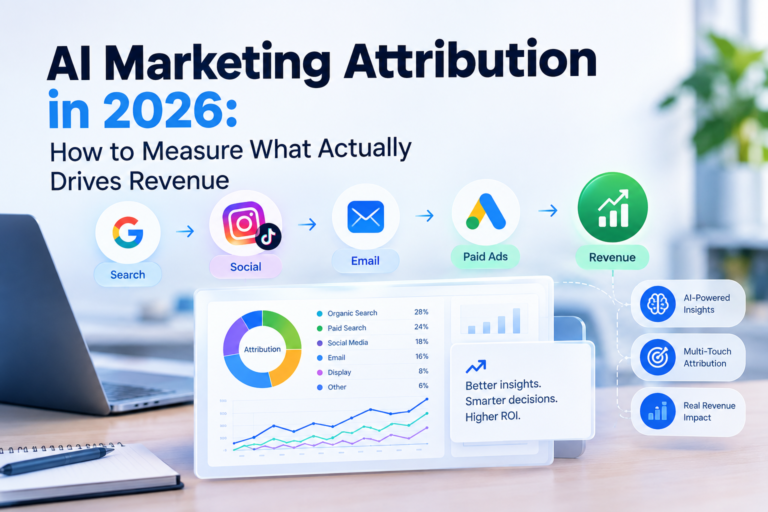
- [AI Marketing Attribution] — Learn how AI can help marketers analyze campaigns and better understand marketing performance.
- [AI Competitor Analysis Tools] — Explore AI tools for researching competitors, identifying opportunities, and monitoring the market.
- [How to Automate SEO With AI] — Learn how AI can support keyword research, content optimization, analysis, and other SEO workflows.