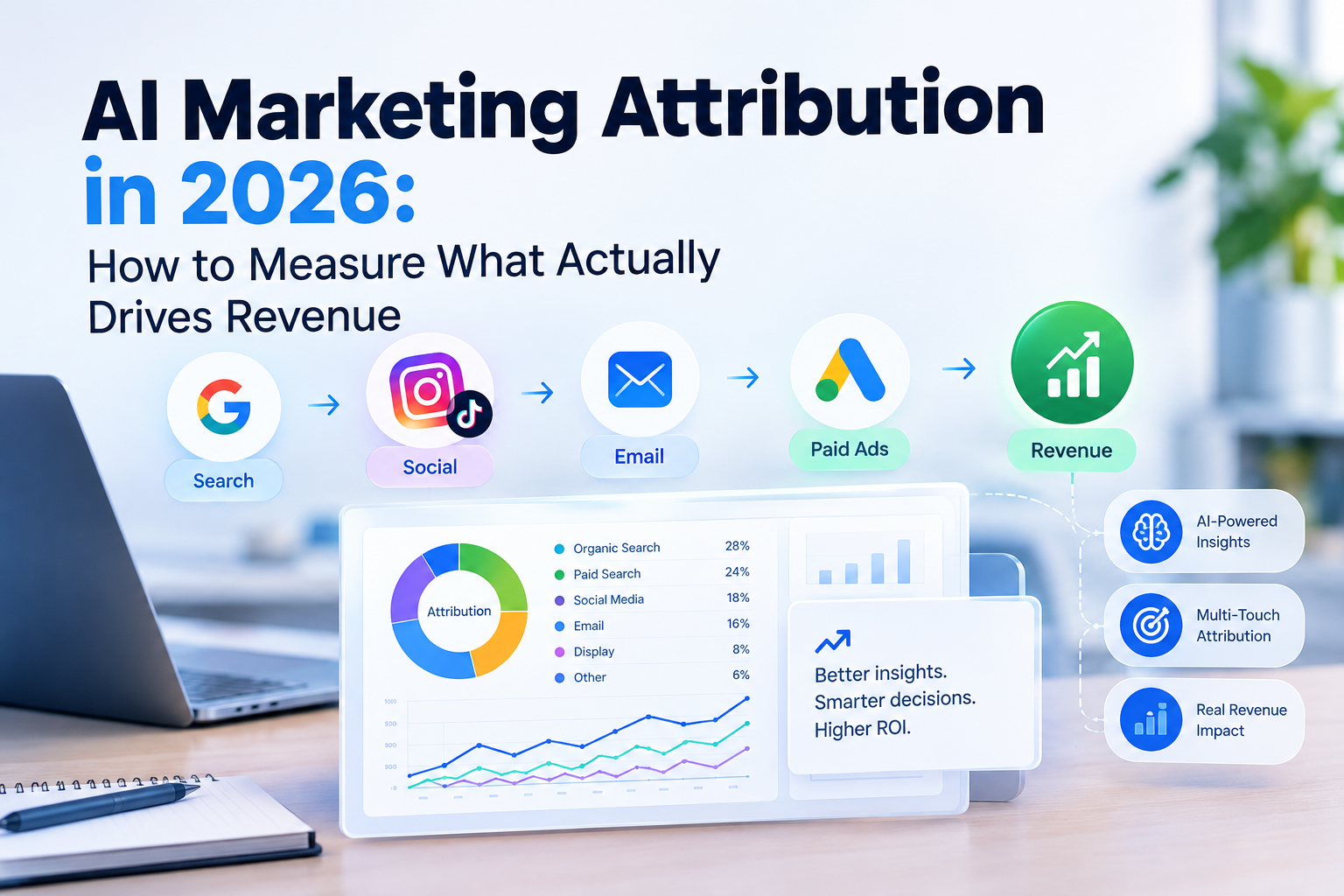
AI Marketing Attribution in 2026: How to Measure What Actually Drives Revenue
Marketing rarely follows a straight line.
A potential customer might discover a company through Google Search, watch a video on social media, return through an email, visit the website several times, and finally make a purchase after clicking a paid advertisement.
If you give all the credit to the final interaction, you may overlook the earlier marketing activities that helped create demand and move the customer toward a decision.
This is the problem marketing attribution is designed to address.
AI marketing attribution uses data-driven models, statistical methods, and machine-learning techniques to estimate how different marketing interactions contribute to important outcomes such as leads, purchases, subscriptions, or revenue.
However, AI does not make attribution automatically accurate. A sophisticated model can still produce misleading conclusions when tracking is incomplete, conversion data is unreliable, or marketers mistake correlation for causation.
This guide explains how AI-powered attribution works, how it differs from simpler attribution methods, what it can and cannot tell you, and how marketers can build a more reliable measurement process in 2026.
Our Experience and Methodology
At AI Tools for Marketers, we focus on explaining how AI and marketing technologies can be used in practical, measurable ways.
For this guide, we reviewed current documentation from Google Analytics, Google Ads, and Google Search Central to distinguish between attribution, data-driven measurement, and incrementality. We also focused on the practical limitations marketers face when interpreting customer journey data.
Rather than treating an attribution model as a perfect representation of causation, we emphasize accurate tracking, transparent measurement, and validation through experimentation.
The numerical examples in this article are simplified illustrations created to explain attribution concepts. They are not claims about the performance of any specific company, campaign, or marketing channel.
Our goal is to help marketers understand what attribution data can reasonably tell them—and where additional evidence is needed before making important decisions.
What Is AI Marketing Attribution?
Marketing attribution is the process of assigning credit to different marketing interactions that occur before a customer completes an important action.
For example, imagine this customer journey:
Organic Search → YouTube → Email → Paid Search → Purchase
A basic last-click attribution system may assign the conversion to the final interaction before the purchase.
An AI or data-driven attribution model can instead analyze customer journey data and estimate how different interactions contributed to the likelihood of the conversion.
Google Analytics describes attribution as the process of assigning credit to different ads, clicks, and other factors along a user’s path to completing a meaningful action. Its data-driven attribution model uses account data to estimate the contribution of interactions along those paths.
The important distinction is this:
Attribution estimates contribution. It does not automatically prove causation.
That distinction matters because marketers can make poor budget decisions when attribution numbers are treated as absolute proof that a particular channel caused every conversion assigned to it.
Why Marketing Attribution Has Become More Difficult
Customer journeys are increasingly fragmented.
A single person can interact with a brand through:
- Google Search
- AI-powered search experiences
- YouTube
- Social media
- Display advertising
- Affiliate websites
- Direct website visits
- Mobile applications
- Offline interactions
The same customer may also use several devices before converting.
This creates a measurement problem.
Suppose a customer first discovers a company through an educational article, watches one of its videos several days later, receives an email, and eventually searches for the brand by name before purchasing.
The branded search may appear immediately before the purchase.
But the earlier interactions may have helped create awareness and familiarity.
A last-click report can therefore provide useful operational information while still leaving out important context about the broader customer journey.
This is why marketers should examine customer paths rather than isolated conversion events.
How AI Attribution Works
AI attribution systems differ in their implementation, but the general process can be understood through four stages.
1. Collecting Customer Journey Data
The system first needs information about interactions that occur before a conversion.
Depending on the business and its measurement setup, this can include:
- Campaign source
- Campaign medium
- Campaign name
- Search interactions
- Ad clicks
- Video engagements
- Email interactions
- Landing-page visits
- Product views
- Form submissions
- Purchases
- Revenue
- Device information
- Time between interactions
The quality of the analysis depends heavily on the quality of the underlying data.
If important interactions are missing or incorrectly recorded, an advanced model cannot simply reconstruct the missing information.
2. Connecting Interactions to Outcomes
The system organizes interactions into customer journeys.
Consider two simplified examples:
Journey A
Social → Organic Search → Purchase
Journey B
Paid Search → Email → Organic Search → Purchase
With sufficient data, a data-driven model can compare converting and non-converting paths and identify patterns associated with successful outcomes.
Google explains that its data-driven attribution methodology evaluates both converting and non-converting paths when estimating how different ad interactions affect key-event outcomes.
3. Estimating Contribution
Instead of assigning all credit to a single interaction, a data-driven model can distribute fractional credit among relevant touchpoints.
For example, a simplified report might look like this:
| Channel | Attributed Revenue |
|---|---|
| Organic Search | $18,500 |
| Paid Search | $14,200 |
| $8,700 | |
| Social Media | $5,600 |
| Display | $3,000 |
These numbers should not automatically be interpreted as the exact amount of revenue each channel independently created.
They represent the output of an attribution methodology.
That difference is critical.
4. Using the Results for Decisions
The purpose of attribution is not to create attractive dashboards.
It is to improve decision-making.
A marketer might use attribution analysis to ask:
- Which channels appear in valuable customer journeys?
- Which campaigns assist conversions?
- Which channels generate traffic but rarely contribute to meaningful outcomes?
- Where should the next budget test take place?
- Which campaigns need better tracking?
- Are certain channels receiving too much credit under the selected model?
Google Analytics currently provides attribution reporting that includes data-driven attribution and last-click approaches for relevant reporting.
AI Attribution vs. Last-Click Attribution
Last-click attribution is simple.
If a customer interacts with several marketing channels and converts after clicking a paid search advertisement, the last-click model assigns the conversion to that final interaction.
That simplicity can be useful.
But it also removes much of the context surrounding the customer journey.
Consider:
YouTube → Blog Article → Email → Paid Search → Purchase
A last-click model may give the entire conversion credit to Paid Search.
A data-driven approach can evaluate the broader path and distribute credit according to the model’s analysis.
Google Analytics currently provides data-driven attribution and last-click options in its attribution reporting. Google also states that older models such as first click, linear, time decay, and position-based attribution are no longer available in its Analytics attribution reports.
When Last Click Still Has Value
Last click is not automatically useless.
It can be useful when:
- You need a simple reporting framework.
- Your customer journey is relatively short.
- You have limited conversion data.
- Stakeholders need a straightforward operational metric.
- You want a baseline against which to compare another model.
The mistake is not using last click.
The mistake is assuming that last click represents the complete causal story.
What AI Attribution Can Actually Tell You
A well-configured attribution system can help marketers investigate several practical questions.
Which channels participate in converting journeys?
If email frequently appears before high-value conversions, it may deserve more attention than a basic last-click report suggests.
Which campaigns assist other channels?
Some campaigns are designed primarily to create awareness or consideration rather than generate immediate purchases.
Attribution analysis can help identify whether those campaigns frequently appear in journeys that eventually lead to meaningful actions.
Which customers have longer journeys?
A company selling an inexpensive product may have a relatively short buying process.
A B2B company selling expensive software may have a much longer journey involving multiple sessions, channels, and decision-makers.
The measurement approach should reflect that difference.
Where should you investigate further?
Attribution should generate useful questions, not eliminate them.
If a channel suddenly receives much more attributed revenue, investigate why.
Possible explanations include:
- A genuine performance improvement
- A tracking change
- A campaign structure change
- A change in customer behavior
- A change in attribution settings
- Missing information from another channel
The attribution report is therefore a starting point for analysis rather than the final answer.
Attribution Is Not the Same as Incrementality
This is one of the most important concepts in modern marketing measurement.
Attribution asks:
Which interactions were associated with the conversion, and how should credit be distributed?
Incrementality asks:
How many additional conversions happened because of the marketing activity?
These questions are related, but they are not identical.
Imagine that 1,000 customers who purchased a product had previously clicked a retargeting advertisement.
An attribution system may assign substantial credit to the retargeting campaign.
But perhaps many of those customers were already planning to purchase.
In that case, the campaign may have received credit for conversions that would have happened anyway.
Incrementality testing attempts to address this problem by comparing outcomes between exposed groups and appropriate control or holdout groups.
Google’s own explanation of data-driven attribution describes the use of modeled comparisons and counterfactual gains when estimating the effect of certain ad interactions. This illustrates why attribution modeling involves estimation rather than simply reading a directly observable causal value from every interaction.
For important budget decisions, marketers should therefore avoid treating attribution as the only evidence available.
A Practical AI Marketing Attribution Framework
You do not need an extremely complicated system to improve measurement.
A practical framework can start with six steps.
Step 1: Define the Business Outcome
Start with the outcome that actually matters.
For an ecommerce company, that might be:
- Completed purchase
- Revenue
- Profit
- Repeat purchase
For a SaaS company:
- Qualified lead
- Trial activation
- Paid subscription
- Expansion revenue
For a service business:
- Qualified inquiry
- Appointment
- Closed customer
Avoid optimizing around metrics simply because they are easy to measure.
A large number of clicks is not necessarily better than a smaller number of qualified leads.
Step 2: Standardize Campaign Tracking
Use consistent campaign naming and tracking parameters.
For example:
utm_source=linkedin
utm_medium=paid_social
utm_campaign=ai_attribution_guide
Poor campaign naming can create fragmented reports and make attribution analysis unnecessarily difficult.
Tracking conventions should also be consistent across teams and platforms.
Step 3: Audit Your Conversion Tracking
Before trusting an attribution report, verify that important conversions are actually being recorded.
Check:
- Purchase events
- Lead forms
- Signup events
- Revenue values
- Duplicate conversions
- Cross-domain tracking
- Consent-related measurement limitations
- Campaign parameters
- Offline conversion imports, where relevant
An advanced model operating on inaccurate data can produce a convincing but incorrect report.
Step 4: Establish a Simple Baseline
Before introducing complex modeling, create a basic baseline.
For example:
- Revenue by channel
- Conversion rate by channel
- Cost per acquisition
- Return on ad spend
- Customer acquisition cost
Then compare that baseline with attribution-based reporting.
This makes it easier to understand whether the more sophisticated model is actually changing your decisions.
Step 5: Compare Attribution Approaches
Do not automatically trust a single attribution view.
Compare data-driven attribution with a simpler approach such as last click.
If the conclusions are similar, the decision may be relatively straightforward.
If they differ substantially, investigate why.
Google Analytics provides tools for comparing attribution models and examining how different approaches affect the distribution of credit.
Step 6: Validate Important Decisions
When an attribution report suggests moving a large amount of budget from one channel to another, treat the result as a hypothesis.
Then validate it through appropriate methods such as:
- Controlled experiments
- Holdout tests
- Geo experiments
- Campaign tests
- Budget experiments
- Other incrementality methods
A stronger measurement process looks like this:
Attribution → Hypothesis → Test → Decision
rather than:
Attribution → Immediate Budget Change
A Simple Example
Suppose an online software company spends $30,000 on marketing during one month.
Its reported revenue from customers acquired during that period is $90,000.
A simplified last-click report says:
| Channel | Last-Click Revenue |
|---|---|
| Paid Search | $45,000 |
| Organic Search | $20,000 |
| $15,000 | |
| Social Media | $10,000 |
The company might initially conclude that Paid Search generated half of the revenue.
Now suppose a different attribution analysis produces this distribution:
| Channel | Data-Driven Attributed Revenue |
|---|---|
| Paid Search | $32,000 |
| Organic Search | $25,000 |
| $18,000 | |
| Social Media | $15,000 |
The second report does not prove that Social Media independently generated $15,000.
Instead, it provides a different interpretation of the customer journeys.
The useful question becomes:
Why does the value assigned to each channel change between the two approaches?
That question is more useful than simply asking which number looks better.
Common AI Attribution Mistakes
Mistake 1: Treating Attribution as Causation
An attributed conversion does not automatically mean that the channel caused the conversion.
Mistake 2: Ignoring Tracking Quality
Missing or incorrectly configured data can undermine the entire analysis.
Mistake 3: Optimizing for Volume Instead of Value
A channel that generates many inexpensive leads may be less valuable than a channel generating fewer leads with much higher customer value.
Mistake 4: Changing Budgets Too Quickly
Attribution models can produce different results.
Major budget decisions should be supported by additional evidence whenever possible.
Mistake 5: Forgetting the Customer Journey
A customer may interact with a company many times before purchasing.
Looking at only one interaction can hide important context.
Mistake 6: Building an Unnecessarily Complicated System
More sophisticated does not automatically mean more accurate.
A small business with limited data may benefit more from clean tracking and clear reporting than from a complex machine-learning system.
When AI Attribution May Not Be Worth the Complexity
AI-powered attribution is not automatically necessary for every company.
A simpler approach may be better when:
- Your business has very few conversions.
- Your customer journey is extremely short.
- Your tracking is incomplete.
- Your marketing channels are limited.
- Your conversion value is difficult to measure.
- Your team does not have enough data to interpret the model responsibly.
In these situations, improving measurement fundamentals may produce more value than adding another analytics platform.
The goal should not be to build the most advanced attribution system.
The goal should be to make better marketing decisions.
How to Choose an AI Attribution Tool
If you are evaluating an attribution platform, do not start with the question:
“Which tool uses the most advanced AI?”
Instead, evaluate the system around your actual measurement requirements.
1. Data Integrations
Can it connect to the platforms where your marketing activity actually happens?
2. Conversion Support
Can it measure the business outcomes that matter to you?
3. Transparency
Can you understand how the system calculates or distributes credit?
A number that cannot be investigated or explained is difficult to use responsibly.
4. Experimentation
Does the platform support experiments or provide information that can complement attribution?
5. Data Quality Controls
Does it help identify tracking gaps, duplicates, or inconsistencies?
6. Reporting Flexibility
Can your marketing team examine campaigns, channels, customer segments, and revenue without requiring complex technical work for every question?
7. Cost Relative to Business Value
A sophisticated attribution platform may not make financial sense for a small company with limited marketing spend.
The best tool is not necessarily the one with the longest feature list.
It is the one that produces information your team can actually use.
How AI Changes the Role of the Marketer
AI attribution does not eliminate the need for human judgment.
It changes the questions marketers can investigate.
Instead of spending most of their time assembling reports, marketers can spend more time asking:
- Why did this channel’s contribution change?
- What customer journeys are becoming more common?
- Which campaigns appear to assist high-value customers?
- Where is tracking incomplete?
- Which attribution findings should be experimentally validated?
- Are we measuring revenue or merely measuring activity?
This shift is important.
Good marketing measurement is not about finding one perfect number.
It is about reducing uncertainty enough to make better decisions.
The Future of Marketing Attribution
Marketing measurement is likely to become more complicated as customers move between traditional search, social platforms, websites, applications, connected devices, and AI-powered interfaces.
At the same time, privacy and measurement limitations can make some customer interactions harder to observe directly.
This means marketers will increasingly need to combine several forms of evidence rather than relying on a single dashboard.
A mature measurement system can combine:
Attribution + Analytics + Experiments + Business Results
Each answers a slightly different question.
Attribution helps explain customer paths.
Analytics helps describe behavior.
Experiments help test causal impact.
Business results determine whether the overall marketing strategy is actually creating value.
The important skill is not simply collecting more data.
It is knowing what the data can legitimately support.
Final Takeaway
AI marketing attribution can make complex customer journeys easier to analyze, but it should not be treated as a magic system that reveals the exact source of every dollar of revenue.
The strongest approach is more disciplined.
Start with accurate tracking. Define meaningful business outcomes. Use attribution to understand customer journeys. Compare different approaches. Treat surprising results as hypotheses. Then use experiments and business data to validate important decisions.
In other words, the goal of AI attribution is not to produce a more complicated report.
It is to help marketers make better decisions with the evidence they have.
That is the real value of AI in marketing measurement.
Frequently Asked Questions
What is AI marketing attribution?
AI marketing attribution uses data-driven models and machine-learning techniques to estimate how different marketing interactions contribute to important outcomes such as leads, purchases, subscriptions, and revenue.
Is AI attribution more accurate than last-click attribution?
Not automatically. Data-driven attribution can provide a more detailed view of customer journeys, but its usefulness depends on data quality, tracking configuration, the model being used, and the business context.
Does attribution prove that a marketing channel caused a sale?
No. Attribution assigns or estimates credit based on observed customer journeys and model assumptions. It should not automatically be interpreted as proof that a specific channel caused a conversion.
What is the difference between attribution and incrementality?
Attribution estimates how credit can be distributed among marketing interactions. Incrementality attempts to determine how many additional outcomes were caused by a marketing activity compared with what would have happened without that activity.
Is Google Analytics useful for marketing attribution?
Yes. Google Analytics provides attribution reporting and currently supports data-driven attribution and relevant last-click approaches. It can also help marketers examine attribution paths and compare attribution approaches.
Should every business use an AI attribution platform?
No. Businesses with limited data, few conversions, or simple customer journeys may benefit more from accurate tracking and straightforward reporting than from a complex attribution platform.
What should marketers measure besides attributed revenue?
Useful metrics can include profit, customer acquisition cost, conversion rate, qualified leads, customer lifetime value, retention, and incremental results.
The right metrics depend on the business model and the objective being measured.
Editorial Note
This article was researched using publicly available documentation from Google Analytics, Google Ads, and Google Search Central.
Information about attribution models and measurement methods is based primarily on official Google documentation. Examples in this article are simplified for educational purposes and should not be interpreted as performance guarantees.
Because analytics platforms and attribution methodologies can change, this article should be reviewed periodically when major measurement or platform updates are introduced.
Sources and Further Reading
Google Analytics Help — Get started with attribution
Official documentation explaining attribution, data-driven attribution, customer paths, and available attribution models.
Google Analytics Help — Change the reporting attribution model for key events
Official documentation covering current attribution settings in Google Analytics.
Google Analytics Help — Conversion attribution models
Official documentation explaining how marketers can compare attribution approaches.
Google Search Central — Creating Helpful, Reliable, People-First Content
Official guidance on creating original, useful, reliable content for people rather than producing content primarily for search engines.
Google AdSense Help — AdSense Program Policies
Official publisher-policy documentation covering requirements for sites monetized with Google AdSense.
Google AdSense Help — AdSense policies: A beginner’s guide
Official guidance emphasizing unique and relevant content and warning against unnecessary keyword repetition and low-value approaches.




One Comment