
Best AI Keyword Research Tools in 2026: 5 Tools Compared
Keyword research is still one of the most important parts of SEO.
Before creating an article, landing page, product page, or content strategy, you need to understand what people are actually searching for—and whether your website has a realistic chance of competing for those searches.
That is where modern keyword research software can help.
Today’s SEO platforms go beyond simply showing search volume. Depending on the tool, you can analyze keyword difficulty, search intent, traffic potential, competitor rankings, SERP features, keyword clusters, content opportunities, and other signals that help you decide what to target.
Some platforms also use AI to organize keywords, generate ideas, identify opportunities for a specific website, or turn keyword research into a broader content strategy.
However, AI does not automatically make a keyword tool better. Reliable data, useful metrics, competitor analysis, and the ability to interpret search results are often more important than the number of AI features a platform advertises.
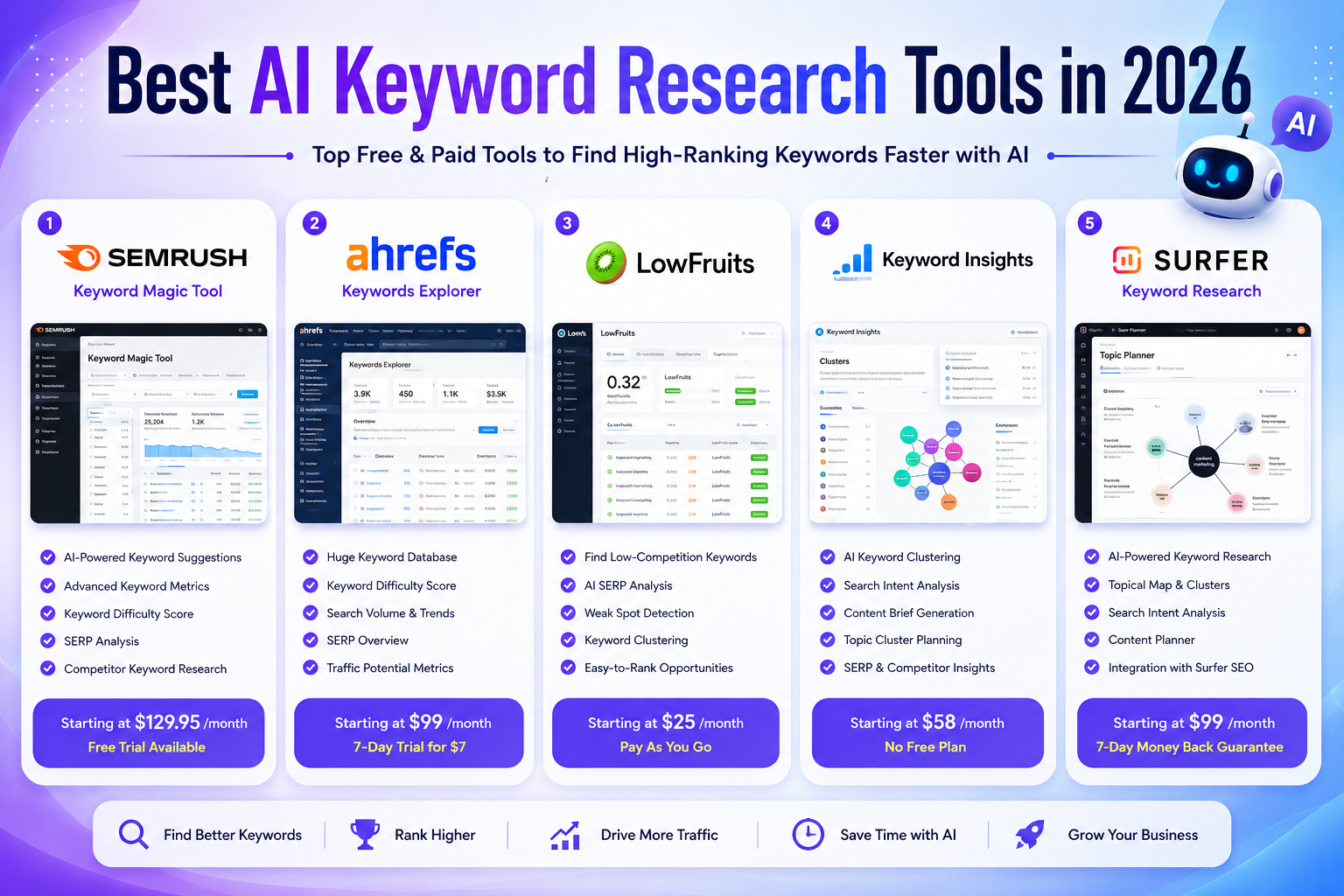
In this guide, we compare five keyword research platforms that are particularly useful for different SEO workflows:
- Semrush Keyword Magic Tool — best for comprehensive keyword research
- Ahrefs Keywords Explorer — best for keyword and competitor analysis
- LowFruits — best for finding lower-competition opportunities
- Keyword Insights — best for keyword clustering and content planning
- Surfer — best for connecting keyword research with content planning and optimization
Methodology: This comparison is based on current product information, official documentation, pricing information, and the intended workflows of each platform. It does not claim hands-on testing of every feature. Prices and feature availability can change, so verify the provider’s current plan before purchasing.
Quick Comparison
| Tool | Best For | Main Strength | Free Access | Pricing Approach |
|---|---|---|---|---|
| Semrush | Comprehensive SEO research | Keyword database, intent, difficulty and competitive research | Limited access/trial | Subscription |
| Ahrefs | Keyword and competitor analysis | Keyword metrics, Traffic Potential and competitor research | Yes, with limitations | Subscription |
| LowFruits | Lower-competition keywords | SERP analysis and identifying weaker competitors | Limited access | Credits/subscriptions |
| Keyword Insights | Keyword clustering | Search-intent-based clustering and content planning | Trial | Credits/subscriptions |
| Surfer | Content-focused SEO | Topic research and content optimization workflow | Limited/trial access may vary | Subscription |
Which Tool Should You Choose?
- Want an all-in-one SEO platform? Start with Semrush.
- Want detailed keyword and competitor data? Consider Ahrefs.
- Have a smaller site and want realistic ranking opportunities? Consider LowFruits.
- Have thousands of keywords to organize? Keyword Insights is worth evaluating.
- Want to connect keyword research with content optimization? Surfer may be the better fit.
What Is an AI Keyword Research Tool?
An AI keyword research tool is SEO software that combines traditional keyword data with artificial intelligence or automation to help users discover, organize, evaluate, or prioritize search queries.
Traditional keyword research usually involves looking at metrics such as:
- Search volume
- Keyword difficulty
- Cost per click
- Competition
- Search intent
- SERP results
- Traffic potential
AI-assisted platforms can add another layer of automation.
For example, AI can help:
- Generate keyword ideas
- Group related keywords
- Classify search intent
- Identify content opportunities
- Personalize keyword recommendations
- Build topic clusters
- Generate content briefs
- Prioritize keywords for a particular website
The important distinction is that AI assists the research process; it does not replace SEO judgment.
A keyword with 50,000 monthly searches is not automatically better than one with 500 searches. Search intent, competition, relevance, business value, and your site’s ability to compete all matter.
What Should You Look for in a Keyword Research Tool?
Before paying for an SEO platform, consider these factors.
1. Keyword Data Quality
The tool should provide useful and reasonably current data for the countries and search engines you care about.
Look for:
- Search volume
- Keyword difficulty
- Search trends
- SERP information
- Click data where available
- Geographic databases
Remember that third-party keyword metrics are estimates. They should help you make decisions, not be treated as exact measurements of future traffic.
2. Search Intent
Understanding why someone searches for a keyword is often more important than its volume.
Common intent categories include:
- Informational
- Commercial
- Transactional
- Navigational
For example:
“what is email marketing”
is very different from:
“best email marketing software for small business”
Even though both queries relate to the same general topic, they represent different stages of the search journey.
3. Keyword Difficulty
Difficulty metrics can help estimate how competitive a keyword may be.
But do not treat a difficulty score as a guarantee.
A keyword with a low score can still be difficult if the current search results contain highly relevant pages with strong topical coverage.
That is why manually reviewing the SERP is still important.
4. Competitor Research
A good platform should help you understand what competing websites are already ranking for.
This can reveal:
- Missing topics
- Long-tail opportunities
- Content gaps
- Pages worth improving
- Keywords competitors rank for but you do not
5. Keyword Clustering
If you have thousands of keywords, manually organizing them can become extremely time-consuming.
Keyword clustering groups related terms so you can decide which keywords belong on the same page and which deserve separate content.
6. Website-Specific Recommendations
Generic keyword difficulty is useful, but personalized recommendations can be even more helpful.
Your site’s authority, existing rankings, topical relevance, and backlink profile can affect how realistic an opportunity is.
1. Semrush Keyword Magic Tool
Best for: comprehensive keyword research and broader SEO campaigns.
Semrush’s Keyword Magic Tool is designed for discovering large numbers of related keywords from a seed term.
The platform currently describes a database of more than 27 billion keywords, with keyword groups, search intent, difficulty, SERP features, and other filtering options. Its AI-assisted features can also provide website-specific signals such as Personal Keyword Difficulty and Potential Traffic.
What Makes Semrush Useful?
The biggest advantage is breadth.
Instead of using the Keyword Magic Tool in isolation, you can connect keyword research with other parts of the Semrush ecosystem, including competitor research, keyword gaps, position tracking, site audits, and content planning.
This makes it useful for people who want one platform for a large part of their SEO workflow.
Key Features
- Large keyword database
- Keyword difficulty
- Search intent classification
- Long-tail keyword discovery
- Question keyword filtering
- Keyword grouping
- SERP feature analysis
- Competitor keyword research
- Keyword Gap
- Website-specific keyword recommendations
- Potential Traffic estimates
- Keyword Strategy Builder
- International keyword research
Semrush’s Keyword Strategy Builder can organize keywords into topics and clusters and help turn research into a content plan.
Pricing
Semrush’s current US pricing page lists the SEO plan at $139/month, or $117.33/month when billed annually, with higher tiers available. The Keyword Magic Tool is included within the broader SEO toolkit rather than being sold as a completely separate standalone product.
Semrush also currently offers a free trial for eligible users, while free access to individual keyword research features is more limited than paid access.
Pros
- Very large keyword database
- Strong filtering and organization
- Useful search-intent data
- Powerful competitor research ecosystem
- Website-specific keyword analysis
- Strong international SEO support
- Integrates keyword research with other SEO workflows
Cons
- Expensive for casual users
- Large number of features can feel overwhelming
- Advanced functionality requires higher-tier access
- Keyword metrics are estimates rather than guarantees
Best For
Semrush is particularly suitable for:
- SEO professionals
- Agencies
- Affiliate marketers
- Content teams
- eCommerce businesses
- Established websites
- Businesses running broader SEO campaigns
Bottom Line
Choose Semrush if you want keyword research to be part of a larger SEO platform.
Its strongest advantage is not simply AI. It is the combination of a large keyword database, competitive research, keyword organization, website-specific analysis, and broader SEO tools.
2. Ahrefs Keywords Explorer
Best for: detailed keyword research, competitor analysis, and traffic-potential analysis.
Ahrefs Keywords Explorer focuses heavily on understanding search demand and evaluating the potential value of individual keywords.
Its current product documentation highlights metrics such as Keyword Difficulty, Search Volume, Traffic Potential, Parent Topic, keyword ideas, search intent, and keyword clustering. Ahrefs says its keyword database contains billions of keywords and that Keywords Explorer can generate and cluster keyword ideas.
Why Consider Ahrefs?
One particularly useful concept is Traffic Potential.
Instead of looking only at the estimated search volume of a keyword, Ahrefs can show how much organic traffic the current top-ranking page receives for that topic.
This can provide additional context when deciding whether a keyword is worth pursuing.
Ahrefs also provides competitor and content research tools that can be useful when building an SEO strategy around existing search results.
Key Features
- Keyword suggestions
- Keyword Difficulty
- Search Volume
- Traffic Potential
- Parent Topic
- Search intent
- SERP analysis
- Keyword clustering
- Competitor research
- Content Gap analysis
- Historical data
- International keyword research
Pricing
Ahrefs currently offers several levels.
Its current pricing page lists the Starter plan at $29/month, while the Lite plan starts at $129/month in the displayed US pricing. Higher plans are available for larger teams and more extensive usage.
Ahrefs also has a free account with limited functionality. Some keyword research capabilities require the paid Starter plan.
Pros
- Strong keyword metrics
- Useful Traffic Potential metric
- Powerful competitor research
- Parent Topic analysis
- Keyword clustering
- Large international database
- Free account available for limited use
Cons
- Serious keyword research can become expensive
- Usage limits vary by plan
- Some advanced capabilities require higher tiers
- Beginners may need time to understand the metrics
Best For
Ahrefs is a strong choice for:
- SEO professionals
- Affiliate marketers
- Publishers
- Agencies
- Competitive niches
- Businesses doing competitor research
Bottom Line
Ahrefs is particularly useful when you want to understand not just how many people search for a keyword, but what the current search results suggest about its traffic potential and competitive environment.
3. LowFruits
Best for: finding keyword opportunities where smaller or newer websites may have a realistic chance of competing.
LowFruits takes a different approach from large all-in-one SEO platforms.
Instead of trying to provide every SEO feature under one roof, it focuses heavily on identifying potentially weaker search results and lower-competition keyword opportunities.
Why Consider LowFruits?
For a new website, targeting a keyword with enormous search volume may not be the best starting point.
A more practical strategy can be finding searches where smaller websites are already ranking.
That is the type of problem LowFruits is designed to help with.
Its workflow can help users examine SERPs and identify potential “weak spots” among ranking pages.
Key Features
Depending on the current plan, LowFruits focuses on capabilities such as:
- Keyword discovery
- SERP analysis
- Low-competition keyword identification
- Competitor discovery
- Long-tail keyword research
- Keyword filtering
- SERP-based opportunity analysis
- Keyword clustering
- Credit-based research
Pricing
LowFruits uses a combination of subscription and credit-based approaches, making it different from tools that require a large all-in-one monthly subscription.
Because credit pricing and plans can change, check the current LowFruits pricing page before publishing an exact price in a comparison table.
Pros
- Focused on realistic ranking opportunities
- Useful for smaller websites
- SERP-oriented approach
- Easier to understand than some enterprise SEO platforms
- Useful for niche and affiliate websites
- Can complement a larger SEO platform
Cons
- Not a complete replacement for an all-in-one SEO suite
- Less suitable if you need extensive technical SEO tools
- Some research actions use credits
- The usefulness of its approach depends on your niche and SERPs
Best For
LowFruits is especially relevant for:
- New websites
- Niche site owners
- Bloggers
- Affiliate marketers
- Small businesses
- Freelance SEOs
Bottom Line
If your biggest problem is “Which keywords can a smaller website realistically compete for?”, LowFruits is worth considering.
It can be particularly useful as a complementary tool rather than as your only SEO platform.
4. Keyword Insights
Best for: keyword clustering, search intent analysis, and turning large keyword lists into content plans.
Keyword research often produces a problem of its own: too many keywords.
Imagine exporting several thousand search terms for a single topic. You still need to decide:
- Which keywords belong together?
- Which terms should have their own page?
- Which keywords have the same intent?
- Which topics should become pillar pages?
- Where could keyword cannibalization occur?
Keyword Insights is designed to help solve this organizational problem.
Why Consider Keyword Insights?
Its main strength is keyword clustering.
Rather than treating every keyword as a separate article opportunity, clustering can help identify groups of searches that may be addressed by the same page.
This is valuable for larger content strategies where manually reviewing thousands of keywords would be impractical.
Key Features
- Keyword clustering
- Search intent analysis
- Content briefs
- Keyword discovery
- Topic planning
- AI writing assistance
- AI content workflows
- Bulk keyword processing
- Content strategy organization
The current pricing page uses a credit system. The Basic plan is listed at $58/month, Professional at $99/month, with Enterprise pricing available on a custom basis. The company also currently advertises a short $1 trial with credits.
Pros
- Strong focus on keyword clustering
- Useful for large keyword lists
- Credit-based workflow
- Content planning features
- Useful for agencies and publishing teams
- Can reduce manual spreadsheet work
Cons
- Less of an all-in-one SEO platform
- Credit consumption needs to be monitored
- May be unnecessary for very small keyword lists
- Subscription cost can be difficult to justify for occasional users
Best For
Keyword Insights is particularly useful for:
- SEO agencies
- Content teams
- Publishers
- Affiliate sites
- Large content projects
- Businesses building topical coverage
Bottom Line
If your SEO problem is not finding keywords, but rather organizing thousands of keywords into a sensible content structure, Keyword Insights is one of the more specialized options to consider.
5. Surfer
Best for: connecting keyword research with content planning and optimization.
Surfer is best understood as a broader content-focused SEO platform rather than simply a keyword database.
Its appeal comes from connecting research, topic planning, content optimization, and writing workflows.
Why Consider Surfer?
Keyword research is only the first step.
After identifying an opportunity, you still need to create a page that satisfies the search intent and provides useful information.
A platform that connects keyword research with content planning can reduce the number of separate tools required for that workflow.
Key Features
Depending on the current plan, Surfer’s ecosystem includes capabilities around:
- Keyword research
- Topic discovery
- Content planning
- Keyword clustering
- Content optimization
- SERP analysis
- Content briefs
- AI-assisted writing
- Internal linking
- Content auditing
Pricing
Surfer’s pricing changes by product, plan, billing period, and available features. Rather than publishing a potentially outdated single price for “Keyword Research,” check the current Surfer pricing page before adding a numerical figure to the article.
Pros
- Strong content-focused workflow
- Connects research and content optimization
- Useful for publishers producing content regularly
- Can reduce the need to switch between tools
- Helpful for content teams
Cons
- More focused on content SEO than deep competitor intelligence
- Subscription costs may be high for beginners
- Not every website needs a full content optimization platform
- Some workflows can be more automated than necessary for experienced SEOs
Best For
Surfer is a good fit for:
- Content marketers
- Publishers
- Bloggers
- Affiliate websites
- SEO agencies
- Businesses publishing content regularly
Bottom Line
Surfer makes the most sense when your workflow looks like:
keyword research → topic planning → content creation → optimization
If you only need occasional keyword ideas, a simpler tool may provide better value.
Semrush vs. Ahrefs vs. LowFruits vs. Keyword Insights vs. Surfer
The biggest differences become clearer when you compare the tools by job.
| Need | Best Fit |
|---|---|
| Large-scale keyword discovery | Semrush |
| Competitor and keyword intelligence | Ahrefs |
| Lower-competition opportunities | LowFruits |
| Large-scale keyword clustering | Keyword Insights |
| Content planning and optimization | Surfer |
These aren’t mutually exclusive choices.
For example, an SEO professional might use Ahrefs or Semrush for broad research, LowFruits to identify easier opportunities, and a clustering platform to organize a large content plan.
How to Do Keyword Research With AI
AI can make keyword research faster, but a good process still requires human judgment.
Step 1: Start With a Topic
Begin with a broad subject related to your website.
For example:
Seed topic: AI writing tools
Do not immediately choose the first keyword suggestion you see.
Use the topic to discover related searches.
Step 2: Expand the Keyword List
Look for:
- Questions
- Comparisons
- Alternatives
- How-to searches
- Product searches
- Long-tail keywords
- Problem-based searches
- Commercial queries
The goal is to understand the entire search landscape.
Step 3: Analyze Search Intent
Ask:
What does the searcher actually want?
If someone searches:
“best AI writing tools”
they are probably comparing products.
Someone searching:
“how does AI writing work”
probably wants educational information.
The page type should match the intent.
Step 4: Check the SERP
Do not rely entirely on a difficulty score.
Search the keyword manually and examine:
- What types of pages rank?
- Are the results mostly major brands?
- Are forums appearing?
- Are small websites ranking?
- Are videos prominent?
- Are product pages ranking?
- Are informational articles ranking?
- Does Google show an AI Overview or other SERP features?
The SERP provides context that a single numerical score cannot fully capture.
Step 5: Evaluate Business Value
A keyword can generate traffic without generating meaningful business results.
For commercial websites, ask:
- Does this search relate to the product?
- Could the visitor become a customer?
- Does the keyword indicate buying intent?
- Does it support a relevant content funnel?
Traffic should not be the only KPI.
Step 6: Group Related Keywords
Once you have a large list, cluster related terms.
This helps prevent creating multiple pages that compete for essentially the same search intent.
Step 7: Prioritize
A practical keyword strategy usually balances:
- Relevance
- Search demand
- Competition
- Search intent
- Business value
- Existing authority
- Content quality
- Ranking feasibility
Why Search Volume Alone Is a Bad Keyword Strategy
One of the most common SEO mistakes is chasing keywords with the highest search volume.
Suppose you have these two keywords:
Keyword A: 50,000 searches/month
Keyword B: 800 searches/month
Keyword A looks more attractive.
But imagine that:
- Keyword A is extremely competitive
- Search intent is unclear
- Large established websites dominate the SERP
- Visitors rarely become customers
Meanwhile:
- Keyword B has clear commercial intent
- Smaller websites already rank
- The topic directly matches your product
- Searchers are much closer to making a decision
Keyword B may be more valuable.
That is why good keyword research is about opportunity, not simply volume.
Common Keyword Research Mistakes
1. Targeting Only High-Volume Keywords
High-volume keywords often attract intense competition.
A new website may benefit more from building authority with specific long-tail topics first.
2. Ignoring Search Intent
A perfectly optimized article can struggle if it does not match what searchers expect.
Always examine the current results before deciding what type of page to create.
3. Trusting Keyword Difficulty Too Much
Difficulty metrics are useful estimates, not guarantees.
Use them as one signal among several.
4. Creating One Article for Every Keyword
Related keywords may belong on the same page.
Publishing separate articles for every slight variation can create unnecessary overlap.
5. Ignoring Business Relevance
A keyword can be easy to rank for and still have little value for your business.
Ask whether the search is relevant to your audience and goals.
6. Forgetting Existing Rankings
Sometimes the easiest SEO opportunity is not creating a new article.
It may be improving a page that already ranks on page two or near the top of page one.
7. Treating AI Recommendations as Facts
AI can suggest keywords and topics, but it can also misunderstand context or generate irrelevant ideas.
Always validate important keywords against real search data and current SERPs.
Do AI Keyword Tools Actually Improve SEO?
They can improve the research process, but no keyword tool can guarantee rankings.
AI is particularly useful for reducing repetitive work such as:
- Expanding seed topics
- Grouping keywords
- Classifying intent
- Generating content ideas
- Finding relationships between queries
- Organizing large datasets
But rankings still depend on many factors, including:
- Relevance
- Content quality
- Search intent
- Website authority
- Competition
- Technical accessibility
- Internal linking
- External references and links
- User experience
A keyword tool helps you make better decisions. It does not make those decisions for you.
Free Keyword Research Options
You do not necessarily need an expensive SEO subscription to start researching keywords.
Depending on your needs, you can combine:
- Search engine autocomplete
- Related searches
- Google Search Console
- Google Trends
- Free features offered by SEO platforms
- Competitor SERP analysis
- Spreadsheet-based keyword organization
Ahrefs currently offers a free account with several SEO capabilities, although more extensive Keywords Explorer access requires a paid plan.
The important thing is to understand what data you actually need before paying for a large SEO suite.
How Much Should You Spend on Keyword Research Software?
The answer depends on how frequently you perform SEO research.
Occasional blogger
A free toolset may be enough.
Small website
A focused tool such as LowFruits may offer better value than an expensive all-in-one platform.
SEO freelancer
A professional subscription can make sense if keyword research and competitor analysis are part of your regular client work.
Agency or large content team
The value comes from scale, reporting, collaboration, exports, automation, and integrations.
Don’t pay for dozens of features you will never use.
Frequently Asked Questions
What Is the Best AI Keyword Research Tool in 2026?
There is no universal winner.
Semrush is a strong choice for broad SEO research, Ahrefs is particularly useful for keyword and competitor analysis, LowFruits focuses on lower-competition opportunities, Keyword Insights specializes in clustering, and Surfer connects keyword research with content workflows.
Is AI Keyword Research Better Than Traditional Keyword Research?
AI can make research faster and easier, but it does not necessarily replace traditional SEO analysis.
The strongest workflow combines automated suggestions with:
- Real keyword data
- SERP analysis
- Search-intent evaluation
- Competitor research
- Human judgment
What Is the Best Free Keyword Research Tool?
There is no single free tool that provides everything.
A combination of Google Search Console, Google Trends, search-result analysis, and limited free features from SEO platforms can be enough for smaller projects.
Are Keyword Difficulty Scores Accurate?
They are useful estimates, but they are not guarantees.
Different SEO platforms calculate difficulty differently, so you should not directly compare a KD score from one platform with a score from another as though they use the same scale.
Should New Websites Target Low-Competition Keywords?
Often, yes.
New websites generally have less authority and fewer established rankings, so finding relevant lower-competition opportunities can be a sensible starting strategy.
However, “low competition” should never be the only criterion. The keyword still needs to be relevant and worth serving.
How Many Keywords Should One Article Target?
There is no universal number.
One high-quality article can naturally rank for many related queries when those searches share the same intent.
The better question is:
Can one page satisfy all of these searches well?
If yes, they may belong together.
If the search intent is substantially different, separate pages may make more sense.
Can AI Find Keywords With Zero Competition?
AI can help identify potentially overlooked opportunities, but no tool can guarantee that a keyword has zero competition.
Competition can change, and third-party metrics are estimates.
Always inspect the actual SERP.
Should I Use More Than One Keyword Research Tool?
You can, especially when the tools serve different purposes.
For example:
- One platform for broad keyword discovery
- Another for competitor research
- Another for clustering
- Another for content optimization
But using multiple subscriptions is not automatically better. Choose tools that add genuinely different information.
Final Verdict
The best keyword research tool is not necessarily the one with the largest database or the most AI features.
It is the tool that helps you make better SEO decisions for your specific website.
Choose Semrush if:
You want a broad SEO platform with extensive keyword research, competitor analysis, filtering, and website-specific research capabilities.
Choose Ahrefs if:
You care heavily about keyword metrics, competitor research, Traffic Potential, and understanding the search landscape.
Choose LowFruits if:
Your priority is finding realistic opportunities where smaller websites may be able to compete.
Choose Keyword Insights if:
You have large keyword lists and need help clustering them into logical content opportunities.
Choose Surfer if:
Your main workflow connects keyword research with content planning and optimization.
Ultimately, the software is only part of the process.
The most valuable keyword strategy combines reliable data, search-intent analysis, SERP review, competitor research, business relevance, and high-quality content.
Use AI to reduce repetitive work—but keep the important decisions human.
How We Evaluated These Tools
For this comparison, we focused on the factors that are most useful when choosing keyword research software:
- Keyword discovery
- Data and metrics
- Search intent
- Keyword difficulty
- Competitor research
- SERP analysis
- Keyword clustering
- Website-specific recommendations
- Content planning
- Pricing accessibility
- Ease of use
- Appropriate use cases
We did not assign arbitrary star ratings because a tool can be excellent for one SEO workflow and unnecessary for another.
For example, a beginner building a small niche website may benefit more from a focused low-competition tool than from an expensive enterprise SEO suite.
Likewise, an SEO agency managing hundreds of projects may value reporting, exports, automation, and integrations much more than a simple keyword generator.
Pricing and features change regularly. Always verify the current provider information before purchasing a subscription.




2 Comments