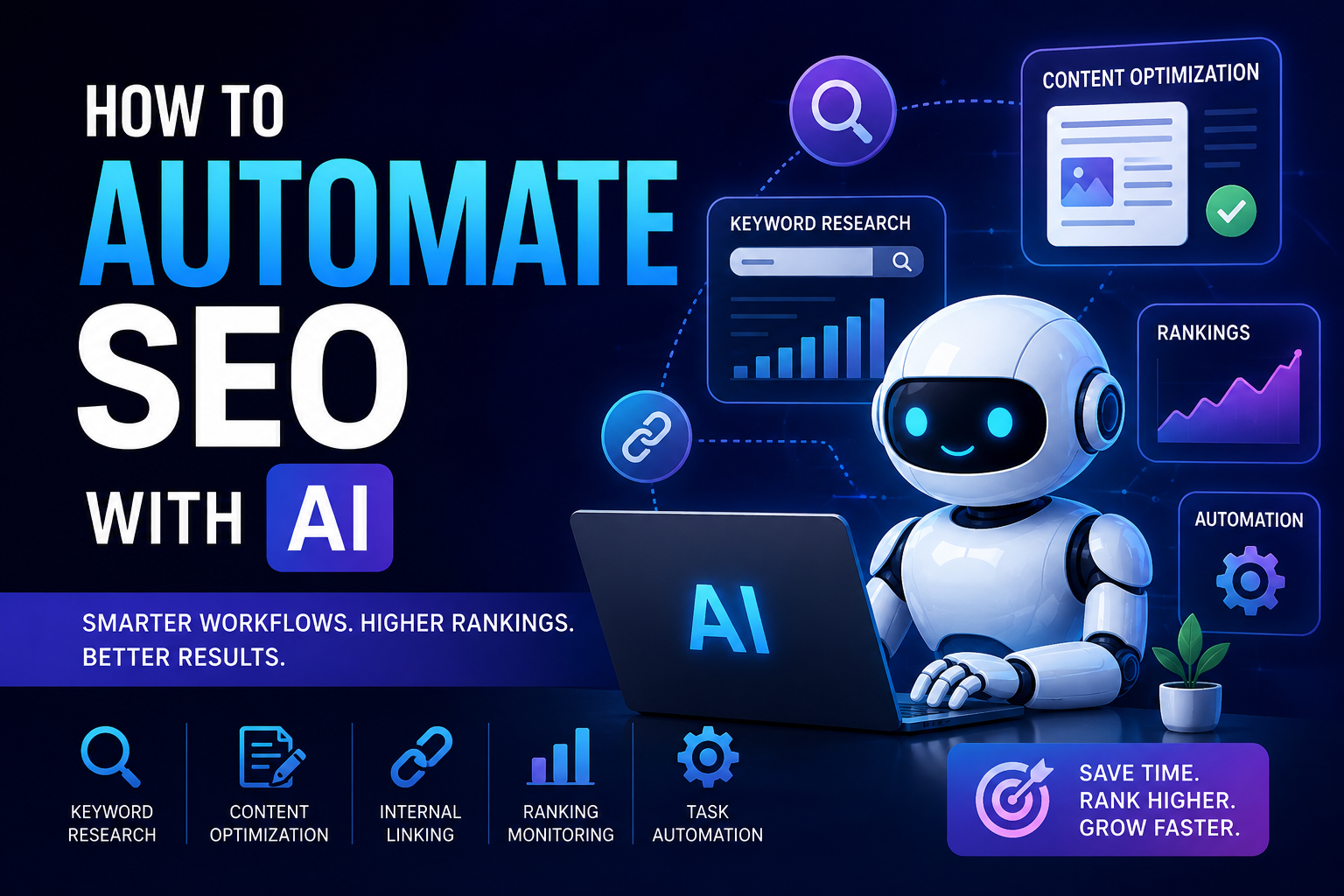
How to Automate SEO With AI in 2026: A Practical Guide to AI SEO Automation
Updated September 2026
SEO has become a collection of interconnected processes rather than a single task.
A modern SEO workflow can involve keyword research, search-intent analysis, SERP research, content planning, technical audits, internal linking, optimization, rank tracking, reporting, and content updates.
Many of these activities are repetitive enough to automate.
That is where AI SEO automation becomes useful.
Instead of asking AI to simply write more articles, you can use AI and automation tools to connect different parts of the SEO workflow. The result can be less manual work, faster analysis, and more consistent processes.
But there is an important distinction:
The goal of AI SEO automation is not to remove humans from SEO. It is to automate repetitive work while keeping humans responsible for strategy, accuracy, originality, and important decisions.
This guide explains what AI SEO automation actually means, what you can automate, what you should keep under human control, how to build an AI-assisted SEO workflow, and which tools are best suited to different use cases in 2026.
What Is AI SEO Automation?
AI SEO automation is the use of artificial intelligence, SEO software, APIs, and workflow automation to perform repeatable search-engine-optimization tasks with less manual effort.
Traditional SEO automation might handle tasks such as:
- Rank tracking
- Website crawling
- Technical issue detection
- Backlink monitoring
- Scheduled reports
- Basic alerts
AI can add another layer.
Instead of simply reporting that something happened, an AI-assisted workflow can analyze information, organize it, identify patterns, generate recommendations, and prepare work for human approval.
For example, consider a page that suddenly loses organic visibility.
A basic automation might send an alert:
“Your page dropped from position 4 to position 11.”
A more advanced AI-assisted workflow could:
- Identify the affected page.
- Compare its historical performance.
- Analyze the current search results.
- Compare competing pages.
- Identify potentially missing topics.
- Check whether important information has become outdated.
- Prepare recommendations for review.
The human can then decide whether those recommendations make sense.
That difference is important.
Automation handles the process.
Humans remain responsible for judgment.
AI SEO Automation vs. AI Content Generation
These terms are often used interchangeably, but they describe different things.
AI content generation
AI content generation usually means using an AI system to produce text, images, outlines, or other content.
A simple workflow looks like:
Keyword → AI → Article
That can save writing time, but it is not a complete SEO strategy.
AI SEO automation
AI SEO automation covers a broader process:
Research
↓
Keyword selection
↓
Search-intent analysis
↓
SERP analysis
↓
Content planning
↓
Drafting
↓
Human review
↓
Optimization
↓
Internal linking
↓
Publishing
↓
Performance monitoring
↓
Content updates
The important point is that AI-generated content is only one possible component of an automated SEO workflow.
Google’s guidance specifically warns that generating many pages with AI without adding value can fall under scaled content abuse. Google recommends focusing on accuracy, quality, relevance, and people-first content instead.
So the better objective is not:
Publish as many AI articles as possible.
It is:
Use AI to make a good SEO process more efficient.
What Can You Automate With AI?
Almost every repetitive SEO process can be assisted by automation, but not every task should be fully automated.
| SEO task | Automation potential | Human involvement |
|---|---|---|
| Keyword discovery | High | Recommended |
| Keyword clustering | High | Recommended |
| Search-intent classification | High | Yes |
| SERP analysis | High | Yes |
| Competitor analysis | High | Yes |
| Content briefs | High | Yes |
| First drafts | High | Essential |
| Meta titles | High | Recommended |
| Meta descriptions | High | Recommended |
| Content optimization | High | Yes |
| Internal-link suggestions | High | Recommended |
| Rank monitoring | Very high | Low |
| SEO reporting | Very high | Low |
| Technical SEO alerts | Very high | Yes |
| Content refreshing | High | Essential |
| Backlink outreach | Medium | Essential |
| SEO strategy | Low to medium | Essential |
| Final publishing decisions | Low | Essential |
The table reveals an important principle:
Automation potential does not mean automation should be total.
Tasks involving repetitive data processing are excellent candidates for automation.
Tasks involving brand strategy, factual judgment, expertise, recommendations, or publishing decisions require much more human oversight.
A Better AI SEO Workflow for 2026
A weak AI SEO workflow looks like this:
Keyword → AI → Article → Publish
It is fast, but it can easily produce generic content.
A stronger workflow looks like this:
Topic discovery
↓
Keyword research
↓
Search intent
↓
SERP analysis
↓
Content gap analysis
↓
Content brief
↓
AI-assisted draft
↓
Human review
↓
SEO optimization
↓
Internal linking
↓
Publish
↓
Monitor
↓
Refresh
This turns SEO from a one-time publishing process into a continuous improvement system.
Google’s current guidance emphasizes original analysis, substantial information, useful context, accurate sourcing, and content created primarily for people rather than search engines.
1. Automate Keyword Research
Keyword research is one of the easiest SEO activities to accelerate with software and AI.
Depending on the platform, an automated workflow can help discover:
- Related keywords
- Long-tail queries
- Question-based searches
- Commercial keywords
- Informational keywords
- Topic clusters
- Competitor keyword opportunities
- Content gaps
However, search volume should not be the only selection criterion.
Consider two keywords:
Keyword A
- 50,000 monthly searches
- Extremely competitive
- Weak business relevance
Keyword B
- 1,500 monthly searches
- Strong commercial intent
- Closely related to your product or audience
- Realistic competition
Keyword B may be the better opportunity.
A Better Keyword Workflow
Seed topic
↓
Keyword discovery
↓
Clustering
↓
Intent classification
↓
Competition analysis
↓
Business relevance
↓
Final keyword selection
AI can accelerate the research.
You make the strategic decision.
2. Automate Keyword Clustering
Large keyword lists quickly become difficult to manage manually.
Suppose you collect hundreds of keywords around:
AI screen recording
You might find:
- AI screen recorder
- best AI screen recorder
- AI screen recording software
- AI screen recorder tools
- screen recorder with AI
- AI recording app
Some of these may belong to the same topic.
Others may deserve separate pages.
AI can help group keywords according to:
- Semantic similarity
- Search intent
- Topic relationships
- SERP similarity
- User needs
The resulting clusters can become a content map.
Example
500 keywords
↓
AI clustering
↓
Intent classification
↓
SERP validation
↓
20 topic groups
↓
20 potential content assets
But there is an important limitation:
Semantic similarity does not automatically mean two keywords should target the same page.
For important clusters, validate the result against actual search results.
3. Automate Search Intent Analysis
Search intent is one of the most important parts of SEO.
A keyword alone does not tell you exactly what the searcher expects.
Common categories include:
Informational
The user wants to learn something.
Examples:
- What is AI SEO?
- How does keyword clustering work?
- What is search intent?
Commercial investigation
The user is evaluating options.
Examples:
- Best AI SEO tools
- Semrush vs Ahrefs
- Best SEO software for agencies
Transactional
The user is ready to take an action.
Examples:
- Buy SEO software
- Semrush pricing
- Ahrefs subscription
Navigational
The user is trying to reach a particular website or brand.
Examples:
- Semrush login
- Ahrefs dashboard
- Google Search Console
AI can classify large keyword lists quickly.
But search results should remain the validation layer.
For example:
“best AI SEO tools”
probably requires a comparison-oriented page containing:
- Tool categories
- Features
- Use cases
- Pricing information
- Strengths
- Limitations
- Decision guidance
A generic definition of AI SEO would not fully satisfy that intent.
4. Automate SERP and Competitor Analysis
This is where AI can become significantly more useful than simply asking a chatbot to write an article.
Instead of starting with:
“Write an article about AI SEO.”
Start with:
“Analyze the current search results, identify the dominant search intent, summarize the important topics covered by ranking pages, and identify useful information that readers may still need.”
A research workflow can examine:
- Search intent
- Common topics
- Content formats
- Frequently discussed questions
- Competitor strengths
- Potential content gaps
- Missing examples
- Missing explanations
- Differentiation opportunities
The objective is not to copy the competition.
It is to understand the current information landscape and then create something better or more useful.
Google explicitly advises creators to avoid simply copying or rewriting other sources and instead provide substantial additional value and originality.
5. Automate SEO Content Briefs
Once keyword and SERP research is complete, AI can turn the findings into a structured content brief.
A useful SEO brief might contain:
- Primary topic
- Primary keyword
- Secondary topics
- Search intent
- Target audience
- Recommended content format
- Proposed title
- Suggested headings
- Important questions
- Entities to explain
- Competitor gaps
- Internal-link opportunities
- External sources
- Conversion goal
- Unique content angle
This is much more useful than simply asking:
“Write a 2,000-word SEO article.”
A structured workflow looks like:
Keyword
↓
SERP research
↓
Search intent
↓
Content gaps
↓
SEO brief
↓
Human approval
↓
Writing
Modern platforms such as Semrush’s Content Toolkit connect topic research, briefing, AI-assisted article creation, content optimization, repurposing, and publishing in one workflow.
6. Automate the First Draft
AI can reduce the time required to produce a first draft.
But there is a major difference between:
AI-generated content
and
AI-assisted content production.
A single generic prompt can produce predictable writing.
A stronger workflow gives the model:
- Research
- Search intent
- A content brief
- Verified facts
- Sources
- Examples
- Brand guidelines
- Internal links
- Target audience
- Specific limitations
- A clear purpose
This gives AI better material to work from.
A useful rule
Let AI accelerate the first version. Let human judgment create the final version.
That does not mean every sentence needs to be manually rewritten.
It means the final article should be checked for:
- Accuracy
- Originality
- Usefulness
- Unsupported claims
- Repetition
- Examples
- Recommendations
- Tone
- Search intent
Google’s guidance does not prohibit AI-assisted content simply because AI was involved. The key issue is whether the resulting content is useful, accurate, original, and created for people rather than primarily to manipulate search rankings.
7. Automate On-Page SEO Optimization
Once an article is drafted, AI can help identify potential improvements.
These may include:
- Missing topics
- Heading structure
- Keyword coverage
- Readability
- Metadata
- Internal-link opportunities
- Content clarity
- Topic coverage
- Entity coverage
- Potentially weak sections
Tools such as Semrush and Surfer provide content-optimization workflows that use SEO data to generate recommendations. Semrush’s current Content Optimizer, for example, analyzes text and provides recommendations for traditional search and AI-search visibility.
But there is a critical warning:
Do not turn SEO optimization into a scoring game.
A page with a perfect optimization score can still be boring, inaccurate, generic, or unhelpful.
Use optimization scores as diagnostics.
The reader is the final test.
8. Automate Internal Linking
Internal linking becomes increasingly difficult as a site grows.
Finding relevant links manually across:
- 100 pages
- 500 pages
- 1,000+ pages
can consume a significant amount of time.
AI-assisted workflows can identify:
- Related articles
- Contextual linking opportunities
- Potential anchor text
- Orphan pages
- Underlinked pages
- Important pages that need more internal links
A practical workflow is:
New article
↓
AI analyzes the content
↓
Scans existing pages
↓
Finds contextual relationships
↓
Suggests destination pages
↓
Suggests natural anchor text
↓
Human review
↓
Links added
The human-review step matters.
A semantically related page is not necessarily the best page to link to.
The link should make sense to the reader.
9. Automate Content Refreshing
Publishing an article should not necessarily be the end of the workflow.
Older content can become less competitive because:
- Information changes
- Products change
- Competitors publish better pages
- Search intent evolves
- Statistics become outdated
- New questions emerge
- Internal links become stale
AI can help monitor existing content for signals such as:
- Ranking declines
- Traffic declines
- CTR changes
- Outdated information
- Broken links
- New competitors
- Missing topics
Example Refresh Workflow
Page loses visibility
↓
AI detects decline
↓
Analyze historical performance
↓
Analyze current SERP
↓
Compare competing pages
↓
Identify outdated or missing information
↓
Prepare refresh recommendations
↓
Human review
↓
Update
↓
Republish
↓
Monitor
This is often more valuable than automatically creating another new article.
10. Automate SEO Reporting
SEO reporting is another area where automation can save significant time.
A workflow can collect:
- Organic clicks
- Impressions
- CTR
- Rankings
- Traffic
- Conversions
- Backlinks
- Technical issues
- Content performance
But a useful report should do more than display numbers.
The real value is:
What changed?
↓
Why might it have changed?
↓
What should we investigate?
↓
What should we do next?
Automation platforms such as Make can connect SEO data, AI models, spreadsheets, CMSs, and communication tools into repeatable workflows. Its current SEO automation guidance includes examples involving keyword research, content briefs, optimization, technical audits, internal linking, rank monitoring, and reporting.
The goal should be:
Turn raw SEO data into useful decisions.
The 5 Best AI SEO Automation Tools in 2026
There is no universal “best” AI SEO automation tool.
The right choice depends on which part of SEO you want to automate.
For this comparison, the categories are intentionally different:
| Tool | Best for | Main strength |
|---|---|---|
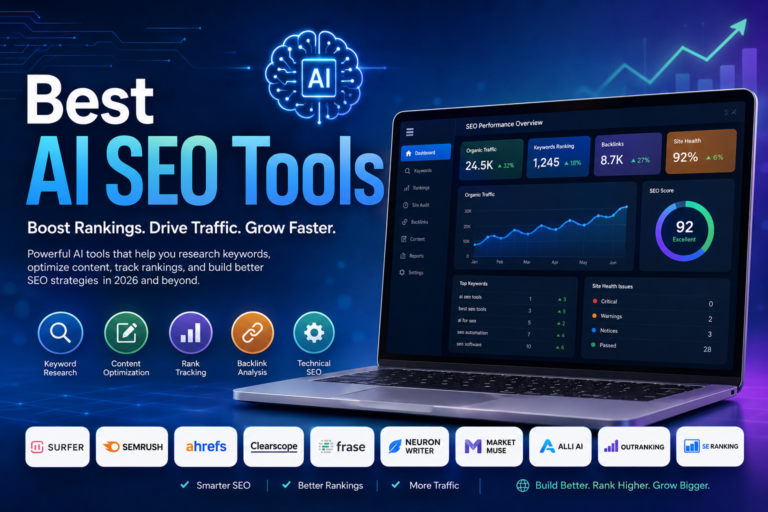
| Semrush | All-around SEO | Broad SEO + content ecosystem |
| Ahrefs | Advanced SEO research | SEO data + AI workflows |
| Surfer | Content optimization | Content-focused optimization |
| Alli AI | Large-scale implementation | On-page SEO automation |
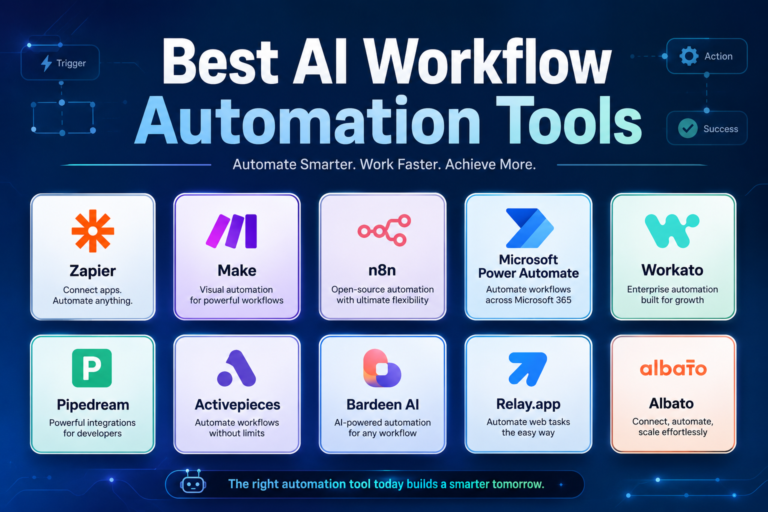
| Make | Custom workflows | Connecting tools and automating processes |
The recommendations below are based on current product capabilities and official documentation, rather than a controlled hands-on benchmark of every feature.
1. Semrush — Best Overall for an Integrated SEO Workflow
Semrush is the strongest overall option for users who want a broad SEO ecosystem rather than a single automation feature.
Its current platform combines SEO research, technical auditing, competitive analysis, content workflows, and AI-search visibility. Its Content Toolkit connects topic research, SEO briefs, AI-assisted article creation, optimization, repurposing, and publishing.
Best for
- SEO teams
- Agencies
- Content marketers
- Businesses
- Websites managing multiple SEO workflows
Why it stands out
The biggest advantage is breadth.
A workflow can move from:
Topic research
↓
Keyword research
↓
Competitor analysis
↓
Content brief
↓
Article
↓
Optimization
↓
Publishing
without requiring you to build every component yourself.
Semrush’s current AI Visibility Toolkit also focuses on tracking how brands appear in generative AI answers and comparing visibility against competitors.
Key capabilities
- Keyword research
- Competitor analysis
- Site auditing
- Rank tracking
- Backlink analysis
- Content briefs
- AI-assisted content creation
- Content optimization
- AI-search visibility
- Content repurposing
- Publishing integrations
Choose Semrush if
You want one broad platform covering a large part of the SEO workflow.
Consider another option if
You only need a narrow content-optimization workflow or want to build your own automation architecture from individual tools.
Bottom line
Semrush is the best overall fit for users who want an integrated SEO and content workflow rather than a collection of disconnected tools.
2. Ahrefs — Best for Advanced SEO Data and AI-Assisted Workflows
Ahrefs is particularly well suited to users who care deeply about SEO data, competitor research, technical analysis, and increasingly sophisticated AI-assisted workflows.
Its current AI feature set includes AI Content Helper, AI-powered keyword suggestions, search-intent analysis, AI Content Level, and other AI-assisted functionality depending on subscription level.
Ahrefs has also expanded its agent-style capabilities. In 2026, its updates described Ask Ahrefs as an embedded AI agent that can access the Ahrefs workspace, navigate tools, run API queries, and apply filters. Its Site Audit workflows also include Agent A functionality for investigating SEO issues.
Best for
- Advanced SEOs
- Agencies
- Large content teams
- Competitive research
- Data-heavy SEO workflows
Key capabilities
- Keyword research
- Competitor analysis
- Backlink research
- Site auditing
- Rank tracking
- Content research
- AI-assisted content workflows
- Search-intent analysis
- AI visibility analysis
- Agent-style workflows
Choose Ahrefs if
Your SEO decisions depend heavily on detailed competitive and search data.
Consider another option if
You mainly want an easy content-writing and optimization workflow and do not need a broad SEO data platform.
Bottom line
Ahrefs is a strong choice for advanced SEO practitioners who want deep data combined with increasingly capable AI workflows.
3. Surfer — Best for Content Optimization
Surfer is more focused on the content side of SEO.
It is particularly useful for websites that already have a publishing process and want additional help optimizing content around search intent, topic coverage, and competitive search data.
Best for
- Bloggers
- Content teams
- SEO writers
- Publishers
- Websites producing many SEO-focused articles
Key strengths
Surfer’s workflow is centered around:
Research → Create → Optimize → Audit → Improve
Its current product ecosystem includes content optimization, content audits, internal-link functionality, rank tracking, AI-assisted content creation, and AI-visibility features.
Choose Surfer if
Your biggest SEO problem is:
“We are producing content, but we need a better process for optimizing it.”
Consider another option if
Your primary requirement is deep backlink research, broad technical SEO, or a complete SEO data ecosystem.
Bottom line
Surfer makes the most sense when content optimization is the main bottleneck in your SEO workflow.
4. Alli AI — Best for Large-Scale On-Page SEO Automation
Alli AI takes a more specialized approach.
Instead of trying to replace every SEO platform, it focuses heavily on implementing and automating on-page SEO changes.
This becomes more interesting as a website grows.
Imagine managing hundreds or thousands of pages and repeatedly needing to make changes to:
- Metadata
- On-page elements
- Internal links
- SEO rules
- Technical recommendations
Manual implementation can become a bottleneck.
Alli provides automation functionality designed for this type of work. Its documentation includes SEO automation workflows and automated metadata functionality.
Best for
- Large websites
- SEO teams
- Agencies
- Repetitive on-page work
Choose Alli AI if
You have a large site and the problem is no longer identifying SEO opportunities but implementing repetitive changes at scale.
Consider another option if
You operate a small website where manual changes are still manageable.
Bottom line
Alli AI becomes more compelling as website size and repetitive on-page implementation increase.
5. Make — Best for Custom SEO Automation
Make is different from the other four tools.
It is not primarily an SEO platform.
It is an automation platform that can connect:
- AI models
- SEO tools
- WordPress
- Google Sheets
- Databases
- Analytics
- Communication tools
- APIs
- Other applications
For example:
New keyword opportunity
↓
AI analyzes keyword
↓
Creates structured brief
↓
Stores brief in database
↓
Notifies writer
↓
Draft enters review system
↓
Human approves
↓
Content moves to CMS
This type of workflow is where Make becomes useful.
Make’s current SEO automation material describes workflows covering keyword research, clustering, content briefs, on-page optimization, technical audits, internal linking, rank monitoring, and reporting.
Best for
- Technical marketers
- Agencies
- Automation-heavy teams
- Custom SEO operations
Choose Make if
You want to connect multiple applications into one customized workflow.
Consider another option if
You want an SEO platform that works out of the box without building your own automation logic.
Bottom line
Make is best viewed as the automation layer around your SEO stack, not as a replacement for an SEO data platform.
Which AI SEO Automation Tool Should You Choose?
Instead of asking:
“Which SEO tool is the best?”
ask:
“Which part of my SEO process is slowing me down?”
You want an all-around SEO platform
Choose Semrush.
It provides a broad combination of SEO research, technical SEO, content workflows, and AI-search capabilities.
You want advanced SEO data
Choose Ahrefs.
It is particularly suited to data-heavy SEO and competitive research workflows.
Your biggest problem is content optimization
Choose Surfer.
It is more focused on the content layer of SEO.
You manage a large website
Consider Alli AI.
Its value increases when repetitive on-page implementation becomes difficult to manage manually.
You want to build your own automation system
Choose Make.
Use it as the workflow layer connecting your SEO tools, AI models, CMS, databases, and reporting systems.
AI SEO Automation Decision Table
| Your situation | Recommended tool |
|---|---|
| Broad SEO platform | Semrush |
| Advanced SEO research | Ahrefs |
| Content optimization | Surfer |
| Large-scale on-page implementation | Alli AI |
| Custom multi-tool workflows | Make |
| Technical SEO ecosystem | Semrush or Ahrefs |
| AI-assisted SEO research | Ahrefs or Semrush |
| Content-focused workflow | Surfer |
| Custom WordPress automation | Make |
| Large repetitive on-page changes | Alli AI |
How to Automate SEO Content Creation
Let’s build a practical workflow.
Suppose your target topic is:
“best AI screen recording tools”
Do not begin with the article.
Begin with the research.
Step 1 — Research the Topic
Identify:
- Search demand
- Competition
- Related queries
- Search intent
- Audience
- Business relevance
Step 2 — Analyze the SERP
Study the current results.
Ask:
- What format dominates?
- What topics do ranking pages cover?
- What questions are common?
- What information is missing?
- What could make a new page genuinely more useful?
Step 3 — Create the Brief
Define:
- Primary topic
- Search intent
- Audience
- Content format
- Structure
- Questions
- Examples
- Competitor gaps
- Unique angle
- Internal links
- Sources
Step 4 — Generate the First Draft
AI can now create the first version using the research and brief.
Step 5 — Human Review
Review:
- Facts
- Claims
- Examples
- Recommendations
- Originality
- Clarity
- Repetition
- Usefulness
Step 6 — Optimize
Use SEO tools to identify possible improvements in:
- Structure
- Topic coverage
- Internal links
- Metadata
- Readability
- Search intent alignment
Step 7 — Publish
Move the approved content into your CMS.
Step 8 — Monitor
Track:
- Impressions
- Clicks
- CTR
- Rankings
- Organic traffic
- Conversions
Step 9 — Refresh
When the article becomes less competitive, analyze it again.
That creates a loop:
Research → Create → Publish → Measure → Improve
rather than:
Write → Publish → Forget
How to Automate Internal Linking With AI
Internal linking can become increasingly difficult as your site grows.
A practical system can work like this:
New article published
↓
AI analyzes its topics
↓
Existing pages are scanned
↓
Relevant relationships are identified
↓
Potential target pages are suggested
↓
Natural anchor text is proposed
↓
Human approves
↓
Links are added
The most important word here is potential.
AI should suggest links.
It should not blindly insert hundreds of links.
Good internal linking should improve:
- Navigation
- Topic relationships
- Context
- Discoverability
- User experience
How to Automate Content Refreshing
One of the most useful SEO automations is monitoring existing content.
Instead of continuously asking:
“What should we publish next?”
ask:
“Which existing pages could become more valuable?”
A monitoring workflow can identify pages with:
- Significant ranking declines
- Traffic losses
- Falling CTR
- Outdated information
- New competitors
- Missing topics
- Broken links
Example
Imagine an article moves from:
Position 4 → Position 11
and organic traffic falls by 30%.
An AI-assisted workflow could investigate:
- When did the decline begin?
- Did the SERP change?
- Did new competitors appear?
- Is the content outdated?
- Are important topics missing?
- Does the page still satisfy search intent?
- Are internal links sufficient?
- Does the title still accurately describe the page?
The result should be a refresh recommendation, not an automatic rewrite.
How to Build an AI SEO Agent
AI agents represent a more advanced stage of automation.
A traditional automation might look like:
Trigger → Action → Action → Action
An agent-oriented workflow is closer to:
Goal → Plan → Research → Decide → Act → Evaluate → Adjust
For example, imagine giving an SEO system the goal:
“Find important pages that lost organic visibility and prepare a prioritized recovery report.”
A sophisticated system could:
- Retrieve performance data.
- Identify declining pages.
- Compare historical performance.
- Analyze ranking changes.
- Examine current competitors.
- Identify potential content gaps.
- Generate recommendations.
- Prioritize the opportunities.
- Prepare a report for human approval.
This is different from asking an AI chatbot one question.
It is a multi-step workflow connected to data and tools.
Ahrefs has expanded in this direction with AI-assisted and agent-style functionality. Its 2026 updates describe Ask Ahrefs as an embedded agent capable of navigating the platform and running data queries, while Agent A can assist with investigating SEO issues.
The 3 Levels of SEO Automation
Level 1: AI-Assisted SEO
You use AI manually.
Example
AI chatbot + Search Console + WordPress
You still perform most actions yourself, but AI accelerates:
- Research
- Brainstorming
- Analysis
- Outlines
- Drafting
- Reporting
Best for
- Beginners
- Small websites
- Solo publishers
Level 2: Automated SEO Workflows
Different applications communicate automatically.
Example
SEO platform + AI + Make + WordPress
A workflow might automatically:
- Detect an opportunity
- Generate a brief
- Store it in a database
- Notify a writer
- Prepare a draft
- Send it for approval
Best for
- Growing websites
- Agencies
- Content teams
Level 3: Agentic SEO
AI systems can work through more complex multi-step objectives using connected data and tools.
Example
SEO data + AI agent + CMS + analytics + approval system
The system can investigate problems, create recommendations, perform selected actions, and report the results.
Best for
- Large websites
- SEO teams
- Agencies
- Complex operations
But more autonomy also means more risk.
The larger the consequences of an automated action, the stronger your approval and monitoring system should be.
What You Should NOT Fully Automate
This may be the most important part of an AI SEO strategy.
AI can perform many repetitive tasks.
That does not mean it should make every important SEO decision.
1. Don’t Fully Automate Keyword Strategy
AI can identify opportunities.
You decide which opportunities matter to your business.
2. Don’t Fully Automate Brand Positioning
Your brand’s positioning, tone, and differentiation should not be delegated blindly to an algorithm.
3. Don’t Fully Automate Important Claims
Verify important facts, statistics, product claims, and expert statements.
An AI-generated sentence can sound authoritative while being incorrect.
4. Don’t Fully Automate Product Recommendations
A product appearing frequently in competitor articles does not automatically make it the right recommendation.
Recommendations should have a clear reason.
5. Don’t Fully Automate Sensitive Topics
Topics involving health, finance, safety, legal issues, or other high-consequence decisions require particularly careful review.
6. Don’t Automatically Publish Everything
A safer workflow is:
AI → Draft → Human review → Approval → Publish
rather than:
AI → Publish
Google’s people-first guidance emphasizes accuracy, expertise, trust, and useful content, while its AI guidance warns against generating large amounts of unoriginal pages without meaningful added value.
How Much SEO Can You Actually Automate?
There is no universal percentage.
It depends on:
- Website size
- Industry
- Content volume
- Team size
- Technical resources
- Tool integrations
- Risk tolerance
- Quality standards
A small website might automate:
- Keyword organization
- Reporting
- Rank alerts
- Content briefs
- Some optimization
while keeping content creation and publishing heavily supervised.
A large organization might automate significantly more.
But the best question is not:
“What percentage of SEO can I automate?”
Instead ask:
“Which repetitive SEO tasks consume the most time without requiring strategic judgment?”
Start with those.
Common AI SEO Automation Mistakes
1. Automating Everything
AI can perform a task without that task being a good candidate for full automation.
Automation should serve the process.
Not replace thinking.
2. Publishing Hundreds of Generic Articles
More pages do not automatically mean more value.
Google specifically warns against scaled content created primarily to manipulate search rankings rather than help users.
3. Using AI Without Search Intent
An article can be technically well written while answering the wrong question.
4. Copying Competitors With AI
Competitor analysis should reveal:
What exists → What is missing → What can we improve?
It should not become:
Copy → Rewrite → Publish.
5. Optimizing for an SEO Score
An optimization score is a diagnostic.
It is not a ranking guarantee.
6. Ignoring Existing Content
Your next SEO opportunity may already exist on your website.
7. Automating Internal Links Without Review
Irrelevant links can hurt user experience and create a poor site architecture.
8. Trusting AI-Generated Facts
Always verify important claims.
9. Confusing AI Content With AI SEO
Generating an article is only one part of SEO.
A real SEO process can include:
Research + Strategy + Content + Technical SEO + Internal Linking + Measurement + Updating
AI SEO Automation vs. Traditional SEO
| Traditional process | AI-assisted automation |
|---|---|
| Manual keyword research | AI-assisted keyword discovery |
| Manual clustering | Automated clustering |
| Manual intent classification | AI-assisted intent analysis |
| Manual SERP review | AI-assisted SERP analysis |
| Manual content briefs | AI-generated briefs |
| Manual first drafts | AI-assisted drafting |
| Manual optimization | AI recommendations |
| Manual link discovery | AI link suggestions |
| Manual rank monitoring | Automated monitoring |
| Manual reporting | Automated reporting |
| Periodic content reviews | Continuous monitoring |
| Human performs most repetitive tasks | Human supervises important decisions |
The objective is not to eliminate SEO professionals.
It is to eliminate unnecessary repetitive work.
The Best AI SEO Stack for Different Users
You do not need every SEO tool.
A simple stack is often better than a complicated one.
Beginner SEO stack
AI assistant + Google Search Console + WordPress + one SEO plugin
Focus on learning:
- Search intent
- Keyword research
- Content quality
- Internal linking
- Technical basics
Do not automate everything immediately.
Intermediate stack
Semrush or Ahrefs + AI + WordPress + Make
Automate selected workflows such as:
- Research
- Brief creation
- Reporting
- Content monitoring
- Internal-link discovery
Advanced stack
Ahrefs or Semrush + AI workflows + Make + WordPress + analytics
Build more sophisticated processes around:
- Content gaps
- Content refreshes
- Technical issues
- Internal linking
- Rank monitoring
- Reporting
- Editorial workflows
How to Start Automating SEO Today
You do not need an AI agent or a dozen integrations to start.
Start with one repetitive task.
Step 1: Choose one repetitive task
For example:
“I spend two hours every week preparing SEO reports.”
Step 2: Document the current process
Write down every step.
Step 3: Separate judgment from repetition
Ask:
- Which steps require expertise?
- Which steps simply move or organize data?
Step 4: Automate the repetitive steps
Use your existing tools first.
Step 5: Keep approval points
Do not automate high-risk decisions immediately.
Step 6: Measure the result
Track:
- Time saved
- Errors
- Quality
- Output
- Business impact
Step 7: Improve the workflow
Remove unnecessary steps.
Step 8: Automate the next bottleneck
Only after the first workflow works reliably.
This approach is usually better than attempting to automate your entire SEO operation at once.
Frequently Asked Questions
Can AI automate SEO completely?
No—not reliably or responsibly for most websites.
AI can automate or accelerate a large amount of repetitive SEO work, including research, clustering, reporting, monitoring, content preparation, and optimization suggestions.
However, strategy, factual verification, quality control, originality, and important publishing decisions still benefit from human oversight.
What is the best AI SEO automation tool in 2026?
There is no single winner for every situation.
Semrush is the strongest overall choice for users who want a broad SEO and content ecosystem.
Ahrefs is particularly attractive for advanced SEO data and AI-assisted workflows.
Surfer is more focused on content optimization.
Alli AI is more specialized in large-scale on-page implementation.
Make is best when you want to build custom workflows connecting multiple applications.
Can AI automate keyword research?
Yes.
AI can help discover, expand, classify, cluster, and prioritize keyword opportunities.
But final keyword selection should consider:
- Search intent
- Competition
- Business relevance
- Existing website authority
- Conversion potential
- Audience needs
Can AI automate content creation?
Yes.
AI can assist with:
- Research
- Outlines
- Briefs
- Drafting
- Optimization
- Repurposing
But fully automated publishing can create quality problems if the output is generic, inaccurate, repetitive, or lacks meaningful original value.
Can AI automate internal linking?
Yes.
AI can identify potentially relevant pages and suggest anchor text.
Human review is recommended before important links are automatically added.
Can AI automatically update old SEO content?
It can help identify pages that may need updating and prepare suggested changes.
A good workflow is:
Detect → Analyze → Recommend → Review → Update → Monitor
rather than:
Detect → Automatically rewrite everything.
What is agentic SEO?
Agentic SEO refers to using AI systems capable of handling multi-step SEO objectives through connected tools and data.
Instead of answering one question, an agent-oriented system can potentially:
Plan → Research → Analyze → Act → Evaluate
with appropriate permissions and oversight.
Is AI SEO the same as AI content generation?
No.
AI content generation is one component of AI-assisted SEO.
AI SEO automation can also include:
- Keyword research
- Search-intent analysis
- SERP analysis
- Content briefs
- Technical auditing
- Internal linking
- Rank monitoring
- Reporting
- Content refreshing
- AI-search visibility analysis
Final Verdict
The biggest change in SEO automation is not simply that AI can write articles faster.
The more important change is that AI can increasingly participate in multi-step SEO workflows.
The old model was:
Person → Tool → Result
The emerging model is:
Goal → Research → Analysis → Action → Monitoring → Human approval
That can make SEO operations substantially more efficient.
But there is a major difference between automating SEO and automating content production.
The first can improve a good process.
The second can easily produce a large amount of mediocre content.
Google’s current guidance consistently points toward helpful, reliable, people-first content, original analysis, substantial value, and accurate information. Google’s guidance also makes clear that AI assistance itself is not the central issue; the problem is using automation to produce unhelpful or unoriginal content at scale.
Our 2026 Picks
Best Overall: Semrush
Best for users who want a broad SEO ecosystem covering research, technical SEO, content workflows, optimization, and AI-search visibility.
Best for Advanced SEO Data: Ahrefs
Best for advanced SEO research, competitive analysis, and increasingly sophisticated AI-assisted workflows.
Best for Content Optimization: Surfer
Best when content optimization is the primary SEO bottleneck.
Best for Large-Scale On-Page Automation: Alli AI
Best suited to websites where repetitive on-page implementation has become difficult to manage manually.
Best for Custom SEO Automation: Make
Best when you want to connect AI, SEO platforms, WordPress, databases, analytics, and other applications into customized workflows.
Automate the repetitive work. Keep humans responsible for strategy, accuracy, originality, and decisions that matter.
That is the most useful way to think about AI SEO automation in 2026.
Methodology and Sources
This article was reviewed and updated using current product documentation from the tools discussed and Google’s current Search and AdSense guidance.
The tool comparison is based on publicly documented capabilities and intended use cases. It is not presented as a controlled hands-on benchmark, and feature availability can vary by plan, region, and product changes.
For SEO quality, the article follows Google’s current emphasis on people-first content, originality, accuracy, useful analysis, clear authorship, and meaningful value rather than arbitrary word counts or mass-produced pages.
Official resources
- Google Search Central — Helpful, Reliable, People-First Content
- Google Search Central — Generative AI Content Guidance
- Google Search Central — Spam Policies
- Google AdSense — Make Sure Your Site Is Ready
- Semrush Content Toolkit
- Ahrefs AI Features
- Make SEO Automation Guide