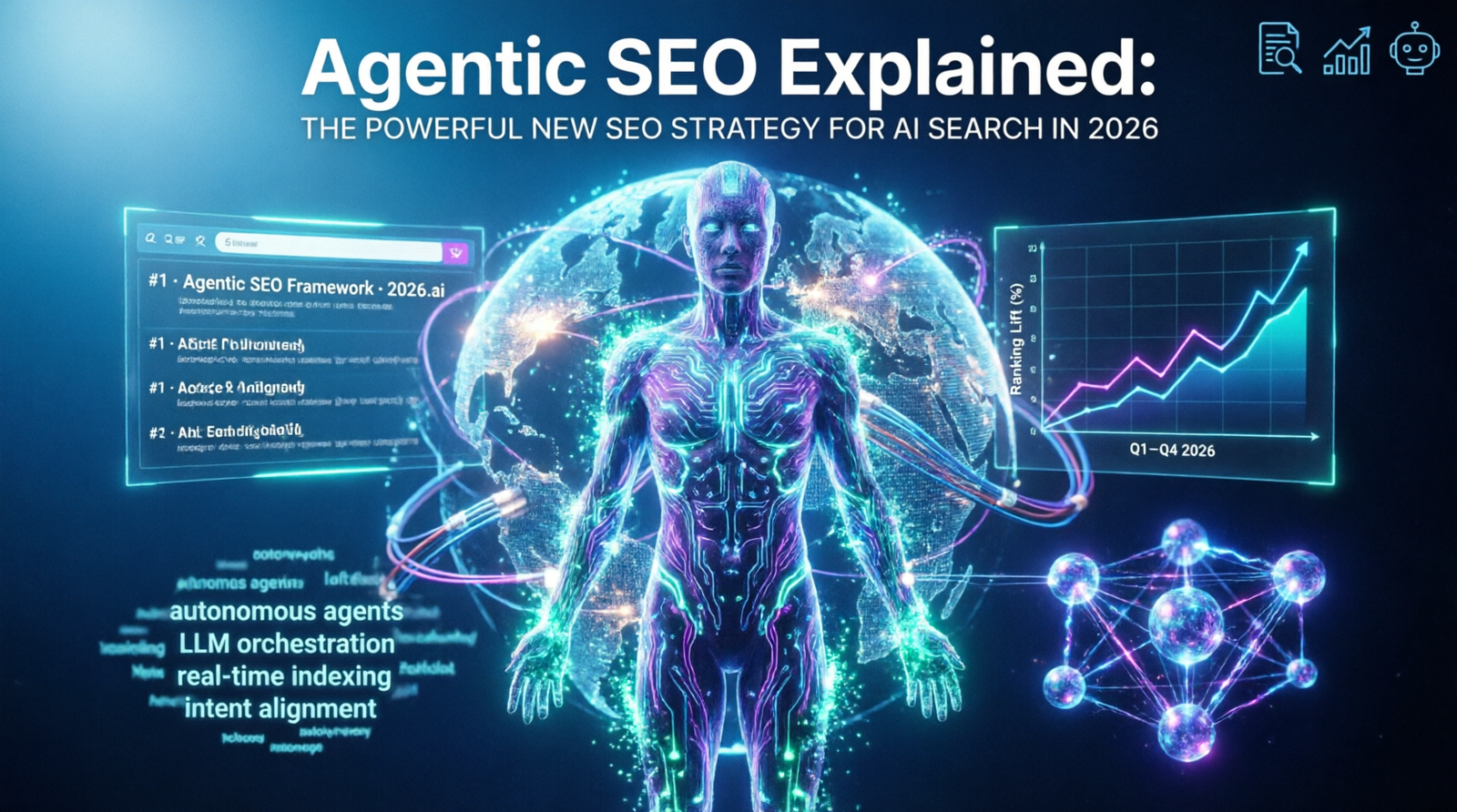
Agentic SEO Explained in 2026: How AI Agents Are Changing SEO
Updated September 13, 2026
SEO is entering a new phase.
Search engines are becoming more capable of understanding complex questions, while AI agents can increasingly perform multi-step tasks such as researching data, analyzing websites, monitoring performance, and preparing recommendations.
That creates an important distinction.
AI search optimization is about helping your website remain useful and discoverable as search becomes more AI-driven.
Agentic SEO is about using AI agents to perform parts of the SEO workflow.
These ideas overlap, but they are not the same thing.
Google’s current guidance for generative AI search continues to emphasize established SEO fundamentals, useful and original content, technical accessibility, and content that provides real value rather than commodity information.
At the same time, SEO platforms such as Ahrefs are using the term agentic SEO to describe workflows in which AI agents can plan tasks, use tools, analyze results, adapt their next steps, and return recommendations or completed work instead of simply generating text.
This guide explains what agentic SEO actually means, how it differs from traditional SEO and AI search optimization, what you can realistically automate, and how to use AI agents without sacrificing accuracy or quality.
Key Takeaways
- Agentic SEO is not a Google ranking factor.
- It generally means using AI agents to perform or coordinate multi-step SEO work.
- Agentic SEO is different from optimizing content for AI-powered search experiences.
- Google says traditional SEO fundamentals continue to matter for AI-powered Search.
- AI agents can help with research, audits, monitoring, analysis, and workflow execution.
- Human review is still important, especially for recommendations, publishing, and high-impact changes.
llms.txtis not required for Google Search and should not be treated as an SEO shortcut.- Google’s new Search Console generative AI performance report can now help site owners monitor impressions from AI Overviews and AI Mode.
- The best use of agentic SEO is not producing more content. It is improving the quality, maintenance, and efficiency of SEO work.
Table of Contents
- What Is Agentic SEO?
- Agentic SEO vs AI Search Optimization
- How Agentic SEO Differs From Traditional SEO
- What Can an SEO Agent Actually Do?
- 10 Practical Agentic SEO Workflows
- How AI Agents Should Be Used in Content Creation
- Why Originality Matters More Than Ever
- What About AI Overviews and AI Mode?
- What About llms.txt?
- How to Measure AI Search Visibility
- E-E-A-T and First-Hand Experience
- 10 Agentic SEO Mistakes to Avoid
- A Practical 30-Day Agentic SEO Plan
- When Should You Use Agentic SEO?
- Is Agentic SEO the Future?
- Frequently Asked Questions
- Final Verdict
What Is Agentic SEO?
Agentic SEO is the use of AI agents to perform, coordinate, monitor, or adapt multi-step SEO workflows.
The important word is workflow.
A normal AI-assisted SEO task might look like:
“Give me 20 keyword ideas for an article about AI image generators.”
An agentic task is more ambitious:
“Find pages on my website that have lost organic visibility, investigate possible causes, compare relevant competitors, prioritize the problems, and prepare recommendations for review.”
The second task requires several steps.
The agent may need to:
- collect data,
- analyze it,
- decide what to investigate next,
- use additional tools,
- compare results,
- form a recommendation,
- and return an output.
This is what makes agentic workflows different from simple AI content generation.
A simplified workflow looks like this:
Goal
  ↓
AI Agent
  ↓
Plan the task
  ↓
Use SEO tools and data
  ↓
Analyze results
  ↓
Decide what to investigate next
  ↓
Prepare recommendations or actions
  ↓
Human review
The exact architecture can vary.
An agent may work alone, use several specialized tools, or coordinate with other agents. The important characteristic is that it can handle a sequence of related decisions rather than simply producing one response.
Ahrefs describes agentic SEO as applying AI agents to SEO workflows so they can act, adapt, and recover, rather than simply generate text.
However, this does not mean that SEO can now be placed on autopilot.
AI agents can make incorrect assumptions, misunderstand data, miss important context, or fail during long workflows. Human review remains especially important when the output affects publishing, client work, technical changes, or business decisions.
Agentic SEO vs AI Search Optimization
These concepts are related but should not be treated as synonyms.
Agentic SEO
Agentic SEO focuses on how SEO work is performed.
Examples include:
- auditing a website,
- analyzing Search Console data,
- finding declining pages,
- researching competitors,
- identifying content gaps,
- monitoring technical issues,
- preparing content briefs,
- updating information,
- organizing internal-link opportunities,
- and preparing optimization recommendations.
AI Search Optimization
AI search optimization focuses on how your website is understood and surfaced in AI-powered search experiences.
This includes creating content that is:
- useful,
- original,
- accurate,
- easy to understand,
- technically accessible,
- well structured,
- and relevant to complex user questions.
Google’s current documentation treats optimization for generative AI features as an extension of established Search practices rather than requiring a completely separate SEO system.
A simple way to visualize the difference is:
                  Modern SEO
                      │
             ┌────────┴────────┐
             ↓                 ↓
      AI Search Visibility   Agentic SEO
             │                 │
             ↓                 ↓
     How content is found    How SEO work
     and understood          gets performed
You can use both approaches at the same time.
How Agentic SEO Differs From Traditional SEO
Traditional SEO still matters.
What changes is how many of the repetitive or analytical steps can be delegated to software.
| Traditional SEO | Agentic SEO |
|---|---|
| Human performs most research | Agent can perform parts of research |
| Human checks data manually | Agent can analyze large datasets |
| SEO tools produce reports | Agent can interpret reports and prioritize issues |
| Automation follows predefined rules | Agents can adapt their next step |
| Content briefs are prepared manually | Agents can gather information and prepare briefs |
| Monitoring is often scheduled | Agents can investigate changes |
| Human makes most recommendations | Agent can prepare recommendations for review |
This does not mean agentic SEO replaces traditional SEO.
A better way to understand the relationship is:
Traditional SEO defines what a good website needs. Agentic SEO can change how efficiently you perform the work.
Google continues to emphasize SEO fundamentals for its generative AI Search experiences.
What Can an SEO Agent Actually Do?
An SEO agent can potentially work across several areas.
Research
An agent can help:
- collect keyword ideas,
- classify search intent,
- analyze competing pages,
- identify content gaps,
- summarize research,
- organize findings.
Content
An agent can help:
- create content briefs,
- identify missing sections,
- compare competing articles,
- suggest internal links,
- detect outdated information,
- prepare draft updates.
Technical SEO
Depending on the tools and permissions available, an agent can help investigate:
- broken links,
- indexing problems,
- redirects,
- metadata,
- sitemap issues,
- duplicate pages,
- large numbers of URLs.
Monitoring
An agent can monitor:
- traffic changes,
- ranking changes,
- Search Console data,
- technical alerts,
- content freshness,
- competitor changes.
Analysis
An agent can investigate questions such as:
“Which pages lost the most organic traffic?”
or:
“Which articles have high impressions but unusually low click-through rates?”
The important distinction is that the agent is not merely displaying the data.
It can potentially interpret the data and determine what should be investigated next.
That is where agentic workflows become more useful than simple scheduled reports.
10 Practical Agentic SEO Workflows
You do not need a sophisticated multi-agent system to benefit from agentic SEO.
Start with narrow workflows.
1. Find Pages Losing Traffic
Give an agent access to appropriate Search Console or analytics data.
Ask it to:
- identify significant declines,
- group affected URLs,
- compare historical performance,
- investigate possible causes,
- rank the pages by priority,
- prepare recommendations.
The agent should not automatically rewrite every declining page.
A traffic decline can have many causes, including seasonality, changing search demand, technical problems, competition, or algorithmic changes.
The goal is investigation, not automatic conclusions.
2. Find Outdated Content
An agent can review an article and identify information that may require verification.
For example:
- outdated product features,
- old pricing,
- discontinued tools,
- obsolete statistics,
- old screenshots,
- broken references.
The agent can create an update checklist.
A human should verify important claims against current primary sources before publication.
3. Build Internal-Link Opportunities
Suppose your website has 300 articles.
An agent can analyze relationships between pages and suggest contextual internal links.
For example:
Article A discusses AI agents.
Article B explains MCP.
The agent may recommend connecting them because readers interested in AI agents may benefit from understanding MCP.
The recommendation should be based on meaning, not simply keyword matching.
4. Audit Content Quality
An agent can review pages for:
- weak introductions,
- repetitive sections,
- unsupported claims,
- missing explanations,
- unclear recommendations,
- outdated information,
- poor structure.
This is useful as a first-pass audit.
It should not replace editorial judgment.
5. Create Content Briefs
Instead of asking AI:
“Write an article about AI SEO tools.”
Use an agent to first investigate:
- the search intent,
- competing pages,
- important subtopics,
- user questions,
- official documentation,
- product differences,
- missing information.
Then create the brief.
The writer—or another AI workflow—can use that research to create the article.
6. Monitor Technical Problems
An agent can periodically review technical SEO data and flag:
- sudden increases in 404 errors,
- unexpected indexing changes,
- broken internal links,
- redirect problems,
- sitemap anomalies.
The agent can then prepare an explanation and proposed next steps.
7. Analyze Competitors
An agent can compare selected competitor pages for:
- content depth,
- structure,
- topics covered,
- unique information,
- internal linking,
- product comparisons,
- supporting evidence.
The goal should not be to copy competitors.
The goal is to identify:
What information is missing from our page?
8. Monitor Content Freshness
For fast-changing subjects such as AI tools, an agent can create a list of pages that may need review.
For example:
Page
↓
Last verified
↓
Features changed?
↓
Pricing changed?
↓
Screenshots outdated?
↓
Sources still valid?
↓
Update required?
This can turn content maintenance into a repeatable process.
9. Generate Optimization Recommendations
An agent can combine:
- Search Console data,
- analytics,
- content information,
- crawl data,
- competitor research.
It can then produce a prioritized list such as:
Priority 1
Update article X
Reason: declining clicks + outdated information

Priority 2
Improve article Y
Reason: strong impressions + weak CTR

Priority 3
Merge articles A and B
Reason: overlapping search intent
This is much more useful than receiving a 50-page SEO report that nobody reads.
10. Prepare Changes for Human Approval
This is one of the safest ways to introduce agentic SEO.
Instead of:
Agent → Website
use:
Agent
  ↓
Analyze
  ↓
Prepare changes
  ↓
Human review
  ↓
Approve
  ↓
Publish
The human remains responsible for important decisions while the agent handles repetitive preparation work.
How AI Agents Should Be Used in Content Creation
One of the biggest mistakes is treating agentic SEO as a content factory.
It is not.
An agent can help with research, organization, comparison, and maintenance.
But simply asking an agent to create thousands of articles is not a sustainable SEO strategy.
Google’s spam policies specifically describe scaled content abuse as producing many pages primarily to manipulate search rankings rather than help users. The policy applies regardless of whether the content was produced by AI or another method.
The important question is therefore not:
“Was AI used?”
A better question is:
“Does this page provide substantial value that justifies its existence?”
AI can be part of a high-quality workflow.
For example:
Human identifies topic
        ↓
Agent researches sources
        ↓
Agent analyzes competing information
        ↓
Human adds expertise / testing
        ↓
AI assists with organization
        ↓
Human verifies claims
        ↓
Editorial review
        ↓
Publish
This is fundamentally different from:
Keyword
 ↓
AI article
 ↓
Publish
Why Originality Matters More Than Ever
If ten websites publish essentially the same AI-generated explanation, creating an eleventh version adds little value.
The stronger opportunity is to add information that is difficult to obtain from a generic summary.
That could include:
- original testing,
- screenshots,
- practical examples,
- documented methodology,
- first-hand observations,
- transparent comparisons,
- specific limitations,
- updated pricing checks,
- unique data,
- original research,
- or a clearly explained point of view.
For example:
Weak
Tool X is a powerful AI SEO platform with many useful features.
Better
Tool X is particularly useful for teams that need automated reporting, but its more advanced features may be unnecessary for individuals managing only a few websites.
The second statement helps the reader make a decision.
That is the kind of value that generic content often fails to provide.
Google’s current guidance for generative AI Search specifically emphasizes unique, non-commodity content rather than trying to optimize through special AI markup or artificial content formats.
What About AI Overviews and AI Mode?
Google’s AI-powered Search experiences have changed how users can discover information.
Instead of receiving only a traditional list of links, users may see an AI-generated response that synthesizes information from multiple sources.
That means a website should focus on making its information:
- accurate,
- clear,
- useful,
- crawlable,
- well organized,
- and supported by evidence where appropriate.
There is no reliable shortcut that guarantees inclusion in an AI-generated answer.
Google’s own guidance emphasizes continuing to follow established SEO practices while creating valuable, original content.
This leads to an important principle:
Optimize for usefulness first, not for an imagined AI-specific ranking trick.
What About llms.txt?
llms.txt has received substantial attention in the AI and SEO community.
The idea is to provide information in a format intended to help AI systems understand a website.
But you should distinguish between an industry experiment and a Google Search requirement.
Google’s current documentation explicitly says that llms.txt is not required for Google Search, including Google’s generative AI Search features. Google also says that creating the file does not provide a special visibility or ranking benefit in Search.
That does not prevent a website owner from experimenting with the format for other systems.
But it should not be your priority.
If your website has:
- thin content,
- outdated information,
- weak internal linking,
- indexing problems,
- duplicate topics,
- poor page structure,
fix those issues first.
A special text file cannot compensate for weak content.
How to Measure AI Search Visibility
Traditional SEO metrics remain important:
- impressions,
- clicks,
- CTR,
- average position,
- organic traffic,
- conversions.
But Google now provides a more direct measurement layer for generative AI Search.
As of August 31, 2026, Google says its Generative AI Performance Report has rolled out to websites worldwide. The report provides data about impressions from generative AI features in Google Search, including AI Overviews and AI Mode.
You can use it to investigate:
- how generative AI impressions change over time,
- which pages receive the most impressions,
- which pages receive the least,
- where impressions originate,
- and how performance differs across dimensions such as country and device.
This is much more useful than relying entirely on screenshots of occasional AI searches.
A Practical AI Search Visibility Framework
Use three measurement layers.
Layer 1: Traditional Search
Track:
- impressions,
- clicks,
- CTR,
- average position,
- indexed pages,
- organic traffic.
Layer 2: Business Results
Track:
- affiliate clicks,
- leads,
- signups,
- conversions,
- revenue,
- engaged sessions.
Layer 3: Generative AI Search
Monitor:
- AI Overview impressions,
- AI Mode impressions,
- pages receiving AI-generated-search impressions,
- changes over time,
- queries and topics where your content performs.
You can also manually test important questions across relevant AI systems.
But treat manual testing as qualitative research rather than a perfect ranking measurement.
Ask:
Does the system understand what my website is about?
Is my site cited or linked where relevant?
Is the information represented accurately?
Which competitors appear repeatedly?
What information are those competitors providing that I am missing?
That is more useful than obsessing over whether your brand appeared in one AI answer on one day.
E-E-A-T and First-Hand Experience
AI-generated explanations are becoming easier to produce.
That makes evidence of real experience increasingly valuable.
For AI tools and SEO software, useful evidence can include:
- screenshots,
- original testing,
- documented evaluation criteria,
- feature verification,
- real examples,
- workflow demonstrations,
- observed limitations,
- current pricing checks,
- transparent methodology.
For example, instead of writing:
“Tool X is the best AI writing platform.”
explain:
“We recommend Tool X for teams that need brand-focused workflows because of X and Y. Its main limitation is Z.”
That gives the recommendation a reason.
If you test products yourself, say what you tested and when.
If you rely on official documentation rather than first-hand testing, make that clear too.
Transparency is more useful than pretending to have experience you do not have.
Build Topic Clusters Instead of Isolated Articles
A website about AI should not look like a random collection of unrelated posts.
It should form a connected knowledge base.
For example:
AI Agents
    │
    ├── MCP
    │
    ├── A2A
    │
    ├── Agent Memory
    │
    ├── Multi-Agent AI
    │
    └── Agentic SEO
Each article should have a clear purpose.
An article about agentic SEO can naturally connect to an article explaining AI agents.
An article about AI agents can explain why communication protocols such as MCP or A2A matter.
This improves navigation and gives readers a logical path through the subject.
Internal links should therefore explain why the next page is relevant, rather than simply saying “read more.”
10 Agentic SEO Mistakes to Avoid
1. Treating Agentic SEO as a Google Ranking Factor
There is no official Google ranking factor called “Agentic SEO.”
It is an industry term describing a way of performing SEO work.
2. Assuming AI Agents Are Always More Efficient
An agent may save time on repetitive tasks.
But poorly designed workflows can create additional checking and correction work.
Use agents where they genuinely reduce effort.
3. Publishing Large Quantities of AI Content
Generating hundreds of pages without adding meaningful value can create serious quality and spam risks.
Google’s scaled-content-abuse policy specifically covers large quantities of unoriginal pages created primarily to manipulate Search.
4. Treating llms.txt as an SEO Shortcut
Google says llms.txt is not needed for Google Search and does not provide a special ranking or visibility advantage.
5. Letting Agents Make Unsupported Conclusions
An agent can identify a correlation.
That does not mean it has proved the cause.
For example:
“Traffic dropped, therefore Google penalized this page.”
That conclusion may be completely wrong.
Require evidence before turning an agent’s hypothesis into a decision.
6. Removing Human Review
For low-risk research tasks, automation may be appropriate.
For publishing, technical changes, client recommendations, or business-critical decisions, human review is often worth keeping.
7. Copying Competitors With AI
Competitive research should help you identify missing information.
It should not become a mechanism for rewriting competitors in different words.
8. Inventing Experience
Never claim:
“We tested all 20 tools”
if you did not.
Never invent screenshots, test results, prices, or performance statistics.
If information comes from documentation or secondary research, identify it appropriately.
9. Ignoring Content Maintenance
AI products change quickly.
Features, pricing, integrations, models, and limitations can become outdated.
An SEO strategy should therefore include maintenance, not just publishing.
10. Measuring Only Rankings
Rankings are useful, but they are not the entire business outcome.
Also measure:
- traffic,
- conversions,
- revenue,
- engagement,
- content usefulness,
- and, where available, visibility in generative AI Search.
A Practical 30-Day Agentic SEO Plan
You do not need to rebuild your entire website.
Start small.
Week 1: Audit
Select 10 important pages.
Look for:
- declining traffic,
- outdated information,
- weak introductions,
- duplicate search intent,
- missing internal links,
- unsupported claims,
- thin sections,
- broken links,
- outdated screenshots.
Use an AI agent to organize the findings, but verify important conclusions yourself.
Week 2: Improve Existing Pages
For each priority page:
- answer the main question earlier,
- remove generic introductions,
- add useful examples,
- verify important claims,
- add primary sources,
- improve internal links,
- update outdated information,
- explain limitations,
- improve recommendations,
- add original observations where available.
Do not increase word count simply to make the article longer.
Make it more useful.
Week 3: Build Topic Connections
Map related articles.
For example:
AI Agents
    ↓
MCP
    ↓
A2A
    ↓
Multi-Agent AI
    ↓
Agentic SEO
Then add contextual internal links where they genuinely help the reader.
Week 4: Establish a Baseline
Choose 20–30 realistic questions related to your site’s topics.
Track:
- traditional Search performance,
- Google generative AI impressions where available,
- which pages perform best,
- competitor visibility,
- important content gaps.
Then repeat the analysis after additional content improvements.
The objective is not to manufacture mentions.
It is to understand whether your website is becoming a better source of information.
When Should You Use Agentic SEO?
Agentic SEO is most useful when a task has several steps and requires some degree of investigation or adaptation.
Good candidates
- large content audits,
- internal-link analysis,
- technical monitoring,
- content freshness checks,
- competitor research,
- Search Console analysis,
- content-gap research,
- recurring reporting,
- large-scale data analysis.
Poor candidates
- publishing content without review,
- making major technical changes automatically,
- interpreting ambiguous traffic changes without evidence,
- generating hundreds of similar articles,
- replacing human expertise with generic AI output.
A useful rule is:
Automate the process where possible, but keep responsibility for important decisions.
Is Agentic SEO the Future?
Agentic SEO is likely to become a more important part of how SEO professionals work.
But the most useful future is not:
AI replaces SEO professionals.
It is closer to:
SEO professionals use increasingly capable agents to investigate, execute, monitor, and maintain more complex workflows.
At the same time, search itself is becoming more AI-driven.
That creates two parallel changes:
Change 1
Search becomes more AI-powered
        ↓
Websites need useful, understandable,
well-supported information

Change 2
SEO workflows become more agentic
        ↓
Professionals can delegate more
research, analysis, and maintenance
These changes reinforce each other.
But neither eliminates the fundamentals.
Frequently Asked Questions
What is Agentic SEO?
Agentic SEO is an emerging term for using AI agents to perform, coordinate, monitor, and adapt SEO workflows. The term is not an official Google ranking factor. Ahrefs uses it to describe applying AI agents to SEO workflows so they can act and adapt instead of simply generating text.
Is Agentic SEO a Google ranking factor?
No.
There is no official Google ranking factor called “Agentic SEO.”
Google’s guidance focuses on established SEO practices, technical accessibility, and useful content for its generative AI Search experiences.
Is Agentic SEO the same as GEO?
Not exactly.
GEO, or Generative Engine Optimization, is generally used to describe efforts intended to improve visibility in generative AI experiences.
Agentic SEO generally describes using AI agents to perform SEO work.
The terminology is still evolving, so definitions can differ between practitioners.
Should I create an llms.txt file?
You can experiment with it for systems that support the format, but it is not required for Google Search.
Google currently says llms.txt does not provide a special visibility or ranking benefit in Google Search.
Does AI-generated content hurt SEO?
Not automatically.
Google’s guidance focuses on the value and quality of the resulting content. However, generating large numbers of pages without adding value can fall under Google’s scaled-content-abuse policy.
Can AI agents replace SEO professionals?
Not reliably.
Agents can automate research, analysis, monitoring, and other workflow steps, but they can also make incorrect assumptions or miss context.
Human judgment remains important for high-impact decisions.
How can I measure performance in Google’s AI search?
Google’s Search Console now includes a Generative AI Performance Report for Search. As of August 31, 2026, Google says the report has rolled out worldwide and includes impressions from AI Overviews and AI Mode.
Should I optimize for AI instead of humans?
No.
Create content that is useful to your audience first.
Clear structure, accurate information, direct answers, useful examples, and strong technical foundations can help both human readers and systems that process web content.
What should I improve first?
Start with your existing important pages.
Prioritize:
- usefulness,
- originality,
- accuracy,
- first-hand evidence,
- internal linking,
- outdated information,
- decision-making value,
- technical accessibility.
Only then should you focus heavily on producing more pages.
Final Verdict
Should You Start Using Agentic SEO in 2026?
Yes—but use it as a workflow strategy, not an SEO hack.
AI agents can increasingly handle parts of SEO research, analysis, monitoring, and maintenance.
At the same time, Google’s search experience is becoming more AI-driven.
But neither development changes the fundamental reason a website succeeds:
It provides useful information that deserves to be discovered.
The old mindset was:
“How do I rank this keyword?”
A better mindset is:
“How do I become one of the most useful sources for this problem?”
And the strongest question is:
“If someone needs to understand this topic, is my website one of the clearest, most useful, accurate, and trustworthy places they can go?”
That is where agentic SEO becomes valuable.
Use AI agents to:
- research faster,
- analyze more data,
- monitor more pages,
- identify problems,
- maintain content,
- and prepare better recommendations.
But keep humans responsible for:
- important judgments,
- factual verification,
- original insights,
- publishing decisions,
- and the quality of the final product.
Don’t chase every new AI SEO acronym.
Don’t publish hundreds of interchangeable pages.
Don’t rely on llms.txt as a shortcut.
Don’t confuse automation with expertise.
Instead:
Create original information.
Show your reasoning.
Document genuine experience.
Support important claims.
Connect related knowledge.
Keep information current.
Use AI agents where they actually improve the workflow.
The technology will continue to change.
The fundamental advantage is much simpler:
Be more useful than the alternatives.