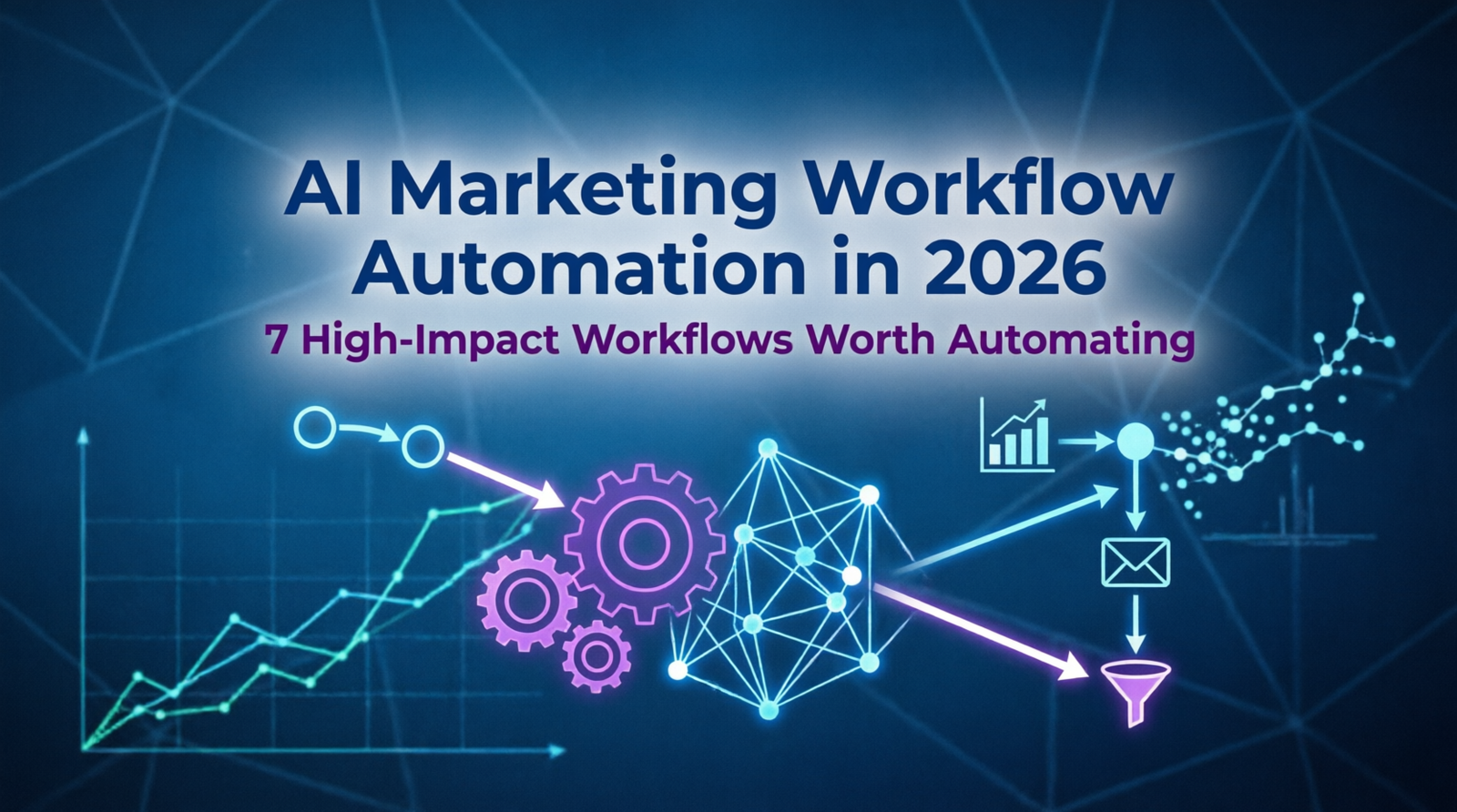
AI Marketing Workflow Automation in 2026: 7 High-Impact Workflows Worth Automating
Updated September 2026
Marketing teams do not have a shortage of AI tools.
They have a workflow problem.
A marketer can use one tool to generate emails, another to analyze keywords, another to summarize customer feedback, and a CRM to manage leads—and still spend hours copying information between systems.
That creates a familiar problem: companies adopt more AI while much of their marketing operation remains manual.
The real opportunity is not to add AI to every task. It is to redesign repetitive processes so that data, rules, AI, validation, human judgment, business systems, and measurement work together.
A practical AI marketing workflow often looks like this:
Trigger → Data → Rules → AI → Validation → Decision → Permission → Human Review → Action → Measurement
The important principle is simple:
Use the simplest technology that can reliably solve the business problem.
Traditional automation is often better for predictable rules. AI becomes useful when a task requires interpretation, classification, summarization, recommendation, personalization, or generation. More autonomous agents can be useful when a system genuinely needs to choose tools or steps dynamically.
And when an automated decision can materially affect customers, money, privacy, or brand reputation, human oversight should remain part of the design.
This guide explains seven practical AI marketing workflows worth automating in 2026, how to choose the right starting point, how to test AI before giving it permissions, and how to measure whether the automation is actually creating business value.
Quick Answer: Which AI Marketing Workflow Should You Automate First?
The best first automation is usually not the most sophisticated one.
Look for a process that is:
- Frequent
- Repetitive
- Measurable
- Based on reasonably reliable data
- Low enough risk to test safely
- Expensive enough in human time to justify automation
| Marketing problem | Recommended workflow | Main AI role | Relative risk |
|---|---|---|---|
| Weekly reporting consumes hours | AI marketing reporting | Analysis and summarization | Low–Medium |
| Large volumes of feedback are difficult to analyze | Customer feedback analysis | Classification and pattern detection | Medium |
| Sales spends too much time reviewing leads | Lead qualification | Classification and scoring | Medium |
| Existing content is losing visibility | SEO content refresh | Analysis and recommendations | Medium |
| Content production is slowing the team | AI-assisted editorial workflow | Research and drafting assistance | Medium–High |
| Competitor research is repetitive | Competitor monitoring | Change detection and analysis | Low–Medium |
| Paid campaigns require constant monitoring | Campaign monitoring | Anomaly detection and recommendations | High |
Start with the workflow closest to your biggest bottleneck
Need to reduce reporting time?
Start with AI marketing reporting.
Need to reduce manual lead screening?
Start with AI lead qualification.
Have thousands of reviews, tickets, or comments?
Start with customer feedback analysis.
Have a large existing content library?
Consider SEO content refresh.
Publish content regularly?
Build an AI-assisted editorial workflow.
Monitor multiple competitors?
Consider competitor monitoring.
Manage high-volume advertising campaigns?
Start with monitoring and recommendations, not unrestricted autonomous optimization.
The key question is not:
Which AI tool should we buy?
It is:
Which marketing workflow is consuming valuable human time without requiring human judgment at every step?
Find the Right Workflow Before Choosing a Tool
Before building anything, ask three questions.
1. Is the task predictable?
If the answer is yes, traditional automation may be enough.
2. Does the task require interpretation?
If yes, an AI workflow may add value.
3. Does the system need to dynamically choose tools or steps?
If yes, an agentic approach may be appropriate.
Then add a fourth question:
4. What happens if the system is wrong?
If the answer involves significant financial, legal, privacy, security, customer, or reputational consequences, introduce human approval and stronger controls.
This leads to a useful rule:
Use rules for rules, AI for ambiguity, agents for dynamic tasks, and humans for consequential judgment.
Who Should Use AI Marketing Workflow Automation?
AI workflow automation can be particularly useful for:
- SaaS companies
- E-commerce businesses
- Marketing agencies
- Content-heavy websites
- Performance marketing teams
- Marketing operations teams
- Businesses with large CRM databases
- Companies processing large amounts of customer feedback
It may be a poor investment when:
- The task happens only occasionally
- The process is already fast manually
- Data quality is poor
- There is no meaningful KPI
- The process changes constantly
- Human judgment is required almost everywhere
- Errors would be more expensive than the time saved
- Maintaining the automation would cost more than the original task
Automation should remove a bottleneck.
It should not create another one.
What Is AI Marketing Workflow Automation?
AI marketing workflow automation is the use of AI inside a structured marketing process to interpret information, generate outputs, recommend actions, or make bounded decisions while automation handles triggers, rules, system updates, and repeatable execution.
Consider a traditional lead process:
Lead submits form → marketer receives notification → marketer reviews lead → CRM is updated → follow-up is written → email is sent
An AI-assisted version could become:
Lead submits form → CRM receives data → workflow validates information → AI analyzes intent → lead is classified → CRM is updated → follow-up is drafted → qualified lead is routed to sales
The AI does not replace the entire workflow.
It provides an intelligence layer inside it.
Traditional automation
If a customer submits a form, send a confirmation email.
There is little ambiguity. A rule is enough.
AI-assisted workflow
Read the customer’s message, determine intent, summarize the request, classify the lead, and recommend the next step.
This requires interpretation.
That is where AI can provide leverage.
Traditional Automation vs. AI Workflow vs. AI Agent
These three approaches are often mixed together, but they solve different problems.
| Approach | How it works | Good use cases | Typical risk |
|---|---|---|---|
| Traditional automation | Fixed rules and predefined actions | Notifications, data transfers, scheduled tasks | Low |
| AI workflow | AI performs a bounded task inside a predefined process | Classification, summarization, analysis | Low–Medium |
| AI agent | AI can select tools or steps to pursue a goal | Dynamic research and multi-step tasks | Medium–High |
| Human-in-the-loop | A person reviews or approves an output/action | Strategic and consequential decisions | Depends on task |
Traditional Automation
If X happens, do Y.
Example:
Form submitted → Send confirmation
The process is deterministic.
AI Workflow
If X happens, interpret the information and determine the appropriate predefined path.
Example:
Lead submitted → Analyze message → Classify intent → Route lead
The overall process is still designed by humans. AI performs one or more bounded tasks inside it.
AI Agent
An agent has more freedom to determine how it will accomplish a goal.
For example:
Investigate why campaign performance declined.
An agent might:
- Retrieve campaign data
- Compare current and historical performance
- Check creative changes
- Examine landing-page signals
- Investigate conversion data
- Gather supporting evidence
- Prepare a recommendation
The exact sequence can change depending on what the system discovers.
That does not make agents automatically better.
If a fixed workflow solves the problem reliably, adding agentic behavior can simply introduce more complexity.
The 10-Part AI Marketing Workflow Framework
A reliable workflow should answer ten questions:
- Trigger — What starts the process?
- Data — What information is required?
- Rules — Which steps are deterministic?
- AI — Where does interpretation or generation help?
- Validation — How will outputs be checked?
- Decision — What possible paths exist?
- Permission — What is the system allowed to change?
- Human review — Which cases require a person?
- Action — What happens in the business system?
- Measurement — How will success be evaluated?
This framework prevents a common mistake: turning an entire business process into an opaque AI system when only one step actually requires AI.
Data Quality Comes Before AI
Many AI workflow failures are actually data failures.
A model can produce a perfectly formatted answer from incorrect inputs.
Common problems include:
- Duplicate CRM records
- Missing customer information
- Incorrect campaign tracking
- Conflicting definitions between systems
- Outdated customer information
- Broken integrations
- Stale website data
- Inconsistent naming conventions
Consider this workflow:
CRM → AI → Lead routing
If the CRM contains duplicate or incomplete records, the AI may classify the lead confidently but incorrectly.
That produces a dangerous combination:
Bad data + good AI = confidently wrong automation.
Before automating, check five areas.
Data completeness
Are the fields required by the workflow actually available?
Data consistency
Do different systems use the same definitions?
Data freshness
Is the information current enough for the decision?
Data ownership
Who is responsible when the data is incorrect?
Data access
Does the AI have enough relevant context to perform its task without receiving unnecessary information?
A better architecture is:
Source → Validation → Normalization → AI
not:
Source → AI → Hope
The 7 AI Marketing Workflows Worth Automating
The following workflows are ordered roughly from easier starting points to processes that require stronger controls.
| Workflow | Best use | Typical complexity | Risk | Automation potential |
|---|---|---|---|---|
| AI Marketing Reporting | Recurring reporting | Medium | Low–Medium | High |
| Customer Feedback Analysis | Large feedback volumes | Easy–Medium | Medium | High |
| Lead Qualification | Lead routing | Medium | Medium | High |
| SEO Content Refresh | Existing content libraries | Medium | Medium | Medium |
| Editorial Workflow | Regular content production | Medium | Medium–High | Medium–High |
| Competitor Monitoring | Competitive intelligence | Medium | Low–Medium | Medium |
| Campaign Monitoring | Paid performance workflows | High | High | Medium |
Implementation time varies substantially by data quality, integrations, testing requirements, and approval systems, so these categories should be treated as planning guidance rather than promises.
1. AI Marketing Reporting
Marketing reporting is one of the strongest places to begin.
Teams may collect information from advertising platforms, analytics systems, CRMs, email platforms, e-commerce systems, and social channels.
The challenge is not always collecting the numbers.
It is answering:
What changed, what evidence supports the change, and what deserves attention?
Why reporting is a good automation candidate
Reporting is usually:
- Repetitive
- Scheduled
- Data-driven
- Relatively structured
- Easy to compare against historical baselines
The goal should not be to let AI invent explanations.
The goal is to shorten the path from raw data to useful attention.
Recommended workflow
Data updated
↓
Metrics collected
↓
Data validated
↓
Current period compared with baseline
↓
Significant changes identified
↓
Evidence summarized
↓
Possible explanations proposed
↓
Recommendations prepared
↓
Human reviews important conclusions
Separate facts from explanations
This is one of the most important design principles.
Observed:
Conversion rate decreased by 18%.
That is a measurable observation.
But:
Conversion rate decreased because the landing page became slower.
That is a hypothesis unless supporting evidence exists.
A better reporting workflow separates:
Observed data → Possible explanation → Recommended investigation/action
AI can help generate hypotheses, but it should not present unsupported explanations as established facts.
Practical workflow recipe
Trigger: Weekly or daily reporting schedule
Inputs: Advertising, analytics, CRM, and revenue data
AI task: Summarize changes and identify anomalies
Validation: Check missing, duplicated, or conflicting metrics
Human checkpoint: Strategic conclusions
Output: Channel or executive report
KPIs: Reporting time, correction rate, decision speed
Best first implementation
Start with recommendation-only reporting.
Let AI identify notable changes without allowing it to automatically change campaigns or budgets.
2. AI Customer Feedback Analysis
Customer feedback is valuable but highly unstructured.
It may appear in:
- Product reviews
- Surveys
- Support tickets
- Emails
- Social comments
- Community discussions
- Feature requests
Manually reading thousands of messages makes it difficult to consistently identify recurring problems.
AI can turn that unstructured information into structured categories.
What to analyze
Do not stop at sentiment.
A useful workflow can extract:
- Sentiment
- Topic
- Problem
- Product area
- Frequency
- Severity
- Customer segment
- Requested improvement
For example:
Negative → Pricing → Subscription perceived as expensive → 28 mentions → Medium severity → Small businesses
That is more useful than simply labeling the messages “negative.”
Recommended workflow
New feedback
↓
Data validation
↓
AI classification
↓
Topic extraction
↓
Problem identification
↓
Severity classification
↓
Clustering
↓
Human review of ambiguous cases
↓
Insight report
Example output
A monthly system might discover:
- 34% of negative feedback concerns onboarding
- 19% concerns pricing clarity
- 12% concerns reporting features
- The onboarding issue is concentrated among smaller customers
- Several comments mention the same missing setup explanation
That gives the product and marketing teams something they can investigate.
KPIs
Track:
- Analysis time
- Classification accuracy
- Human correction rate
- Recurring issues identified
- Time from feedback to action
3. AI Lead Qualification and Routing
Lead qualification is a strong AI workflow candidate because it combines structured data with unstructured customer messages.
Sales teams may need to evaluate:
- Intent
- Company fit
- Use case
- Urgency
- Purchase readiness
- Existing customer information
The goal is not necessarily to replace sales.
It is to reduce repetitive screening.
Recommended workflow
New lead
↓
CRM receives information
↓
Required fields checked
↓
Duplicate records checked
↓
AI analyzes lead
↓
Intent and fit classified
↓
Output validated
↓
Lead score updated
↓
Routing decision
For example:
High intent + high confidence → Sales
Medium intent → Nurture
Low intent → Educational content
Low confidence → Human review
Example
A visitor writes:
“We have 40 employees and need an AI automation platform for our marketing department. Can someone schedule a demo?”
The system might classify:
- Intent: High
- Use case: Marketing automation
- Urgency: High
- Recommended action: Sales follow-up
Another visitor asks:
“What is AI marketing automation?”
That may indicate informational intent rather than immediate buying intent.
The two leads should not necessarily receive the same treatment.
Start with recommendation mode
A safe progression is:
Read → Analyze → Recommend → Update CRM → Route
Only give the workflow additional permissions after testing shows that it performs reliably.
KPIs
Measure:
- Qualification time
- Sales acceptance rate
- Lead-to-opportunity conversion
- False-positive rate
- False-negative rate
- Human override rate
4. AI SEO Content Refresh
SEO automation should not mean automatically rewriting every article.
For many websites, the bigger opportunity is deciding which existing pages deserve improvement.
An article may lose visibility because:
- Information becomes outdated
- Search intent changes
- Competitors publish stronger resources
- Important questions are missing
- Internal links become weak
- Products or features change
- The article no longer fully satisfies the user
The important question can therefore be:
Which existing page should we improve before creating another page?
What AI can help identify
Content decay
Traffic or rankings have declined.
Potentially outdated information
Statistics, features, pricing, or other factual details may need verification.
Content gaps
Important subtopics or questions may be missing.
Internal-link opportunities
Related pages could strengthen the content structure.
Search-intent changes
The type of content users now expect may have changed.
Potential overlap
Several pages may address substantially similar intents and deserve editorial review.
Recommended workflow
Page reaches review threshold
↓
Search and traffic data collected
↓
Content analyzed
↓
Search intent reviewed
↓
Potential gaps identified
↓
Refresh recommendations generated
↓
Human verifies recommendations
↓
Editor updates page
↓
Performance monitored
This distinction is important for SEO.
Google’s current guidance emphasizes helpful, reliable, people-first content and warns against creating large amounts of AI-generated content without adding meaningful value.
Refresh before creating
Before publishing another article targeting a similar topic, ask:
- Do we already have a relevant page?
- Is that page losing visibility?
- Does it already target the same search intent?
- Can it be substantially improved?
- Should overlapping pages be consolidated?
This can prevent a common content-marketing mistake:
Publishing more pages when the existing pages need more value.
5. AI-Assisted Editorial Workflow
AI can reduce repetitive editorial work.
But there is an enormous difference between:
AI-assisted content production
and:
AI-generated content published without meaningful human review.
A good editorial workflow uses AI to accelerate research organization, outlining, drafting, formatting, and analysis while preserving human responsibility for expertise, accuracy, originality, and final judgment.
Google’s guidance does not prohibit AI-assisted content simply because AI was involved. The focus is whether the resulting content is useful, original, accurate, and created for people rather than primarily to manipulate Search.
Better editorial workflow
Content idea
↓
Research
↓
AI-assisted content brief
↓
Human reviews angle
↓
AI assists with drafting
↓
Human adds expertise and original analysis
↓
Fact-checking
↓
Editing
↓
SEO optimization
↓
Final review
↓
Publish
↓
Measure
The wrong workflow
Keyword → AI → Publish
The better workflow
Research → AI assistance → Human analysis → Evidence → Editing → Fact-checking → Publish
The objective is not maximum publishing volume.
It is:
More useful content with less wasted production time.
Editorial KPIs
Track:
- Production time
- Correction rate
- Fact-checking workload
- Organic performance
- Engagement
- Conversions
- Human revision rate
6. AI Competitor Monitoring
Competitor monitoring can become a recurring intelligence workflow instead of a manual weekly task.
A system can monitor observable changes such as:
- New product pages
- Pricing changes
- New features
- New offers
- New landing pages
- New content
- Messaging changes
- Major website changes
The objective is not to collect every change.
It is to identify changes that might actually matter.
Recommended workflow
Source changes
↓
Information collected
↓
Change detected
↓
AI summarizes change
↓
Change categorized
↓
Evidence attached
↓
Potential implications identified
↓
Human decides whether action is required
A useful competitive intelligence chain is:
Signal → Evidence → Business implication → Decision
Not:
Competitor did X → Copy X
Questions the workflow should answer
- What changed?
- When did it change?
- What evidence supports the finding?
- Why might it matter?
- Is it strategically important?
- Does it require action?
KPIs
Measure:
- Relevant changes detected
- False-positive rate
- Research time saved
- Time from change to awareness
- Number of useful insights generated
7. AI Campaign Monitoring and Optimization Recommendations
Campaign automation deserves more caution because it can directly affect advertising spend.
The safest architecture is:
Detect → Investigate → Recommend → Approve → Execute → Measure
—not:
AI sees a change → AI changes the budget
Modern advertising platforms are increasingly adding AI and agentic capabilities directly into marketing workflows. For example, Google announced new AI and agentic capabilities across Google Ads and Google Analytics in August 2026, including an in-product AI agent designed to help marketers uncover insights and take actions while keeping the marketer in control.
Recommended workflow
Campaign data updated
↓
Performance metrics collected
↓
Anomalies detected
↓
Creative, audience, landing-page, and conversion signals compared
↓
Possible causes investigated
↓
Recommendation generated
↓
Human reviews
↓
Approved action executed
↓
Result measured
Example
Suppose:
- CTR falls 22%
- CPC rises 17%
- Conversion rate falls 14%
A useful AI report might say:
Observed: Performance deteriorated after a creative change.
Possible explanation: The new creative may be attracting lower-intent traffic.
Recommended investigation: Compare the new creative’s audience and landing-page behavior against the previous version.
Notice the language.
The system does not claim:
“The creative definitely caused the decline.”
It separates evidence from hypothesis.
Never Optimize on One Metric
A campaign might show:
CTR ↑
CPC ↓
Conversions ↓
A system optimizing only for clicks could incorrectly conclude that performance improved.
A better hierarchy is:
Revenue / Profit
↓
Qualified conversions
↓
Conversions
↓
Traffic
↓
Clicks
↓
Impressions
The correct hierarchy depends on the business model, but the principle is universal:
Do not optimize a proxy metric when the real business outcome is available.
If the goal is qualified leads, CTR alone is insufficient.
If the goal is profit, cheap traffic alone is insufficient.
Permission Levels for AI Marketing Systems
One of the most useful ways to control AI automation is to increase permissions gradually.
Level 1 — Observe
AI analyzes data.
Level 2 — Recommend
AI suggests actions.
Level 3 — Draft
AI prepares changes but does not execute them.
Level 4 — Human Approval
A person reviews and approves.
Level 5 — Controlled Execution
The system can automatically perform predefined low-risk actions.
Do not give a new workflow unrestricted permission to:
- Increase large advertising budgets
- Delete campaigns
- Change major targeting settings
- Send sensitive customer communications
- Change pricing
- Delete CRM records
- Make irreversible decisions
Define boundaries such as:
- Maximum budget change
- Maximum campaigns affected
- Allowed action types
- Approval requirements
- Operating hours
- Rollback conditions
- Escalation rules
Model confidence is not the same thing as business confidence.
A Complete Example: AI Lead Qualification Workflow
Imagine a SaaS company receiving 200 inbound leads each month.
A salesperson currently reviews every lead manually.
Here’s how a controlled AI workflow could work.
1. Trigger
A new lead submits the website form.
2. Data
The workflow collects:
- Company
- Job title
- Company size
- Form answers
- Lead message
- Existing CRM information
3. Rules
Before AI runs:
- Check required fields
- Detect duplicates
- Normalize fields
- Reject obviously invalid submissions
4. AI Task
AI classifies:
- Intent
- Use case
- Urgency
- Lead quality
- Recommended next step
5. Validation
The system checks:
- Required output fields
- Confidence threshold
- Valid categories
- Missing information
6. Decision
High intent + high confidence
→ Sales queue
Medium intent
→ Nurture
Low intent
→ Educational sequence
Low confidence
→ Human review
7. Permission
The workflow can:
- Read approved lead information
- Classify leads
- Update lead scores
It cannot:
- Change pricing
- Send contracts
- Delete records
- Spend advertising money
8. Human Review
Sales reviews:
- High-value leads
- Low-confidence classifications
- Unusual cases
9. Action
The CRM routes the approved category.
10. Measurement
Track:
- Qualification time
- Sales acceptance
- Conversion
- Override rate
- False positives
- False negatives
That is the difference between adding AI to a process and building a controlled AI workflow.
Choosing the Right AI Marketing Stack
You do not need twenty AI tools.
A practical stack normally has several layers:
| Layer | Purpose |
|---|---|
| Data sources | Provide business information |
| CRM/database | Store operational data |
| Automation platform | Connect systems and trigger processes |
| AI model | Interpret, classify, summarize, recommend, or generate |
| Validation | Check AI outputs |
| Human approval | Control sensitive decisions |
| Analytics | Measure results |
Depending on the workflow, a stack could include categories such as:
- Automation platforms
- CRM systems
- AI models
- Analytics platforms
- Advertising platforms
- Content management systems
- Monitoring systems
Examples include Zapier, Make, n8n, HubSpot, Salesforce, OpenAI, Claude, Gemini, Google Analytics, Search Console, Google Ads, Meta Ads, and WordPress.
The important rule is:
Choose the workflow first. Choose the tools second.
Data Security, Privacy, and Access Control
Connecting more systems also increases the amount of information an AI workflow can potentially access.
Use a least-privilege approach.
Give each workflow only the data and permissions it actually needs.
Recommended controls include:
- Limit data access
- Separate read and write permissions
- Avoid unnecessary customer information
- Define retention policies
- Log important actions
- Use approved AI providers for sensitive information
- Review permissions after major changes
- Define escalation and rollback procedures
For example, a lead-scoring workflow may need:
Company → Job title → Form answers → Message
It may not need:
Billing records → Employee information → Unrelated customer data
Security is therefore part of workflow architecture, not something to add after deployment.
Google Cloud’s August 2026 security guidance highlights this exact challenge: agents can have access to email, databases, and APIs, so governance and permissions become central to scaling autonomous workflows safely.
No-Code vs. Low-Code vs. API-Based AI Workflows
Different workflows require different technical approaches.
| Approach | Best for | Flexibility | Complexity |
|---|---|---|---|
| No-code | Simple marketing automation | Medium | Low |
| Low-code | Multi-step workflows | High | Medium |
| API-based | Custom business-critical systems | Very high | High |
| Agentic systems | Dynamic multi-step processes | Very high | Very high |
No-code example
Form → Automation platform → AI → CRM
Good for validating an idea quickly.
Low-code example
Webhook → Workflow engine → Validation → AI → CRM → Notification
Useful when branching logic and custom validation are needed.
API-based example
Application → Backend → AI API → Validation → Business API → Database
Better suited to business-critical systems.
Agentic example
Goal → Agent → Tool selection → Data retrieval → Reasoning → Approval → Action → Evaluation
Use this architecture only when dynamic decision-making genuinely creates additional value.
Productionizing an AI Marketing Workflow
A workflow that works in a demo is not automatically ready for production.
Before granting real permissions, establish four control layers.
1. Failure paths
Define what happens when:
- Data is missing
- AI output is invalid
- An API fails
- Systems disagree
- A high-risk case appears
- The workflow repeatedly fails
For example:
Valid + low risk → Continue
Low confidence → Human review
Missing data → Request information
Invalid output → Retry or fallback
Repeated failure → Stop and escalate
High-risk action → Human approval
2. Observability
For important workflows, record:
- Trigger
- Input source
- Model/version
- Prompt version
- Output
- Validation result
- Action taken
- Human override
- Error
- Cost
- Latency
You should be able to answer:
What did the system receive, what did it decide, and what did it actually do?
3. Versioning
Treat the following as part of the workflow configuration:
- Prompt
- Model
- Business rules
- Data schema
A useful mental model is:
Prompt + Model + Rules + Data Schema = Workflow Version
4. Permissions
Increase permissions gradually:
Read → Analyze → Recommend → Draft → Human Approval → Controlled Execution
AI capability does not automatically equal authorization.
Test Before You Automate
Avoid:
Build → Production
Use:
Build → Test → Compare → Shadow → Pilot → Monitor → Expand
Step 1: Build a representative test set
Use historical examples where the correct human outcome is known.
Include:
- Normal cases
- Ambiguous cases
- Missing data
- Unusual customers
- High-value cases
- Out-of-scope cases
Step 2: Run the AI
Have the system perform its intended task.
Step 3: Compare results
Measure:
- Correct classifications
- False positives
- False negatives
- Human overrides
- Low-confidence cases
Step 4: Test edge cases
Do not test only the easy examples.
The difficult cases often reveal the actual risk.
Step 5: Use shadow mode
Allow AI to make recommendations without executing production actions.
Compare:
AI recommendation vs. human decision
Step 6: Start with limited permissions
Only increase permissions when the workflow demonstrates reliable performance.
Monitor and Maintain the Workflow
Deployment is not the end.
AI workflows can degrade when:
- Source data changes
- APIs change
- Customer behavior changes
- Business rules change
- Prompts change
- Models change
- New edge cases appear
Track at least:
| Metric | Why it matters |
|---|---|
| Accuracy | Measures output quality |
| Human override rate | Shows where AI struggles |
| Failure rate | Measures reliability |
| Retry rate | Identifies instability |
| Cost per execution | Controls operating cost |
| Latency | Measures speed |
| Business KPI | Measures actual value |
Review the workflow regularly.
Look for:
- Failed executions
- Human overrides
- Unexpected edge cases
- Rising AI costs
- Permission changes
- Source-data changes
- Model or prompt changes
- Declining business value
An AI workflow is a system to monitor, not a feature you switch on once.
How to Measure AI Marketing Workflow ROI
Do not measure an automation project by how impressive the technology looks.
Measure what changed.
Establish a baseline
Before deployment, record the current process.
For example:
| Metric | Before | After |
|---|---|---|
| Reporting time | 5 hrs/week | 1.5 hrs/week |
| Manual corrections | 12% | 5% |
| Delivery time | 2 days | Same day |
| Human review | 100% | 30% |
These numbers are illustrative.
The principle is to compare equivalent metrics before and after deployment.
Four types of value
1. Time saved
How many hours did the workflow remove?
2. Capacity created
How much productive capacity became available?
3. Business impact
Did revenue, conversion, qualified leads, retention, or efficiency improve?
4. Quality and risk
Did errors, corrections, or missed opportunities decline?
This distinction matters.
Time saved is not automatically financial value.
If automation saves 15 hours but nobody uses those hours productively, the realized value may be much lower than the theoretical labor saving.
A better framework is:
Time Saved → Capacity Created → Realized Business Value
A practical value equation
Automation Value = Time Value + Business Impact + Capacity Value + Error Reduction − Operating Cost
This is a planning framework, not a standardized accounting formula.
Include:
- Software
- AI usage
- Integrations
- Monitoring
- Maintenance
- Development
- Human review
- Error correction
Then:
Net Value = Value Created − Total Automation Cost
Illustrative example
Suppose a workflow saves:
15 hours/month
and the internal value of an hour is:
$30
Then:
15 × $30 = $450/month
If the workflow costs:
$100/month
to operate:
$450 − $100 = $350/month estimated net benefit
Illustrative ROI:
($450 − $100) ÷ $100 × 100 = 350%
This is only an example. A real ROI calculation should include implementation costs, changes in quality, business outcomes, human review, and error correction.
Score an Automation Opportunity Before Building It
You can use a simple seven-factor score.
Rate each from 1 to 5:
| Factor | Score |
|---|---|
| Task frequency | /5 |
| Time consumed | /5 |
| Repetitive nature | /5 |
| Data reliability | /5 |
| AI suitability | /5 |
| Business impact | /5 |
| Ease of measurement | /5 |
25–35: Strong candidate
Run a controlled pilot.
18–24: Potential candidate
Test before investing heavily.
Below 18: Probably not your first project
Find a more frequent and measurable process.
But opportunity score is only half the decision.
Add a risk gate
Consider:
- Financial consequences
- Legal consequences
- Privacy
- Security
- Customer impact
- Brand reputation
- Reversibility
A high-opportunity workflow with high risk may still need human approval.
Automation suitability does not automatically equal automation permission.
When Should You Not Use AI Automation?
AI is not automatically better.
1. A simple rule already solves the problem
If:
Form submitted → Send confirmation
works perfectly with ordinary automation, adding AI only adds complexity.
2. Errors are too expensive
Use human approval for decisions with serious consequences.
3. The process is broken
Automation does not fix a bad process.
It makes the bad process run faster.
4. The data is unreliable
AI cannot magically transform unreliable inputs into reliable decisions.
5. There is no clear success metric
If you cannot measure success, you cannot confidently prove that automation created value.
6. The process changes constantly
Stabilize the process before automating it.
7. AI adds more complexity than value
If employees spend more time monitoring the automation than performing the original task, the automation may have failed.
Do not automate yet if you cannot answer:
- What does a correct output look like?
- What is the baseline KPI?
- What happens when the AI is wrong?
- Who owns the workflow?
- Which actions require human approval?
- Can an automated action be reversed?
- Have historical examples been tested?
- What happens when an integration fails?
If several answers are unclear, redesign the process first.
The goal is not maximum automation. It is optimal automation.
AI Marketing Workflow Maturity
You do not need to jump from manual work directly to autonomous agents.
| Level | Operating model | Example |
|---|---|---|
| 1 | Manual | Marketer performs every step |
| 2 | Rule-based | Predictable tasks are automated |
| 3 | AI-assisted | AI performs bounded interpretation |
| 4 | Human-in-the-loop | AI recommends; human approves |
| 5 | Controlled agentic | AI dynamically selects tools within guardrails |
The goal is not necessarily Level 5.
Use the lowest level that reliably delivers the required business outcome.
What Is Changing in AI Marketing Workflows in 2026?
The important shift in 2026 is not simply that AI models are becoming better at generating text.
AI is increasingly being connected to the systems where marketing work actually happens.
A June 2026 BCG survey of 300 global CMOs found a significant gap between AI ambition and workflow transformation: 96% said AI was driving end-to-end transformation of marketing, while 42% said they were still using generative AI mainly to assist humans with individual tasks. Only 8% reported campaigns in which multiple AI agents operated autonomously.
Google Cloud’s 2026 AI Agent Trends research similarly describes a movement from one-off prompts toward systems that can understand goals, plan multiple steps, use tools, and operate with human oversight.
That creates several important changes.
From isolated AI to connected workflows
AI is increasingly being connected to:
- CRMs
- Analytics systems
- Advertising platforms
- Content management systems
- Customer databases
- Internal business applications
The opportunity is moving from isolated prompts toward connected processes.
From generation to decision support
The workflow becomes:
Analyze → Interpret → Recommend → Act
rather than simply:
Generate
From unrestricted autonomy to controlled autonomy
As agents become capable of performing more actions, businesses need:
- Permission boundaries
- Approval checkpoints
- Monitoring
- Logging
- Rollback procedures
- Security controls
This is particularly important when AI can access business systems.
From model quality to workflow quality
A stronger model does not automatically create a stronger business process.
The complete system is:
Data + Rules + Model + Validation + Permissions + Human Oversight + Measurement
From AI experiments to workflow economics
Marketing teams increasingly need to answer:
How much does the workflow cost?
How much time does it save?
What business result does it improve?
How often does a human need to intervene?
This makes workflow economics as important as model capability.
How to Build Your First AI Marketing Workflow
You do not need to automate your entire marketing department.
Start with one process.
Step 1: Find a repetitive problem
Look for a task performed every week or every day.
Examples:
- Reporting
- Lead classification
- Customer feedback analysis
- Content auditing
- Competitor monitoring
- Data transfer
Step 2: Map the current process
Write:
Trigger → Input → Decision → Action → Result → Measurement
If you cannot describe the process clearly, do not automate it yet.
Step 3: Separate rules from intelligence
Ask:
What should always happen?
Use traditional automation.
What requires interpretation?
Consider AI.
What requires judgment or accountability?
Keep a human involved.
Step 4: Add one AI capability
Start with one:
- Classification
- Summarization
- Recommendation
- Personalization
- Generation
Do not start with a complex multi-agent architecture unless the problem genuinely requires it.
Step 5: Start in recommendation mode
A safe progression is:
AI analyzes → AI recommends → Human approves → Automation executes
Measure:
- Accuracy
- Overrides
- Edge cases
- Time saved
- Business outcome
Step 6: Add guardrails
Define:
- What the AI can access
- What it cannot access
- Which actions require approval
- What happens when data is missing
- What happens when output is invalid
- Retry limits
- Escalation rules
- Rollback procedures
Step 7: Establish the baseline
Before automation, record:
- Average task time
- Number of people involved
- Error rate
- Response time
- Output quality
- Business result
Without a baseline, it is easy to confuse:
AI is doing something
with:
AI is creating value.
Frequently Asked Questions
What is AI marketing workflow automation?
AI marketing workflow automation uses AI inside a structured marketing process to interpret data, classify information, generate outputs, recommend actions, or make bounded decisions while traditional automation handles repeatable system actions.
What is the difference between an AI workflow and an AI agent?
An AI workflow usually contains a bounded AI task inside a predefined process. An AI agent can dynamically determine more of the steps or tools required to accomplish a goal within defined instructions and permissions.
Which AI marketing workflow should I automate first?
Start with a frequent, measurable, relatively low-risk process. Marketing reporting, customer-feedback analysis, and lead qualification are often good starting points.
How much does AI workflow automation cost?
There is no universal price. Costs depend on AI usage, automation software, integrations, development, monitoring, maintenance, data infrastructure, and human review.
How do you measure AI workflow ROI?
Establish a baseline and compare time saved, capacity created, quality changes, business outcomes, and operating costs after deployment.
How do you safely deploy an AI marketing workflow?
Test historical examples, run the workflow in shadow mode, validate outputs, define failure paths, limit permissions, require human approval for consequential actions, and increase autonomy gradually.
Final Verdict: The Best AI Workflow Is Not the One With the Most AI
The biggest mistake marketers can make in 2026 is collecting dozens of AI tools without redesigning the underlying process.
The real opportunity is not:
Which AI tool can write my next email?
It is:
How can I redesign the workflow so the right information reaches the right system, the right AI performs the right task, and humans intervene where judgment actually matters?
Start with one repetitive process.
Map it.
Separate rules from intelligence.
Add AI where interpretation creates genuine leverage.
Test it against real examples.
Start in recommendation mode when risk is significant.
Add guardrails.
Define failure paths.
Give the system only the permissions it needs.
Monitor it after launch.
Measure the actual outcome.
Then expand.
The competitive advantage will not necessarily belong to the company using the most AI.
It may belong to the company that designs the best human-AI workflow.
Automate the repetitive.
Use AI for the ambiguous.
Use agents for the dynamic.
Keep humans responsible for the consequential.
Measure the business outcome—not the number of AI steps in the workflow.
Sources and further reading
For the claims and recommendations in this article, the most useful primary sources include:
- Google Search Central — Creating Helpful, Reliable, People-First Content
- Google Search Central — Generative AI Content Guidance
- Google Search Central — Spam Policies
- Google Search Central — AI Optimization Guide
- Google Cloud — 2026 AI Agent Trends
- BCG — CMO Survey 2026: Agentic Marketing Transformation
- Google — New AI and Agentic Experiences for Ads and Analytics
Note: This article discusses AI workflow design at a general level. Specific AI model capabilities, pricing, APIs, integrations, and product features can change quickly, so readers should verify current vendor documentation before implementing a production workflow.
Related Articles
This article should act as a pillar page for the AI Automation content cluster.
Use contextual internal links throughout the article rather than relying only on this section.
- Best AI Automation Tools in 2026 — for readers ready to choose an automation platform
- Best AI Marketing Tools in 2026 — for broader marketing AI solutions
- Best AI SEO Tools in 2026 — for SEO-specific workflows
- Best AI Writing Tools in 2026 — for AI-assisted editorial workflows
- Best AI Productivity Tools in 2026 — for broader productivity automation
- AI Agents Explained: What They Are and When to Use Them — for readers interested in agentic systems
- A2A Protocol Explained: How AI Agents Communicate — for readers exploring multi-agent systems
The ideal reader journey is:
Problem → Workflow → Decision → Tool Category → Tool Comparison
rather than:
Problem → Generic AI Explanation → End