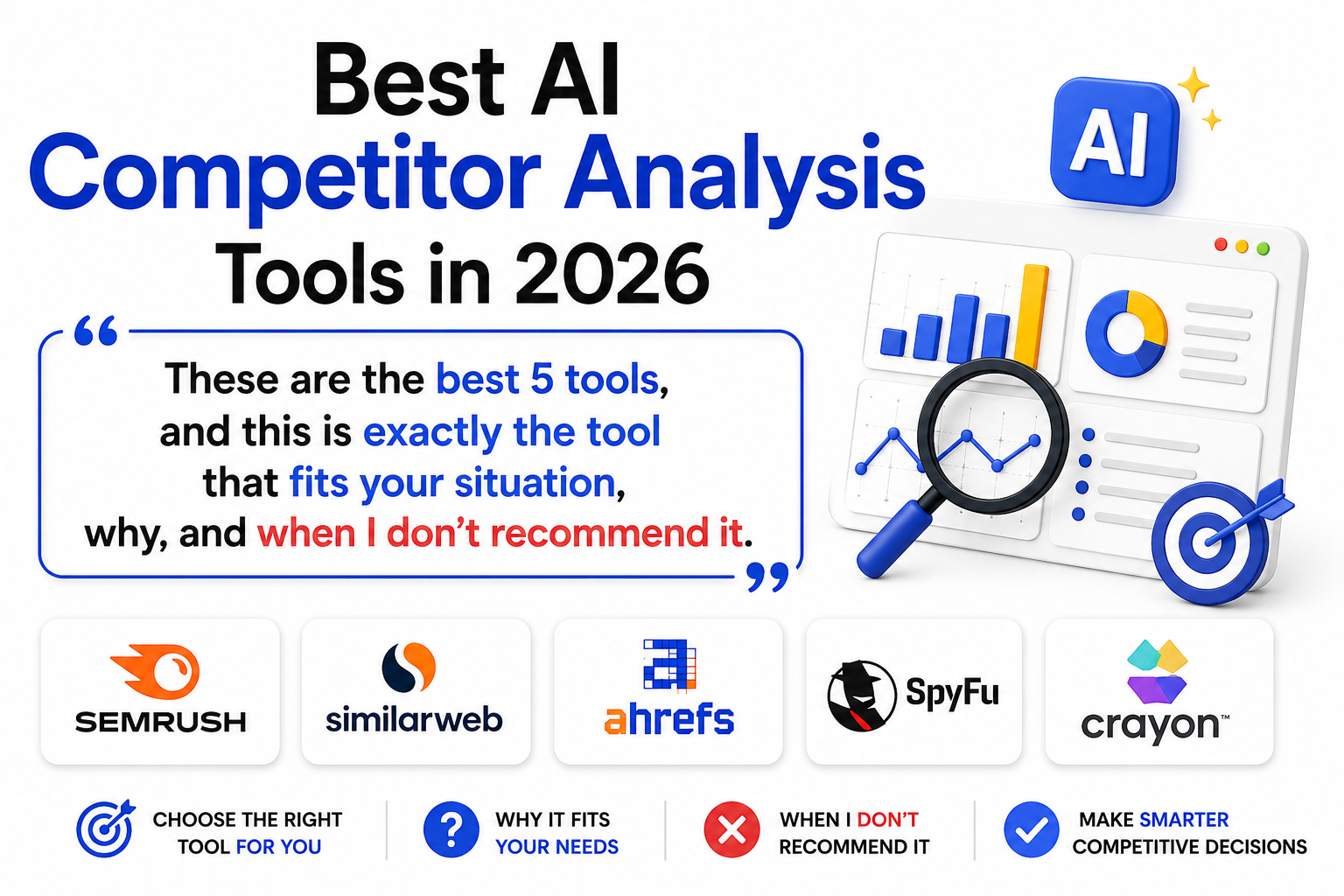
Best AI Competitor Analysis Tools in 2026: 5 Platforms Compared
Last reviewed: September 2026
Knowing who your competitors are is only the first step.
The more useful question is why they are winning.
Which keywords bring them organic visibility? Which pages attract traffic and backlinks? Are they investing in paid search? Which channels appear to drive their growth? How are they positioned in the market? And increasingly, are they being mentioned or cited in AI-generated search results?
AI-powered and data-driven competitor analysis platforms can help answer these questions by combining information about SEO, backlinks, PPC, traffic, content, audiences, market trends, and AI search visibility.
But there is no single tool that is best for every business.
An SEO specialist may need detailed keyword and backlink data. An affiliate marketer may care about competitor keywords and paid advertising. An eCommerce company may need traffic and audience intelligence. A B2B sales organization may need continuous monitoring of competitor pricing, products, messaging, and market activity.
That is why this guide does not rank platforms simply by the number of features they offer.
Instead, we evaluate them according to the competitive questions they are best suited to answer.
The best competitor analysis tool is not necessarily the one with the most features. It is the one that helps you answer an important business question and turn the answer into a useful decision.
Quick Comparison
| Tool | Best for | Main strength | Best fit |
|---|---|---|---|
| Semrush | Overall competitor research | SEO, PPC, content, and AI visibility in one platform | Marketers and agencies |
| Similarweb | Traffic and market intelligence | Traffic sources, audiences, markets, and digital benchmarking | eCommerce and growth teams |
| Ahrefs | SEO competitor analysis | Keywords, backlinks, content gaps, and AI visibility | SEO professionals and content teams |
| SpyFu | SEO + PPC competitor research | Competitor keywords, ads, and advertising history | PPC marketers and affiliate marketers |
| Crayon | Enterprise competitive intelligence | Continuous competitor monitoring and sales intelligence | B2B and enterprise teams |
The short answer
Best overall: Semrush
Best for SEO: Ahrefs
Best for traffic intelligence: Similarweb
Best for SEO + PPC: SpyFu
Best for enterprise competitive intelligence: Crayon
These recommendations are use-case based. A different tool may be the better choice if your competitive research has a different objective.
How We Evaluated These Tools
“Competitor analysis” can mean very different things depending on the business.
For this comparison, we evaluated the platforms across several practical areas.
1. SEO competitor research
Can the tool help identify competing keywords, ranking pages, search visibility, and content opportunities?
2. Backlink and content research
Can you understand which pages and websites help competitors attract links and search visibility?
3. Traffic and market intelligence
Can the platform help estimate competitor traffic, acquisition channels, audiences, geographic markets, or industry position?
4. PPC and advertising research
Can you investigate competitor paid keywords, advertising activity, ad history, or paid-search strategies?
5. AI search visibility
Can the platform help you understand how brands appear in AI-generated answers and compare that visibility with competitors?
This is becoming a more relevant part of competitive research as users increasingly interact with AI-generated search experiences alongside traditional search engines.
6. Practical fit
Finally, we considered the type of organization each platform makes the most sense for.
A solo website owner, an SEO agency, and a large B2B sales organization do not need the same competitive-intelligence workflow.
One important limitation
Competitor-analysis platforms generally do not have access to another company’s complete private analytics.
Traffic, clicks, advertising spend, and similar metrics may therefore be estimated, modeled, or derived from third-party data.
These tools are most useful when you treat their information as competitive intelligence and directional evidence, rather than assuming every number is an exact representation of a competitor’s internal analytics.
1. Semrush — Best Overall
Semrush is our best overall choice for marketers who want a broad competitive research platform covering multiple digital marketing channels.
Its main advantage is breadth.
Instead of using one platform for SEO, another for PPC, and another for AI-search visibility, Semrush can bring many of these research workflows into one environment.
Best for
- SEO professionals
- Marketing agencies
- Affiliate marketers
- Content teams
- PPC marketers
- Businesses managing multiple competitors
- Companies researching AI search visibility
Why We Recommend Semrush
Competitor research often starts with a simple question:
Why is this competitor performing better than us?
There may not be a single answer.
A competitor could rank for more valuable keywords, have stronger backlinks, publish better-performing content, invest heavily in paid search, or gain visibility in AI-generated answers.
Semrush is particularly useful when you want to investigate several of these areas from one broader marketing platform.
Its current AI Visibility Toolkit also includes competitor research that can compare how often competitors are mentioned in AI-generated search results and identify topics or prompts where competitors have an advantage.
What You Can Use It For
- Competitor keyword research
- Organic search research
- PPC research
- Backlink analysis
- Content gap research
- Competitor advertising research
- Market research
- AI visibility analysis
- Competitive benchmarking
Who Should Choose Semrush?
Semrush is a strong fit if:
- SEO and PPC are both important to your strategy
- You manage several competitors
- You work with multiple websites
- You operate an agency
- You want broad marketing research
- You want traditional search and AI-search insights in the same general workflow
When Semrush May Be More Than You Need
Semrush can be unnecessarily broad if you only need one specific type of data.
For example, if your only question is:
“Which websites link to my competitor?”
a specialized SEO platform may be sufficient.
Likewise, if your primary question is:
“Where does this competitor get its traffic?”
a traffic-intelligence platform such as Similarweb may be a better fit.
Pros
- Broad competitor research
- Strong SEO capabilities
- PPC research
- Content research
- AI visibility capabilities
- Suitable for agencies and marketing teams
Cons
- Large feature set can feel overwhelming
- May be more than a beginner needs
- Costs can increase as research requirements grow
Our Verdict
Choose Semrush when you want one broad platform for competitor research across SEO, PPC, content, and AI search visibility.
2. Similarweb — Best for Traffic & Market Intelligence
If your main competitive question is:
Where is this competitor getting its visitors?
Similarweb is one of the strongest platforms to consider.
Unlike SEO-focused tools, Similarweb is designed around broader digital traffic and market intelligence.
Best for
- eCommerce businesses
- Growth marketers
- Market researchers
- Agencies
- Competitive intelligence teams
- Companies entering new markets
Why We Recommend Similarweb
SEO data can explain a competitor’s search visibility, but search is only one acquisition channel.
A website may receive visitors from:
- Search
- Direct traffic
- Referrals
- Social platforms
- Display advertising
- Other digital channels
Similarweb provides a broader view of digital traffic and market activity.
Its methodology combines multiple data sources with data synthesis and modeling. The company says these sources can include directly measured first-party analytics from participating websites and apps, contributor data, and public data.
That makes Similarweb particularly useful for directional competitive benchmarking.
What You Can Use It For
- Traffic analysis
- Traffic-source research
- Audience analysis
- Market research
- Geographic analysis
- Competitor benchmarking
- Channel analysis
- Digital market intelligence
Who Should Choose Similarweb?
Choose Similarweb if:
- You want to compare competitor traffic
- You are researching a new market
- Audience intelligence matters
- You want to understand acquisition channels
- You operate an eCommerce business
- SEO alone does not explain competitor growth
The Important Limitation: Traffic Is Not Exact
This is one of the most important things to understand about competitor traffic platforms.
You normally do not have access to another company’s private Google Analytics or internal reporting.
Therefore, third-party traffic figures should be used to understand direction, relative scale, trends, and channel mix, rather than treated as exact financial or analytics data.
Pros
- Broad digital traffic intelligence
- Market research capabilities
- Audience insights
- Competitor benchmarking
- Broader than traditional SEO platforms
Cons
- Traffic figures are not direct access to competitor analytics
- Advanced research can be expensive
- Smaller websites may not need its full capabilities
Our Verdict
Choose Similarweb when your competitive questions are mainly about traffic, audiences, acquisition channels, and market position.
3. Ahrefs — Best for SEO Competitor Analysis
If your biggest competitive battle is in organic search, Ahrefs is one of the strongest choices.
Its core strength is helping marketers understand how competing websites earn search visibility, links, and traffic.
Best for
- SEO specialists
- Bloggers
- Affiliate marketers
- Content marketers
- Link builders
- SaaS companies
- SEO agencies
Why We Recommend Ahrefs
Imagine a competitor consistently outranks your website.
You need answers to questions such as:
- Which keywords are responsible?
- Which pages perform best?
- Which topics are they covering?
- Which websites link to them?
- Which keywords do they rank for that you don’t?
- Which content opportunities are you missing?
Ahrefs is particularly well suited to these questions.
Its Site Explorer provides competitor research across organic search, backlinks, and paid traffic. Its competitive-analysis tools also include Content Gap and Link Intersect workflows for finding keywords and referring websites that may represent opportunities.
What You Can Use It For
- Competitor keyword research
- Backlink analysis
- Content gap research
- Organic search analysis
- Rank tracking
- Content research
- AI visibility research
- Competitor benchmarking
AI Search Visibility
Ahrefs has also expanded beyond traditional SEO through Brand Radar.
Brand Radar is designed to track how brands appear in AI search and compare AI visibility against competitors. It can help identify mentions, cited pages and domains, and areas where competitors are receiving visibility that your brand is not.
This makes Ahrefs particularly relevant for marketers who want competitor research to cover both traditional search and newer AI-search experiences.
Who Should Choose Ahrefs?
Choose Ahrefs if:
- SEO is your main growth channel
- Competitor backlinks matter
- You want keyword gaps
- Content opportunities are important
- You want to understand why competing pages outperform yours
- AI search visibility is becoming part of your SEO strategy
When Ahrefs May Not Be the Best Fit
Ahrefs is primarily a search and marketing intelligence platform.
If your main question is:
“How much traffic does this competitor receive from direct, social, referral, and other channels?”
you may want a broader traffic-intelligence platform.
Likewise, if your sales team needs continuous monitoring of competitor pricing, product changes, and competitive deals, an enterprise competitive-intelligence platform may be more appropriate.
Pros
- Strong SEO research
- Powerful backlink analysis
- Competitor keyword research
- Content gap analysis
- AI visibility capabilities
- Strong fit for SEO-focused teams
Cons
- More SEO-focused than broad market-intelligence platforms
- Can require a learning curve
- Some advanced capabilities may be unnecessary for beginners
Our Verdict
Choose Ahrefs if your main question is: “How is my competitor winning in organic search, and what can I learn from it?”
4. SpyFu — Best for Competitor SEO + PPC
SpyFu is particularly useful for marketers who want to investigate both organic search competition and paid search competition.
Its PPC research is especially relevant when you want to understand competitor paid keywords, advertising activity, and ad history.
Best for
- PPC marketers
- SEO specialists
- Affiliate marketers
- Small businesses
- Agencies
- Growth marketers
Why We Recommend SpyFu
Suppose you want to know:
Which keywords is my competitor paying for?
Or:
What ads has this competitor tested?
Or:
Which domains compete with us in paid search?
These are exactly the types of questions SpyFu is designed to help answer.
Its current PPC competitor tools provide research into paid keywords, estimated ad activity, competing advertisers, and advertising history.
Its SEO competitor tools can identify domains competing for similar organic keywords and help track ranking changes.
What You Can Use It For
- Competitor PPC keywords
- Advertising research
- Ad history
- SEO competitor research
- Keyword gaps
- Competitor comparisons
- Ranking history
- PPC benchmarking
Who Should Choose SpyFu?
Choose SpyFu if:
- PPC is important to your strategy
- You want competitor advertising research
- You are an affiliate marketer
- You want SEO and PPC competitor research together
- Historical advertising information matters
SpyFu has also added AI-assisted workflows around its existing SEO and PPC data, making the platform more than a traditional keyword-research database.
When SpyFu May Not Be the Best Fit
SpyFu is less suited to organizations that need company-wide competitive intelligence.
For example, if your sales and product teams need continuous monitoring of:
- Pricing
- Product launches
- Website changes
- Positioning
- Sales competition
- Market announcements
an enterprise competitive-intelligence platform may be a better fit.
Pros
- Strong PPC competitor research
- Competitor advertising history
- SEO competitor research
- Useful for affiliate marketers
- Straightforward competitive workflows
Cons
- Less broad than all-in-one marketing platforms
- Not primarily designed for enterprise competitive intelligence
- Market and audience intelligence is not its main focus
Our Verdict
Choose SpyFu when competitor keywords and paid advertising are major parts of your competitive strategy.
5. Crayon — Best for Enterprise Competitive Intelligence
Crayon is fundamentally different from the other platforms in this comparison.
Instead of focusing mainly on SEO, PPC, or website traffic, Crayon is built around continuous competitive intelligence.
That distinction matters.
A large B2B company may not simply want to know which keywords a competitor ranks for.
Its teams may need to know:
- Did the competitor change its pricing?
- Did it launch a new product?
- Did its website messaging change?
- What are customers saying about the competitor?
- What are competitors announcing?
- Which competitors are appearing in sales opportunities?
- What information should sales representatives know?
That is a broader competitive-intelligence problem.
Best for
- Enterprise companies
- B2B SaaS companies
- Product marketing teams
- Sales teams
- Competitive intelligence teams
- Revenue organizations
Why Crayon Is Different
Crayon says its platform monitors competitor activity across areas such as website changes, pricing updates, job postings, release notes, support documents, customer reviews, filings, and press releases.
It can then surface and summarize relevant changes for teams.
Crayon also focuses on distributing competitive intelligence into sales workflows and tools such as Salesforce, Slack, Microsoft Teams, and other sales-enablement systems.
Who Should Choose Crayon?
Choose an enterprise competitive-intelligence platform when competitor monitoring is a recurring business process rather than an occasional marketing task.
It becomes particularly relevant when:
- Multiple departments need competitor information
- Competitors change frequently
- Sales teams need battlecards
- Product teams monitor competing products
- Marketing teams track positioning
- Competitive information needs to be distributed continuously
When We Wouldn’t Recommend Crayon
This is probably the easiest platform on this list to overbuy.
If you are a solo blogger asking:
“Which keywords does my competitor rank for?”
you probably do not need enterprise competitive-intelligence software.
An SEO platform is likely to be much more practical.
Pros
- Designed for continuous competitive intelligence
- Strong enterprise orientation
- Useful for sales and product teams
- Competitor monitoring
- Competitive alerts and summaries
- Sales enablement workflows
Cons
- Enterprise-oriented
- Excessive for many small websites
- Not primarily a backlink or keyword-research tool
- Pricing is tailored to the organization’s competitive-intelligence requirements
Our Verdict
Choose Crayon when competitor intelligence needs to be continuously monitored and shared across sales, marketing, and product teams.
Which Competitor Analysis Tool Should You Choose?
The easiest way to choose is to start with the question you need answered, rather than the software.
“My competitors rank higher than me.”
Best fit: Ahrefs
Your main problem is SEO.
You want to investigate:
- Keyword gaps
- Ranking pages
- Backlinks
- Content opportunities
- Organic search visibility
Ahrefs is a strong fit when organic search is at the center of your competitive strategy.
Alternative: Semrush
Choose Semrush if you also need substantial PPC research, broader marketing workflows, and AI visibility research.
“I want to know where my competitors get their traffic.”
Best fit: Similarweb
This is primarily a traffic and market-intelligence question.
You want to understand:
- Acquisition channels
- Traffic trends
- Audiences
- Geographic markets
- Market position
Remember that third-party traffic data should be interpreted as modeled intelligence rather than exact access to a competitor’s private analytics.
“I want to know which keywords and ads my competitors use.”
Best fit: SpyFu
This is where SpyFu is particularly useful.
You can investigate competitor paid keywords, advertising activity, ad history, and SEO competition.
“I want one broad marketing platform.”
Best fit: Semrush
If you want to investigate multiple competitive channels from one platform, Semrush is the strongest general-purpose choice on this list.
“Our sales team needs continuous competitor intelligence.”
Best fit: Crayon
At this point, you are dealing with more than SEO.
You need information that can influence:
- Sales conversations
- Product strategy
- Positioning
- Competitive battlecards
- Pricing discussions
- Revenue strategy
That is where enterprise competitive intelligence becomes more valuable.
Semrush vs Ahrefs
This is one of the most important comparisons for SEO users.
Choose Ahrefs if:
- SEO is your primary growth channel
- Backlinks are important
- Keyword gaps matter
- Content research is a priority
- You want detailed organic competitor research
- AI search visibility is becoming part of your SEO workflow
Ahrefs’ current Site Explorer and competitive-analysis tools cover competitor keywords, pages, backlinks, paid traffic, and content gaps. Brand Radar extends the platform into AI-search visibility.
Choose Semrush if:
- You want SEO and PPC together
- You need broader marketing research
- You manage multiple clients or websites
- You want a wider range of competitive workflows
- You want traditional search and AI-search research within one broader platform
Semrush’s current AI Visibility Toolkit includes competitor research designed to compare brand visibility in AI-generated results and identify gaps.
Our decision
SEO-first → Ahrefs
Broader marketing intelligence → Semrush
Similarweb vs Semrush
These platforms answer different competitive questions.
Choose Similarweb if:
Your main question is:
Where does this competitor get its traffic?
You care about:
- Traffic
- Audiences
- Acquisition channels
- Geographic markets
- Digital market intelligence
Choose Semrush if:
Your question is:
What is this competitor doing across search and digital marketing?
You care about:
- Keywords
- Organic search
- PPC
- Content
- Competitor research
- AI visibility
Our decision
Traffic and market intelligence → Similarweb
Broad marketing competitor research → Semrush
Ahrefs vs SpyFu
Both can help with competitor SEO research, but their strengths differ.
Choose Ahrefs if you care more about:
- Backlinks
- Organic search
- Content
- Keyword gaps
- SEO strategy
- AI visibility
Choose SpyFu if you care more about:
- PPC
- Competitor advertisements
- Paid keywords
- Advertising history
- SEO + PPC comparisons
SpyFu’s current competitor tools cover both SEO and PPC research, including competitor keywords, ad activity, ranking changes, and advertising history.
Our decision
SEO depth → Ahrefs
SEO + PPC competitor research → SpyFu
How to Choose the Right Competitor Analysis Tool
Before paying for a platform, ask yourself these questions.
1. What exactly do I want to know?
Don’t start with:
“I need competitor analysis.”
Start with something specific:
“I need competitor traffic analysis.”
Or:
“I need competitor SEO analysis.”
Or:
“I need competitor PPC research.”
The answer should influence your tool choice.
2. How many competitors do I need to monitor?
If you have three direct competitors and research them occasionally, you probably do not need an enterprise intelligence platform.
If you monitor dozens of competitors continuously, centralized monitoring and alerts become much more valuable.
3. Do I need SEO or broader market intelligence?
A useful starting point is:
SEO → Ahrefs or Semrush
Traffic and market intelligence → Similarweb
PPC competitor research → SpyFu
Enterprise competitive intelligence → Crayon
These categories overlap, but they make the buying decision easier.
4. How frequently will I use the tool?
Think about your actual workflow.
If you research competitors once every few months, an expensive platform may provide little additional value.
If competitor research is part of your weekly or daily marketing process, automation and historical data become much more valuable.
5. Do I need AI search visibility?
Traditional search is no longer the only discovery environment.
AI-generated answers can influence how users discover brands, products, and information.
This creates new competitive questions:
- Which competitors appear in AI answers?
- How frequently are they mentioned?
- Which sources are cited?
- Which topics generate visibility for competitors?
- Which opportunities are missing from your own AI visibility?
Ahrefs Brand Radar and Semrush’s AI Visibility Toolkit are examples of platforms that now provide dedicated competitive AI-visibility research.
6. Will the information change a decision?
This may be the most important question.
If competitor data will not change what you do, collecting more data may not create much value.
The objective is not to build the largest competitor dashboard.
The objective is to make better decisions.
How to Turn Competitor Data Into Action
Competitor research becomes valuable when it changes your next action.
Competitor ranks for keywords you don’t
Don’t automatically copy those keywords.
Ask:
- Is the topic relevant to my audience?
- Does it have commercial value?
- Can I create something genuinely better?
- Is the competition realistic?
- Does the topic fit my website?
Then build a focused content-gap strategy.
Competitor has stronger backlinks
Don’t try to copy every backlink.
Instead, identify:
- Relevant publications
- Industry resources
- Partner websites
- Original research opportunities
- Link-worthy content
- Websites that naturally reference useful resources
The objective is to understand why competitors earn links.
Competitor gets traffic from a channel you don’t use
Investigate the channel before investing heavily.
Ask:
- Is the audience relevant?
- Is the traffic likely to convert?
- Can we realistically compete?
- What resources would the experiment require?
- Can we measure the result?
Competitor data should generate hypotheses, not automatic decisions.
Competitor changes its pricing
Don’t immediately lower your own price.
First determine whether the change affects:
- Positioning
- Features
- Target audience
- Packaging
- Perceived value
Sometimes a competitor’s price reduction creates an opportunity to differentiate rather than compete directly on price.
Competitor appears frequently in AI answers
Look beyond the mention itself.
Investigate:
- Which pages are cited?
- Which third-party sources mention the competitor?
- Which topics generate visibility?
- Which questions trigger those mentions?
- Which sources repeatedly influence AI answers?
AI visibility should be treated as another competitive signal, not as a replacement for traditional SEO analysis.
Competitor launches a new product
Don’t assume you need to copy it.
Instead ask:
Does this change our customers’ expectations?
If yes, decide whether you need to:
- Improve an existing product
- Clarify your positioning
- Create new content
- Adjust messaging
- Change your product roadmap
- Ignore the change because it does not materially affect your market
Common Mistakes
1. Choosing the Most Expensive Tool
More expensive does not automatically mean more useful.
A small website may receive more value from a focused SEO platform than from an enterprise competitive-intelligence system.
2. Trying to Track Everyone
You don’t need to monitor every company in your industry.
Start with competitors that actually compete for the same customers, keywords, or market.
3. Treating Estimated Traffic as Exact
Third-party traffic data is not the same as accessing a competitor’s private analytics.
Use estimates to understand relative trends, direction, and channel mix, not as exact financial statements.
4. Copying Competitors
Competitor analysis should not become a copying exercise.
The objective is to identify:
- Opportunities
- Weaknesses
- Market gaps
- Better strategies
- Unserved customer needs
Your competitors can provide useful evidence without becoming your template.
5. Ignoring Your Own Data
Competitor research should be compared against your own:
- Google Search Console data
- Analytics
- Rankings
- Conversion data
- Sales information
- Customer feedback
A strategy that works for a competitor may not work for your audience.
6. Collecting Data Without a Plan
More data does not automatically create more insight.
Before researching a competitor, define the decision you are trying to make.
For example:
“I want to determine whether we should target this keyword cluster.”
That is much more useful than:
“Let’s see what our competitor is doing.”
Pros and Cons of AI Competitor Analysis Tools
Advantages
- Reduce manual research time
- Discover keyword opportunities
- Identify content gaps
- Investigate competitor backlinks
- Analyze PPC strategies
- Understand traffic channels
- Monitor market changes
- Compare competitive positioning
- Track AI search visibility
- Support better marketing decisions
Disadvantages
- Premium platforms can be expensive
- Some competitive metrics are estimates
- Large platforms can be difficult for beginners
- AI-generated recommendations still require human judgment
- Enterprise platforms may be unnecessary for small businesses
- Different platforms may produce different estimates
The best way to use these tools is as decision-support systems, not perfect representations of a competitor’s private business data.
Frequently Asked Questions
What is the best AI competitor analysis tool in 2026?
Semrush is our best-overall choice for marketers who want broad competitor research across SEO, PPC, content, and AI visibility.
However, the best choice depends on your objective. Ahrefs is a stronger fit for SEO-first research, Similarweb for traffic intelligence, SpyFu for SEO/PPC research, and Crayon for enterprise competitive intelligence.
What is the best competitor analysis tool for SEO?
Ahrefs is our recommendation when SEO is the primary objective.
It is particularly useful for competitor keywords, backlinks, content gaps, organic search research, and AI visibility through Brand Radar.
What is the best tool for competitor traffic analysis?
Similarweb is our recommendation when the primary question is where competitors get their digital traffic and how they compare within a market.
Remember that third-party traffic measurements are estimates based on multiple data sources and modeling rather than direct access to another company’s private analytics.
What is the best tool for competitor PPC research?
SpyFu is our recommendation for competitor PPC research.
Its current tools allow marketers to investigate competitor paid keywords, advertising activity, ad history, and PPC competitors.
What is the best enterprise competitive intelligence platform?
Crayon is our recommendation when competitive intelligence is a continuous business process involving sales, marketing, product, and revenue teams.
This is a substantially different use case from researching competitor keywords.
Should a small business use Crayon?
Usually not unless the business has a genuine need for continuous competitive intelligence.
If your main requirements are SEO, PPC, backlinks, or competitor traffic research, a specialized marketing platform will usually be more practical.
Can these tools show exact competitor traffic?
No.
Third-party competitor traffic figures should generally be treated as estimates or modeled intelligence.
Use them to identify trends, relative scale, and potential opportunities rather than assuming they represent exact private analytics.
Can competitor analysis tools track AI search visibility?
Some can.
Ahrefs Brand Radar and Semrush’s AI Visibility Toolkit both provide tools for researching how brands appear in AI-generated answers and comparing visibility with competitors.
The exact metrics and AI platforms covered can change as these products evolve.
Do I need more than one competitor analysis tool?
Not necessarily.
Start with the platform that solves your biggest problem.
For example:
SEO → Ahrefs
Broad marketing research → Semrush
Traffic intelligence → Similarweb
PPC competitor research → SpyFu
Enterprise competitive intelligence → Crayon
Only add another platform when your existing tool cannot answer an important business question.
Final Verdict
There is no universal winner in competitor analysis.
The right platform depends on what you need to discover and what decision you want to make with that information.
Best Overall — Semrush
Choose Semrush if you want broad competitor research across SEO, PPC, content, and AI visibility.
Best for Traffic Intelligence — Similarweb
Choose Similarweb if your main question is where competitors get their traffic, audiences, and digital acquisition.
Best for SEO — Ahrefs
Choose Ahrefs if you want to understand how competitors win in organic search, content, backlinks, and AI visibility.
Best for SEO + PPC — SpyFu
Choose SpyFu if you specifically want to investigate competitor keywords, paid search, and advertising activity.
Best for Enterprise — Crayon
Choose Crayon when competitor research becomes a continuous intelligence function shared across sales, product, marketing, and revenue teams.
Our Recommendation by Situation
| Your situation | Recommended tool |
|---|---|
| Small website competing in Google | Ahrefs |
| SEO-focused content business | Ahrefs |
| Affiliate marketer researching SEO + PPC | SpyFu |
| Agency managing multiple marketing channels | Semrush |
| Business researching competitor traffic | Similarweb |
| eCommerce market research | Similarweb |
| Large B2B sales organization | Crayon |
| Need one broad marketing platform | Semrush |
| Need competitor AI-search visibility | Ahrefs or Semrush |
The biggest mistake is choosing the platform with the most features.
Choose the platform that answers the question you actually have.
If you need to understand why a competitor outranks you, start with SEO data.
If you need to understand where a competitor’s visitors come from, look at traffic intelligence.
If you want to investigate paid search, focus on PPC research.
If your sales and product teams need ongoing competitive updates, consider enterprise competitive intelligence.
And if AI search is becoming part of your acquisition strategy, add AI visibility to your competitive research process.
That is the difference between simply collecting competitor data and building useful competitive intelligence.
Related Articles
If you’re building a broader AI marketing toolkit, these guides may also help:
- Best AI SEO Tools in 2026
- Best AI Rank Tracking Tools in 2026
- Best AI Backlink Tools in 2026
- Best AI SEO Audit Tools in 2026
- Best AI SERP Analysis Tools in 2026
- Best AI GEO Tools in 2026
- Best AI AEO Tools in 2026
- Best AI Sales Tools in 2026
- Best AI CRM Tools in 2026
Sources
- Google Search Central — Creating helpful, reliable, people-first content
- Semrush — Official website
- Ahrefs — Brand Radar
- Ahrefs — Brand Radar methodology
- Similarweb — How we measure digital traffic
- SpyFu — PPC competitor research
- SpyFu — SEO competitor research